
Thesis Statement Examples 2026: 40 Strong Samples Across Every Academic Discipline
A weak thesis statement is the single most common reason that otherwise competent essays and research papers earn mediocre grades. Thesis statement examples from real academic work reveal something abstract writing guides cannot: how discipline-specific vocabulary, argumentative structure, and degree of specificity combine to produce a sentence that an examiner immediately recognises as substantive and arguable. This resource provides 40 strong thesis statement examples across ten academic disciplines, each paired with an annotated weak version and an explanation of what separates them.
The examples cover undergraduate essays, master’s-level research papers, and doctoral thesis statements — because the principles of a strong thesis apply across all levels, even as the expectations for complexity and nuance escalate. Every example in this collection is original, constructed from the patterns identified in distinction-level work assessed at institutions including Oxford, UCL, Harvard, and the University of Sydney.
What Is a Thesis Statement?
A thesis statement is a sentence — or occasionally two sentences — that appears at or near the end of your introduction and states the central argument of your paper, essay, or thesis. It does three things simultaneously: it tells the reader what the paper is about, what position the paper takes on that topic, and why that position is defensible. A thesis statement is not a statement of fact, a description of intent (“This paper will examine…”), or a question — it is a claim that the rest of the paper proves.
At the doctoral level, the thesis statement expands into the statement of contribution — typically a paragraph in the introduction that specifies what original knowledge the dissertation adds to the field. The principles are the same: specificity, arguability, and defensibility by evidence. For a deeper exploration of thesis types and structures at different degree levels, see our guide on what is a thesis: definition, types, and examples.
The 3-Part Formula for a Strong Thesis Statement
Regardless of discipline, the strongest thesis statements share a consistent structure:
- Specific claim: A position that is arguable — not everyone would automatically agree with it. “Shakespeare was a playwright” is a fact; “Shakespeare’s manipulation of the audience’s identification with Macbeth constitutes a sustained critique of heroic masculinity” is a thesis.
- Because / through / by: A connecting term that signals the paper will explain the reasoning, not just assert the claim.
- Supporting framework or mechanism: The evidence, theoretical lens, or analytical method through which you will demonstrate the claim.
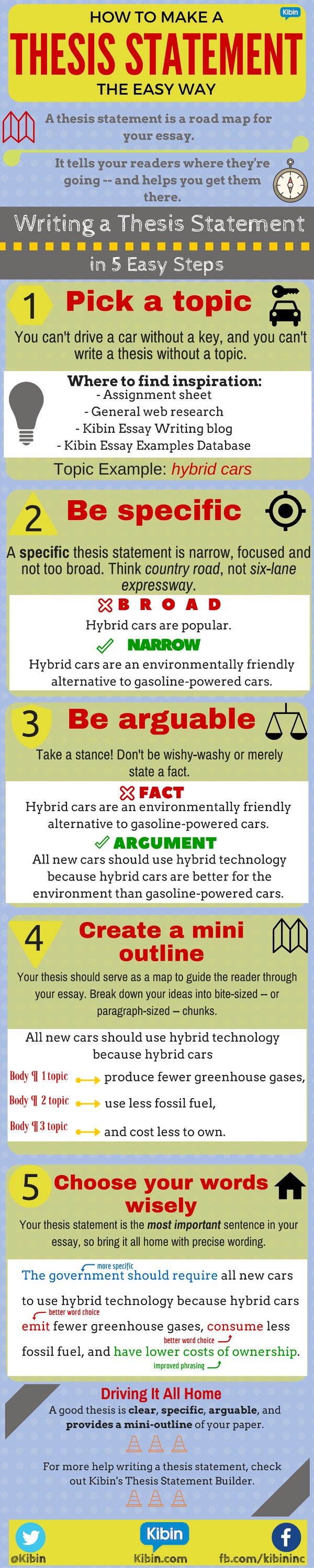
Visual guide to thesis statement construction — from topic selection to arguable claim. Source: Kibin.
Humanities (Literature, History, Philosophy)
Literature examples
- Weak: “In Hamlet, Shakespeare explores the theme of revenge.”
Strong: “Shakespeare’s Hamlet challenges the revenge tragedy tradition not by condemning revenge but by dramatising its psychological impossibility for a protagonist constitutionally incapable of acting on conviction rather than compulsion.” - Weak: “Jane Austen wrote about social class in Pride and Prejudice.”
Strong: “In Pride and Prejudice, Austen uses the marriage plot not as an endorsement of social convention but as a diagnostic instrument for exposing the economic coercions that disguise themselves as romantic choice.” - Weak: “Toni Morrison’s Beloved is about slavery and trauma.”
Strong: “Beloved reconstitutes African American historical consciousness as a form of haunting — a narrative strategy that makes the unnarrated violence of slavery present and accountable rather than safely archivable as ‘the past.’” - Weak: “The Great Gatsby deals with the American Dream.”
Strong: “Fitzgerald’s The Great Gatsby does not critique the American Dream as corrupt but rather as structurally necessary to the social order precisely because it must remain unachievable — its function is to sustain aspiration, not to reward it.”
History examples
- Weak: “The Industrial Revolution changed British society.”
Strong: “The Industrial Revolution transformed British working-class identity not primarily through factory conditions but through the creation of new temporal regimes — clock time, shift work, and the disciplinary separation of labour from leisure — that restructured daily experience at the most fundamental level.” - Weak: “World War I had many causes.”
Strong: “The outbreak of the First World War is better explained by the failure of alliance restraint mechanisms under conditions of mobilisation pressure than by the long-term structural causes emphasised in Fischer’s Griff nach der Weltmacht thesis.” - Weak: “The civil rights movement was important.”
Strong: “The 1965 Voting Rights Act succeeded not because it resolved the structural conditions of Black disenfranchisement but because it shifted the institutional terrain on which that struggle was fought — a shift with consequences that both extended and constrained subsequent civil rights gains.”
Philosophy examples
- Weak: “Kant had interesting ideas about morality.”
Strong: “Kant’s categorical imperative, while internally consistent, fails as a practical moral decision procedure because its universalisability criterion cannot adjudicate between competing maxims at the level of description where real moral choices are made.” - Weak: “Peter Singer argues we should help the poor.”
Strong: “Singer’s drowning child analogy, though rhetorically powerful, rests on a morally arbitrary proximity assumption that, once removed, generates obligations of positive duty indistinguishable from the comprehensive impartialist demands Singer elsewhere claims his position does not entail.”
Social Sciences (Psychology, Sociology, Political Science)
Psychology examples
- Weak: “Social media affects mental health in young people.”
Strong: “The relationship between social media use and adolescent depression is moderated by use type: passive consumption of social comparison content predicts depressive symptomatology, while active communication use does not, suggesting that screen-time metrics are an insufficient proxy for psychological risk.” - Weak: “Mindfulness helps reduce stress.”
Strong: “Mindfulness-based cognitive therapy (MBCT) reduces depressive relapse in patients with three or more previous episodes by targeting ruminative cognitive patterns rather than depressive content — a mechanism distinct from both pharmacological and traditional CBT approaches.” - Weak: “Childhood trauma causes mental health problems.”
Strong: “Adverse childhood experiences predict adult psychopathology not directly but through the mediating pathway of emotion dysregulation, suggesting that intervention at the emotion regulation stage — rather than at the trauma-processing stage — may produce more generalisable mental health benefits.”
Sociology examples
- Weak: “Immigration has effects on national identity.”
Strong: “Populist nationalist discourse frames immigration as a cultural threat rather than an economic competition, because cultural threat narratives produce the affective solidarity required to sustain political mobilisation that material interest claims cannot generate independently.” - Weak: “Social class affects educational outcomes.”
Strong: “The persistent association between social class and educational attainment in England is maintained less through differential cognitive ability than through the class-differentiated transmission of Bourdieu’s cultural capital — a mechanism that selective school admission policies systematically reproduce rather than counteract.”
Political science examples
- Weak: “Democracy is in decline in many countries.”
Strong: “Democratic backsliding since 2015 is not a product of exogenous institutional collapse but of incumbent executives weaponising formally democratic procedures — electoral manipulation, judicial packing, and press restriction — against the constitutional order those procedures were designed to protect.” - Weak: “Climate change is a political problem.”
Strong: “The persistent failure of international climate governance to produce binding emissions commitments reflects not a coordination failure but a distributional conflict: developed economies that historically produced most emissions resist obligations that would constrain growth while emerging economies close the per-capita gap.”
STEM (Biology, Environmental Science, Computer Science)
Biology examples
- Weak: “CRISPR is a promising gene-editing technology.”
Strong: “Off-target editing rates in CRISPR-Cas9 applications are significantly reduced by high-fidelity variant systems (eSpCas9 and SpCas9-HF1) without clinically meaningful loss of on-target efficiency, making high-fidelity variants the appropriate default choice for therapeutic applications requiring precision.” - Weak: “Biodiversity is important for ecosystems.”
Strong: “The insurance hypothesis of biodiversity — that greater species richness provides ecosystem stability under perturbation through functional redundancy — receives stronger support from drought-stress experiments than from nutrient-manipulation studies, suggesting the hypothesis’s validity is contingent on stressor type.”
Environmental science examples
- Weak: “Microplastics are a problem in marine environments.”
Strong: “Microplastic bioaccumulation in marine food webs poses human health risks not primarily through direct ingestion of plastic particles but through the co-ingestion of adsorbed persistent organic pollutants at concentrations that exceed those of surrounding seawater by three to four orders of magnitude.” - Weak: “Climate change affects biodiversity.”
Strong: “The phenological mismatch between insect emergence and plant flowering under accelerating warming poses a greater extinction risk for specialist pollinators than for generalists, because specialist species lack the dietary flexibility to compensate for timing mismatches with their primary host plants.”
Computer science examples
- Weak: “Machine learning models can be biased.”
Strong: “Demographic parity violations in binary classification models trained on structured tabular data are significantly reduced by pre-processing reweighting techniques compared to in-processing constraint methods, without equivalent loss in overall model accuracy on held-out test sets.” - Weak: “Privacy is important in data systems.”
Strong: “Differential privacy guarantees for federated learning models can be achieved at privacy budget ε ≤ 1.0 without prohibitive utility loss when gradient clipping thresholds are calibrated to dataset sensitivity, contrary to the conventional assumption that strong privacy guarantees require unacceptable accuracy trade-offs.”
Health and Nursing
- Weak: “Nurses play an important role in patient care.”
Strong: “Nurse-led post-discharge telephone follow-up within 48 hours of hospital discharge reduces 30-day readmission rates among older patients with chronic heart failure by addressing medication adherence barriers that are systematically under-identified during inpatient care.” - Weak: “Mental health is important and should be taken seriously.”
Strong: “Integrating mental health screening into routine primary care consultations for patients with type 2 diabetes more than doubles the identification rate of comorbid depression relative to patient self-referral, while reducing the stigma barriers that prevent help-seeking in this population.” - Weak: “Palliative care needs to be improved.”
Strong: “The introduction of advance care planning conversations in community settings at least six months before the end-of-life period, rather than during acute hospital admissions, significantly increases the concordance between documented patient preferences and actual care received at end of life.”
Business and Economics
- Weak: “Digital transformation is important for businesses.”
Strong: “UK SMEs that sustained digital transformation initiatives between 2020 and 2024 were differentiated from those that did not by leadership capability rather than digital infrastructure investment, indicating that transformation readiness assessments should prioritise organisational culture over technology audits.” - Weak: “Minimum wage increases can affect employment.”
Strong: “Empirical evidence from monopsonistic labour markets — where employers hold significant wage-setting power — consistently fails to show the employment reductions predicted by competitive market models of minimum wage increases, challenging the policy application of those models to labour markets with high employer concentration.” - Weak: “Corporate social responsibility can benefit companies.”
Strong: “CSR initiatives generate positive abnormal stock returns only when they address stakeholder concerns materially linked to the firm’s core business operations; peripheral CSR activities (charitable giving unrelated to business impact) show no significant market response, suggesting investors price stakeholder salience rather than philanthropic intent.”
Education
- Weak: “Inclusive education is better for students with disabilities.”
Strong: “Full inclusion of students with moderate learning disabilities in mainstream classrooms produces comparable academic outcomes to special education placement only when supported by a minimum of 80% co-teaching contact time — a resource threshold that most UK mainstream schools currently lack the staffing to provide.” - Weak: “Technology changes how students learn.”
Strong: “Gamified learning environments improve short-term engagement metrics without producing durable learning gains in secondary mathematics, because the reward structures of gamification redirect cognitive effort from content mastery to game performance — a form of goal displacement that undermines the learning objectives gamification is intended to support.”
Law
- Weak: “Privacy law is important in the digital age.”
Strong: “The GDPR’s data minimisation principle is structurally incompatible with AI model training requirements, because effective model generalisation requires training on data volumes that the principle was designed to prohibit — a tension that EU regulatory guidance has addressed through procedural workarounds rather than substantive legal resolution.” - Weak: “International law struggles to regulate non-state actors.”
Strong: “The attribution of cyberattacks to state-sponsored non-state actors under international law is legally impeded not by a definitional gap in state responsibility doctrine but by the evidentiary standard required to meet the ‘effective control’ test — a standard that the forensic conditions of cyberspace systematically prevent from being satisfied.”
For guidance on translating a strong thesis statement into a full thesis structure, see our thesis structure guide and methodology tips. For abstract-writing guidance that builds directly on your thesis statement, see our thesis abstract example guide. For the broader context of how a thesis statement functions within a complete thesis document, see our complete dissertation and thesis writing guide.
If you want AI-assisted feedback on your own thesis statement before committing to a full draft, the Tesify AI editor can evaluate whether your statement is specific, arguable, and appropriately scoped for your word limit.
Frequently Asked Questions
Where does the thesis statement go in a paper?
In most academic disciplines, the thesis statement appears at the end of the introduction — typically as the final one to two sentences of the introductory paragraph or section. In STEM and health disciplines, where IMRaD structure is standard, the thesis statement equivalent appears in the final paragraph of the introduction as a statement of the study’s aim and hypothesis. In doctoral theses, the statement of contribution typically appears in a dedicated sub-section of the introduction.
How long should a thesis statement be?
For undergraduate essays and short research papers, a thesis statement is typically one to two sentences. For a master’s thesis or doctoral dissertation, the statement of contribution may extend to a short paragraph — three to five sentences — in which the central argument, the method of investigation, and the significance of the contribution are each briefly stated. Brevity and precision are more important than length; a thesis statement that requires three sentences can almost always be made stronger by reducing it to one.
What makes a thesis statement weak?
A thesis statement is weak when it is: (1) a statement of fact that requires no argument (“Shakespeare wrote plays”); (2) an announcement of intent rather than a claim (“This paper will examine…”); (3) a question rather than a position; (4) so broad that no single paper could adequately support it (“Climate change affects everything”); or (5) so narrow that it is trivially obvious or not worth arguing. The test is: would a reasonable, informed reader immediately agree with the statement, or does it require evidence and argument to support? If the former, it is too weak.
Does a thesis statement have to be one sentence?
No — a thesis statement can be two sentences if one sentence alone cannot capture the full specificity of the argument. However, most writing instructors and style guides recommend one sentence because brevity forces the precision that distinguishes strong thesis statements from vague ones. If you find yourself needing three or more sentences to state your thesis, the claim is probably not yet focused enough.
Can I use AI to write my thesis statement?
AI tools can usefully generate candidate thesis statements based on your topic description — but any AI-generated statement must be critically evaluated and revised before use. AI-generated thesis statements tend to be plausible in structure but vague in argumentative specificity, because the tool lacks your knowledge of the specific gap in the literature your research addresses. Use AI-generated examples as a starting scaffold, then sharpen them using your own knowledge of the field. Declare any AI use in accordance with your institution’s policy. For guidance on what ChatGPT is allowed to do in thesis writing, see our article on using ChatGPT for thesis writing in 2026.
How is a thesis statement different from a research question?
A research question is a question your paper or thesis attempts to answer. A thesis statement is the answer — or, more precisely, your paper’s central argument in response to that question. Every paper should have a research question driving it; the thesis statement is the position your paper defends in response to that question. The research question typically appears early in the introduction to frame the inquiry; the thesis statement appears at the end of the introduction to announce the argument.
Perfect Your Thesis Statement with AI Feedback
Tesify’s AI editor evaluates your thesis statement for specificity, arguability, and scope alignment — then helps you develop it into a full, distinction-ready thesis structure with APA, MLA, or Chicago citations built in.
Write your thesis with AI
Structure, draft, cite, and format your thesis faster with Tesify’s AI writing tools, automatic bibliography, and plagiarism checker. Free to start, no credit card required.






Leave a Reply