
ChatGPT for Thesis Writing: What’s Allowed, What Works, and What to Avoid (2026)
ChatGPT changed the way millions of students approach academic writing — but it also created one of the most confusing compliance landscapes in higher education history. Different universities have different policies. Different supervisors have different opinions. And ChatGPT itself is capable of both genuinely useful assistance and subtly plausible errors that can seriously damage your thesis.
This guide gives you a clear, honest picture of using ChatGPT for thesis writing in 2026: what universities actually allow, where it genuinely helps, where it causes problems, and what purpose-built academic AI tools like Tesify offer instead.
University AI Policies in 2026
The higher education landscape on AI use has changed rapidly since ChatGPT’s release in late 2022. By 2026, most major universities have moved from blanket bans to nuanced, task-specific policies. The key principle at almost every institution: undisclosed AI use is prohibited; disclosed, bounded AI use is often permitted.
| University | General Policy (2026) |
|---|---|
| University of Oxford | Submission of AI-generated text prohibited without Standing Committee permission; AI for background research with citation permitted |
| University of Cambridge | AI text generation for submitted work prohibited; AI-assisted proofreading generally accepted with declaration |
| UCL | Module-specific; many require AI use declaration appendix; some modules explicitly permit AI drafting with disclosure |
| MIT | Course-specific; significant proportion now permit AI as writing aid with attribution; AI in research methods requires specific course approval |
| University of Sydney | Assessment-specific AI permissions disclosed in course outlines; thesis must include AI use declaration if any AI tool was used |
The safest rule: if your module handbook or thesis regulations do not explicitly permit AI use for writing, assume it is not permitted. If you are unsure, ask your supervisor in writing so you have a record. Korean-speaking students can find institution-specific guidance on AI permissibility in this Korean-language guide to whether AI thesis writing is allowed.
Where ChatGPT Genuinely Helps
Used appropriately, ChatGPT offers real value to thesis students:
- Breaking writer’s block: Ask ChatGPT to write the worst possible paragraph on your current section. Reading a bad version often clarifies what you actually want to say, and the blank page disappears.
- Simplifying complex sources: Paste a dense theoretical paragraph and ask “explain this in plain English” to check your own understanding before paraphrasing.
- Generating outline structures: Ask for five possible approaches to structuring a chapter on your topic. You will almost certainly use none of them verbatim, but the exercise often reveals a structure you had not considered.
- Improving clarity and style: Paste a paragraph and ask “make this clearer without changing the meaning.” Then compare the two versions and choose what works.
- Proofreading grammar and style: ChatGPT is excellent at catching awkward phrasing, redundant phrases, and subject-verb agreement errors.
- Explaining statistical concepts: “Explain what a moderating variable is and give me an example in educational research” is a legitimate use that supplements your reading rather than replacing it.
A Carnegie Mellon University study found that graduate students who used AI tools with proper instruction reduced their writing time by 65% and improved average grades from B+ to A. The key phrase is “with proper instruction” — unsupervised AI use showed no similar benefit.
Where ChatGPT Falls Short
The same power that makes ChatGPT useful — its ability to generate fluent, confident-sounding text on almost any topic — makes it dangerous for research:
- Factual accuracy: ChatGPT confidently states incorrect facts. Statistics, dates, names, and claims may be plausible but wrong.
- Deep specialisation: In niche research areas, ChatGPT’s training data may be thin. It will still generate confident prose, but the content may reflect common misunderstandings rather than the current state of scholarship.
- Citation generation: The most dangerous failure mode — detailed in the next section.
- Original analysis: ChatGPT cannot analyse your actual data. It can only describe what studies typically find, not what your study found.
- Argument coherence across 80,000 words: ChatGPT has no memory of your complete thesis. It cannot maintain a consistent argument across 80,000 words the way a purpose-built academic writing tool can.
The Citations Problem: AI Hallucinations
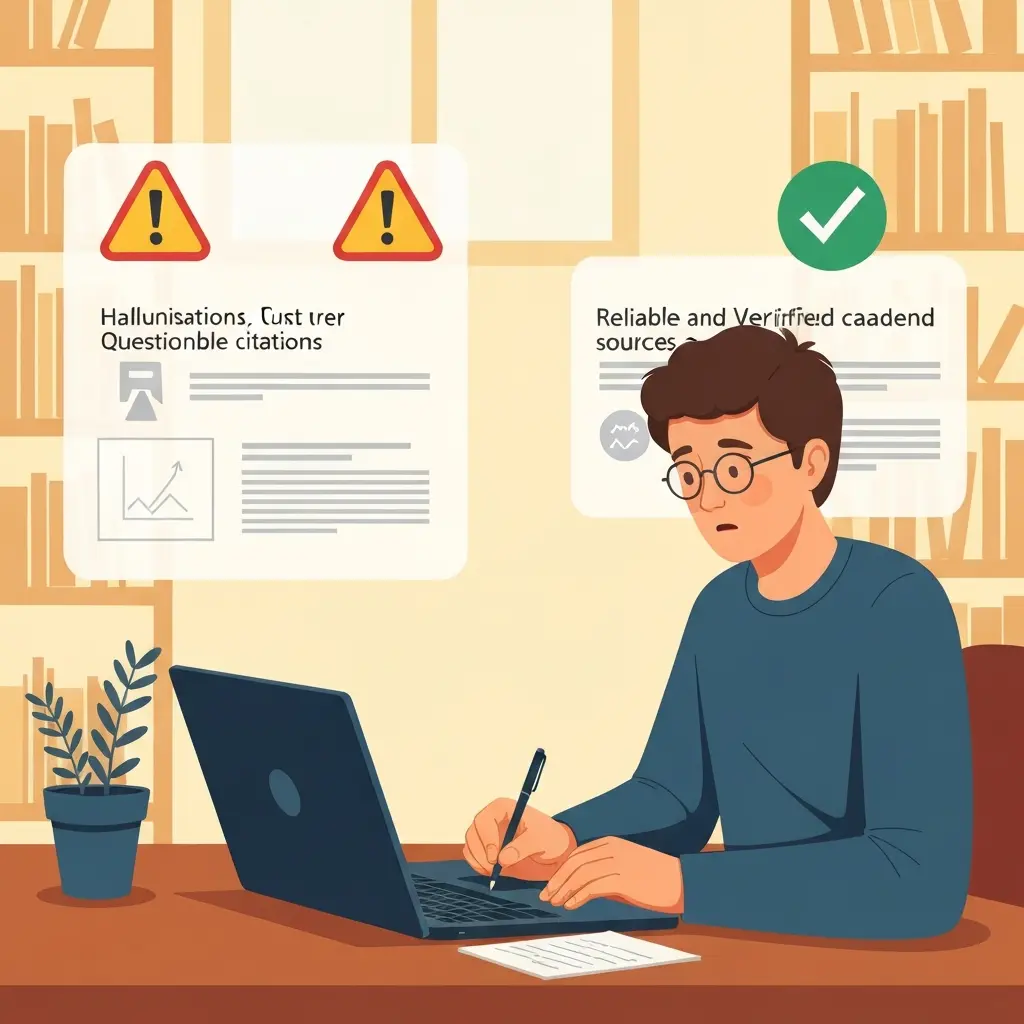
This is the single biggest risk of using ChatGPT for thesis research. ChatGPT regularly produces citations to papers that do not exist — plausible author names, realistic-sounding titles, correct-format journal names, credible-looking DOIs. These are called “hallucinations,” and they are one of the most embarrassing and damaging errors a thesis can contain.
In a 2024 study published in Nature, researchers found that ChatGPT produced at least one fabricated citation in 76% of responses that included references. Worse, the fabricated citations are often indistinguishable from real ones without manual verification in an academic database.
Rule: Never use a citation from ChatGPT without verifying it in Google Scholar, PubMed, Scopus, or your library database first. If you cannot find the paper, it almost certainly does not exist. Use Google Scholar to cross-check every AI-generated reference.
Safe Ways to Use ChatGPT in Thesis Writing
Here is a framework for using ChatGPT in a way that adds value without creating compliance risk:
| Task | Safe? | Condition |
|---|---|---|
| Brainstorming ideas and structures | Yes | No disclosure needed; you are not submitting ChatGPT’s ideas |
| Grammar and style editing | Usually yes | Declare if your institution requires AI use disclosure |
| Explaining concepts for your own understanding | Yes | Always verify against your primary sources |
| Drafting text for submission | Only if permitted and disclosed | Must be declared; must be substantively edited |
| Generating citations or references | No | Always fabrication risk — verify in database first |
| Analysing your own data | Not appropriate | ChatGPT cannot access or accurately analyse your dataset |
How to Cite ChatGPT in Your Thesis
If your institution permits AI use with disclosure, you must cite ChatGPT according to your required citation style. In APA 7th edition, the recommended format is:
OpenAI. (2025). ChatGPT (Version GPT-4o) [Large language model]. https://chat.openai.com
In the text: (OpenAI, 2025). Include a note in your methodology or acknowledgements explaining specifically how the tool was used. For a full guide to APA citation including AI tools, see our APA citation format guide.
Purpose-Built Alternatives to ChatGPT
ChatGPT is a general-purpose tool not designed for academic thesis writing. Purpose-built academic AI tools offer significant advantages. For a full ranked comparison of what is available in 2026, see our guide to the best AI thesis writing tools compared.
- Tesify: Designed specifically for thesis and dissertation writing. Maintains the coherence of your entire thesis across chapters, manages citations automatically, and provides feedback calibrated for academic standards. Verified citations, not hallucinations.
- Elicit: AI research assistant that searches and summarises real academic papers — eliminates the hallucination risk for literature reviews.
- Paperpal / Writefull: Language enhancement tools calibrated for academic register — more appropriate than ChatGPT for style editing in academic contexts.
- Research Rabbit / Connected Papers: Visualise relationships between papers and discover relevant literature — no writing capability but essential for literature reviews.
For a complete comparison of AI tools for thesis writing, see our guide to the best approaches to dissertation writing with AI. For guidance on how to use AI without compromising your academic integrity, see our academic integrity and plagiarism guide.
Frequently Asked Questions
Will my university detect if I used ChatGPT for my thesis?
Possibly. Turnitin’s AI detection module and standalone tools like GPTZero are increasingly effective at identifying AI-generated text, though no tool is infallible. Turnitin reports approximately 85% accuracy; false positives remain an issue for non-native English speakers. More importantly, experienced examiners often recognise AI-generated writing through stylistic uniformity, absence of genuine critical thinking, and inconsistency with the student’s previous work or verbal responses. The viva voce examination, common at PhD level, directly tests the depth of understanding that AI-generated writing cannot provide.
Can I use ChatGPT to write my literature review?
Using ChatGPT to draft your literature review text is risky for two reasons. First, it is likely to violate your institution’s AI policy unless you declare it. Second, and more practically, ChatGPT will fabricate citations — and a literature review full of papers that do not exist is not a literature review. If you want AI assistance with your literature review, use Elicit or ResearchRabbit to find real papers, then write the review yourself with ChatGPT available only as a style editor.
What is the best AI tool for writing a thesis in 2026?
The best approach is to use a combination of purpose-built tools rather than one general AI. Tesify for chapter-by-chapter writing structure and citation management; Elicit for finding real academic sources without hallucination risk; Grammarly or Writefull for grammar and style; and Zotero or Mendeley for reference management. This combination covers the full thesis writing workflow with genuine academic rigour, without the hallucination and policy compliance risks of using ChatGPT as your primary writing tool.
Is it academically dishonest to use ChatGPT for grammar correction?
At most institutions, using AI for grammar correction and proofreading is permitted — this is comparable to using Grammarly, which has been widely accepted for years. However, some institutions now require disclosure of any AI tool use, including proofreading assistance. Check your specific module handbook. Using AI for proofreading is significantly different from using AI to generate substantive content, and most policies reflect this distinction.
Does ChatGPT have access to recent academic papers?
ChatGPT’s base model has a training data cutoff and does not have real-time access to academic databases. Even with browsing capabilities enabled, it cannot access papers behind journal paywalls. For current literature searches, use Google Scholar, PubMed, Scopus, or Web of Science directly — or use Elicit, which is specifically designed to search and summarise real academic papers with accurate citations.
Write Your Thesis with AI That Understands Academia
Tesify is purpose-built for thesis and dissertation writing — with verified citation management, chapter-level coherence, and AI guidance calibrated for academic standards. No hallucinations. No policy compliance risk. Just a better way to write your thesis.
Write your thesis with AI
Structure, draft, cite, and format your thesis faster with Tesify’s AI writing tools, automatic bibliography, and plagiarism checker. Free to start, no credit card required.





Leave a Reply