
Academic Integrity and Plagiarism: A Complete Student Guide for 2026
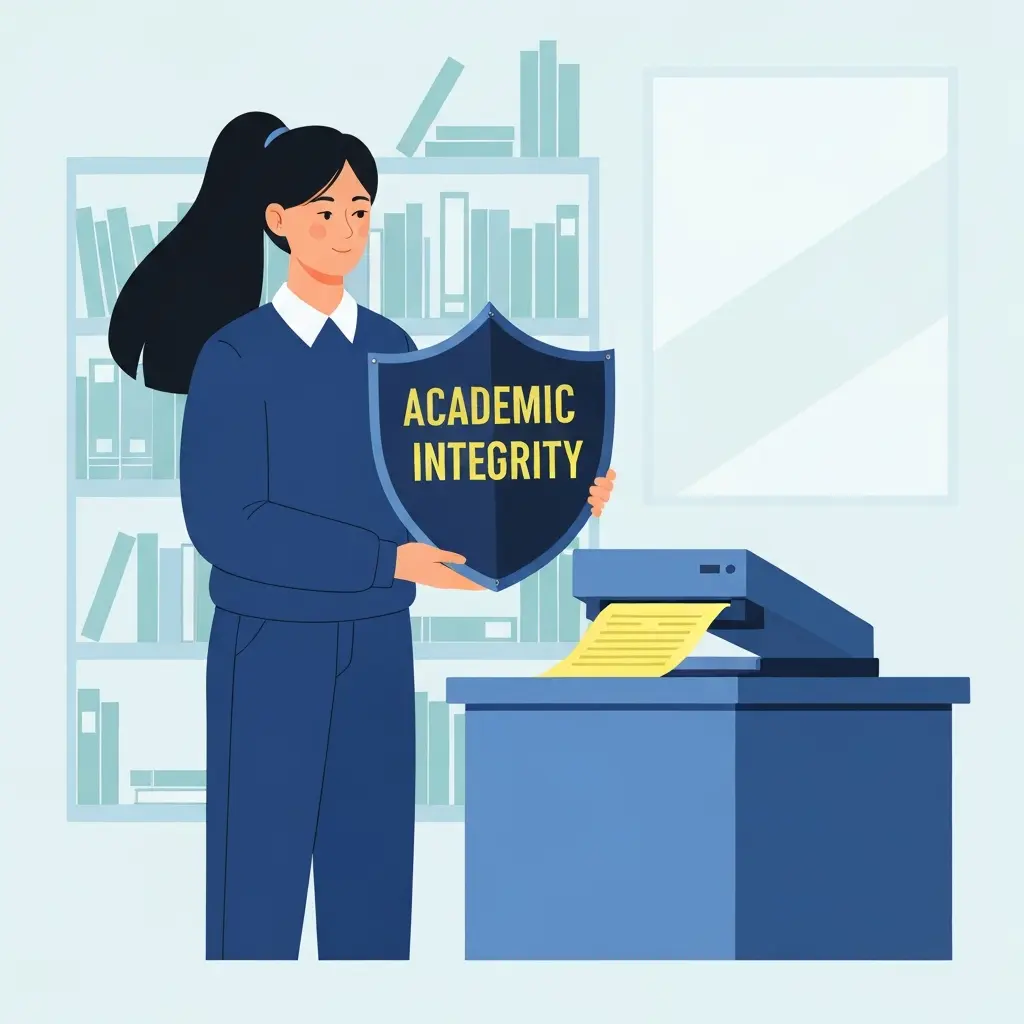
Academic integrity is the foundation of every qualification you earn. In an era when AI writing tools are increasingly available and plagiarism detection has become increasingly sophisticated, understanding what constitutes academic misconduct — and how to avoid it — has never been more important. Universities are now investigating more misconduct cases than ever before, and the penalties can include failing grades, module retakes, degree suspension, and permanent record notes.
This guide covers everything students need to know about academic integrity and plagiarism — from the five types of misconduct to how Turnitin and AI detectors work, and from proper citation practices to navigating the genuinely complex questions around AI-assisted writing in 2026.
What Is Academic Integrity?
Academic integrity is the set of ethical principles governing scholarly work. The International Center for Academic Integrity (ICAI) identifies six core values: honesty, trust, fairness, respect, responsibility, and courage. In practice, this means:
- Submitting only work that you produced yourself (unless collaboration is explicitly permitted)
- Accurately representing the contribution of all sources through correct citation
- Not misrepresenting your data or findings
- Following your institution’s specific rules on AI tool use, collaboration, and resubmission
Academic misconduct is not always deliberate. Poor citation practice, careless note-taking that blurs the line between your words and a source’s, or not fully understanding your institution’s AI policy can all lead to unintentional breaches — but institutions treat them seriously regardless of intent.
The Five Types of Plagiarism
| Type | Definition | Example |
|---|---|---|
| Direct plagiarism | Copying text word-for-word without quotation marks or attribution | Copying a Wikipedia paragraph directly into your essay |
| Mosaic plagiarism | Swapping synonyms or rearranging phrases without citation | Replacing “large” with “significant” throughout a copied paragraph |
| Accidental plagiarism | Forgetting to cite, or using a paraphrase too close to the original | Not adding a citation to a fact you read in a textbook |
| Self-plagiarism | Submitting your own previous work without permission | Submitting your Year 1 essay again in Year 3 with minor changes |
| AI plagiarism | Submitting AI-generated text as your own without declaration | Submitting a ChatGPT-written essay without disclosure |
Consequences: What Universities Actually Do
The Higher Education Policy Institute (HEPI) reported that UK universities investigated approximately 7,000 academic misconduct cases in 2023–24. US institutions report similar trends. The consequences of proven misconduct vary by severity and institution:
- First offence, minor: Written warning, zero for the assessment, opportunity to resubmit
- First offence, major: Failing grade for the module, required to retake the module, suspension
- Repeat offences: Degree suspension, permanent notation on academic transcript, expulsion
- Doctoral level: Thesis rejection, degree revocation (even years after graduation)
The consequences of AI-related misconduct are still evolving. Several UK universities are now treating undisclosed AI submission as equivalent to contract cheating — one of the most serious categories of misconduct.
How Turnitin and Similarity Checkers Work
Turnitin is used by more than 15,000 institutions worldwide. It compares your submission against a database of billions of webpages, published journal articles, previously submitted student work, and online book repositories. It generates a “similarity index” — the percentage of your text that matches existing sources.
Key facts about Turnitin:
- A high similarity score does not automatically mean plagiarism — properly quoted and cited material will show as “similar” but is acceptable
- Typical acceptable similarity thresholds are 15–20% for most assignments, though institutions vary
- Turnitin stores your submitted work in its database unless you opt out — future students who plagiarise your work will be detected
- Turnitin now includes an AI detection module, with the company reporting approximately 85% accuracy in detecting AI-generated text
A 2024 Stanford study found that Turnitin’s AI detection incorrectly flagged approximately 6–8% of legitimate work by non-native English speakers as AI-generated — a significant false positive rate that students should be aware of if English is not their first language.
AI Detection Tools in 2026
In addition to Turnitin’s built-in AI detection, universities increasingly use standalone tools including GPTZero, Copyleaks, and Originality.ai. None of these tools is infallible. Key points:
- AI detectors work by identifying statistical patterns in text that are characteristic of large language models — low “perplexity” (predictability) and low “burstiness” (variation in sentence complexity)
- Human writing tends to be less predictable and more variable than AI output
- Heavily edited AI text and AI text on highly technical topics may evade detection
- Conversely, some human writing — particularly by students with a very formal or formulaic style — can trigger false positives
- No AI detection tool is accepted as standalone proof of misconduct — most institutions require additional evidence before taking disciplinary action
University AI Policies: What Is and Isn’t Permitted
AI policies vary dramatically between institutions, faculties, and even individual modules. Some permit AI use for ideation only; others permit drafting with mandatory disclosure; others prohibit all AI use in assessments. The only safe course is to check your specific module handbook.
| Institution | General AI Policy |
|---|---|
| University of Oxford | Prohibits AI-generated text submission without explicit written permission from the Standing Committee |
| University of Cambridge | Prohibits AI text generation for submitted work; permits AI for background research with citation |
| UCL | Assessment-specific policies; many modules now require AI use declaration appendix |
| Stanford University | Instructor-specific; many courses now explicitly permit AI with attribution |
| University of Melbourne | Task-specific; AI use in many assessments permitted with disclosure statement |
If your institution permits AI use with disclosure, cite the tool according to your required citation style. For APA 7th edition AI citation guidance, see our APA citation format guide.
How to Cite Correctly to Avoid Plagiarism
Correct citation is the primary defence against plagiarism — both intentional and accidental. The fundamental rule: every idea, fact, statistic, or argument that did not come from your own independent analysis must be attributed to its source. This includes:
- Direct quotations (always use quotation marks AND a citation)
- Paraphrased ideas and arguments (citation required even when you use your own words)
- Statistics and data from other studies
- Specific theoretical frameworks and models
- Figures, tables, and diagrams reproduced or adapted from other sources
The exception is “common knowledge” — facts that are widely known and not attributed to any particular source. Even here, if in doubt, cite.
Paraphrasing Without Plagiarising
Mosaic plagiarism (synonym-swapping) is one of the most common accidental offences. True paraphrase requires restructuring the idea entirely — changing both the words and the sentence structure — while retaining the meaning. Always add a citation after a paraphrase.
Mosaic (plagiarism): “Cognitive behavioural therapy is more effective than drug therapy for long-term maintenance of anxiety disorder remission.”
True paraphrase (acceptable): “For patients with anxiety disorders, psychological treatment through CBT produces more durable remission outcomes over the long term than drug-based approaches (Smith, 2023).”
Self-Plagiarism and Contract Cheating
Self-plagiarism — submitting your own previous work without disclosure — is treated as misconduct by most institutions, even though the work is technically yours. This is because assessments measure your learning at a specific point in time, and reusing old work misrepresents your current ability.
Contract cheating — paying someone else to produce your work — is the most serious form of academic misconduct. In the UK, the 2022 Higher Education (Freedom of Speech) Act gave universities stronger powers to act against essay mill websites. Students should be aware that essay mills track client data, and that work produced by mills is usually identifiable through inconsistencies in writing style.
For guidance on avoiding AI-related plagiarism specifically, see our guide on using AI for dissertation writing: university rules and best practices.
Frequently Asked Questions
What percentage similarity on Turnitin is acceptable?
Most institutions consider 15–20% similarity acceptable, given that some overlap comes from correctly quoted and cited material, standard academic phrases, and reference lists. However, there is no universal threshold — a 30% similarity report with all matches properly cited may be fine, while a 5% similarity report where the matches are undisclosed copying may be treated as plagiarism. Examiners read the similarity report in context, not just the overall percentage.
Can I reuse sections of my previous assignments in my thesis?
Sometimes, with disclosure. Some institutions allow students to incorporate assessed work into their final thesis with their supervisor’s explicit permission and a clear declaration in the thesis. Others prohibit this entirely. Check your institution’s guidelines. Where permitted, the reused sections must be clearly identified and the original submission context disclosed.
Is it plagiarism to paraphrase without citing?
Yes. Paraphrasing another author’s idea without attribution is plagiarism, even if you change every word. The idea or argument originated with another person, and academic convention requires you to credit them for it. A citation is required whenever you represent someone else’s idea, argument, analysis, or data — regardless of whether you use their exact words or not.
How do universities detect AI-generated writing?
Universities use AI detection tools (Turnitin AI Detection, GPTZero, Copyleaks) that identify statistical patterns typical of large language models, particularly low perplexity (predictable word choice) and low burstiness (uniformly structured sentences). Human examiners also assess style consistency, topic knowledge depth, and writing that is inconsistent with a student’s previous work or verbal presentation. No tool is definitive — but a combination of AI detection and examiner judgment is increasingly effective.
What should I do if I am accused of plagiarism?
Read the allegation carefully and gather all your source materials, drafts, and notes. Request a copy of the similarity report. Check your institution’s academic misconduct procedure and, if available, contact your student union’s academic advisor — they can accompany you to any hearing. Respond calmly and with evidence. If the allegation is based on AI detection alone, challenge its reliability as sole evidence. Outcomes are often more lenient for first-time, unintentional offences than students expect, especially with strong mitigating evidence.
Check Your Thesis for Plagiarism Before Submission
Tesify’s plagiarism checker scans your thesis against academic databases and web sources, highlighting any similarity before you submit. Catch potential issues early — not after your examiner does.
Write your thesis with AI
Structure, draft, cite, and format your thesis faster with Tesify’s AI writing tools, automatic bibliography, and plagiarism checker. Free to start, no credit card required.


Leave a Reply