
How to Write an Architecture Thesis in 2026: Design Project + Written Document Guide
When you sit down to figure out how to write an architecture thesis, the first obstacle is that most thesis advice on the internet is written for other disciplines. Five chapters, a literature review, some survey data, a conclusion — none of that maps cleanly onto what an architecture programme actually asks for. Architecture produces two inseparable outputs: a design project with drawings, models, and spatial documentation, and a written research document that frames, contextualises, and argues for what the project does. Getting both right — and making them speak to the same central inquiry — is the defining challenge of the final year.
This guide is written for architecture students at undergraduate thesis level and taught master’s level, covering the full process from topic selection to jury preparation. It addresses what is specific to architecture: the role of site analysis, how precedent studies function as research, why your drawings are your data, and how the written components differ from a conventional humanities or social science dissertation.
An architecture thesis in 2026 consists of two linked outputs: (1) a design project — site, programme, concept, drawings, and models — and (2) a written document of roughly 8,000–15,000 words that frames the inquiry with a research question, literature review, methodology, and conclusions. Both parts must address the same central argument. The design is not an illustration of the writing; the writing is not a caption for the design. They are two registers of the same investigation.
The Dual Structure: Design Project and Written Document
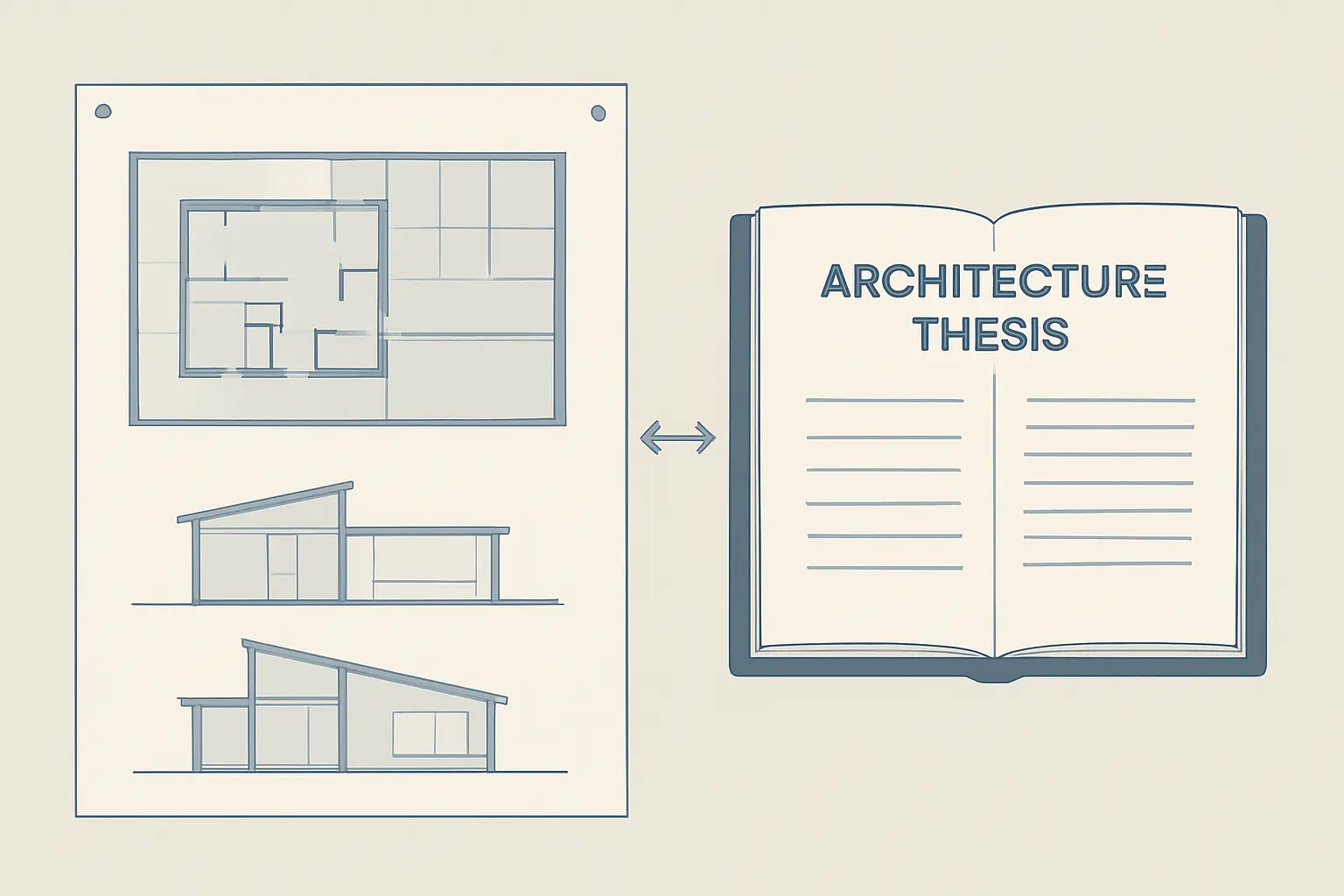
Most architecture schools distinguish between the design thesis and the written thesis, but they are assessed together and marked as a single work. The design project asks: what is being proposed, where, and why? The written document asks: what position is this project taking in relation to existing knowledge, precedent, and theory?
A common and costly mistake is to write the text as a report on the design — a sequential account of decisions made during studio. The better approach is to treat the two components as parallel arguments: the written thesis argues in words; the project argues in space and form. The jury will read both and assess whether they cohere.
| Component | Typical scope |
|---|---|
| Written document | 8,000–15,000 words depending on degree level and institution |
| Design drawings | Plans, sections, elevations at multiple scales; site plan; axonometrics or perspectives |
| Physical or digital model | At least one study model and one presentation model |
| Process documentation | Sketchbooks, iteration records, site visit photographs |
Unlike the engineering thesis — where the written report typically carries the full argumentative weight — architecture distributes the argument across media. The jury expects spatial reasoning to be visible in the drawings, not just described in prose.
For a parallel view of how a discipline-specific thesis differs from a generic academic dissertation, see this guide to how to write an engineering thesis, which highlights how technical programmes structure their dual deliverables of written report and artefact.
Choosing Your Architecture Thesis Topic
The thesis topic in architecture is almost always inseparable from a site and a programme. A topic like “adaptive reuse of industrial buildings” only becomes a thesis when it is anchored to a specific building, a specific community, and a specific argument about what that reuse should achieve.
When selecting a topic, look for a genuine tension in the built environment: a site that has been neglected or contested; a building type that is failing its users; a neighbourhood experiencing pressures of gentrification, climate risk, or demographic change. The strongest architecture theses are investigative proposals — they take a position on a spatial problem rather than demonstrating technical competence for its own sake.
Four questions that sharpen a topic:
- What spatial problem does this project exist to solve?
- Who is the project for, and what is currently inadequate about what exists?
- What design position or theory does the project test?
- Can you formulate a research question that the design will answer?
Avoid topics that are too broad (“housing in the city”) or too vague (“sustainable architecture”). Specificity of site, scale, and user group is what makes a project arguable and assessable by a jury.
Site Selection and Site Analysis
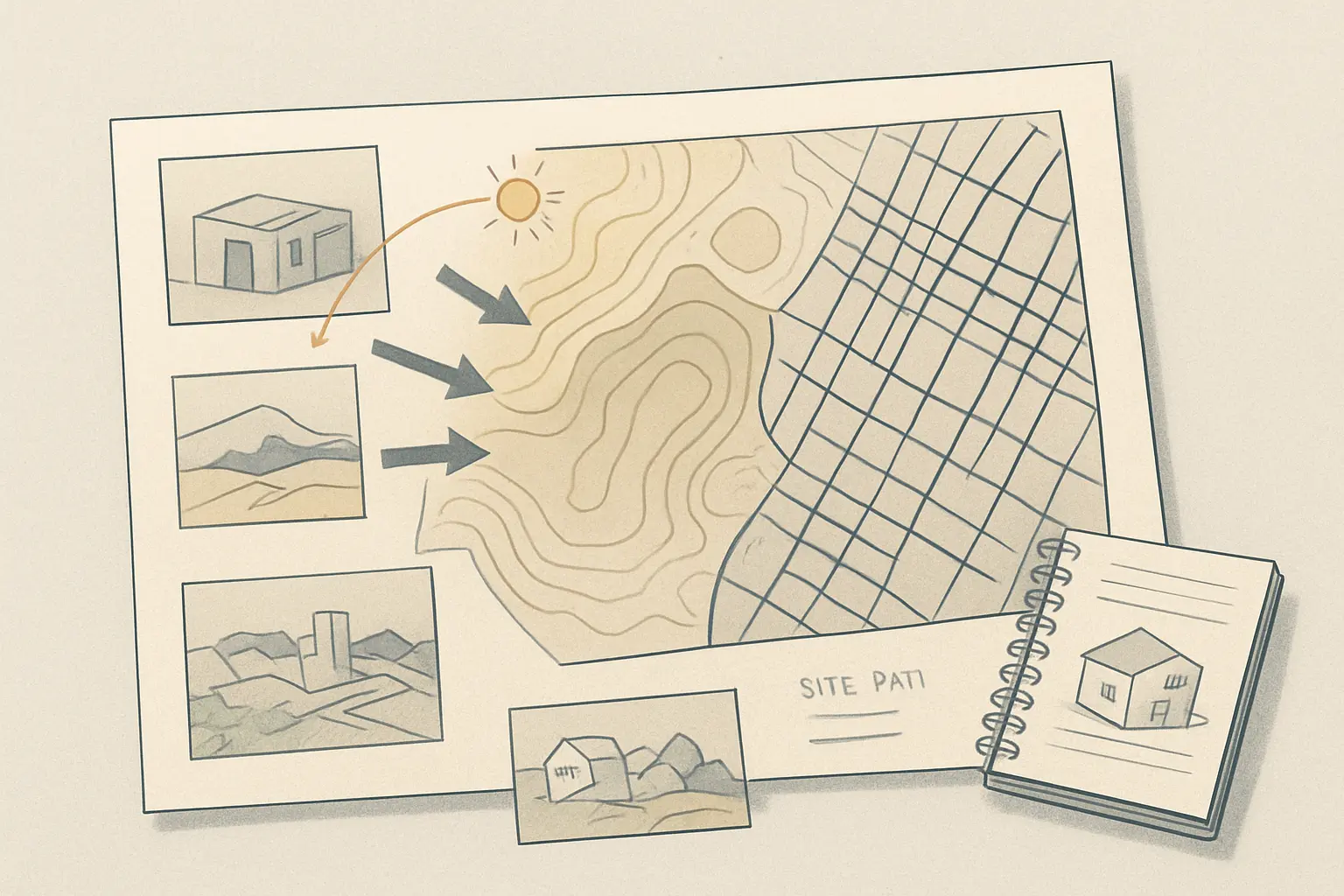
The site is not just a location — it is the primary argument. Choosing a weak site produces a weak thesis regardless of how sophisticated the architectural language becomes. When selecting a site, look for places where the spatial problem you are investigating is legible: a flood-prone riverbank for a thesis on climate adaptation; an underserved peri-urban edge for a thesis on infrastructure and informality.
Once selected, site analysis in an architecture thesis goes far beyond a satellite image printout. A rigorous site analysis covers four domains:
Physical and environmental data: Sun path and solar angles across seasons; prevailing wind direction and speed; flood zones, soil conditions, and topography; existing vegetation and microclimates.
Urban and contextual data: Street network, block structure, building heights, and setback patterns; land use, zoning, and planning designations; pedestrian and vehicular movement; views in and out of the site.
Historical data: Former uses of the site and its neighbourhood; archival maps showing how the area has changed; significant events that have shaped the site’s current condition.
Social and cultural data: Who uses the site and surrounding area, and when? Cultural associations, memory, and significance; stakeholder groups and contested interests; community aspirations documented through brief interviews or observation.
Document findings through hand-drawn analysis diagrams, annotated maps, and field sketches. These drawings are design research — they belong in both your process portfolio and your written methodology chapter. A jury that asks “Why here?” expects an answer grounded in this material.
Precedent Studies
Precedent studies are not a literature review of buildings. They are a design research method: you examine built projects to extract specific lessons that will inform your own proposal. The difference between a precedent study and a “buildings I like” mood board is the level of analytical drawing and the explicit transfer of lessons to your own project.
For each precedent, produce at minimum two diagrams:
- Massing and void diagram — how does the building relate to its site boundaries, public space, and context in three dimensions?
- Circulation and programme adjacency diagram — how are spaces sequenced, how does movement work, and where are the moments of compression and release?
Written annotations should move beyond “I like this building because it is light-filled.” They should articulate the design logic that made a decision effective — and then state how that logic can be transferred or modified for your own site. A precedent study that cannot generate a transferable lesson has not done its work.
Aim for three to six precedents, including both canonical and contemporary examples. At least one should be from the same geographic region or climate as your site, since context-blind precedents produce context-blind designs.
Design Research Methods
Architecture operates across qualitative, quantitative, and practice-based research paradigms. Most undergraduate and taught master’s theses use a combination of:
Case study method: Detailed analysis of one or more built projects or urban situations, examining how design decisions were made and what outcomes they produced. This is the most common method in architecture research and functions as both precedent study and empirical investigation.
Site ethnography: Observation, mapping, and informal interview to document how people actually use a site or building type. Particularly relevant for theses addressing community facilities, public space, or housing.
Historical-comparative analysis: Tracing how a building type, spatial typology, or urban pattern has evolved over time, using archival drawings, photographs, and texts. Useful for theses that take a position on heritage, transformation, or cultural continuity.
Practice-based research (design as research): The design project itself is the primary research output. The methodology describes how design decisions were made, tested, and revised, and how the design process generated knowledge that could not have been reached through text-based investigation alone.
In your methodology chapter, name the method explicitly, justify its choice in relation to your research question, and describe precisely how you applied it — including how you collected data and how you analysed it.
Drawings, Diagrams, and Models as Data
This is the element that makes architecture methodology genuinely distinctive. In a conventional social science thesis, data comes from surveys, interviews, or archival documents. In an architecture thesis, your drawings are your data.
A section through a building reveals spatial hierarchy and structural logic. An overlay diagram of land use and flood risk reveals urban vulnerability. A sequence of model photographs traces how massing evolved from one iteration to the next. These are analytical instruments, not decoration.
To treat drawings as data, document them systematically:
- Date each drawing or model photograph at the time of production
- Label it with the specific question it was investigating
- Note what it revealed and how that shifted subsequent design decisions
- Arrange process documentation in a legible sequence that shows thinking evolving
Physical models serve the same evidential function. A series of sectional models at consistent scale shows how your understanding of spatial section changed across the project. This iteration evidence is what separates a design thesis from a portfolio presentation — the portfolio shows resolved outcomes; the thesis shows the reasoning that produced them.
Writing the Thesis Document
If you are uncertain how many chapters your written document needs, the answer depends on degree level, institution, and whether your programme follows a conventional academic structure or a practice-based model. A good starting reference is this overview of how many chapters a thesis should have, which covers typical structures by degree type and discipline.
The Research Question
The research question anchors the entire document. In architecture, it typically takes one of two forms:
- A design-led question: “How can the adaptive reuse of decommissioned water infrastructure create new forms of public space in post-industrial cities?”
- A position-based question: “To what extent does parametric design production reinforce, rather than challenge, existing urban typologies?”
Avoid questions that are answered by yes or no, or that are so open-ended they cannot be tested through a design project. A good architecture research question is resolvable through spatial investigation and propositional design.
Literature Review and Theoretical Framework
The literature review in an architecture thesis draws on architectural theory, urban studies, history of architecture, and any cognate disciplines relevant to the project. It is not a catalogue of everything written on a topic — it is a structured argument that positions your project within existing knowledge and identifies what your project contributes that does not already exist.
Group your sources thematically: a section on the theoretical framework (key concepts your project deploys — typology, programme, tectonics, phenomenology, or whatever is relevant); a section on the precedents and history of your building type or urban problem; a section on the specific site context and its existing scholarship.
For a foundational walkthrough covering the essential structure and content of a literature review chapter, the guide on how to write a literature review covers the core requirements across disciplines and degree levels — including how to identify and articulate the research gap that your design project addresses.
A practical guide to organising and conducting a literature review efficiently — identifying gaps and structuring sources around your research question — is available at how to write your literature review faster with AI in 2026, covering how to use AI tools to map the field without ghostwriting your analysis.
Methodology Chapter
The methodology chapter describes your research process — not your design process. It explains why you chose the methods you used, how you collected and analysed your data (including drawings and models as data), and how you ensured rigour. For practice-based research, this means articulating how design iteration functions as a knowledge-generating process rather than a series of aesthetic decisions.
Keep it concise: three to six pages is typically sufficient for an undergraduate or master’s thesis. The methodology should be readable by someone who has not seen the design project and should still make complete sense.
Conclusions
Architecture thesis conclusions rarely claim the problem is solved. They articulate what the design project has demonstrated or tested — what it suggests is possible at this site and at this scale, what design principles it advances, and what questions remain open. A strong conclusion does not oversell the project. It situates the contribution honestly and identifies limits as well as propositions.
Building Your Architecture Thesis Timeline
The architecture thesis typically unfolds over two or three semesters. A well-structured timeline prevents the most common failure mode: a fully developed design project paired with a hastily written document produced in the final two weeks, or the reverse — a polished text with an underdeveloped spatial proposal.
| Phase | Period | Key deliverables |
|---|---|---|
| Research and framing | Months 1–2 | Research question, site identification, initial precedents, working bibliography |
| Site analysis and precedent study | Months 2–4 | Analysis drawings, site visit documentation, precedent diagrams and annotations |
| Concept development | Months 3–5 | Sketch designs, study models, first literature review draft |
| Design development | Months 5–8 | Developed drawings at multiple scales, sectional models, methodology draft |
| Written document | Months 7–10 | Full drafts of all written chapters, supervisor feedback incorporated |
| Production and refinement | Months 9–11 | Final drawings, presentation model, revised and proofed written document |
| Submission and jury preparation | Month 12 | Final submission package, verbal thesis statement rehearsed |
Notice the overlapping phases — writing while designing, designing while writing. This is not inefficiency. It is how the two components stay in productive conversation with each other. For a step-by-step method for translating this structure into a visual project plan, the guide on how to build a realistic thesis timeline with a Gantt chart walks through the process with templates applicable to any thesis format.
The Final Jury and Oral Defence
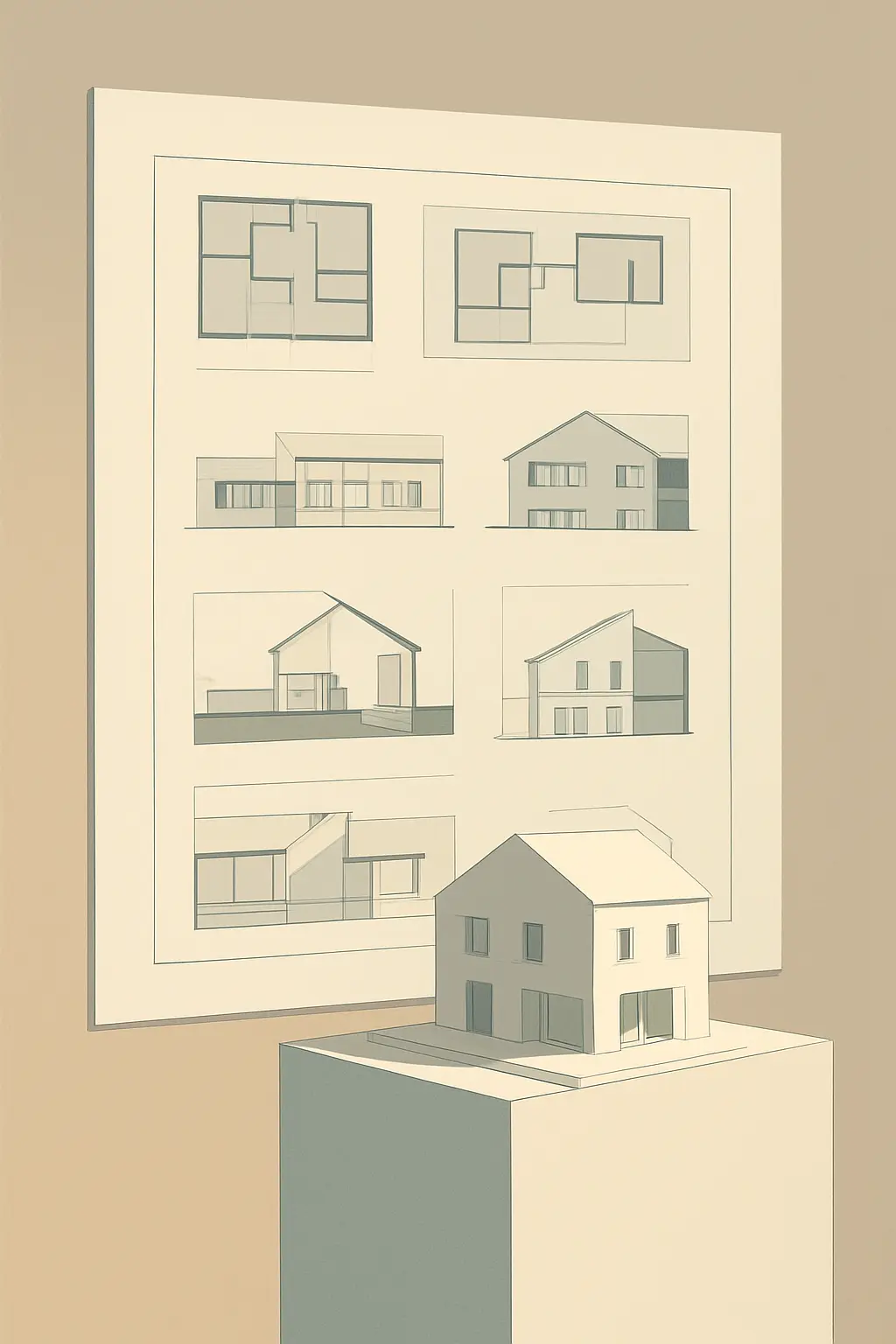
The architecture thesis jury — also called the design review, viva, or final crit depending on institution — is typically one to three hours. External jurors, often practitioners and academics from outside your institution, will examine your project and your written document and ask questions about both.
What juries are actually assessing:
- Clarity of inquiry: Is the research question clear, and does the project address it?
- Rigour of method: Can you articulate how you made your design decisions and why those decisions constitute research?
- Quality of spatial argument: Do the drawings, models, and spaces work — do they do what the thesis claims?
- Command of theory: Do you understand the theoretical territory your project occupies, and can you hold a conversation about it?
- Defensibility: Can you stand behind your choices under direct challenge?
Prepare a two-minute verbal statement of your thesis before the jury — not a tour of the drawings, but the argument: what problem you identified, what position you took, what the design proposes, and what it demonstrates. Practice explaining the project to people who have not seen it, because the jury will assess whether the project is legible to an informed external reader, not just to your studio peers.
When jurors challenge a decision, do not apologise. Explain your reasoning. “I chose to leave the rear elevation unresolved because the project’s argument is entirely about the public street front and the experience of approach” is a defensible position. Vague answers about time pressure or personal taste are not. Juries respond to students who know what they think and can articulate why they think it.
External references: The University of Waterloo’s Master’s Design Thesis guidelines and Cal Poly’s Fifth-Year Thesis Process are among the most detailed publicly available programme documents on architecture thesis expectations. Both are worth reviewing if your own institution’s guidelines are sparse.
Frequently Asked Questions
How long should an architecture thesis be?
The written document for an undergraduate architecture thesis is typically 8,000–12,000 words. A taught master’s thesis is usually 12,000–15,000 words, though some programmes require less if the design component is extensive. The design project has no fixed word count — it is assessed on the completeness and rigour of the drawing and model set. Always check your specific programme requirements, as these figures vary between institutions and countries.
What is the difference between an architecture thesis and a portfolio?
A portfolio presents resolved design outcomes; a thesis documents a research process. The thesis includes a written research document with a research question, literature review, methodology, and conclusions. It also includes process documentation — sketches, iteration models, site analysis drawings — that shows how design decisions were made and justified. A portfolio omits the written argument and the visible process; a thesis makes both central.
How many precedent studies should an architecture thesis include?
Most architecture theses analyse three to six precedents in depth. Depth matters more than breadth: two pages of analytical drawing and text per precedent is more useful than a two-sentence mention of twelve buildings. Each precedent should generate a transferable lesson that is explicitly connected to your own design proposal. More than six precedents usually signals that the selection criteria are not clear enough.
Can my architecture thesis design project be entirely speculative or unbuildable?
Yes — many excellent architecture theses are speculative proposals that are not intended for immediate construction. What matters is that the project is rigorous and internally consistent: the structural logic should be resolved at the level the drawings claim, and the spatial argument should hold. A deliberately speculative project needs to be framed as such in the written document, with a clear statement of what kind of knowledge it is producing and what rules of rigour apply.
Do I need a separate methodology chapter in my architecture thesis?
Most architecture programmes expect a methodology section, though some integrate it into the introduction rather than treating it as a standalone chapter. Whether separate or integrated, the methodology must explain your research method (case study, site ethnography, practice-based research, etc.), justify why that method is appropriate for your research question, and describe how you applied it. Three to six pages is typically sufficient. Check your programme’s submission guidelines for the required chapter structure.
When should I start writing the text of my architecture thesis?
Start writing from the beginning of the thesis year, not after the design is complete. The research question, literature review, and methodology should be drafted — at least in outline form — while you are still doing site analysis and precedent studies. Writing early helps clarify your argument, reveals gaps in your research, and ensures the written document and design project remain in alignment. Students who defer writing until the design is resolved almost always run out of time to produce a strong written thesis.
Write your thesis with AI
Structure, draft, cite, and format your thesis faster with Tesify’s AI writing tools, automatic bibliography, and plagiarism checker. Free to start, no credit card required.





Leave a Reply