
How to Write a Chemistry Thesis: The Complete Discipline Guide (2026)
A chemistry thesis rarely fits the standard IMRaD template without modification, and that mismatch trips up more students than any single writing skill. If your project involves synthesising and characterising compounds, your “Methods” and “Results” chapters typically fuse into synthesis-and-characterisation chapters organised around individual compounds or reaction series, your data reporting has to follow strict spectroscopic conventions your supervisor will check line by line, and your appendices carry as much evidential weight as your main text. None of this is taught explicitly in most undergraduate courses, which is why so many first-time thesis writers in chemistry either over-adapt a biology-style thesis template or under-structure a purely narrative account of “what I did in the lab.”
This guide sets out how to write a chemistry thesis specifically for synthetic and physical chemistry projects: how to adapt the IMRaD structure for compound-based research, how to write synthesis and characterisation chapters that read clearly while still satisfying rigorous reporting standards, how to format spectroscopic data (NMR, IR, MS) the way examiners and journals expect, how to build a proper Supporting Information document, how to handle schemes and figures, and what your safety, ethics, and data-availability statements need to cover.
Quick answer: A chemistry thesis adapts IMRaD into a synthesis-and-characterisation structure: an introduction and literature review, followed by chapters organised by reaction series or target compound, each combining synthetic methods with the spectroscopic evidence (NMR, IR, MS, and often X-ray or elemental analysis) that confirms structure and purity, followed by discussion and a Supporting Information appendix containing the full spectra and experimental detail that would otherwise overwhelm the main text. Data should be reported using consistent, discipline-standard conventions — chemical shifts in ppm with multiplicity, coupling constants and integration for NMR; diagnostic absorption bands in cm⁻¹ for IR; and m/z with ionisation mode for mass spectrometry.
Adapting IMRaD for Synthetic Chemistry
The classic IMRaD structure (Introduction, Methods, Results, and Discussion) assumes a clean separation between what you did and what you found. Synthetic chemistry theses usually abandon that separation at the chapter level because a compound’s synthesis and its characterisation are reported together — you cannot meaningfully present a “result” (a new compound) without simultaneously presenting the method that made it and the spectroscopic evidence that confirms what it actually is. The typical chemistry thesis structure looks like this instead:
- Introduction — background chemistry, the gap in the literature, and the overall research aims.
- Literature review — often integrated into the introduction for shorter theses, or a standalone chapter for longer PhD theses.
- Results and discussion chapters, organised by target or reaction series — each chapter typically opens with the synthetic strategy and retrosynthetic reasoning, presents the synthesis of each compound with yields and conditions, then presents and discusses the characterisation data that confirms structure and purity, integrating results and discussion rather than separating them.
- Overall discussion / conclusions — synthesising findings across chapters and situating them against the literature reviewed at the start.
- Experimental (full experimental procedures) — a dedicated chapter, distinct from the results chapters, containing the complete, reproducible synthetic and analytical procedures for every compound.
- Supporting Information / Appendices — full spectra, crystallographic data, and any material too voluminous for the main text.
The key structural decision to agree with your supervisor early is where synthesis stops being “methods” and starts being “results” — in most chemistry departments, the yield, physical appearance, and basic characterisation of a new compound is treated as a result, while the general reaction conditions and reagent sourcing are treated as method, and both live together in the same chapter.
Writing Synthesis Chapters
Each synthesis chapter should open by stating the specific synthetic target and the retrosynthetic logic behind the route chosen, ideally with a scheme showing the full route at a glance before the prose walks through it step by step. For each compound, report the reaction conditions (reagents, equivalents, solvent, temperature, time), the isolation and purification method (extraction, chromatography, recrystallisation), and the yield, expressed as a percentage of theoretical yield with the actual mass obtained. Where a route failed or required modification, say so explicitly and explain the change — a documented failed attempt with a clear rationale for the fix is stronger evidence of competent research practice than a silently “clean” narrative that omits the troubleshooting that actually happened in the lab.
Write the narrative around the chemistry, not the chronology of your lab notebook. Group compounds by structural family or synthetic step rather than by the calendar order in which you made them, and use consistent compound numbering (bold numerals in the text, matched to your schemes) throughout the thesis so a reader can trace any compound from the introduction through to the experimental chapter without re-reading definitions.
Writing Characterisation Chapters
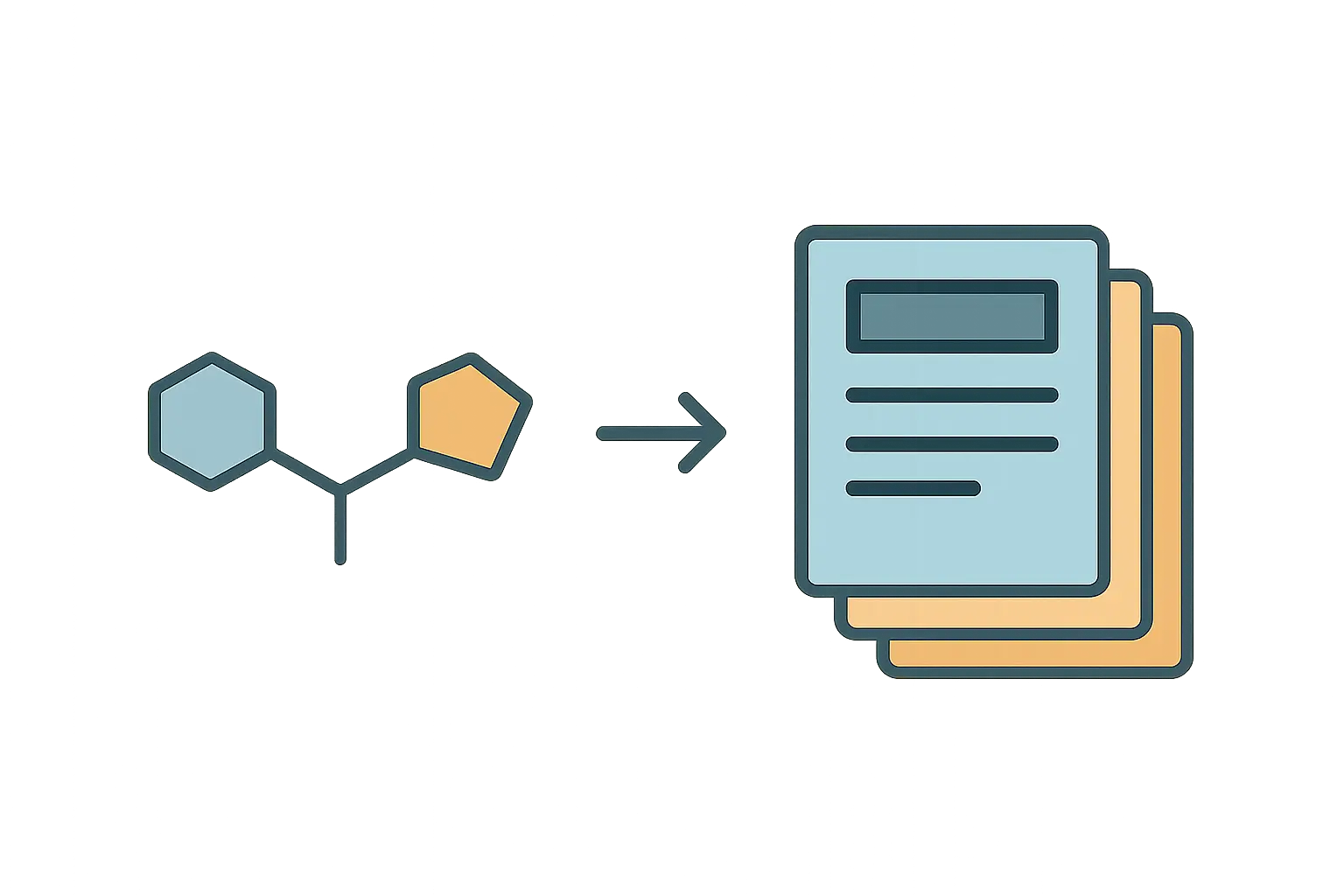
Characterisation discussion should build an argument, not just list numbers. For each new compound, briefly interpret what the spectroscopic data shows and why it confirms the proposed structure — which NMR signals and coupling patterns are diagnostic of the new bond formed, which IR band confirms loss of a starting-material functional group, which mass spectral fragment supports the molecular formula. This interpretive commentary is what distinguishes a characterisation chapter from a raw data dump, and it is one of the most commonly under-developed sections in first drafts. Where structure could plausibly be ambiguous from NMR and MS alone, note what additional evidence (X-ray crystallography, NOE experiments, comparison to an authentic sample) resolved the ambiguity.
Reporting NMR Data
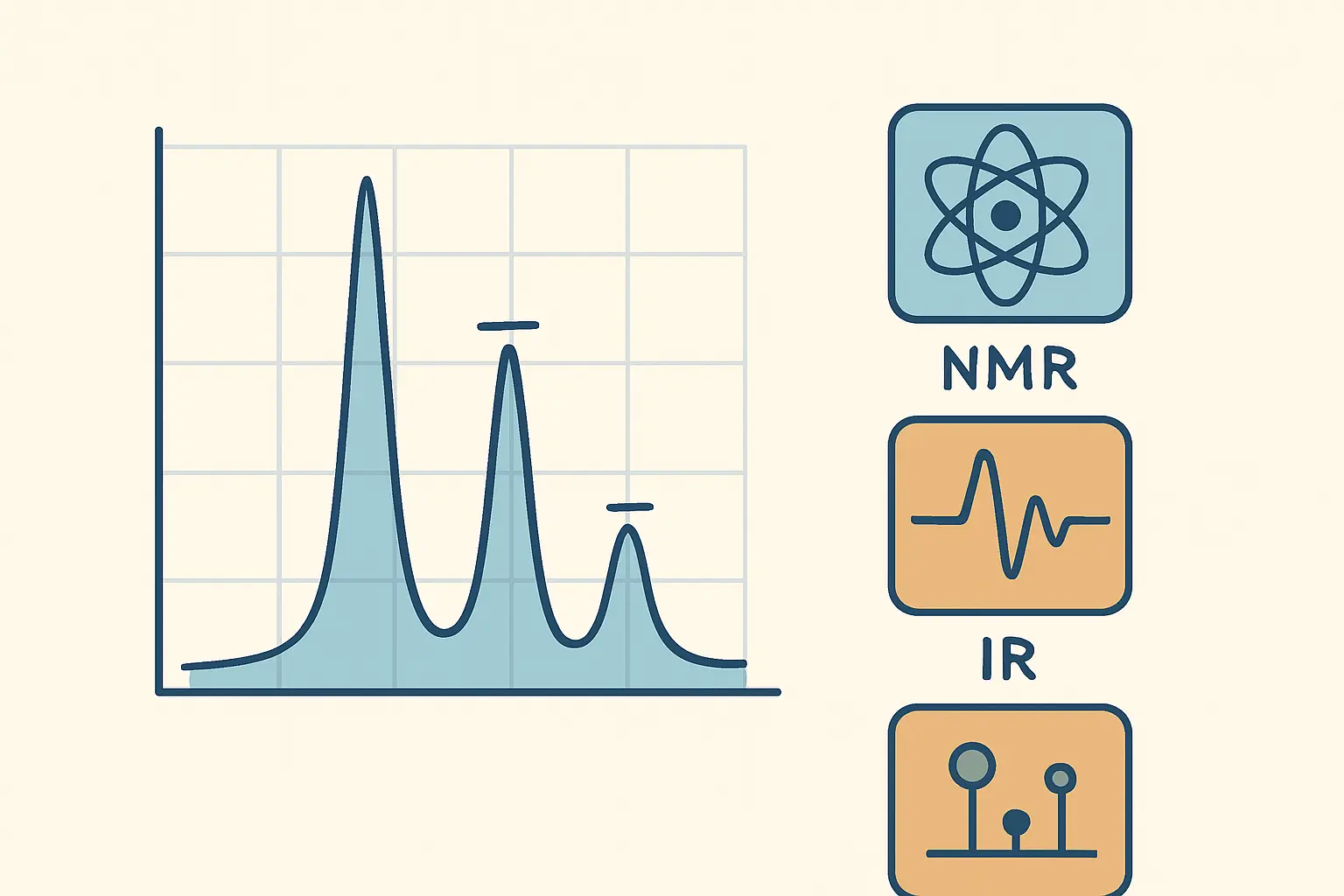
Chemistry departments and journals expect NMR data to be reported in a standard, compact format. According to American Chemical Society author guidance, both proton (1H) and carbon (13C) NMR data should generally be reported for new compounds, listing the solvent and instrument frequency, with 13C shifts typically rounded to one decimal place. A conventional entry follows this pattern:
13C NMR (101 MHz, CDCl3) δ 168.2, 152.4, 138.9, 129.6, 55.8, 34.1.
Each signal is reported as chemical shift (δ, ppm), multiplicity (s = singlet, d = doublet, t = triplet, q = quartet, m = multiplet, dd = doublet of doublets), coupling constant J in Hz where resolvable, and integration (number of protons). Consistency matters more than any single formatting choice: pick one convention (typically the one used by your target journal or department style guide) and apply it identically across every compound in the thesis, since inconsistent formatting across chapters is one of the fastest things an examiner notices.
Reporting IR and Mass Spectrometry Data
For infrared spectroscopy, report only the absorption bands diagnostic of the key functional groups relevant to confirming the transformation — a carbonyl stretch confirming ester formation, an N–H stretch confirming amide formation — rather than every peak in the spectrum, and round band positions to the nearest whole wavenumber (cm-1). For mass spectrometry, report the ionisation method used (for example ESI or EI), the observed m/z value, and the ion assigned (such as [M+H]+ or [M+Na]+), limited to the peaks actually used for structural assignment rather than the full raw spectrum. High-resolution mass spectrometry (HRMS) data or elemental analysis is generally expected as confirmatory evidence of molecular formula for any newly reported compound, alongside melting point where the compound is a solid.
Building the Supporting Information
The Supporting Information (SI) is not an afterthought — in a synthetic chemistry thesis, it is where an examiner will go to verify that your reported data is genuine and internally consistent. A complete SI typically includes: full experimental procedures for every compound (even those only briefly mentioned in the main text), copies of raw NMR spectra for every new compound, HPLC or GC traces used to establish purity where relevant, crystallographic information files (CIFs) for any X-ray structures, and any computational output files if the thesis includes modelling work. Organise the SI in the same order as the compounds appear in the results chapters and use the same compound numbering, so a reader can move between the main text and the SI without friction. Many examiners spot-check SI spectra against the reported peak lists in the main text specifically to confirm that reported multiplicities and integrations were transcribed accurately, so proofread this section as carefully as any prose chapter.
Figures, Schemes, and ChemDraw Conventions
Reaction schemes should be drawn in a chemical structure editor such as ChemDraw, using consistent bond lengths, font, and atom label sizing across the entire thesis — most departments provide or require a specific style template. Number schemes sequentially and separately from figures (Scheme 1, Scheme 2… versus Figure 1, Figure 2…), and give every scheme a caption that states the reagents and conditions if they are not already labelled directly above the reaction arrow. Structures of key compounds discussed in the text should be numbered in bold and referenced consistently by that number in prose, tables, and the experimental chapter alike. Spectra reproduced in the main text (as opposed to the SI) should be limited to the ones that carry the interpretive argument you are making — a handful of annotated, publication-quality spectra illustrating a key point, not a wall of every spectrum collected.
Safety Statements, Ethics, and Data Availability
Most chemistry departments now require an explicit safety statement in the thesis or its experimental chapter, summarising the hazard classifications of key reagents used, any specialist handling procedures followed (glovebox work, pyrophoric reagents, high-pressure hydrogenation), and confirmation that risk assessments were completed and approved before work began — check your specific department’s requirements, since the exact format varies by institution. Where research involves biological testing of synthesised compounds, a separate ethics approval statement covering that testing is required in addition to the chemical safety statement, and the two should not be conflated. Increasingly, funders and journals also expect a data availability statement describing where raw spectroscopic data, crystallographic files, and any computational datasets have been deposited or how they can be accessed — check your university’s research data policy and your funder’s requirements before submission, since some now mandate deposit in a repository such as an institutional data archive as a condition of the award.
Preparing for Your Viva or Defence
Chemistry vivas frequently probe two things beyond the standard defence questions: whether you can explain why a particular spectroscopic signal is diagnostic (not just that it appears where expected), and whether you can defend the purity and characterisation of your key compounds under direct questioning about specific spectra. Revisit your most chemically significant compounds before the viva and be ready to talk through the full assignment logic for each key spectrum from memory, not just recognise it on the page. Related discipline-specific guides on this site, including our guide to writing a pharmacy (PharmD) thesis and our guide to writing a dentistry (BDS/DDS) thesis, cover the equivalent structural and evidential expectations for lab-adjacent health-science disciplines, and are useful comparison reading if your chemistry project sits at a pharmaceutical or biomedical interface.
FAQ
Does a chemistry thesis need a separate methods chapter?
Most synthetic chemistry theses use a dedicated experimental chapter containing the full, reproducible procedures for every compound, separate from the results-and-discussion chapters, which integrate a shorter account of the synthesis alongside its characterisation and interpretation.
What data confirms a new compound has been made correctly?
Typically a combination of 1H and 13C NMR spectra, diagnostic IR bands, and either high-resolution mass spectrometry or elemental analysis to confirm molecular formula, supplemented by melting point for solids and, where structural ambiguity remains, X-ray crystallography.
What goes in the Supporting Information versus the main thesis text?
The main text should carry the interpretive argument, with a small number of annotated, illustrative spectra. The Supporting Information should carry the complete raw spectra, purity traces, crystallographic files, and full experimental procedures for every compound, organised to mirror the compound numbering used in the main text.
How should I number compounds and schemes consistently?
Assign each compound a bold sequential number the first time it appears and use that same number consistently in text, schemes, tables, the experimental chapter, and the Supporting Information. Number schemes and figures in separate sequences (Scheme 1, Scheme 2… and Figure 1, Figure 2…).
Do I need a safety statement even if my project didn’t involve hazardous reagents?
Most departments still expect a brief safety statement confirming that a risk assessment was completed and followed, even for lower-hazard work, since it demonstrates that safe laboratory practice was formally considered rather than assumed. Check your specific department’s thesis requirements for the expected format.
Bringing Your Chemistry Thesis Together
The disciplines that read a chemistry thesis fluently — supervisors, examiners, and later readers searching for your compounds — are looking for the same three things throughout: a clear synthetic logic, consistently and correctly reported spectroscopic evidence, and an honest account of what worked and what didn’t. Get the structural conventions above right early, agree your department’s specific formatting expectations with your supervisor before you draft the experimental chapter, and the rest of the writing process becomes considerably more manageable. Structured drafting tools such as Tesify can help organise chapters and track compound numbering consistency as you write, but the chemistry — the interpretive argument connecting your synthesis to your spectra — has to be yours.
Write your thesis with AI
Structure, draft, cite, and format your thesis faster with Tesify’s AI writing tools, automatic bibliography, and plagiarism checker. Free to start, no credit card required.





Leave a Reply