

AI Research Proposal Generator in 2026: Draft a Defensible Proposal Faster with Tesify
Your supervisor has given you three weeks to submit a research proposal. You open a blank document, stare at the cursor, and realise you have no idea where to start — not because you lack ideas, but because the proposal format is a beast of its own. What counts as a “problem statement”? How specific should the research questions be at this stage? Do you need a full literature review or just a brief overview? Using a generic AI research proposal generator might seem like the obvious shortcut, but the tools that promise to do it all for you are quietly the most dangerous ones in your toolkit. This guide shows you the right approach: using AI to accelerate your thinking, not replace it.
A research proposal is the document that gets your project approved — by a supervisor, ethics board, graduate school, or funding committee. Unlike a thesis chapter, it has to be watertight before you’ve done the actual research. That pressure to be both confident and honest about what you plan to do (not what you’ve done) is exactly where students get stuck. The good news: AI can help you move through each section faster, as long as you stay in the driver’s seat on your ideas, your sources, and your argument.
What a Research Proposal Actually Contains
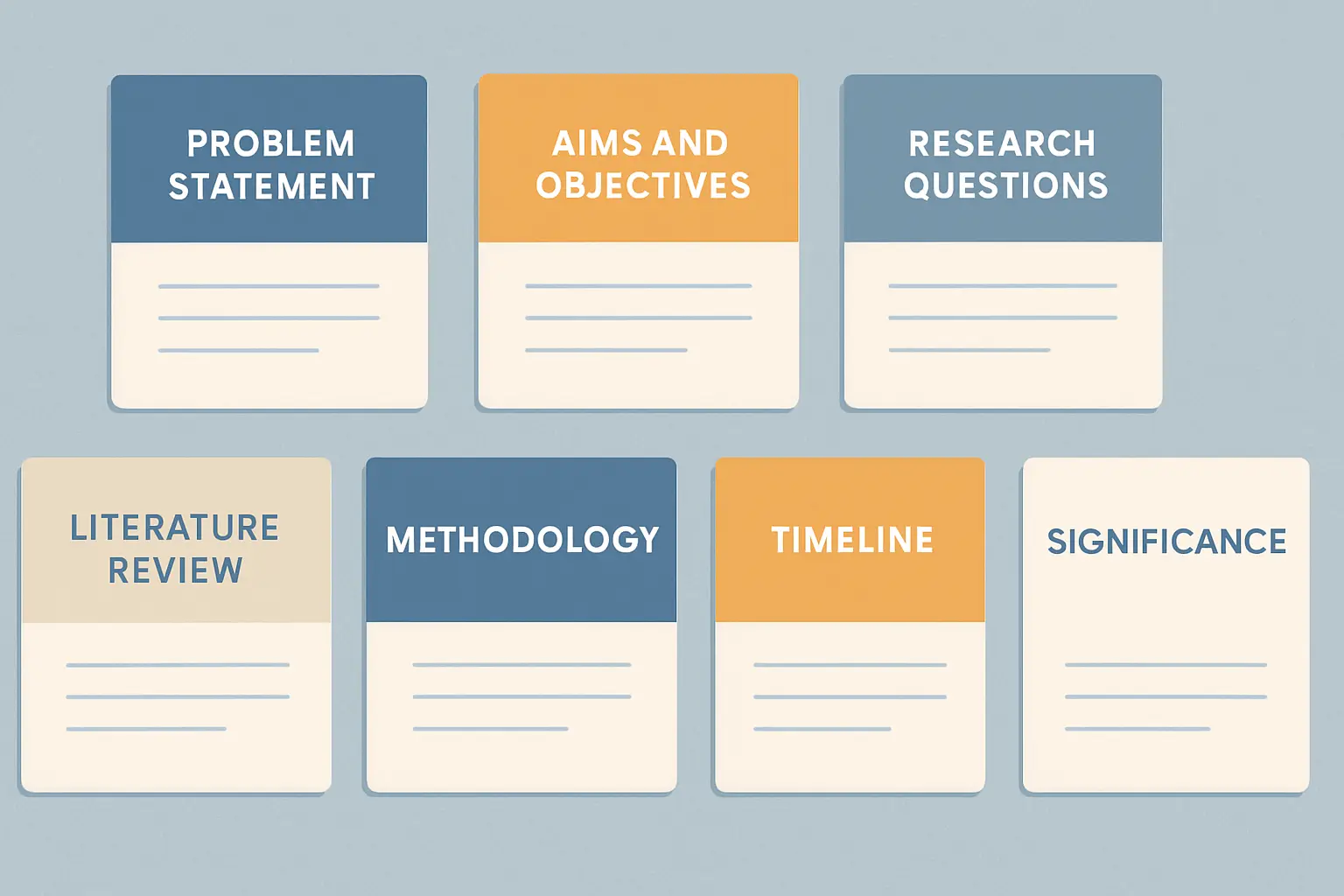
Before any AI tool can help you, you need to know what you’re building. Most institutions require the same seven core sections, even if they name them differently. Understanding what each section does is the difference between a proposal that gets approved and one that gets sent back with a page of comments.
If you want a complete annotated breakdown of how these sections should look when finished, the Research Proposal Template: How to Write a Winning Proposal (2026) covers each one with examples and common mistakes. For now, here is what you need to know going in:
| Section | What It Does | Typical Length |
|---|---|---|
| Problem Statement | Defines the gap or issue your research addresses | 150–300 words |
| Aims & Objectives | Broad aim (what you want to achieve) + SMART objectives (how) | 100–200 words |
| Research Questions | The specific questions your study will answer | 50–150 words |
| Brief Literature Review | Shows existing knowledge and the gap you fill | 400–800 words |
| Methodology Outline | Research design, data collection, analysis approach | 300–600 words |
| Timeline | Realistic Gantt-style breakdown of research phases | Table or 100–200 words |
| Significance | Why this research matters — theoretical and practical contribution | 150–250 words |
Notice that the proposal isn’t long — a master’s proposal is typically 1,500–3,000 words total. The challenge isn’t volume; it’s precision. Every sentence is load-bearing.
Where You’re Losing the Most Time
Proposal-writing anxiety usually concentrates in three places. Knowing them lets you target AI help where it actually counts.
The blank-page problem on the problem statement
The problem statement is the hardest sentence in academic writing: it has to be specific enough to be credible, but broad enough that a study is actually needed. Students spend hours trying to find the “right” framing before writing a single word. This is exactly where AI excels as a sparring partner — give it your rough topic and three bullet points of what you think the gap is, and ask it to draft three alternative framings. You then choose and refine, rather than starting cold.
Structural uncertainty
Many students don’t know where aims end and research questions begin, or whether methodology goes before or after the literature review. This isn’t a knowledge failure — most supervisor feedback at proposal stage is structural, not substantive. AI can map your content to the correct section order in seconds.
Over-writing the literature review
The brief literature review in a proposal is not your full Chapter 2. It needs to establish the gap, not survey the entire field. Students who have already started reading tend to dump everything they know into this section. AI tools that understand academic writing conventions can help you cut ruthlessly. For the full literature review that comes later, see our guide on how to write your literature review faster with AI in 2026 — the workflow there builds directly on the proposal-stage summary.
The Generic AI Trap: Plausible Is Not Defensible
The biggest risk with generic AI research proposal generators is that they optimise for text that sounds academic rather than text that is academically sound. Three failure modes appear repeatedly:
Fabricated references
A 2025 Deakin University study published in JMIR Mental Health tasked ChatGPT (GPT-4o) with generating citations for mental-health literature reviews and found that more than half — around 56% — were either entirely fabricated or contained significant bibliographic errors such as wrong authors, invalid DOIs, or incorrect publication details; only 43.8% of the references were both real and accurate. If you use a generic AI generator to produce your literature review section and paste those citations into your proposal, your supervisor will spot them in minutes. Worse, submitting them constitutes academic misconduct, regardless of how they were generated.
The core mechanism behind this is that large language models predict the next plausible token — they don’t retrieve from a live database of published literature. A tool that promises to “write your proposal with sources” is almost always inventing those sources.
Generic methodology descriptions
Ask a generic AI generator to write a methodology section for a qualitative study on healthcare workers’ experiences, and it will produce something that sounds reasonable but describes no actual method. It won’t know whether your institution requires ethics approval before data collection, whether you’re using IPA or thematic analysis, or whether your supervisor prefers positivist or interpretivist framing. A proposal with a boilerplate methodology is easy to reject.
No awareness of your specific requirements
Different institutions, programmes, and supervisors have radically different expectations. A funded research council proposal looks nothing like a master’s thesis proposal. Generic tools have no way to apply your programme’s conventions. The output needs more revision than if you had written it yourself — you’re editing AI copy rather than developing your own thinking.
How to Use AI the Right Way, Section by Section
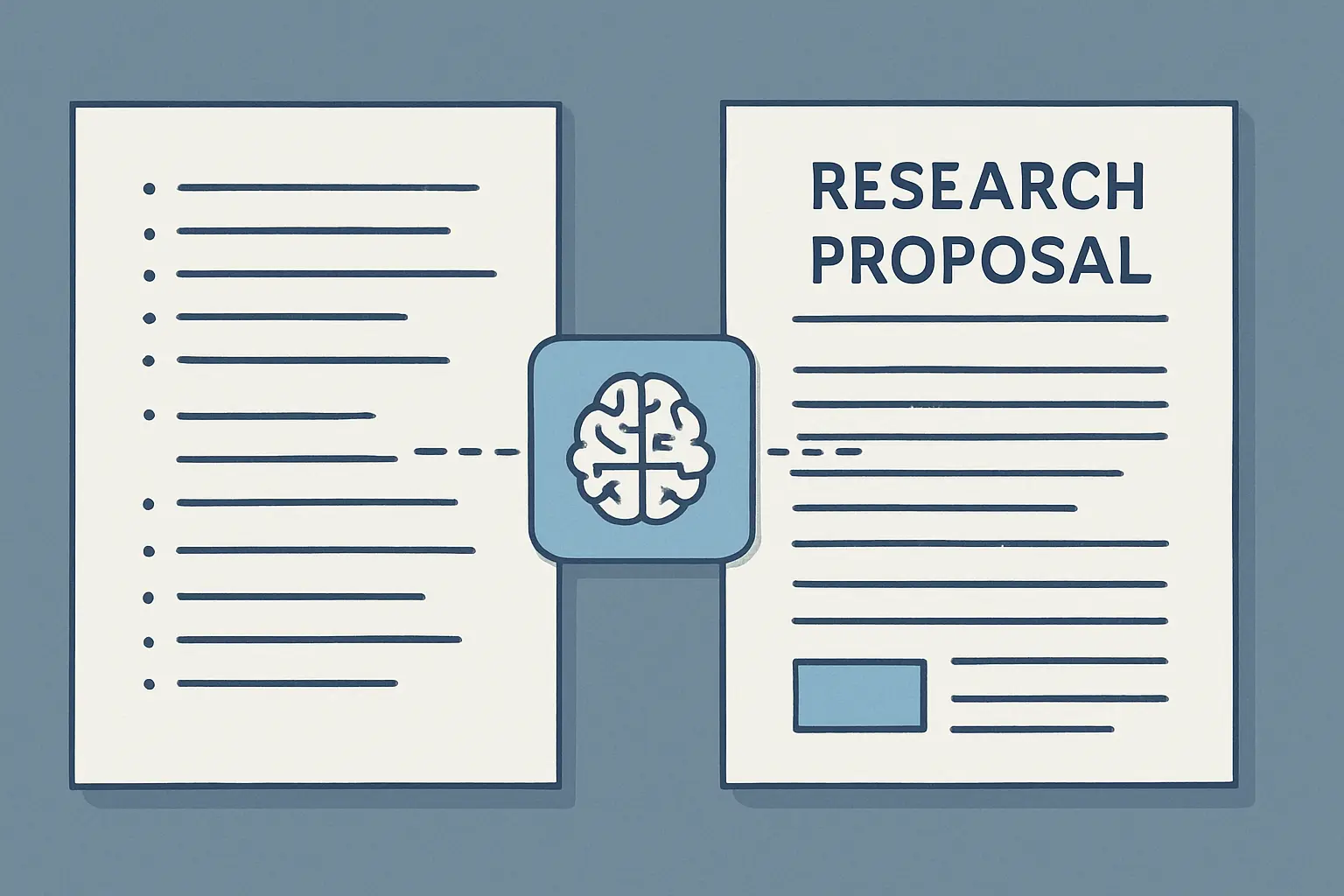
The correct mental model is this: you are the researcher; AI is the editor and structural consultant. You supply the substance — your topic, your actual sources (found via Google Scholar, your library databases, or tools like Elicit), your specific research question, and your methodological reasoning. AI helps you express it more precisely, flag logical inconsistencies, and ensure each section does what it’s supposed to do.
Here is a section-by-section workflow:
1. Problem statement
Write 3–5 bullet points describing: what is currently unknown or unresolved in your area, why it matters, and who is affected. Feed these to an AI tool and ask it to draft a 200-word problem statement. Read it critically — does it accurately represent your thinking? Revise until it does. Do not let the AI invent the problem on your behalf.
2. Aims, objectives, and research questions
Draft one broad aim sentence yourself (e.g., “This study aims to explore how X affects Y among Z”). Then ask AI to generate three SMART objectives and two to three research questions derived from that aim. Check that the questions are actually answerable with the methods you have in mind. The golden thread connecting your aim, objectives, and questions has to hold under examination — only you can verify it does. For a deeper dive into how to craft sharp research questions, the step-by-step research proposal guide on Tesify walks through the full drafting process with annotated examples.
3. Brief literature review
Identify 8–12 real, verified sources (papers you have actually read or skimmed). Paste the titles and key findings as bullet points. Ask AI to help you weave these into a coherent narrative that ends with the gap your study addresses. Check every citation before submission — AI may rephrase a finding in a way that subtly misrepresents the original study.
4. Methodology outline
Describe your planned approach in plain language: research design, participants or data sources, data collection method, and intended analysis. Ask AI to formalise this into academic register and check for missing components (e.g., have you addressed sampling rationale? Ethical considerations?). Never let AI choose your methodology — that is an intellectual decision only you can defend when a committee asks why you chose interviews over surveys.
5. Timeline
List your key phases and realistic durations. AI can convert this into a formatted Gantt table and flag obvious overlaps or missing phases (e.g., you’ve planned data analysis before ethics approval). If time pressure is already affecting your writing process, our guide on how to write your thesis while working full-time in 2026 has strategies for building in realistic buffers.
6. Significance
Draft two or three sentences about the theoretical and practical contribution of your study. AI can expand this into a polished paragraph — but again, the substance has to come from you. Ask yourself: what changes if this study is done? Who benefits? A generic “this research will contribute to the literature” is not significance; AI left to its own devices will produce exactly this kind of filler.
Where Tesify Fits In
Tesify is built specifically for thesis and dissertation writing — not as a general-purpose chatbot but as an AI editor that understands academic conventions, citation integrity, and the structural expectations of formal academic documents. That distinction matters at the proposal stage.
When you draft your proposal sections in Tesify, the AI editor works on your text rather than generating de novo content. It flags where your argumentation is thin, where transitions are missing, and where your language shifts from formal to informal. The bibliography tool pulls from verified sources rather than generating plausible-sounding fake ones — so when you cite a paper in your literature review section, the citation is checkable.
The result is a proposal draft that is genuinely yours: your research question, your sources, your methodological reasoning — expressed with the clarity and precision that gets approved. That’s the difference between an AI research proposal generator that saves you time and one that creates a risk you have to manage. If you want to see what the drafting process actually looks like, the AI thesis drafting workflow shows a similar approach applied to full thesis chapters.
Ready to draft a proposal your supervisor will actually approve?
Tesify’s AI editor keeps the ideas yours while helping you express them with precision. Start your proposal draft — free to begin.
Frequently Asked Questions
Is it academic misconduct to use an AI research proposal generator?
It depends on how you use it and what your institution’s policy says. Using AI as a writing assistant — to refine your own ideas, improve structure, and polish language — is permitted with disclosure at most universities in 2026. Using AI to generate the intellectual substance of your proposal (your research question, your literature, your methodology) without doing the underlying thinking yourself is considered academic misconduct under most updated policies. The rule of thumb: if you couldn’t defend every claim in the proposal under questioning, it shouldn’t be there.
What is the difference between AI generating a proposal and AI helping you draft one?
When AI generates a proposal, it invents the topic, the references, the research questions, and the methodology — typically producing plausible-sounding but unverifiable content. When AI helps you draft one, you supply all of the intellectual inputs (your topic, your real sources, your chosen approach) and the AI helps you organise, phrase, and refine those inputs into a coherent document. The second approach is academically defensible; the first is not.
Can Tesify write my research proposal for me?
No — and that’s intentional. Tesify is designed as an academic AI editor, not a ghostwriter. It helps you structure, refine, and improve text you have drafted, and it supports your citation work with verified bibliography tools. The research question, the argument, the methodology, and the intellectual content are always yours. This isn’t a limitation; it’s what makes the output defensible when your supervisor or ethics board reviews it.
How much time can AI realistically save on a research proposal?
Used correctly, AI can cut the time spent on structural uncertainty, formatting, and language polishing by a significant margin — allowing you to concentrate that time on the thinking that actually has to be yours. Where students waste the most hours is staring at blank sections they don’t know how to start; AI prompting techniques can break that paralysis immediately. The intellectual work — reading, thinking, deciding on your approach — still takes as long as it takes.
Will my supervisor know I used AI to help write my proposal?
AI detection tools are increasingly present in academic workflows, but the more important question is whether your supervisor can see that the thinking is genuinely yours. A proposal that reads fluently but describes a methodology you cannot explain, or cites sources you haven’t read, will raise questions regardless of detection software. The safest position — and the one that serves your actual research — is to use AI for what it’s good at (structure, language) while keeping the intellectual substance entirely your own. Disclose AI use in line with your institution’s guidelines.
Write your thesis with AI
Structure, draft, cite, and format your thesis faster with Tesify’s AI writing tools, automatic bibliography, and plagiarism checker. Free to start, no credit card required.





Leave a Reply