
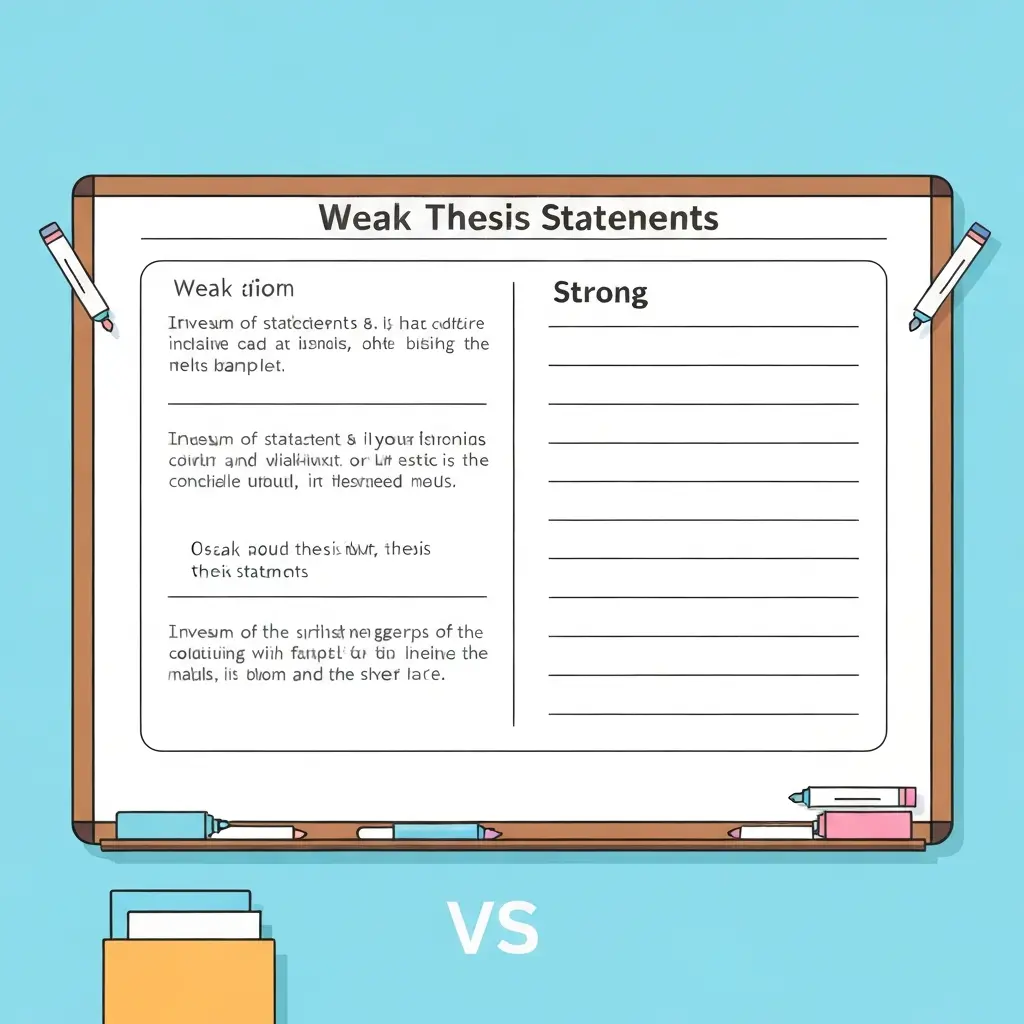
Thesis Statement Examples: 30+ Strong vs Weak Comparisons Across Every Discipline (2026)
A thesis statement is the single most important sentence in your academic writing. It is the claim your entire essay, dissertation, or research paper exists to prove. Get it right and every other paragraph clicks into place. Get it wrong — too vague, too obvious, or too broad — and no amount of good writing can rescue the argument beneath it. This guide gives you 30+ thesis statement examples with direct strong vs weak comparisons across nine disciplines, plus a formula you can apply to any subject.
Students often struggle with thesis statements not because they lack ideas, but because they conflate a topic with an argument. “Climate change affects agriculture” is a topic. “Rising temperatures in sub-Saharan Africa will reduce maize yields by 20–40% by 2050, disproportionately affecting smallholder farmers with no access to drought-resistant seed varieties” is a thesis statement — a specific, arguable, evidenced claim.
The Formula for a Strong Thesis Statement
Before we get to the examples, it helps to understand what makes a thesis statement work. A strong thesis statement must be:
- Arguable: Someone with knowledge of the field could reasonably disagree with it. “World War II involved significant loss of life” is not arguable — it is a fact. “Britain’s decision to delay the opening of a second front in Europe prolonged World War II by at least eighteen months” is arguable.
- Specific: It names the phenomenon, the mechanism, and (where relevant) the time period, population, or context. Specificity signals that you have actually thought through your argument.
- Scoped appropriately: You must be able to prove it within your word count. A 2,000-word essay cannot support a thesis that would require a book to prove.
- Positioned at the end of your introduction: The examiner expects to find it in the final paragraph of your introduction, after you have established the context and stakes.
History
| Weak Thesis Statement | Strong Thesis Statement |
|---|---|
| The Industrial Revolution changed society in many ways. | The Industrial Revolution transformed the British working class not primarily through factory wages but through the destruction of pre-industrial community structures, creating a new form of social atomisation that fuelled the Chartist movement. |
| The Cold War was caused by tensions between the US and USSR. | The Cold War’s origins lay less in ideological conflict than in the security dilemma created by post-war power vacuums in Central Europe, with both superpowers reacting defensively to perceived encirclement rather than pursuing ideological conquest. |
Psychology
| Weak | Strong |
|---|---|
| Social media affects teenagers’ mental health. | Daily social media use exceeding three hours significantly increases anxiety and depressive symptoms in adolescent girls by fostering upward social comparison, with passive scrolling producing stronger negative effects than active communication. |
| Cognitive behavioural therapy helps people with depression. | Cognitive behavioural therapy (CBT) produces equivalent outcomes to antidepressant medication for mild-to-moderate depression but demonstrates superior relapse prevention at 12-month follow-up, suggesting it should be the first-line recommended treatment in primary care settings. |
Literature and English
| Weak | Strong |
|---|---|
| Hamlet is a play about revenge and madness. | In Hamlet, Shakespeare uses theatrical metafiction — plays, performances, and role-playing — to argue that identity itself is performative, destabilising the early modern distinction between authentic selfhood and social mask. |
| 1984 is about a dystopian society where the government controls people. | Orwell’s 1984 depicts totalitarianism not as an external political imposition but as an internal psychological condition, arguing through Winston’s self-censorship that state control succeeds only because citizens have already internalised its logic. |
Biology and Life Sciences
| Weak | Strong |
|---|---|
| Climate change is affecting wildlife. | Phenological mismatch — the growing temporal disconnect between peak insect emergence and migratory bird arrival — represents a greater threat to North Atlantic seabird populations than direct temperature stress, requiring conservation strategies that target insect habitat rather than breeding colony protection. |
| Gut microbiome is important for health. | Disruption of the gut–brain axis through antibiotic-induced microbiome dysbiosis in early childhood significantly elevates lifetime risk of anxiety disorder, suggesting that probiotic supplementation during antibiotic courses should be incorporated into paediatric prescribing guidelines. |
Business and Economics
| Weak | Strong |
|---|---|
| Remote working has changed how businesses operate. | Mandatory return-to-office policies enacted by UK financial firms in 2024–2025 reduced employee retention among high-performing women more sharply than among male peers, primarily because women disproportionately bear domestic responsibilities that hybrid working had previously allowed them to manage. |
| Minimum wage increases affect employment. | The UK’s 2024 National Living Wage increase to £11.44 did not produce measurable job losses in the hospitality sector because businesses absorbed costs through reduced profit margins and modest price increases rather than workforce reductions, undermining standard neoclassical predictions. |
Sociology
| Weak | Strong |
|---|---|
| Poverty affects children’s outcomes. | Childhood poverty reduces educational attainment not primarily through lack of material resources but through the chronic stress response it triggers, impairing working memory and executive function in ways that persist into adulthood even after economic circumstances improve. |
Political Science
| Weak | Strong |
|---|---|
| Social media has changed politics. | Algorithmic content personalisation on major social media platforms has not created ideological “filter bubbles” as commonly claimed; rather, it has intensified existing partisan identities among already highly engaged users while leaving low-engagement voters largely unaffected. |
Education
| Weak | Strong |
|---|---|
| Class size affects student learning. | Class size reductions below 20 students improve literacy outcomes for disadvantaged pupils in Key Stage 1 significantly more than for their more affluent peers, suggesting that class size policy functions as a socioeconomic equity intervention rather than a universal quality improvement. |
Environmental Studies
| Weak | Strong |
|---|---|
| Plastic pollution is a serious problem in the ocean. | Microplastic ingestion by North Atlantic zooplankton reduces their lipid content and reproductive success at concentrations now routinely measured in surface waters, threatening the base of the marine food web in ways that macro-plastic pollution mitigation policies do not address. |
Once you have crafted your thesis statement, it becomes the anchor for your entire argument. See how it fits into the broader architecture in our thesis writing masterclass and learn how to develop it into a full introduction in our thesis introduction examples guide.
Frequently Asked Questions
How long should a thesis statement be?
A thesis statement is typically one to three sentences long. One sentence is ideal for essays and short research papers; two or three may be needed for longer dissertations where you need to specify the scope, approach, and argument. The key is that it must be a single, coherent claim — not a list of points you will cover. Avoid “this paper will discuss X, Y, and Z” — that is an outline, not a thesis statement.
Where does the thesis statement go?
In most academic writing, the thesis statement appears at the end of the introduction — typically the final sentence or two of your introductory paragraph or section. This placement allows you to first establish context and background before delivering your central claim, which the reader then expects the rest of the paper to prove.
Can a thesis statement be a question?
No. A thesis statement must be a declarative statement — a claim, not a question. Your research question is what you are investigating; your thesis statement is the answer you have arrived at. If you find yourself writing “Does X cause Y?”, revise it to “X causes Y because…” or “X does not cause Y, because…” depending on what your evidence shows.
Can my thesis statement change as I write?
Yes — and it often should. Many experienced writers use a “working thesis” as a starting point, knowing it will be refined as their argument develops. This is normal and healthy. What matters is that your final thesis statement accurately reflects the argument you have actually made, not the argument you intended to make at the start. Revise your thesis statement when you revise your conclusion.
Write your thesis with AI
Structure, draft, cite, and format your thesis faster with Tesify’s AI writing tools, automatic bibliography, and plagiarism checker. Free to start, no credit card required.




Leave a Reply