
Thesis Structure Guide: Fix Your Dissertation Methodology Chapter
Your methodology chapter looks fine on paper. You’ve described your research design, mentioned your data collection approach, and even thrown in a few references to Creswell or Bryman. But your supervisor keeps sending it back. Or worse — you read it yourself and something just feels off, like you’re describing what you did without actually justifying why you did it.
That gap — between describing and justifying — is where most methodology chapters collapse. And it’s more common than you’d think. A 2022 survey by the UK Council for Graduate Education found that methodology and research design were the most frequently cited weaknesses in PhD viva feedback, appearing in over 61% of examiner reports reviewed.
This thesis structure guide exists to close that gap. You’ll get a clear diagnosis of what’s actually broken in your methodology chapter, a step-by-step fix, and a practical framework you can apply this week.
Why Methodology Chapters Fail (And It’s Not What You Think)
Most students assume their methodology chapter is weak because they didn’t explain their methods clearly enough. So they add more detail — more description of the interview process, more explanation of the survey tool, more words about thematic analysis. The chapter gets longer. The supervisor still isn’t satisfied.
Here’s the counterintuitive truth: more description is rarely the fix. The problem isn’t length or detail. It’s architecture.
A methodology chapter has a very specific job. It must convince an examiner — who is often sceptical by professional habit — that your research design was the right choice for your research questions, not just a choice. That requires argument, not just narration.
The Three Most Common Methodology Failures
After reviewing hundreds of dissertation feedback reports and examiner comments, three structural failures appear again and again:
- The Shopping List Problem: The chapter lists methods (interviews, surveys, thematic analysis) without explaining why those specific tools suit the specific research questions. It reads like a menu, not a rationale.
- The Missing Philosophy Problem: There’s no ontological or epistemological grounding. The student jumps straight to “I used semi-structured interviews” without establishing what view of knowledge production underpins the entire study.
- The Generic Limitation Problem: Limitations are acknowledged in vague, boilerplate language (“small sample size may affect generalisability”) without any real engagement with what those limitations mean for the study’s conclusions.
Sound familiar? If any of these hit close to home, you’re not alone — and you’re in the right place. Our Research Methodology Guide 2026 expands on the full range of research paradigms and design types if you want a deeper foundation before proceeding.
A dissertation methodology chapter is the section of a thesis that explains and justifies the research design, data collection methods, analysis approach, and ethical considerations used in a study. It typically runs 1,500–3,500 words at undergraduate/master’s level and up to 8,000 words in a PhD, depending on institutional requirements.
Thesis Structure Guide: What a Methodology Chapter Actually Needs
Before you can fix anything, you need a clear map of what a functional methodology chapter contains. Think of it like a nested argument — each layer supports the next.
| Layer | What It Covers | Common Mistake | Word Count (Master’s) |
|---|---|---|---|
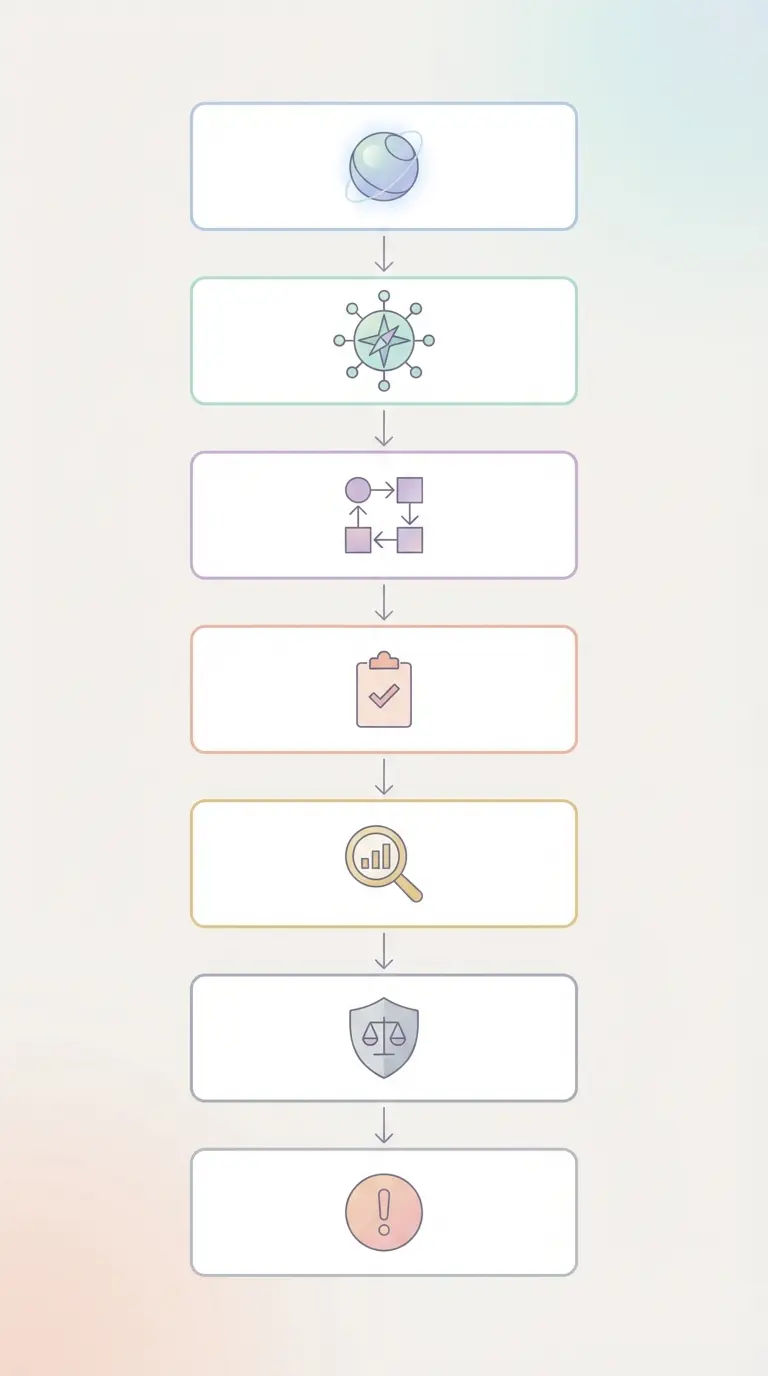
| 1. Philosophy | Ontology, epistemology, research paradigm | Skipped entirely | 200–400 words |
| 2. Research Approach | Qualitative/quantitative/mixed, inductive/deductive | Stated but not justified | 300–500 words |
| 3. Research Design | Case study, survey, experiment, ethnography, etc. | Described but not connected to RQs | 300–500 words |
| 4. Data Collection | Methods, instruments, sampling strategy | Too much description, not enough rationale | 400–600 words |
| 5. Data Analysis | Thematic analysis, regression, discourse analysis, etc. | Named but not explained step by step | 300–400 words |
| 6. Quality & Ethics | Validity, reliability, trustworthiness, consent, anonymity | Generic, copied-sounding language | 200–400 words |
| 7. Limitations | Honest, specific constraints and their implications | Vague or defensive tone | 150–250 words |
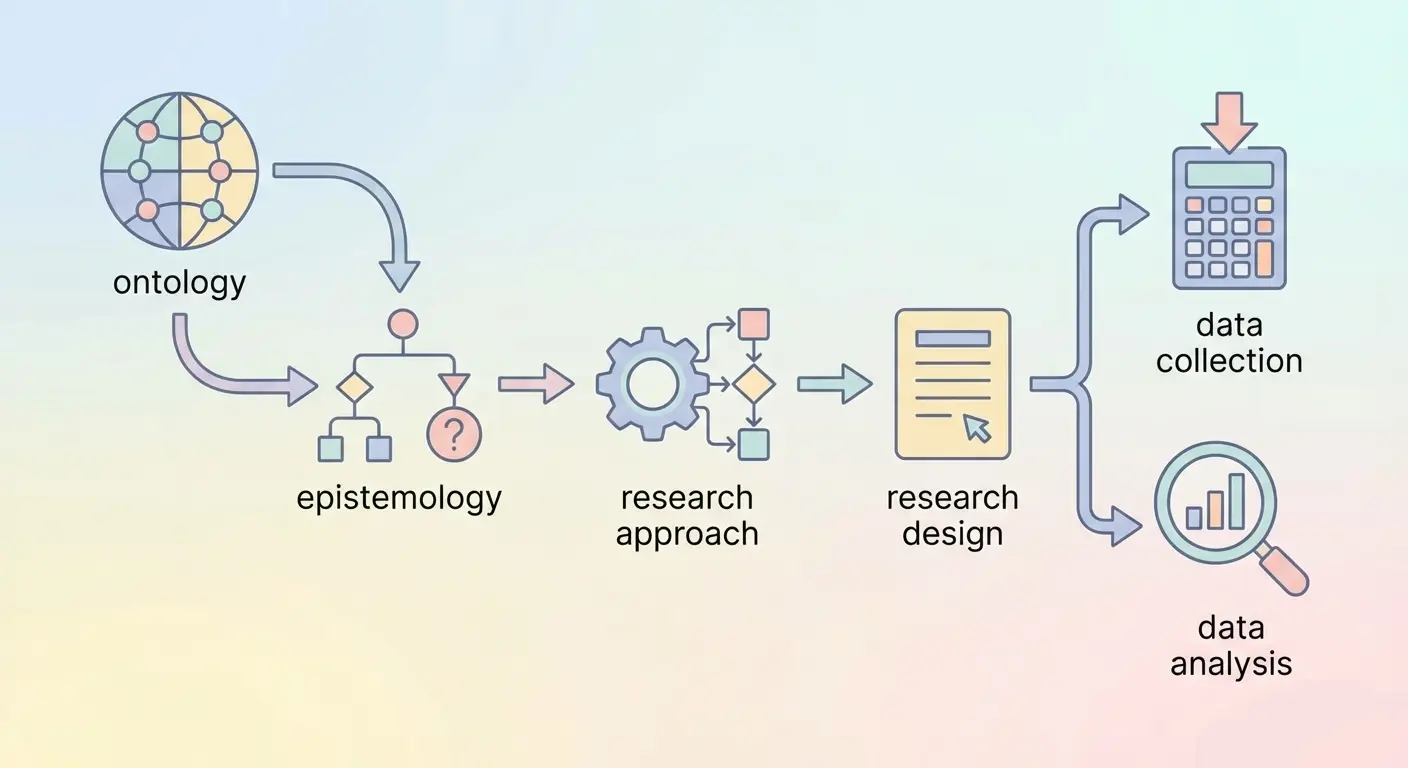
Notice that the philosophy layer comes first — yet it’s the most frequently missing layer. That’s not a coincidence. It’s the foundation every other decision rests on. Get this wrong, or skip it, and the entire chapter loses coherence.
For a broader view of how the methodology chapter fits into your full thesis, the resources at Purdue OWL’s Thesis and Dissertation guide offer solid orientation on academic writing expectations across disciplines.
The Philosophical Foundations Most Students Skip
Here’s where it gets interesting — and where most thesis structure guides either rush through or overcomplicate things.
Your methodology chapter needs to show that you understand why knowledge is produced the way it is in your field, not just how. That starts with two questions that sound abstract but have very practical consequences:
- Ontology: What do you believe reality is? Is there one objective social reality (realism) or multiple subjective realities constructed by individuals (relativism)?
- Epistemology: How do you believe knowledge about that reality can be gained? Through objective measurement (positivism), through interpretation of meaning (interpretivism), or something in between?
Your answers to these questions should determine everything else in your methodology chapter. A student who adopts an interpretivist epistemology shouldn’t be running statistical significance tests. A student with a positivist outlook shouldn’t be doing unstructured phenomenological interviews. When there’s a mismatch — and there often is — examiners spot it immediately.
Matching Your Paradigm to Your Research Question
The most practical way to get this right is to work backwards from your research question. Ask yourself: what kind of knowledge am I trying to generate?
- Causal relationships, patterns, measurable outcomes → positivist paradigm → quantitative methods
- Lived experience, meaning, social phenomena → interpretivist paradigm → qualitative methods
- Power structures, social justice, systemic critique → critical paradigm → often qualitative or mixed
- Real-world mechanisms and contexts → pragmatist paradigm → typically mixed methods
This isn’t a rigid formula. Plenty of excellent dissertations use mixed methods from a pragmatist position. What matters is that you make the connection explicit — in your own words, referenced to key methodologists like Creswell (2018), Bryman (2016), or Saunders, Lewis & Thornhill (2019).
Research Design Alignment: Connecting Your ‘What’ to Your ‘Why’
Once your philosophical position is established, your research design choices need to flow from it — visibly and explicitly. This is the layer where most students get closest to the mark, but still fall short because they describe what design they used without explaining why it fits their specific research questions better than alternatives.
Examiners at institutions like UCL, Oxford, and the University of Melbourne are trained to ask: “Why not a survey instead of interviews? Why not a case study instead of an experiment?” Your methodology chapter needs to pre-empt those questions.
How to Justify Your Research Design Choice
Use a simple three-part structure for each major design decision:
- Name the design: “This study employed a single-case study design…”
- Define it briefly with a citation: “…as defined by Yin (2018, p. 45) as an empirical inquiry that investigates a contemporary phenomenon within its real-life context…”
- Justify it against alternatives: “A case study was preferred over a survey design because this study seeks to understand the how and why of a complex organisational process, not to measure prevalence across a large population.”
That third step — the explicit comparison with alternatives — is what separates a competent methodology chapter from a strong one. Don’t just say what you did. Say what you didn’t do and why.
This principle applies to every design layer: research strategy, time horizon (cross-sectional vs. longitudinal), and data collection instrument. Each choice needs its own brief justification.
Data Collection and Sampling: Justify Every Decision
Data collection is usually where methodology chapters are most detailed — and yet also most superficially treated. Students spend paragraphs describing the interview schedule or the survey platform, then give one sentence to sampling: “A purposive sample of 12 participants was used.”
That’s not enough. Sampling is one of the most scrutinised areas in any research methodology because it directly affects what claims you can make from your data.
What Your Sampling Section Must Address
- Sampling strategy: Why purposive, snowball, random, stratified, or convenience? Name it and justify it against your research aims.
- Sample size: Justify the number. For qualitative research, cite saturation (Guest, Bunce & Johnson, 2006 suggested saturation often occurs around 12 interviews in homogeneous samples). For quantitative research, reference a power calculation or cite norms in your field.
- Inclusion and exclusion criteria: Who qualified to participate and who didn’t? This signals rigour.
- Access and recruitment: How did you reach participants? What ethical considerations shaped this?
What most students miss here is that transparency about sampling constraints is a sign of academic maturity, not weakness. Saying “convenience sampling was used due to access limitations, which affects the generalisability of findings to [broader population]” is far stronger than pretending you had unlimited research resources.
For practical guidance on making your data collection procedures transparent and reproducible — which is increasingly expected even at master’s level — take a look at these research methodology reproducibility tips that cover documentation, data management, and reporting standards.
Validity, Reliability, and Ethics Done Right
These three areas get the most boilerplate treatment in methodology chapters worldwide. You’ve probably written (or are tempted to write) something like: “Steps were taken to ensure validity and reliability. Ethics approval was obtained from the university ethics committee.”
That’s not good enough — but it’s also an easy fix.
Validity and Reliability (or Trustworthiness)
First, use the right vocabulary for your paradigm. Quantitative researchers discuss internal validity, external validity, reliability, and objectivity. Qualitative researchers use Lincoln and Guba’s (1985) parallel framework: credibility, transferability, dependability, and confirmability. Using positivist validity language in an interpretivist study is a red flag.
Then, specify the actual strategies you used:
- Member checking: Did you return transcripts to participants for review?
- Triangulation: Did you cross-reference data from multiple sources or methods?
- Reflexivity: Did you maintain a research journal to track your interpretive decisions?
- Pilot testing: Did you trial your survey or interview schedule before the main data collection?
Ethics: Specific, Not Symbolic
Ethics sections fail when they treat ethics as a box-ticking exercise. Name your institution’s ethics approval number if you have one. Then explain — specifically — how you addressed consent (written, verbal, online?), confidentiality (pseudonyms, data storage, deletion timelines), the right to withdraw, and any particular vulnerabilities of your participant group.
If your study involved no human participants, still address research ethics in relation to data use, intellectual property, and honest reporting.
Step-by-Step Fix: Rebuilding Your Methodology Chapter
Fair warning: this takes effort. But it’s a structured effort — and once you follow these steps, the chapter genuinely comes together. This is the practical heart of this thesis structure guide.
-
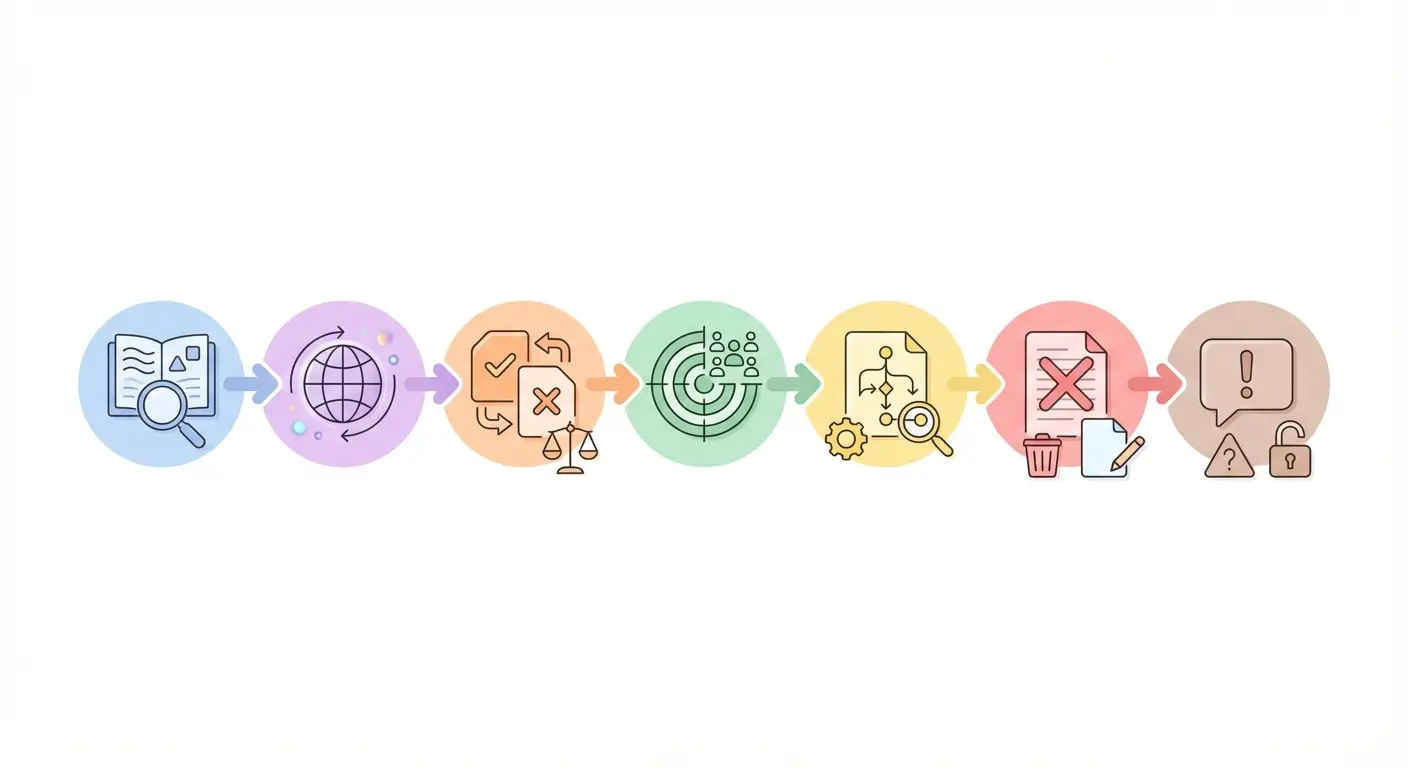
Step 1: Audit What You Have
Print your current methodology chapter. Highlight every sentence that describes what you did in yellow. Highlight every sentence that justifies why in green. If you have mostly yellow, that’s your diagnosis. Your ratio should be roughly 40% description, 60% justification. -
Step 2: Add Your Philosophical Position
Write a 200–350 word paragraph — before your research design section — that names your ontological and epistemological position, briefly explains it, and explicitly links it to your research questions. Cite at least two methodologists (Creswell, Bryman, Saunders et al., or Lincoln & Guba are all solid choices). -
Step 3: Justify Each Design Decision Against Alternatives
Go through every major design choice (approach, strategy, time horizon, instrument) and add one to two sentences for each that explicitly considers and dismisses an alternative. Use phrases like “while X design was considered, it was rejected because…” -
Step 4: Strengthen Your Sampling Rationale
Add a dedicated paragraph on sample size justification. For qualitative work, reference saturation theory. For quantitative work, reference power analysis or field norms. Add your inclusion and exclusion criteria if they’re currently absent. -
Step 5: Rewrite Your Analysis Section Procedurally
Don’t just name your analysis approach. Walk through it step by step. If you used Braun and Clarke’s (2006) thematic analysis, describe how you moved through their six phases for your data. If you ran regression analysis, specify your variables, software, and how you checked assumptions. -
Step 6: Replace Boilerplate Quality and Ethics Language
Delete any generic sentences. Replace each with a specific strategy you actually used, with enough detail that a reader could assess whether it was adequate. -
Step 7: Write Honest, Specific Limitations
Aim for three to five specific limitations. For each one: name it, explain why it arose, and briefly note what it means for interpreting your findings. This shows intellectual honesty — which examiners respect.
If you’re dealing with broader structural issues beyond the methodology chapter, the Dissertation Writing Fix: 7 Real Steps guide covers the full range of recovery strategies for stalled dissertations — from restructuring arguments to managing supervisor feedback.
Methodology Chapter Checklist Before You Submit
Use this checklist after applying the fixes above. Each item should get a genuine tick — not a hopeful one.
- ☐ Philosophical position — Ontology and epistemology named and justified
- ☐ Paradigm-method alignment — Research approach matches philosophical stance
- ☐ Research design justified — Alternatives considered and rejected with reasoning
- ☐ Research questions linked — Every major design decision tied back to your RQs
- ☐ Sampling strategy named and justified — Why this strategy for this study?
- ☐ Sample size justified — Saturation, power calculation, or field norm cited
- ☐ Inclusion/exclusion criteria stated — Who qualified and who didn’t?
- ☐ Data collection described procedurally — Enough detail for replication
- ☐ Analysis explained step by step — Not just named but walked through
- ☐ Correct quality vocabulary — Validity/reliability OR trustworthiness (match your paradigm)
- ☐ Quality strategies specified — Member checking, triangulation, pilot testing, etc.
- ☐ Ethics addressed specifically — Consent, confidentiality, right to withdraw
- ☐ Limitations are specific — Not vague; each one has implications noted
- ☐ Past tense used throughout — You’re reporting what you did, not what you plan to do
- ☐ Key methodologists cited — At least 4–6 methodology-specific references
This kind of systematic pre-submission review is standard practice at research-intensive universities. The PMC guide on writing a doctoral thesis reinforces many of these standards from a peer-reviewed perspective, and it’s worth a read if you’re at PhD level.
- Free Dissertation & Thesis Template (Grad Coach) — practical downloadable structure
- Overleaf LaTeX Thesis Templates — for those working in LaTeX
- What Is a Thesis? — Scribbr Guide — accessible overview of thesis components
Two Things Nobody Tells You About Methodology Chapters
Most guides stop at the checklist. Here are two insights that consistently separate strong methodology chapters from adequate ones — and that you won’t find in your university handbook.
1. Your Methodology Should Talk to Your Literature Review
The methodology chapter doesn’t exist in isolation. It should reference gaps, debates, or methodological criticisms that appeared in your literature review. If your literature review noted that previous studies in your field relied too heavily on self-report surveys, your methodology chapter should acknowledge that critique and explain how your design addresses it (or why it doesn’t, and why that’s acceptable).
This cross-referencing signals to examiners that you’ve thought about your methodology as part of a coherent research argument — not as a separate administrative requirement.
2. Positioning Yourself in the Text Matters
Many students write their methodology chapter in a voice that sounds detached and passive (“interviews were conducted,” “data were collected”). This is technically appropriate, but it can accidentally strip out the argumentative voice your chapter needs.
You can write in a way that’s both scholarly and active: “This study employed semi-structured interviews because the research questions required…” positions you as a researcher making deliberate choices. That’s the voice examiners want to hear.
For deeper guidance on academic voice and clarity in writing, this PhD writing improvement guide offers concrete techniques from experienced researchers and supervisors.
Frequently Asked Questions
How long should a dissertation methodology chapter be?
At undergraduate level, a methodology chapter is typically 1,500–2,000 words. At master’s level, expect 2,000–3,500 words. PhD methodology chapters can range from 5,000–10,000 words depending on the discipline and institution. Always check your university’s specific guidelines, as word counts vary significantly between programmes and countries.
What is the difference between methodology and methods in a thesis?
Methodology refers to the theoretical and philosophical framework that guides your research — the rationale for why you chose certain approaches. Methods are the specific tools and procedures you used, like interviews, surveys, or statistical tests. A strong dissertation explains both: the ‘why’ (methodology) and the ‘how’ (methods).
What tense should I use when writing the methodology chapter?
Use past tense throughout the methodology chapter because you are reporting what you already did (“Participants were recruited via…,” “Data were analysed using…”). This is standard practice in academic writing and signals to your examiner that the research is complete. Present tense is generally reserved for your literature review and discussion sections.
Can I change my methodology after starting data collection?
Minor adjustments are sometimes necessary and acceptable, but significant changes mid-study require supervisor approval and potentially a new ethics review. If your original design isn’t working, speak to your supervisor immediately rather than quietly pivoting. Transparency about methodological adjustments — and the rationale for them — is far better than trying to hide them in the final write-up.
What references should I cite in a dissertation methodology chapter?
Cite key methodologists relevant to your approach: Creswell & Creswell (2018) for mixed methods and general research design; Bryman (2016) or Saunders, Lewis & Thornhill (2019) for business and social science research; Yin (2018) for case studies; Braun & Clarke (2006) for thematic analysis; Lincoln & Guba (1985) for qualitative trustworthiness. Always supplement with discipline-specific methodology literature from your field.
Why does my supervisor keep rejecting my methodology chapter?
The most common reason is that the chapter describes what you did without justifying why those choices were appropriate for your research questions. Supervisors also frequently flag missing philosophical grounding, insufficient sampling rationale, and generic ethics or limitations language. The fix is to move from description to argumentation — every methodological choice should be explicitly defended against alternatives.
What to Do Right Now
Your methodology chapter isn’t broken because you’re a poor researcher. It’s broken because nobody gives you a clear architecture for what the chapter actually needs to do — argue, not just describe.
Start with the audit in Step 1. Highlight your description in yellow and your justification in green. That visual alone will show you exactly where the gaps are — and the steps above give you a clear path to fill them.
Once your methodology chapter is solid, the rest of your thesis tends to feel more stable too. That’s not a coincidence. The methodology is the argumentative spine of your entire study. Get it right, and everything else has something real to lean on.
If you want to go deeper on research design before you revise, the Research Methodology Guide 2026 covers every major paradigm and design type with clear explanations and worked examples. And if broader dissertation structure is the issue — not just the methodology — the Dissertation Writing Fix: 7 Real Steps guide has you covered from introduction to conclusion.
You’ve got this. One chapter at a time.
- Research Methodology Guide 2026: Complete Overview — master the full research design landscape
- Research Methodology Reproducibility Tips — make your methods chapter airtight with practical documentation standards
- Dissertation Writing Fix: 7 Real Steps — recovery strategies for every part of a stalled dissertation
- Dissertation Structure & Layout 101 (Video Guide) — visual walkthrough of how a full thesis fits together
Write your thesis with AI
Structure, draft, cite, and format your thesis faster with Tesify’s AI writing tools, automatic bibliography, and plagiarism checker. Free to start, no credit card required.






Leave a Reply