
Thesis Abstract Example: Templates and Annotated Samples for Every Discipline (2026)
Your thesis abstract is the first — and sometimes only — part of your work that examiners, researchers, and future readers will read. It must compress your entire thesis into 200–350 words without oversimplifying what you found or understating your contribution. Most students write their abstract last and spend too little time on it; treating it as an afterthought rather than the precision instrument it is. This guide gives you six annotated abstract examples across six disciplines, a fill-in template, and a checklist to make sure you have included everything that matters.
The abstract is one of the very few parts of your thesis with a hard word limit at most institutions — usually between 150 and 500 words. That constraint forces a clarity that is actually harder to achieve than writing at length. If you cannot explain your thesis in 300 words, there is a good chance your argument is not yet fully clear to you.
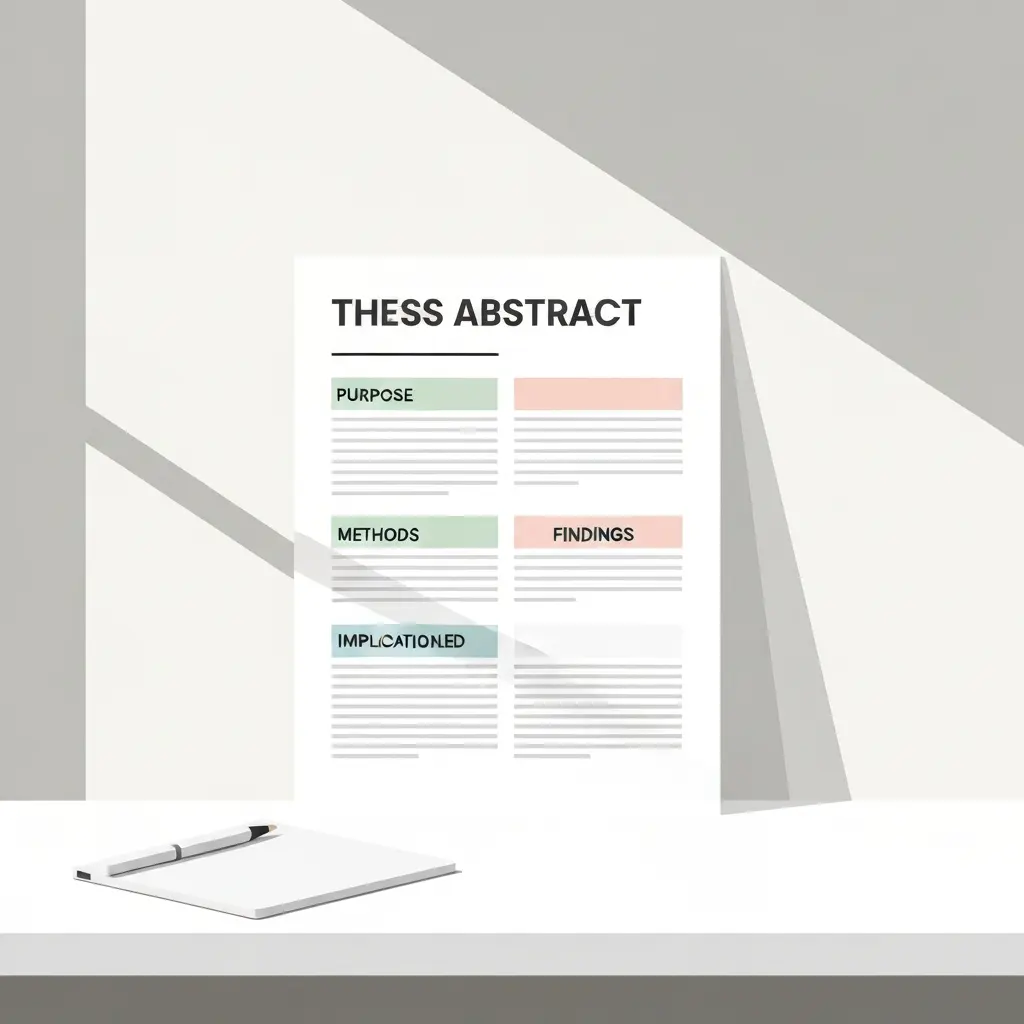
Abstract Structure: The Four-Part Framework
Regardless of discipline, almost every strong thesis abstract follows a four-part structure. The proportions vary, but the elements are consistent:
| Part | Content | Typical Sentences |
|---|---|---|
| 1. Purpose | Research question, problem, and rationale | 1–2 |
| 2. Methods | How you investigated the question | 1–3 |
| 3. Findings | Key results, most important first | 2–4 |
| 4. Implications | What the findings mean; contribution to the field | 1–2 |
In sciences and social sciences (IMRAD structure), these four parts are usually explicit and in strict order. In humanities, the structure is more fluid — purpose and implication may be interweaved — but the same information must still be present.
Fill-In Abstract Template
[Topic/field context sentence establishing why this matters]. Despite [existing knowledge / what is already known], [the gap — what is NOT known or understood]. This [dissertation/thesis/study] investigates [your specific research question].
Using [methodology — e.g. a mixed-methods approach combining X and Y / a qualitative case study / a randomised controlled trial], [sample/data description — e.g. data were collected from N participants / X datasets / N interviews]. [Any key analytical approach used].
The findings reveal that [main finding 1]. Furthermore, [main finding 2]. Contrary to [prior expectation / existing theory], [surprising or counter-intuitive finding, if applicable].
These findings suggest that [implication for theory / practice / policy]. The study contributes to [field/debate] by [specific contribution — extending / challenging / supporting / adding nuance to existing understanding]. [Final sentence: broader significance or call to action for the field].
Example 1: Natural Sciences
“Ocean acidification represents one of the most significant threats to marine ecosystems, yet its specific effects on calcification rates in non-reef bivalves remain poorly characterised at ecologically realistic pH levels. This thesis investigates the impact of projected end-of-century ocean pH (7.8) on the growth, shell integrity, and metabolic rate of Mytilus edulis (common mussel) populations in the Irish Sea. Mussel specimens (n=180) were maintained across three pH treatments (8.1, 8.0, and 7.8) for 12 weeks under controlled temperature and salinity conditions. Shell mass accumulation, micro-CT imaging of shell microstructure, and respirometry measurements were conducted at four-week intervals. Results demonstrate a 23.4% reduction in shell mass accumulation at pH 7.8 compared to the control, alongside significant dissolution of the outer calcite layer visible in micro-CT analysis. Metabolic rates increased by an average of 18% at reduced pH, suggesting that mussels divert energy from growth to acid-base regulation. These findings indicate that M. edulis populations face substantial physiological stress at pH levels projected within current climate models and suggest that commercial mussel aquaculture in the Irish Sea will face measurable production losses by 2080 without adaptive management interventions.”
What works: Opens with the broader problem before narrowing to the specific gap. Methods are precise (n=180, three treatments, 12 weeks). Findings are quantified (23.4%, 18%). Implications link directly to real-world relevance (commercial aquaculture).
Example 2: Social Sciences
“Despite significant policy investment in urban regeneration since 2010, social mobility outcomes in post-industrial Northern English towns remain among the lowest in the developed world. Existing research has focused predominantly on structural economic barriers; however, the role of place-based identity and aspiration in mediating mobility outcomes has received limited empirical attention. This dissertation examines how residents of post-industrial communities in West Yorkshire construct aspirational narratives and what factors constrain or enable upward mobility. Twenty-eight semi-structured interviews were conducted with adults aged 18–55 in Bradford and Wakefield between January and April 2026, supplemented by ethnographic observation of two community employment programmes. Thematic analysis revealed three primary mechanisms through which place identity constrains mobility: localised social networks that penalise aspiration, school cultures that frame higher education as culturally incongruent, and a collective narrative of economic decline that functions as self-fulfilling expectation. Participants who had experienced upward mobility overwhelmingly cited contact with individuals from higher-status backgrounds as the catalyst for aspiration shift. The findings suggest that mobility interventions focused solely on skills and employability underestimate the cultural work required to enable individuals to envision themselves in different social positions. Policy should prioritise heterogeneous social mixing over place-based economic investment.”
What works: Gap is precisely framed (structural vs cultural). Methods are specific (28 interviews, two sites, dates). Findings are structured thematically. Implications include a direct policy recommendation.
Example 3: Humanities
“Virginia Woolf’s essays have long been treated by critics as supplementary to her fiction — illuminating biographical documents or stylistic precedents, but rarely as works of original philosophical argument. This dissertation argues that the essays of the 1920s constitute a coherent, if unprogrammatic, feminist epistemology that anticipates key positions in later standpoint theory by insisting on the cognitive value of marginalised perspective. Close readings of ‘A Room of One’s Own,’ ‘On Not Knowing Greek,’ and ‘Professions for Women,’ situated within the specific social and institutional contexts of interwar London literary culture, reveal a sustained argument that women’s historical exclusion from institutions of knowledge production has generated a distinctive and theoretically generative cognitive standpoint. This finding challenges prevailing accounts of Woolf’s feminism as primarily aesthetic or proto-poststructuralist and repositions her essays within the tradition of feminist social epistemology. The study contributes to Woolf scholarship and to feminist theory by recovering an intellectual genealogy that shows standpoint epistemology’s roots extending earlier and in different disciplinary soil than is commonly acknowledged.”
What works: Humanities abstracts can be longer in the purpose section. The contribution is stated explicitly and clearly. The gap (essays treated as supplementary, not philosophical) sets up the argument precisely.
Example 4: Engineering
“Lithium-ion batteries remain the dominant energy storage technology for electric vehicles; however, dendrite formation during fast-charging cycles represents a significant safety risk and cycle-life limitation not fully mitigated by current electrolyte formulations. This thesis investigates the effectiveness of a novel dual-additive electrolyte system — combining fluoroethylene carbonate (FEC) and lithium difluoro(oxalato)borate (LiDFOB) — in suppressing dendrite formation in lithium metal anodes under fast-charge conditions. Electrochemical testing was conducted across 500 charge-discharge cycles at 3C rate in a controlled environment; SEI layer morphology was characterised using cryo-transmission electron microscopy (cryo-TEM) and X-ray photoelectron spectroscopy (XPS). The dual-additive electrolyte reduced dendrite incidence by 67% compared to the FEC-only control and extended cycle life to 89% capacity retention at cycle 500, compared to 71% for the control. Cryo-TEM imaging revealed a more uniform, inorganic-rich SEI layer in the dual-additive condition. These results demonstrate that synergistic additive combinations targeting both SEI composition and ionic transport can substantially outperform single-additive systems and suggest a viable path toward commercially deployable fast-charging lithium metal batteries.”
What works: Technical terms are used precisely without over-explanation. Quantitative results dominate (67%, 89% vs 71%). Contribution to the field is clearly stated in the final sentence.
Example 5: Education
“Metacognitive skill development is widely recognised as central to effective learning, yet few secondary schools in England have implemented evidence-based metacognitive instruction programmes, and the impact of teacher professional development on such implementation remains understudied. This dissertation examines the effects of a six-week metacognitive teaching professional development (MTPD) programme on both teacher practice and Year 9 student academic self-regulation in four comprehensive schools in the East Midlands. A mixed-methods design combined pre-post student academic self-regulation surveys (n=312), classroom observation of 24 lesson sequences, and semi-structured teacher interviews (n=16). Students in the MTPD condition demonstrated significantly greater gains in academic self-regulation scores (Cohen’s d=0.52) compared to the matched control group. Observation data indicated that trained teachers used metacognitive scaffolding strategies in 74% of observed lessons post-training, compared to 12% pre-training. Interview analysis identified sustained departmental dialogue as the key mediating factor in implementation fidelity. The findings provide classroom-level evidence that targeted teacher professional development can produce meaningful improvements in student self-regulation within a single term, offering practical guidance for school improvement practitioners and CPD designers.”
What works: Mixed-methods design is specified clearly. All three data sources are mentioned. Effect size is reported (Cohen’s d=0.52). The final sentence specifies the practical audience for the findings.
Example 6: Business / Management
“Environmental, Social, and Governance (ESG) reporting has expanded rapidly among FTSE 100 companies since 2019, yet the relationship between ESG disclosure quality and long-term firm value remains contested in the empirical literature, with results varying substantially by sector and measurement approach. This dissertation examines whether high-quality voluntary ESG disclosure — as assessed by the Bloomberg ESG Disclosure Score — is positively associated with firm value, measured by Tobin’s Q, in the UK retail sector between 2019 and 2024. Panel data regression analysis was conducted on a sample of 42 listed UK retail firms across five financial years, controlling for firm size, leverage, profitability, and market conditions. Results indicate a statistically significant positive association between ESG disclosure quality and Tobin’s Q (β=0.14, p<0.01), with the social dimension of ESG showing the strongest independent effect. No significant moderating effect of firm size was observed. These findings support the stakeholder theory prediction that ESG transparency enhances firm value through reputational signalling, and suggest that UK retail companies have a financial incentive — not merely a regulatory obligation — to improve the quality of voluntary ESG disclosures."
What works: Research design is tightly specified (42 firms, 5 years, panel regression). Statistical results are cited with coefficients and p-values. Findings are anchored in existing theory (stakeholder theory). Practical implication for firms is stated in the final sentence.
Abstract Checklist Before Submission
Before you finalise your abstract, check every item on this list:
- Does the first sentence establish the broader research context (not start with “This dissertation”)?
- Is the gap or problem your research addresses explicitly stated?
- Is your research question or aim clearly expressed?
- Are your main methods described with enough specificity (sample size, data type, analytical approach)?
- Are your key findings stated — not vaguely referenced?
- Does the abstract state your study’s contribution to the field?
- Is it within your institution’s word limit?
- Is it a single, self-contained piece — readable without access to the thesis itself?
- Does it avoid abbreviations, jargon, and citations (most universities prohibit references in abstracts)?
- Did you write it last, after your conclusion was finalised?
For the full context on how the abstract sits within your thesis, see our thesis writing masterclass. For chapter-by-chapter examples of what strong thesis writing looks like in practice, see our dissertation example guide.
Frequently Asked Questions
How long should a thesis abstract be?
Most universities set abstract word limits between 150 and 500 words, with 250–350 words being the most common range for master’s theses and PhD dissertations. For undergraduate dissertations, 150–250 words is typical. Always check your institution’s submission guidelines — word limits vary between departments and degree levels, and exceeding them may result in a rejected submission.
Should I include keywords in my abstract?
Many journals and institutional repositories ask for a separate list of 5–8 keywords immediately after the abstract — these are used for database indexing and help other researchers find your work. Keywords should be the core terms your target audience would use to search for research like yours. Some disciplines (particularly sciences and social sciences) expect this; humanities varies. Check your institution’s thesis submission guidelines.
Can I include citations in my abstract?
Generally, no. Most universities and journals prohibit citations in abstracts because the abstract must be a standalone document that is fully comprehensible without access to the references. Exceptions exist in some medical and scientific fields where a specific methodological tool or dataset must be cited. As a default, avoid citations in your abstract unless your supervisor or institution explicitly requires them.
What tense should I use in my abstract?
Use past tense for what you did (methodology) and what you found (results): “interviews were conducted,” “results demonstrated.” Use present tense for your conclusions, contributions, and implications: “the findings suggest,” “this study contributes.” The abstract mix of past and present tense is standard academic convention and signals the distinction between completed empirical work and ongoing theoretical contribution.
What is the difference between an abstract and an introduction?
An abstract is a complete summary of the entire thesis — purpose, methods, findings, and implications — in 200–350 words, designed to stand alone. An introduction is the first chapter of the thesis itself, providing background, context, a literature overview, the research question, scope, and a chapter roadmap — typically 1,000–4,000 words. Abstracts are written for any potential reader; introductions assume the reader will proceed to read the whole thesis.
Write your thesis with AI
Structure, draft, cite, and format your thesis faster with Tesify’s AI writing tools, automatic bibliography, and plagiarism checker. Free to start, no credit card required.





Leave a Reply