
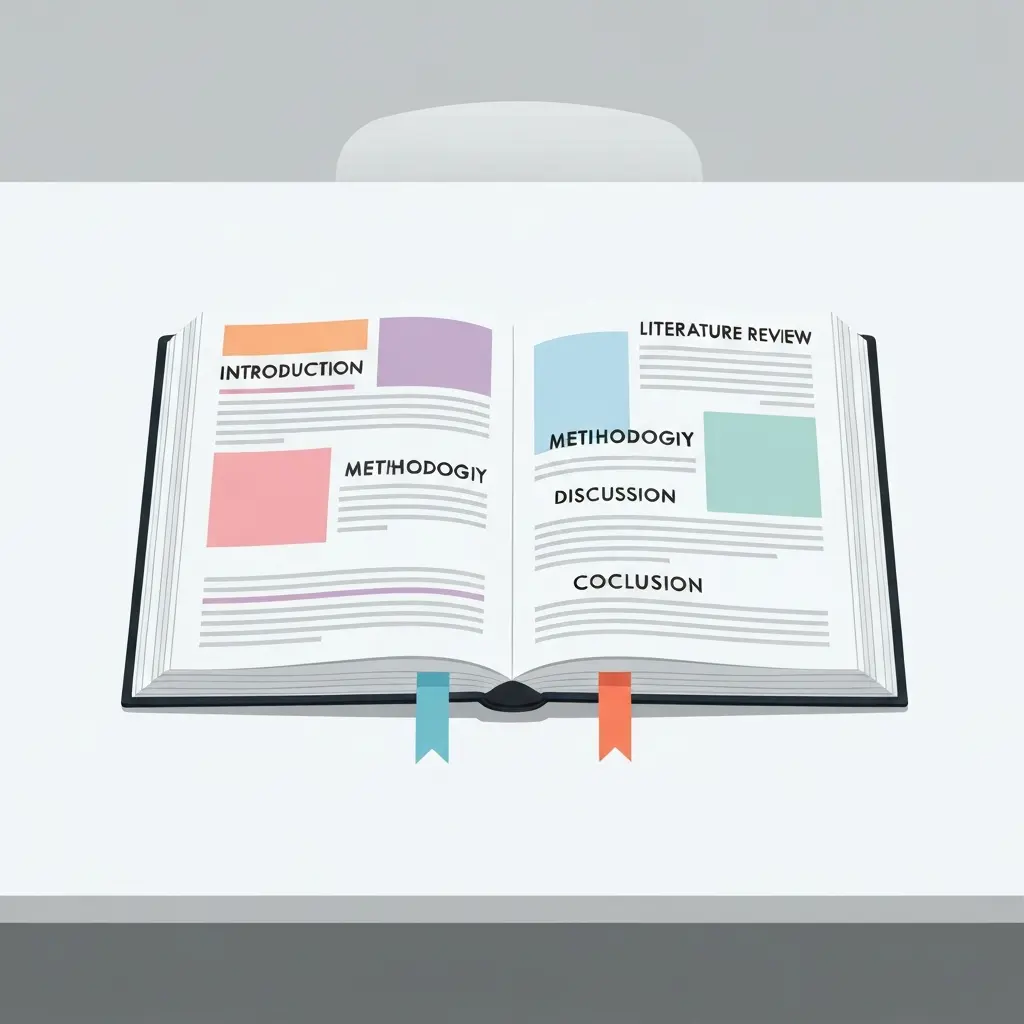
Dissertation Example: A Chapter-by-Chapter Guide with Annotated Samples (2026)
The fastest way to understand what a strong dissertation looks like is to study a real one. But most students never see an excellent dissertation example up close — their university may share a few PDFs, but without commentary, it is hard to know what makes a passage work and what to replicate in your own writing. This guide solves that problem by walking through each chapter of a dissertation with annotated examples and examiner-level commentary.
We will look at the specific language choices, structural decisions, and argumentative moves that separate a first-class dissertation from a 2:1 — and show you exactly how to apply those lessons to your own work.
Annotated Introduction Example
The introduction is your first — and most important — chance to convince the examiner that your research matters. Here is a model passage from a social sciences dissertation, followed by commentary on what makes it effective:
“Despite a decade of policy initiatives aimed at closing the gender pay gap in the UK financial sector, women in investment banking continue to earn 28.9% less than their male counterparts (ONS, 2025). Existing research has extensively documented this disparity, but far less attention has been paid to the role of informal networking practices in perpetuating it. This dissertation investigates whether differential access to informal mentorship networks constitutes a structural barrier to women’s promotion within UK investment banks, drawing on 24 semi-structured interviews with employees at three major institutions.”
What works here:
- Opens with a striking statistic — hooks the reader immediately and establishes stakes
- Identifies the gap clearly (“far less attention has been paid to…”) in the second sentence
- States the research question and method concisely in the final sentence
- Specificity — 24 interviews, three institutions. Vagueness signals weak methodology
What a weak introduction looks like instead: “This dissertation is about gender inequality in the workplace. Gender inequality is a big problem. Many researchers have studied it. This dissertation will add to that literature.” — This tells the examiner nothing about your unique contribution.
Annotated Literature Review Example
The literature review is not an annotated bibliography. It is a structured argument. Here is a passage that shows how to synthesise rather than simply summarise:
“Early structural accounts of workplace inequality focused primarily on formal barriers — discriminatory hiring practices, unequal pay scales, and legal exclusions (Hartmann, 1979; Reskin, 2003). As these formal barriers were progressively dismantled through legislation, scholars shifted attention toward what Williams (1992) termed the ‘glass ceiling’ — invisible organisational processes that concentrate men at senior levels. More recent work, however, challenges the ceiling metaphor as insufficiently dynamic, preferring instead the concept of ‘sticky floors’ (Booth et al., 2003) or ‘labyrinthine pathways’ (Eagly & Carli, 2007) to capture the multiple, intersecting obstacles women navigate throughout careers. Crucially, this literature has focused almost exclusively on formal organisational structures, leaving the role of informal networks — the subject of the present study — largely undertheorised.”
What works here:
- Chronological narrative arc — traces how thinking has evolved, not just who said what
- Evaluation language — “challenges,” “insufficiently dynamic,” “undertheorised” — shows critical engagement
- Gap statement at the end — the final sentence directly sets up the research question
- Multiple sources per claim — signals broad reading and comparative thinking
For more worked examples with different disciplinary approaches, explore our dedicated literature review examples resource.
Annotated Methodology Example
The methodology chapter must do more than describe what you did — it must justify why. Here is a model passage:
“This study adopts an interpretivist ontological position, grounded in the assumption that social reality is constructed through individual experience and meaning-making (Bryman, 2016). This philosophical stance informed the choice of qualitative methodology, as the research question — concerned with how participants subjectively experience and navigate informal networks — requires methods capable of generating rich, contextualised data that quantitative instruments cannot capture. Semi-structured interviews were selected over structured questionnaires because they permit the conversational flexibility to pursue unexpected lines of inquiry while maintaining sufficient consistency for cross-participant comparison (Kvale & Brinkmann, 2015).”
What works here:
- Philosophy before methods — establishes ontological position first, then derives method from it
- Justified comparisons — explains why semi-structured over structured, not just what was chosen
- Cited methodological literature — Bryman, Kvale and Brinkmann are classic methodology texts; citing them signals methodological literacy
Annotated Results Example
Results chapters present findings without interpretation (save that for discussion). Here is how to do it cleanly:
“Three overarching themes emerged from thematic analysis of the interview data: (1) the perceived importance of informal networks for career advancement, (2) differential access to those networks by gender, and (3) the role of senior sponsorship in mediating access. All 24 participants reported that informal networking — defined for the purposes of this study as non-structured, non-mandatory professional interaction — was considered either ‘very important’ or ‘extremely important’ to promotion outcomes. However, 18 of the 22 female participants (82%) described experiencing at least one barrier to accessing these networks, compared with only 1 of the 2 male participants.”
What works here:
- Themes are enumerated clearly — easy for the examiner to follow
- Specific numbers — 24 participants, 18 of 22, 82% — results are precise, not vague
- No interpretation — reports what was found without explaining why; that comes in discussion
Annotated Discussion Example
The discussion is where your analytical voice should shine. Here is a passage that connects findings back to theory effectively:
“The finding that 82% of female participants reported barriers to informal network access provides empirical support for Eagly and Carli’s (2007) ‘labyrinth’ model while simultaneously extending it: the barriers described by participants were not merely structural but actively reproduced through what Bourdieu (1986) would term ‘social capital’ asymmetries — where access to informal mentorship circles was itself contingent on pre-existing social capital that women were less likely to possess on entry. This finding challenges the implicit assumption in much glass ceiling literature that formal equality of opportunity is sufficient to produce equitable outcomes.”
What works here:
- Opens by citing the specific finding — keeps the discussion grounded in results
- Engages with and extends theory — does not just confirm existing ideas, but nuances them
- Draws on multiple theoretical frameworks — Eagly & Carli plus Bourdieu creates intellectual depth
Annotated Conclusion Example
The conclusion must answer the research question directly. Many students write conclusions that gesture vaguely toward findings rather than stating them plainly. Here is the right approach:
“This dissertation set out to investigate whether differential access to informal mentorship networks constitutes a structural barrier to women’s promotion within UK investment banks. The findings clearly indicate that it does: female employees at all three institutions reported systematic exclusion from the informal networks that senior employees identified as central to promotion decisions. This exclusion was not the result of deliberate discrimination but emerged from social capital asymmetries reproduced by existing network structures. The study’s primary contribution is to extend Eagly and Carli’s labyrinth model by identifying informal network access as a previously undertheorised mechanism within the labyrinth.”
What works here:
- Restates the research question in full — connects directly back to the introduction
- Answers it definitively — “The findings clearly indicate that it does”
- States the original contribution — every dissertation must do this
For more annotated conclusion examples, see our thesis conclusion examples guide.
5 Common Mistakes Real Dissertations Make
Even good dissertations often fall short in the same predictable ways. Watch out for these:
- Descriptive literature review. Summarising sources one by one rather than synthesising them into a coherent argument. Fix: group sources by theme or position and discuss them comparatively.
- Unjustified methodology. Describing what you did without explaining why. Fix: for every design choice, ask “why this and not the alternatives?”
- Vague research question. “This dissertation examines leadership” does not tell the examiner what you will argue. Fix: add a specific claim, context, population, and timeframe.
- Weak conclusion. Ending with limitations and future research without first directly answering the research question. Fix: make your answer to the research question the opening sentence of your conclusion.
- Inconsistent referencing. Mixing APA 6th and 7th edition, or switching between Harvard styles. Fix: choose one style guide and check every reference against it before submission.
Want the full step-by-step process? Our masterclass article on how to write a thesis takes you from blank page to final submission.
Frequently Asked Questions
Where can I find real dissertation examples to read?
EThOS (the British Library’s electronic theses database), ProQuest Dissertations & Theses, and your own university’s institutional repository are the best sources of real dissertation examples. Many universities also publish prize-winning dissertations on their department websites. Searching for “undergraduate dissertation examples [your subject] PDF” will surface publicly available samples.
How do I use a dissertation example without plagiarising?
Use dissertation examples to study structure, argumentation style, and genre conventions — not to copy content. Pay attention to how chapters are introduced and concluded, how sources are synthesised, and how the discussion connects findings to theory. Never copy sentences or paragraphs, even paraphrased. If you quote directly from a dissertation for analytical purposes, cite it as you would any other academic source.
What does a first-class dissertation look like compared to a 2:1?
First-class dissertations typically demonstrate: a sharper, more focused research question; a literature review that genuinely builds an intellectual case rather than summarising; methodology chapters that engage with philosophical foundations; a discussion that extends or challenges existing theory rather than simply confirming it; and a conclusion that articulates a clear, original contribution. A 2:1 dissertation often does all of these adequately — a first-class one does them with precision and flair.
Is a dissertation example the same across all disciplines?
No. STEM dissertations often separate results from discussion and use passive voice; humanities dissertations may integrate analysis throughout; social sciences usually follow the IMRAD structure. The chapter headings themselves may differ — a psychology dissertation will have a formal “Results” chapter, while a history dissertation may not. Always look at examples from your specific discipline and, ideally, from your specific department.
How long should each chapter of a dissertation be?
For a 10,000-word undergraduate dissertation: Introduction ~1,000–1,500 words; Literature Review ~2,500–3,000 words; Methodology ~1,500–2,000 words; Results and Discussion ~3,000–3,500 words; Conclusion ~800–1,000 words. These are approximate — different disciplines weight chapters differently. Your supervisor’s guidance always takes precedence over general rules.
Write your thesis with AI
Structure, draft, cite, and format your thesis faster with Tesify’s AI writing tools, automatic bibliography, and plagiarism checker. Free to start, no credit card required.




Leave a Reply