
What Is the Difference Between Ratio Decidendi and Obiter Dicta? (2026)
The ratio decidendi is the legal reasoning essential to a court’s decision — the rule the case actually establishes, and the part that binds later courts. Obiter dicta are everything else a judge says along the way: observations, hypotheticals and comments not necessary to the outcome. Obiter can persuade a later court; it cannot bind one.
Why does the distinction matter for a law dissertation?
Because it decides whether your argument has authority behind it. If you assert that a case establishes a rule, and the passage you rely on turns out to be obiter, you have not shown what you claimed — you have shown that one judge once mused about it.
This is among the most common substantive errors in undergraduate legal writing, and it is invisible in a quotation. A sentence lifted from a judgment reads identically whether it is the core holding or an aside. Only reading it in the context of what the court had to decide tells you which it is.
How do you identify the ratio of a case?
Work backwards from the outcome. Ask what the court had to decide in order to dispose of the dispute, and which propositions of law were necessary to reach that result. Those propositions are the ratio; reasoning that could be removed without changing the outcome is not.
A practical test: if you deleted the passage, would the decision still follow? If yes, it is obiter. If the conclusion collapses without it, you have found the ratio.
Why is the ratio often hard to pin down?
Because judgments are written to resolve disputes, not to be quoted in dissertations. Judges rarely announce “the ratio of this case is”. In appellate courts several judges may give separate judgments reaching the same result by different routes, which means the binding rule has to be extracted from what a majority actually agreed on.
Where the reasoning genuinely diverges, the honest move in a dissertation is to say so and defend your reading, rather than presenting a contested ratio as settled.
Is the ratio the same as the headnote?
No, and treating them as equivalent is a habit worth breaking early. A headnote is an editorial summary written by a law reporter, not part of the judgment and not authoritative. It is a finding aid.
Headnotes are useful for deciding whether a case is worth your time. They are not a substitute for reading the judgment, and citing one as though it were the court’s reasoning is an error.
What is obiter dicta useful for, then?
A great deal. Obiter from a senior court is persuasive authority and frequently signals where the law is heading — courts often flag issues they are not deciding but expect to face. For a reform-oriented dissertation that is valuable material.
The requirement is simply that you label it accurately. Writing “the Supreme Court observed, obiter, that…” is precise and shows command. Presenting the same passage as the holding is an error.
Which courts bind which?
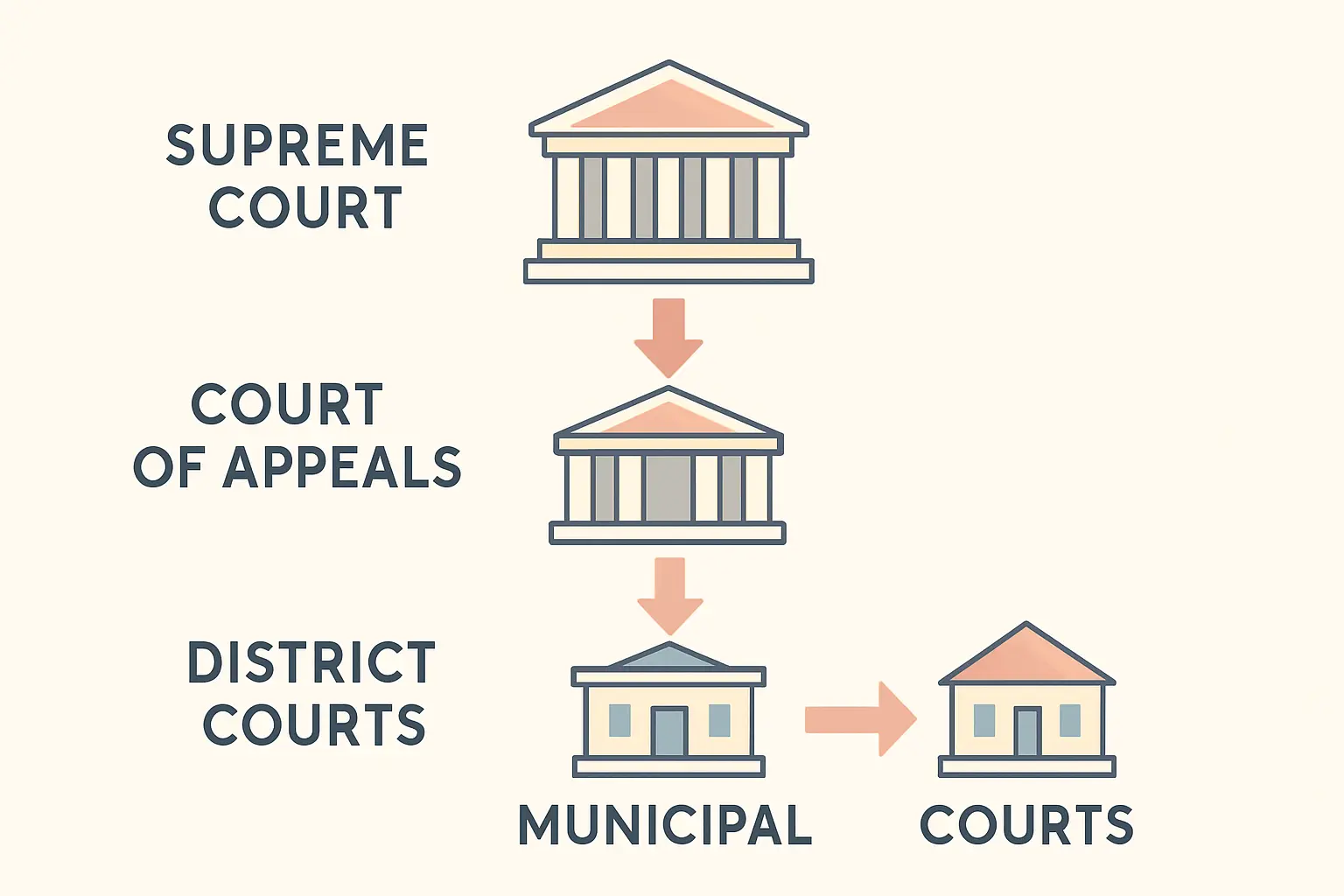
Precedent operates down a hierarchy. The Courts and Tribunals Judiciary sets out the structure for England and Wales in this order: the United Kingdom Supreme Court, then the Court of Appeal with its Civil Division and Criminal Division, then the High Court of England and Wales with its King’s Bench, Chancery and Family Divisions, and below those the Crown Court and the County Court.
A decision binds courts below it in that structure. Decisions from courts at the same level are generally persuasive rather than binding, and decisions from other jurisdictions are persuasive only.
What does it mean to distinguish a case?
Distinguishing is how a court avoids a precedent it would otherwise be bound by: it identifies a material factual or legal difference between the earlier case and the one before it, so the earlier ratio does not apply.
For dissertation writers this is where much of the interesting analysis lives. A line of cases distinguishing an authority on increasingly fine grounds is strong evidence that the underlying rule is under strain — which is a finding, not just a description.
What is the difference between overruling and reversing?
Overruling is when a higher court declares that a rule established in an earlier, different case is no longer good law. Reversing is when an appellate court changes the outcome of the very case before it on appeal. Students frequently use the words interchangeably; examiners notice.
What does “per incuriam” mean?
A decision reached per incuriam is one given without regard to a relevant statutory provision or binding authority that would have affected it. Such a decision may be treated as not binding. It is a narrow exception and should be invoked carefully rather than as a convenient way past inconvenient authority.
How do I know whether a case is still good law?
Check whether it has been overruled, departed from, or superseded by legislation before you build an argument on it. Senior courts have mechanisms for departing from their own earlier decisions, and a statute can displace a common law rule entirely, so age alone tells you nothing.
This is the single check most worth doing before a case enters your dissertation. An argument resting on an authority that no longer stands is not a weak argument; it is a wrong one.
How should I cite the case once I have found the ratio?
Use the neutral citation — the court-assigned reference that does not depend on any particular law report series — so your reader can locate the judgment regardless of which service they use. UK legal writing then formats that citation according to footnote-based OSCOLA; our OSCOLA referencing guide covers cases, statutes and legal sources.
You will also want a pinpoint reference to the paragraph you rely on, which matters more than usual here: a pinpoint to the paragraph containing the ratio is part of showing that you identified it correctly.
Where can I read full judgments for free?
The National Archives’ Find Case Law service provides free access to court judgments and tribunal decisions from England and Wales, plus UK-wide cases from the Supreme Court and Privy Council. You can search it by neutral citation as well as by party name or keyword. Our guide to primary legal sources for a law dissertation covers that service and the official statute book alongside it.
Can I rely on a case summary instead of the judgment?
Not for identifying the ratio. Summaries compress, and compression is exactly what destroys the distinction between essential reasoning and observation. Use summaries to decide whether a case is worth reading; use the judgment to say what it holds.
This applies with force to AI-generated summaries, which can present obiter as holding and, in documented cases, invent authorities outright. Our guide on using AI for a law dissertation sets out the boundary.
Does every case have a single clear ratio?
No. Some cases produce no majority reasoning, only a majority outcome; others are read differently by later courts than by their own authors. A dissertation that acknowledges a contested ratio and argues for one reading is doing better legal analysis than one that pretends the question is closed.
How does this fit into my dissertation’s method?
Identifying rationes is the core operation of doctrinal analysis, so your case selection criteria and analytical framework should reflect it. Our guides to choosing a legal research method and writing a doctrinal methodology section cover how to set that out.
Read the cases, then build the argument
Extracting rationes accurately is slow work, and it is the work that separates a strong doctrinal chapter from a summary of headnotes. Tesify helps you organise those readings into a structured argument and keep your citations consistent — 100% written by you.
Write your thesis with AI
Structure, draft, cite, and format your thesis faster with Tesify’s AI writing tools, automatic bibliography, and plagiarism checker. Free to start, no credit card required.






Leave a Reply