

How to Identify a Research Gap in a Clinical Psychology Thesis (2026)
Quick answer: A research gap in a clinical psychology thesis is a specific, evidenced absence in the literature — not a topic you find interesting, but a documented place where the evidence base is thin, contradictory, untested in a population, or methodologically weak. You find it by systematically mapping what has already been studied, sorting the missing pieces into a gap type, and then writing a funnel-shaped gap statement that narrows from the broad problem to the exact question your thesis will answer.
This sits inside the wider process covered in how to write a psychology dissertation — this guide zooms in on just the gap-identification step. Committees reject more proposals over a vague or unevidenced “gap” than over almost anything else in the introduction chapter. “Not much research exists on X” is an assertion, not a gap — it becomes a gap only once you have actually searched and can say what kind of absence you found. This guide walks through a repeatable five-step process for identifying a research gap in clinical psychology specifically, then works through five illustrative examples across different sub-areas of the field, each one labelled by gap type so you can see the pattern and copy the structure into your own introduction.
Step 1: Separate “topic” from “gap”
A topic is a subject area — adolescent depression, exposure therapy, digital mental health. A gap is a specific, falsifiable claim about what is missing inside that topic. Before you search anything, force yourself to write one sentence in the form: “Despite [what we know], we do not know [the specific missing piece], for [the specific population or context].” If you cannot fill in all three brackets yet, you have a topic, not a gap, and steps 2–4 exist to get you there.
Step 2: Map the literature with a documented search strategy
Run a structured search in the databases clinical psychology committees expect to see cited: PsycINFO, PubMed/MEDLINE, and — for treatment-outcome questions — the Cochrane Library and PROSPERO for registered systematic reviews already underway. Use a PICO frame (Population, Intervention, Comparison, Outcome) to build your search string even for non-treatment questions; it forces you to be explicit about who, what, versus what, and measured how. Keep a simple search log: database, string, date run, number of hits, number retained after title/abstract screening. Committees increasingly ask to see this log in an appendix, and it is also what lets you defend, at your proposal meeting, that the gap is real rather than a failure to search properly. If you have not yet built the wider synthesis this search will feed into, work through how to do a literature review for your thesis first — the gap statement below only holds up once the surrounding review is solid.
Step 3: Sort what you find into a gap type
Evidence-synthesis methodologists (the approach is closest to the PICO-based gap framework used in AHRQ and Cochrane guidance for systematic reviewers) generally sort research gaps into a small number of recurring types. Adapted for a clinical psychology thesis, the most useful five are:
- Population gap — the intervention or model is tested, but not in your population (age group, comorbidity profile, cultural group, care setting).
- Methodological gap — the question has been studied, but only with designs that cannot answer it well (uncontrolled pre-post studies where an RCT is needed; self-report only where behavioural or physiological measures would strengthen the claim).
- Contradictory-findings gap — the existing studies disagree, and no moderator analysis or later trial has resolved why.
- Theoretical gap — a mechanism is assumed (e.g., a specific mediator of treatment response) but has not actually been tested directly.
- Emerging-context gap — a genuinely new delivery format, technology, or clinical presentation (telehealth delivery, a new diagnostic subtype, an app-based intervention) has outpaced the evidence base that would normally govern it.
Naming the type in your introduction — “this is a population gap: X has strong RCT support in adults but has not been tested in adolescents” — is precisely what turns a vague claim into a defensible one, because it tells the reader exactly what kind of study would close it. This typology is a field-agnostic complement to the broader PICO, SPIDER and FINER framework for identifying a research gap — that guide covers the general search-and-question logic; the five gap types above are how that logic plays out specifically in clinical psychology.

Step 4: Confirm the gap is still open right now
A gap you found in a 2019 review may already be closed. Before you commit, re-run your search restricted to the last 24 months and check PROSPERO for a registered systematic review already answering your question — if one exists and is close to completion, you either need a different angle or a very clear statement of how your study differs (different population, different outcome measure, different theoretical lens).
Step 5: Write the gap statement using the funnel structure
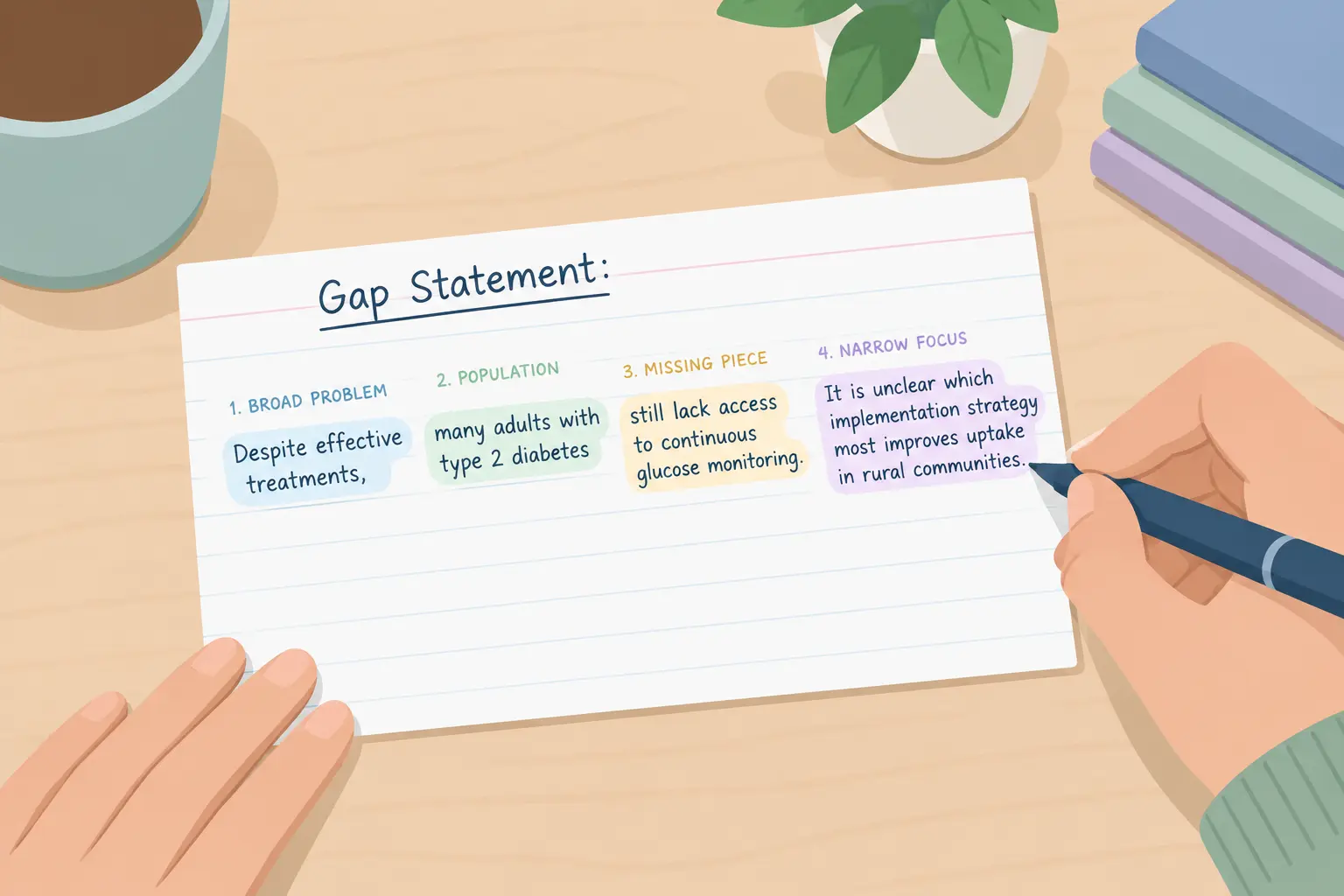
Move from broad to narrow in four sentences: (1) state the clinical problem and its scale, (2) summarise what the existing evidence establishes, (3) name the specific missing piece and its type, (4) state, in one sentence, what your study will do about it. Keep step 4 as a plain descriptive sentence here — the polished, evaluable research question and hypotheses belong in the next section of your proposal, not inside the gap statement itself; see the worked research questions, hypotheses and variables examples across six psychology sub-fields for how that translation is usually written up.
Five illustrative examples, by gap type
The examples below are illustrative composites built to show the pattern, not descriptions of any single real study. Use them as templates for phrasing, not as citable findings.
1. Population gap — adolescent treatment-resistant depression
Illustrative: Cognitive behavioural therapy (CBT) protocols for treatment-resistant depression have accumulated a reasonably strong adult evidence base, but adolescent-specific trials remain scarce, and the few that exist rarely report on comorbid presentations (depression with school refusal, or with non-suicidal self-injury). A thesis could state: “Despite established efficacy of CBT-based protocols for treatment-resistant depression in adults, controlled evidence in adolescents with co-occurring school refusal is limited — a population gap this study addresses by [design].”
2. Methodological gap — exposure therapy delivered via telehealth for OCD
Illustrative: Exposure and response prevention (ERP) for obsessive-compulsive disorder is well supported in-person, and pilot telehealth studies exist, but many rely on uncontrolled pre-post designs rather than randomised comparison against in-person delivery. The gap statement would name the missing design directly rather than the missing topic: “existing telehealth-ERP evidence is largely uncontrolled; a randomised, non-inferiority comparison against in-person ERP has not been reported for [specific OCD presentation].”
3. Contradictory-findings gap — transdiagnostic treatment for comorbid anxiety-depression in older adults
Illustrative: Some trials of transdiagnostic protocols in older adults show effects comparable to disorder-specific CBT; others show smaller effects, and no published moderator analysis has tested whether baseline cognitive functioning explains the discrepancy. Naming the disagreement, not just the topic, is what makes this a gap: “findings on transdiagnostic treatment effect size in older adults are inconsistent across three trials, and cognitive functioning as a moderator of this inconsistency has not been tested.”
4. Theoretical gap — the assumed mechanism behind digital phenotyping for relapse prediction in psychosis
Illustrative: Passive smartphone sensing (movement, sleep, communication patterns) is repeatedly proposed as an early-warning signal for psychotic relapse, and the correlational association is reasonably documented, but the assumed causal mechanism — that specific behavioural changes precede rather than follow symptom onset — is rarely tested with the lagged, within-person analysis that would actually establish sequence. The gap is theoretical, not just empirical.
5. Emerging-context gap — cultural adaptation of an evidence-based treatment for an underserved population
Illustrative: An evidence-based protocol developed and validated in one cultural context is often exported without a documented, systematic cultural adaptation process (language, explanatory models of illness, family involvement norms), leaving a gap between “this treatment works” and “this treatment works, adapted, for this specific underserved group.” Frameworks such as Bernal’s cultural adaptation model give you a structure to name exactly which adaptation domains remain untested. If you are choosing which measurement instrument to adapt or use in this kind of study, how to choose a validated psychology scale for your dissertation covers reliability, permissions and reporting in detail.
Common mistakes committees flag
- Stating the gap as “more research is needed” without naming the gap type — always name it.
- Basing the gap entirely on a narrative impression rather than a documented search (keep the search log).
- Confusing a personal interest with an evidenced absence — the gap must survive a stranger reading only your literature review, not your motivation section.
- Choosing a gap so narrow it has no clinical or theoretical significance, or so broad it cannot be answered by one thesis-scale study.
- Failing to re-check currency — citing a 2018 gap that a 2024 trial has since closed.
- Treating a single unreplicated study’s null result as proof of a contradictory-findings gap — check whether a second trial exists before claiming the field disagrees with itself.
One more distinction worth holding onto: a gap statement is not the same as a rationale. The rationale explains why the gap matters clinically or theoretically — cost to the health system, patient burden, a theory’s predictive failure — while the gap statement itself stays narrowly descriptive of what is missing in the evidence. Committees often ask for both in the same paragraph, but conflating them (arguing importance instead of demonstrating absence) is one of the most common ways an otherwise strong introduction chapter gets sent back for revision.
Where Tesify fits
Once you have run your own search and sorted your findings into a gap type, Tesify’s thesis workspace helps you turn that raw evidence map into a clean, funnel-structured gap statement and a first-draft research question — it will not run your literature search for you, and it should not invent citations, but it is genuinely useful for tightening the prose once your evidence base is real. Tesify Auto Bibliography can also keep the references from your search log formatted correctly in APA 7 as you go, which matters once your reference list runs past thirty sources.
Frequently asked questions
What is the difference between a research gap and a research problem?
The research problem is the broader issue your thesis addresses (e.g., relapse in early psychosis); the research gap is the specific missing evidence inside that problem that your study is positioned to close.
How many sources do I need before I can claim a gap exists?
There is no fixed number — what matters is that your search was systematic (documented database, string, and date) and current (re-run within the last few months of your proposal), not that you hit an arbitrary source count.
Can a research gap be purely methodological?
Yes. A topic can be well studied in terms of outcomes while still lacking studies that use the design needed to answer a causal or comparative question — that is a legitimate, and often easier to defend, gap type.
Is “no studies exist” ever a safe gap to claim?
Be careful with absolute claims. Committees will test them at your defence. It is safer, and usually more accurate, to state that evidence is “limited,” “inconsistent,” or “not yet extended to [population/context]” than to assert nothing exists at all.
Do I need to use a formal gap-typology framework?
You do not have to cite a named framework, but naming the type of gap (population, methodological, contradictory, theoretical, emerging-context) in plain language achieves the same clarity and is what committees are actually looking for.
How does a research gap turn into a hypothesis?
The gap statement identifies what is missing; the hypothesis is your falsifiable prediction about what you expect to find once you supply that missing piece. See the worked hypothesis examples linked below for how that translation works across several psychology sub-fields.
Should the gap statement appear before or after my theoretical framework?
Convention in most clinical psychology programmes places the gap statement at the end of the literature review, immediately before the research questions, with the theoretical framework introduced earlier to give the gap context.
Can my supervisor tell me what my gap is?
A supervisor can point you toward a promising area, but the specific, evidenced gap statement has to come from your own documented search — that ownership is part of what a thesis proposal is assessed on.
Write your thesis with AI
Structure, draft, cite, and format your thesis faster with Tesify’s AI writing tools, automatic bibliography, and plagiarism checker. Free to start, no credit card required.






Leave a Reply