
How to Write a Psychology Dissertation 2026: Structure, Ethics and Methods
For many psychology undergraduates and postgraduates, the dissertation is the most demanding piece of writing they will face — and the most consequential. Knowing how to write a psychology dissertation means more than arranging chapters in sequence; it requires a precisely framed research question, an empirical design matched to that question, ethics approval from your departmental committee or IRB, and a write-up that meets British Psychological Society (BPS) and APA 7th edition standards throughout. This guide covers every stage of that process, from choosing a topic to submitting a polished final draft.
Psychology dissertations differ meaningfully from those in humanities or even other social sciences. Participants are human beings whose wellbeing must be protected under the BPS Code of Human Research Ethics (April 2021) and the APA Ethics Code Standard 8. Methods range from double-blind experiments to phenomenological interviews. Results must be reported with effect sizes and confidence intervals, not just p-values. The scope of what counts as legitimate research is wide, but the standards for rigour are high and examiners check both.
This guide is written for students at UK, US, Australian, and international universities working on an undergraduate, master’s, or doctoral psychology dissertation in 2026. You will find concrete guidance on research design, ethics, chapter-by-chapter structure, APA statistical reporting, and the most common errors to avoid.
Choosing a Topic and Formulating Your Research Question
The single most consequential decision in any psychology dissertation is the research question. A poorly framed question makes every subsequent step harder: literature reviews sprawl, ethics applications become unwieldy, and results chapters lose focus. A well-framed question contains the population, the key variables, and the relationship you intend to examine.
Start with broad areas of genuine interest — clinical psychology, cognitive neuroscience, developmental, social, health, forensic, or occupational psychology — then narrow by applying three tests:
- Is it empirically testable? Can you collect data within your time and resource constraints? A dissertation measuring long-term neurological change is unlikely to be feasible in 12 weeks.
- Is there a gap in the literature? You do not need to overturn decades of research. Identify an unanswered question, an under-studied population, or a method that has not yet been applied to your topic.
- Can it pass an ethics committee? Topics involving deception, vulnerable participants, or clinical samples require additional safeguards and a longer approval timeline. Factor this into your planning from week one.
A workable quantitative research question for a 10,000-word undergraduate dissertation might be: “Does a brief mindfulness-based stress reduction intervention reduce self-reported anxiety in first-year university students compared to a waitlist control?” It names the intervention, the outcome measure, the population, and implies a comparison group. That level of specificity is the target.
For an exploratory qualitative study, the same area might become: “What factors do first-generation university students identify as contributing to academic burnout?” This opens the door to semi-structured interviews and thematic analysis rather than an experiment.
Avoid topics that depend on clinical access you are unlikely to obtain (e.g., inpatient samples) or tools that require paid licences your institution does not hold. A good supervisor conversation at this stage saves weeks later in the process.
Psychology Research Ethics 2026: BPS, APA and IRB
Ethics approval is not an administrative formality — it is the foundation of legitimate psychological research. In the UK, your university’s Research Ethics Committee (UREC, or a departmental equivalent) applies the principles of the BPS Code of Human Research Ethics (April 2021). In the US, research with human participants at institutions receiving federal funding must be reviewed by an Institutional Review Board (IRB), guided by the Belmont Report’s three core principles: respect for persons, beneficence, and justice.
The BPS Code identifies four central obligations for any researcher working with human participants:
| Principle | What it requires in your dissertation |
|---|---|
| Informed consent | Participants must receive a written information sheet and sign a consent form before any data collection begins. Consent must be freely given, specific to the study, and withdrawable at any time without penalty. |
| Confidentiality and anonymisation | Identifiable data must be stored separately from responses and kept in a password-protected location for the period specified by your institution — typically five years. Under UK GDPR, you must also provide a privacy notice. |
| Deception and debriefing | Deception is permissible only when it is necessary for scientific validity and the study could not otherwise be conducted. Participants must be fully debriefed immediately after their involvement ends and given the right to withdraw their data on learning the true purpose. |
| Right to withdraw | Participants may withdraw their data at any time up to the agreed withdrawal deadline you specify in the participant information sheet. This right must be stated clearly and exercised without consequence. |
APA Ethics Code Standard 8 mirrors these principles and adds guidance on the circumstances under which informed consent may be waived (only when permitted by institutional regulations or when participation poses no foreseeable risk or distress), the handling of animal subjects, and scholarly integrity in data reporting. If you fabricate, falsify, or selectively omit data, this is research misconduct regardless of dissertation level.
Practical timeline note: Ethics applications at many UK universities take four to eight weeks to process through committee. Submit your application before you have identified participants, and never collect a single response without written approval in hand. Delays here compress every downstream phase.
Research Design and Methods

Psychology has one of the widest methodological repertoires of any academic discipline. Your choice of method follows directly from your research question and your epistemological position — broadly, whether you assume psychological phenomena can be objectively measured (positivism, typically quantitative) or whether they are best understood through participants’ subjective accounts (interpretivism, typically qualitative). For a thorough treatment of this foundational decision, the guide to choosing between qualitative and quantitative research at Tesify covers the decision logic in detail.
Quantitative designs
- Between-subjects experiment: The gold standard for establishing causality. Participants are randomly assigned to conditions, and the researcher controls the independent variable. Run a power analysis in G*Power (free software) before recruitment to determine the sample size required to detect your expected effect with adequate power (typically .80 at α = .05). Under-powered studies — those unable to reliably detect a real effect — are one of the most common weaknesses examiners flag.
- Within-subjects (repeated measures) design: Each participant experiences all conditions, giving greater statistical power with a smaller sample. Order effects must be addressed through counterbalancing.
- Cross-sectional survey: Captures self-report data at a single point in time. Surveys are logistically feasible and can reach large samples, but they cannot establish causality. If you use rating scales, a well-constructed Likert scale questionnaire will improve internal reliability — pilot your instrument with 10–15 participants and calculate Cronbach’s alpha before full data collection.
- Longitudinal design: Measures the same participants at multiple time points. Powerful for tracking change, but attrition risk is high and the timeline must accommodate follow-up waves.
Qualitative designs
- Semi-structured interviews: Flexible and data-rich. A topic guide keeps conversations comparable while allowing you to probe unexpected themes. Aim for theoretical saturation — the point at which new data generates no new themes — rather than a fixed sample size. For most undergraduate dissertations, this falls between 8 and 20 participants.
- Reflexive thematic analysis (Braun and Clarke): The most widely used qualitative method in UK psychology dissertations. It is epistemologically flexible, applicable to many research questions, and produces themes grounded in the data rather than imposed by prior categories.
- Interpretative Phenomenological Analysis (IPA): Focused on the lived experience and meaning-making of a small, purposively selected group. Particularly suited to health, clinical, and counselling psychology topics. IPA samples are deliberately small — typically 4–8 participants — because depth is valued over breadth.
- Discourse analysis: Examines language and the construction of meaning in text or talk. Appropriate for social, critical, and political psychology topics where power, ideology, and rhetoric are central.
Mixed methods
Some dissertations combine a quantitative phase (for example, a validated screening questionnaire administered to a large sample) with a qualitative phase (semi-structured interviews with purposively selected respondents). This is a powerful design but demanding within a standard dissertation word limit. If you choose mixed methods, be explicit about the integration strategy (concurrent, sequential, or embedded) and which strand takes priority in answering your research question.
Structuring Your Psychology Dissertation Chapter by Chapter
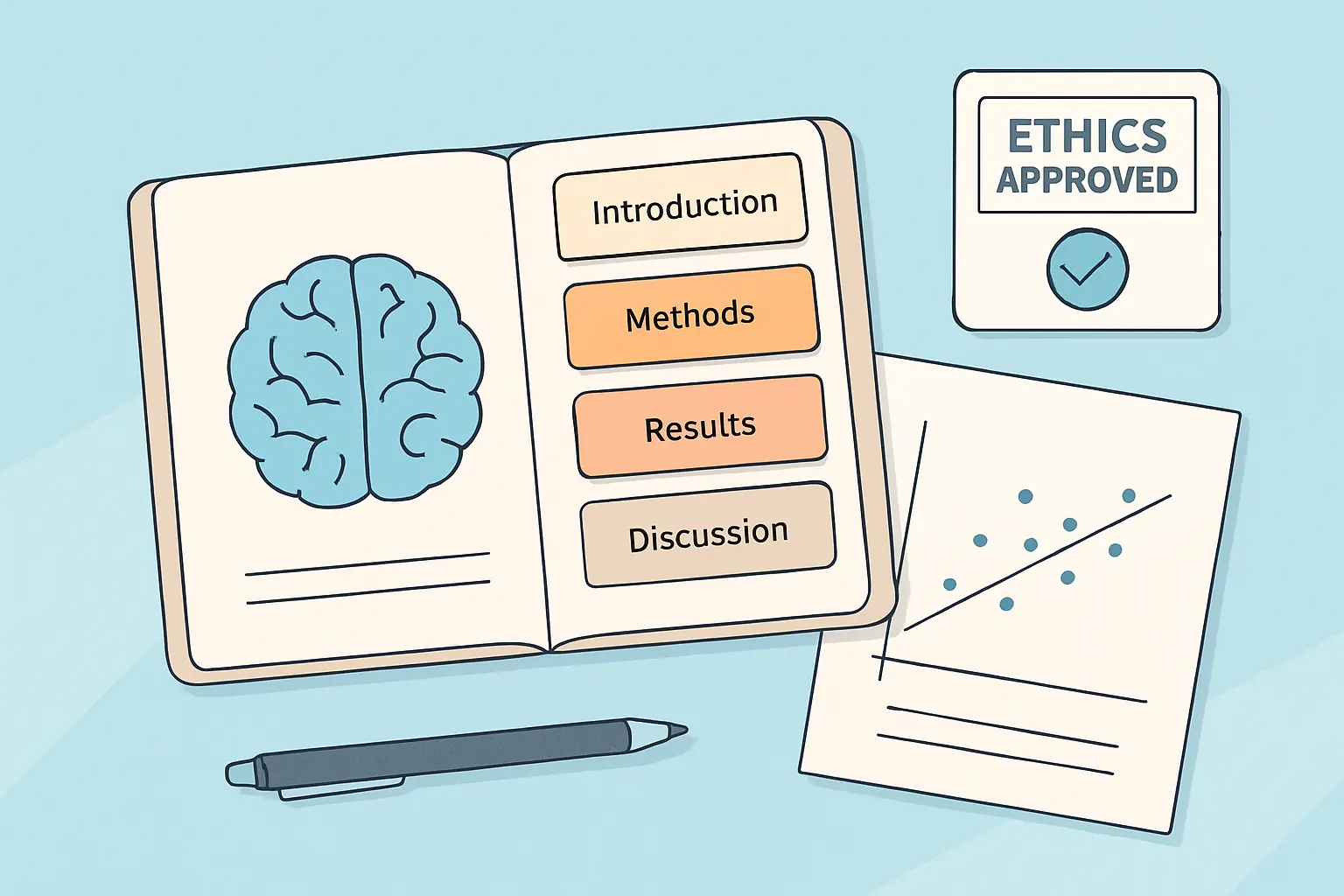
Most psychology dissertations follow the IMRaD convention — Introduction, Methodology, Results, and Discussion — with the Literature Review either embedded in an extended Introduction or presented as its own chapter. Here is what each section must accomplish and the most common structural errors to avoid.
Introduction
The introduction uses a funnel structure: broad context → specific literature gap → your research question and hypotheses (or research questions for qualitative work). It establishes why the topic matters, identifies what the existing literature has not yet answered, and ends with a clear statement of aims. Every empirical claim requires a citation. Typical length in a 10,000-word dissertation: 1,000–1,500 words.
Literature Review
The literature review’s purpose is critical synthesis, not description. Group studies by theoretical position or theme, identify contradictions between findings, evaluate methodological strengths and limitations, and build toward the gap your study addresses. Avoid writing a sequence of “Smith (2022) found that…” summaries that never connect to an argument. A well-executed literature review argues a position.
The theoretical or conceptual framework underpinning your review should be stated explicitly — whether that is an established theory (for example, the transactional model of stress and coping) or a conceptual map you derive from the literature. Understanding the difference between theoretical and conceptual frameworks will sharpen both your literature review and your methodology rationale.
Methodology Chapter
The methodology chapter must be replicable. A reader with equivalent training should be able to reproduce your study from your description alone. Include the following, in order:
- Research design and rationale — why this design fits your research question
- Participants — recruitment strategy, inclusion and exclusion criteria, final sample demographics
- Materials and measures — all questionnaires, stimuli, equipment, or software used, with validation evidence for any standardised measures
- Procedure — a step-by-step walkthrough from participant recruitment to debrief
- Ethics — committee name, approval reference, and key protections implemented
- Data analysis plan — the specific tests or analytic approach and the justification for choosing them
Results Chapter
The results chapter presents findings without interpretation. For quantitative studies, present descriptive statistics first (means, standard deviations, ranges), then inferential tests in APA 7 format. Tables and figures each require a number and a descriptive title; never present the same data in both a table and a figure. For qualitative studies, organise the chapter around themes, presenting each theme with direct participant quotes as evidence and using coded identifiers (e.g., P4, P7) to protect anonymity.
If your analysis involves regression modelling, the step-by-step guide to running multiple regression in SPSS and reporting it in APA covers assumption checking, output interpretation, and write-up format in full.
Discussion Chapter
The discussion interprets your results in the context of your literature review. Begin by stating whether each hypothesis was supported, then explain why the findings may have emerged, compare them with prior studies (supporting and contradicting), and acknowledge limitations — sampling, measurement, design constraints — with the implications each limitation has for confidence in your conclusions. End with theoretical and practical implications, and directions for future research. This is the chapter where your analytical voice is most apparent.
Conclusion
Whether stand-alone or the final section of your discussion, the conclusion should be concise (200–400 words), avoid introducing new material, and summarise the original contribution of your dissertation clearly. A good conclusion answers: what did you find, why does it matter, and what should happen next?
Abstract (Written Last)
Write the abstract after every other section is complete. It should be 150–250 words (confirm your department’s limit) and cover: background and rationale, research question or aim, method and participants, key findings, and principal implications. It is the most widely read section of your dissertation — often the only section read by those deciding whether to cite your work.
Reporting Statistics in APA 7 Format
APA 7th edition requires that every inferential test reports the test statistic, degrees of freedom, exact p-value (reported as p < .001 only when below that threshold), a measure of effect size, and 95% confidence intervals. Reporting only the p-value is non-compliant with APA 7 and will draw examiner comment.
Standard reporting formats by test type:
| Test | APA 7 format example | Effect size metric |
|---|---|---|
| Independent t-test | t(48) = 2.34, p = .023, d = 0.66, 95% CI [0.09, 1.23] | Cohen’s d |
| One-way ANOVA | F(2, 87) = 5.41, p = .006, η² = .11 | Eta-squared (η²) |
| Pearson correlation | r(98) = .43, p < .001 | r itself |
| Chi-square | χ²(1, N = 120) = 6.82, p = .009, φ = .24 | Phi (φ) or Cramér’s V |
Cohen’s conventional benchmarks for interpreting effect sizes are: for d, small = 0.20, medium = 0.50, large = 0.80; for η², small = .01, medium = .06, large = .14. Use these as a starting point, but interpret the practical significance of your effect in the context of your field — benchmarks vary across specialisms in psychology. A statistically significant result with a trivially small effect size is not a strong finding; a non-significant result in an adequately powered study that detects a precise near-zero effect is informative in its own right.
Common Pitfalls and How to Avoid Them
Psychology sits at the intersection of natural science, social science, and clinical practice, which means its dissertation conventions can differ markedly from adjacent disciplines. If you are working in a related health or social science field, the guides to writing a midwifery dissertation and writing a social work dissertation address participant ethics with vulnerable populations, practice-based research designs, and reflective methodologies that frequently appear at the boundaries of these fields.
Frequently Asked Questions
How long is a psychology dissertation?
Word count varies by level and institution. UK undergraduate psychology dissertations are typically 8,000–12,000 words. Master’s dissertations range from 15,000–25,000 words. PhD theses in psychology commonly run 70,000–100,000 words. Always check your department’s specific regulations — these are the binding limits, not guidelines.
Do I need ethics approval for a psychology dissertation?
Yes. Any research involving human participants — including online surveys, interviews, and observational studies — requires ethics review before data collection begins. In the UK this is your departmental or university Research Ethics Committee; in the US it is an Institutional Review Board (IRB). Only research using fully anonymised pre-existing public datasets may be exempt — confirm this with your supervisor before assuming it applies.
What referencing style do psychology dissertations use?
The vast majority of psychology dissertations use APA 7th edition. In the UK this is effectively universal across the discipline, consistent with BPS alignment to APA style. If your supervisor has not specified a different style, default to APA 7. Use a reference manager such as Zotero or Mendeley (both free) to handle formatting automatically.
Can I use qualitative methods for a psychology dissertation?
Yes. Qualitative methods are well-established in psychology, particularly in health, clinical, counselling, and critical psychology. Approaches such as reflexive thematic analysis, IPA, and grounded theory are routinely accepted and examined by UK and US institutions. The key is to articulate your epistemological position clearly and demonstrate methodological rigour through reflexivity, audit trails, and member-checking where appropriate.
How do I choose between an experiment and a survey for my psychology dissertation?
Use an experiment if your research question asks about causation — whether one variable directly causes changes in another. Use a survey if your question asks about associations, prevalence, or relationships between self-reported constructs. Experiments require random assignment and experimental control; surveys are more feasible when you need a large or geographically distributed sample. The research question should determine the method, not the other way around.
What is a good sample size for a psychology dissertation?
For quantitative studies, use G*Power to run an a priori power analysis: input your expected effect size, desired statistical power (typically .80), and alpha level (.05), and the software calculates the required N. For qualitative studies, sample size is determined by theoretical saturation rather than statistical power — typically 8–25 participants for most designs, though IPA studies work with as few as 4 to allow the depth the method demands.
Writing your psychology dissertation? Tesify helps you structure arguments, manage your reference list, and run an originality self-check — keeping your work authentically yours from first draft to final submission. Start free at Tesify →
Write your thesis with AI
Structure, draft, cite, and format your thesis faster with Tesify’s AI writing tools, automatic bibliography, and plagiarism checker. Free to start, no credit card required.






Leave a Reply