
Theoretical vs Conceptual Framework: How They Differ and How to Build Each (2026)
Few questions generate more confusion in graduate seminars than this one: what is the difference between a theoretical framework and a conceptual framework, and which does your dissertation actually need? Supervisors use the terms interchangeably. Examiners penalise candidates who conflate them. Methodology textbooks often define them in ways that make the distinction seem merely cosmetic. It is not. The theoretical vs conceptual framework distinction is substantive — it reflects fundamentally different relationships between the researcher and existing knowledge, between deductive and inductive logic, and between testing theory and building it. Getting this right is not a matter of academic formality; it directly shapes your research design, your data collection choices, and how your findings can legitimately be interpreted.
This guide draws on the foundational literature — Imenda (2014), Grant and Osanloo (2014), Ravitch and Riggan’s Reason and Rigor, and the USC and National University methodology guidance — to offer a precise, discipline-grounded account of both constructs. It provides step-by-step construction protocols for each, a comparative reference table, worked examples from psychology, education, management, and the health sciences, and clear guidance on where each framework sits within a thesis structure.
Precise Definitions: What Each Framework Actually Is
The Theoretical Framework
A theoretical framework is the adoption and application of an existing, formally articulated theory — or a constellation of related theories — to provide the explanatory backdrop for a research study. The theory has been published, debated, and accepted into the scholarly literature before the researcher selects it. It is not invented for the study; it is conscripted from the discipline’s intellectual heritage.
The USC Libraries’ research methodology guide defines a theoretical framework as “the structure that can hold or support a theory of a research study” and explains that it “introduces and describes the theory that explains why the research problem under study exists.” The key word is explains: the theoretical framework makes claims about causal or correlational mechanisms in the world, and the researcher’s study tests, extends, or refines those claims.
Well-known examples of theories that serve as theoretical frameworks include:
- Bandura’s Social Cognitive Theory — used in education, health behaviour, and organisational research
- Vygotsky’s Zone of Proximal Development — used in learning science and pedagogy
- Bourdieu’s Theory of Practice (habitus, field, capital) — used in sociology, education, and cultural studies
- Rogers’ Diffusion of Innovations — used in technology adoption, public health, and communication
- Expectancy Theory (Vroom) — used in organisational behaviour and management
- The Health Belief Model — used in public health and clinical research
Each of these theories offers a set of established constructs, defined relationships between those constructs, and a body of prior empirical work against which new findings can be compared. Selecting a theoretical framework commits the researcher to a particular explanatory logic.
The Conceptual Framework
A conceptual framework is a researcher-constructed map of the key concepts and the presumed or proposed relationships among them that are relevant to a specific research problem. Unlike a theoretical framework, it is not derived from a single established theory. Instead, it is assembled — often synthesised from multiple theoretical, empirical, and conceptual sources — to represent the researcher’s own understanding of what the study is investigating and how the variables or phenomena of interest connect.
Ravitch and Riggan, in their methodological text Reason and Rigor: How Conceptual Frameworks Guide Research, describe a conceptual framework as “the system of concepts, assumptions, expectations, beliefs, and theories that supports and informs your research.” This definition captures its composite, researcher-authored character: it is a system, not simply a borrowed lens.
Imenda (2014), writing in the Journal of Social Sciences, draws the distinction sharply: “a conceptual framework is derived from concepts that can explain the research problem meaningfully, through an inductive process whereby small individual concepts are joined together to portray a bigger map of possible relationships.” The inductive logic here is diagnostic — conceptual frameworks are constructed when no single theory adequately covers the terrain.
A conceptual framework is typically presented as either a visual diagram (boxes representing concepts linked by labelled arrows denoting relationships) or as a written narrative that identifies the independent, dependent, mediating, and moderating variables and articulates the researcher’s propositions about how they relate. In many cases, both forms are used together: the diagram as a visual abstract, the narrative as the analytical justification.
Key Differences: A Comparative Reference Table
| Dimension | Theoretical Framework | Conceptual Framework |
|---|---|---|
| Origin | Adopted from existing, formally published theory | Constructed by the researcher from multiple sources |
| Logical approach | Primarily deductive (theory → hypotheses → data) | Primarily inductive (data → concepts → propositions) |
| Research purpose | Testing, extending, or refining an existing theory | Exploring, explaining, or building new understanding |
| Typical methodology | Quantitative; experimental; survey-based | Qualitative; mixed methods; grounded theory |
| Source of constructs | Constructs defined within the chosen theory | Constructs drawn from literature, field, researcher judgement |
| Relationship to literature | Synthesises prior empirical tests of the theory | Synthesises concepts across multiple bodies of literature |
| Visual representation | Rarely diagrammed; usually textual narrative | Commonly presented as a diagram with labelled arrows |
| Field maturity | Best suited to established fields with developed theories | Suited to emerging fields or multi-disciplinary problems |
| Authorship | Attributed to the original theorist(s) | Attributed to the researcher of the current study |
| Can both appear in one study? | Yes — a theoretical framework provides the broad lens; a conceptual framework narrows it to the study’s specific variables and propositions | |
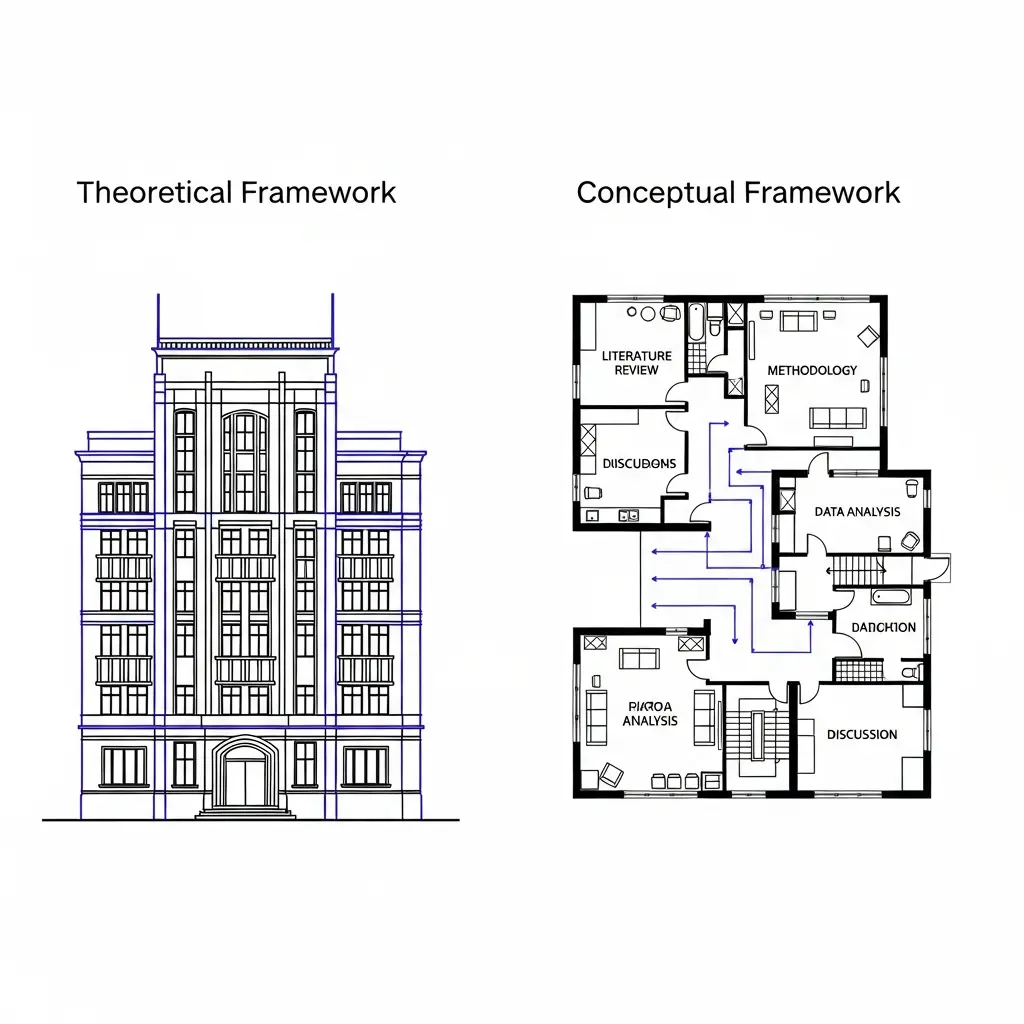
Grant and Osanloo (2014) offer an instructive analogy: the theoretical framework is like the elevation blueprint of a house — the overall structural logic — while the conceptual framework is like the floor plan, showing exactly how information flows through the specific rooms of the current investigation. Both are necessary for a complete architectural picture; they work at different levels of abstraction.
When to Use a Theoretical Framework vs a Conceptual Framework
Use a Theoretical Framework When
- Your research question is explicitly framed as a test of an existing theory’s predictions (e.g., “Does Self-Determination Theory account for exercise adherence among older adults in rural Australia?”)
- You are conducting deductive, hypothesis-driven research with operationalised variables derived from the theory’s constructs
- Your discipline has a well-developed body of formal theory (social psychology, behavioural economics, cognitive neuroscience)
- Your methodology is primarily quantitative — surveys, experiments, randomised controlled trials, longitudinal studies
- You intend to contribute to an ongoing empirical programme that tests, refines, or extends a named theory across new populations or contexts
Use a Conceptual Framework When
- No single published theory adequately addresses the full scope of your research problem
- You are conducting inductive, exploratory, or grounded research where you want meaning to emerge from the data, not be imposed by pre-existing theoretical categories
- Your study is inherently multi-disciplinary, drawing on insights from health science, policy, psychology, and sociology simultaneously
- You are working in an emerging or applied field (educational technology, digital health, sustainability management) where formal theory is still developing
- Your methodology is primarily qualitative — phenomenology, case study, ethnography, narrative inquiry
- You are undertaking practice-based research or professional doctoral work where the research problem is defined by practice contexts rather than theoretical gaps
When Both Are Appropriate
Many doctoral theses — particularly in education, health sciences, and social policy — include both. A common structure is to invoke an established theoretical framework (e.g., Bronfenbrenner’s Ecological Systems Theory) to explain the macro-level mechanisms at play, and then to construct a conceptual framework that specifies the particular variables, relationships, and contextual factors the study will empirically examine. The theoretical framework provides intellectual legitimacy and situates the study in the discipline’s conversation; the conceptual framework provides operational precision.
Relationship to Research Paradigm, Ontology, and Epistemology
Neither a theoretical nor a conceptual framework can be chosen in isolation from the researcher’s broader paradigmatic commitments. Research paradigms — the foundational worldview assumptions about the nature of reality (ontology) and the nature of knowledge (epistemology) — condition which frameworks are coherent choices. For a detailed treatment of paradigms, see our companion guide on research paradigms: positivism, constructivism, ontology, epistemology, and axiology.
In brief:
- A positivist or post-positivist paradigm aligns naturally with theoretical frameworks grounded in established theories; the researcher tests objective, law-like relationships.
- A constructivist or interpretivist paradigm aligns with conceptual frameworks that acknowledge knowledge as socially situated and constructed; the researcher builds understanding from participants’ meanings.
- A pragmatist paradigm — common in mixed-methods research — may invoke elements of both: a theoretical framework anchors the quantitative strand; a conceptual framework maps the qualitative strand’s exploratory variables.
- A critical paradigm (feminist, post-colonial, critical race theory) typically operates through theoretical frameworks derived from critical social theories, but may construct conceptual frameworks that identify the specific power relations and structural variables under investigation.
Misalignment — for example, adopting a positivist theoretical framework while using an interpretivist methodology — is one of the most common and serious errors examiners identify at viva stage. Your framework and your paradigm must be philosophically coherent.
How to Build a Theoretical Framework: Step-by-Step
Step 1: Identify the Core Phenomenon Your Research Seeks to Explain
Before selecting a theory, articulate what mechanism, relationship, or phenomenon you are trying to explain. Write a single sentence: “This study seeks to explain why/how/what [phenomenon] occurs in [context].” This sentence is the specification that your theoretical framework must address.
Step 2: Conduct a Systematic Review of Relevant Theories
Search discipline-appropriate databases — Google Scholar, JSTOR, Web of Science, PsycINFO — using the phenomenon plus “theory” or “theoretical framework” as search terms. A systematic literature review approach at this stage ensures you are not selecting a theory out of familiarity bias or ignoring competing frameworks.
Step 3: Evaluate Each Candidate Theory Against Four Criteria
- Explanatory scope: Does the theory’s constructs and propositions map onto your research phenomenon?
- Empirical support: Has the theory been tested across contexts similar to yours? What is the strength and consistency of the evidence base?
- Philosophical alignment: Is the theory’s underlying ontology and epistemology consistent with your research paradigm?
- Analytical utility: Can the theory’s constructs be meaningfully operationalised in your setting, with your population, using your methods? Understanding the types of validity your operationalisations must satisfy — including construct, internal, and external validity — is essential for evaluating whether a theory’s concepts can be translated into reliable measures.
Step 4: Select and Justify Your Theory (or Combination of Theories)
Some research problems are best served by a single theory; others require two or three complementary frameworks. If combining theories, explain how they relate — are they nested (one macro, one micro), sequential (one explains preconditions, one explains outcomes), or integrated (constructs from both appear in the same explanatory model)? Justify the combination explicitly; do not simply list multiple theories without articulating how they interact.
Step 5: Explicate the Theory’s Key Constructs Relative to Your Study
Not all constructs in a theory will be relevant to every study. Identify which constructs you are using, define them according to the original theorist’s definitions (not your own), and map them directly onto your research questions, variables, and hypotheses. This is the substance of the theoretical framework section in your thesis: the bridge between abstract theory and your specific inquiry.
Step 6: Derive Hypotheses or Research Questions from the Theory
A theoretical framework that does not generate testable predictions or focused research questions has not been properly applied. If you are working deductively, your hypotheses should follow logically from the theory’s propositions — they should be, in effect, formal applications of the theory to your specific context. If you are extending the theory to a new setting, articulate what the theory would predict and why that prediction warrants empirical examination.
Step 7: Write the Framework Section
Structure the written section as: (a) brief history and provenance of the theory; (b) core constructs and their definitions; (c) the theory’s main propositions and the empirical evidence supporting them; (d) critique and known limitations; (e) justification for selecting this theory for the present study; (f) explicit mapping of the theory’s constructs onto your research questions. Aim for precision over comprehensiveness — a deeply engaged treatment of one or two theories is stronger than a superficial survey of five.
How to Build a Conceptual Framework: Step-by-Step
Step 1: Articulate Your Research Problem in Variable or Concept Terms
Begin with the phenomenon you are studying and identify the core concepts involved. What are you trying to understand, explain, or illuminate? For applied research, this often begins with a real-world problem statement; for exploratory qualitative research, it begins with a phenomenon whose meaning is contested or poorly understood.
Step 2: Conduct an Integrative Literature Review
Unlike a systematic review, the literature review for a conceptual framework is integrative — it draws from multiple disciplines and bodies of knowledge simultaneously. You are looking for: (a) empirical findings about relationships between the concepts you have identified; (b) theoretical accounts that address aspects of your phenomenon even if none covers it completely; (c) conceptual definitions of your key variables that are well-supported and widely accepted. Document every key source, as your conceptual framework will need to be grounded and cited.
Step 3: Identify and Define Your Key Concepts or Variables
From the literature, extract the core concepts that appear repeatedly in relation to your phenomenon. Define each concept carefully, drawing on the best available definitions in the literature. For quantitative research, distinguish between independent variables (predictors), dependent variables (outcomes), mediating variables (mechanisms), and moderating variables (conditions that strengthen or weaken relationships). For qualitative research, identify the core phenomena, categories, or themes that will structure your inquiry.
Step 4: Propose the Relationships
This is the creative and analytical core of the conceptual framework. Based on the literature, what relationships do you propose exist between your concepts? In quantitative research, these propositions take the form of directional hypotheses: “Variable A is positively associated with Variable B, mediated by Variable C.” In qualitative research, they take the form of analytical sensitivities: “The experience of X is shaped by the interplay of Y and Z, as understood by participants in their specific context.”
The relationships you propose should be evidence-grounded — each arrow in your diagram or each proposition in your narrative should cite at least one supporting empirical or theoretical source. A conceptual framework is not speculative art; it is a argued, cited intellectual structure.
Step 5: Construct the Visual Diagram
The standard visual representation uses boxes (or ovals) for each concept and directional arrows for proposed relationships. Label each arrow with the nature of the relationship (positive effect, negative effect, moderates, mediates). Keep the diagram readable — a good conceptual framework diagram contains between four and eight concepts. A diagram with fifteen variables and thirty arrows has not clarified your study; it has documented your confusion.
Step 6: Write the Narrative Justification
The diagram is a summary; the narrative is the argument. For each concept in your framework, write a paragraph that (a) defines it, (b) justifies its inclusion by citing empirical evidence, and (c) explains its proposed relationship to the other concepts in the framework. The narrative should make a logically coherent case that the relationships you are proposing are theoretically plausible and empirically warranted, even as the study will provide new evidence about them.
Step 7: Revisit After Pilot Data or Early Analysis
Conceptual frameworks are not fixed at the proposal stage in qualitative or mixed-methods research. Ravitch and Riggan describe the conceptual framework as a “living document” that evolves as new data and insights emerge. In qualitative dissertations, it is legitimate — indeed, expected — to revise the framework in the findings or discussion chapter to reflect what the inquiry actually revealed. Make this iteration explicit; describe how and why the framework changed.
Worked Examples Across Disciplines
Example 1: Psychology — Theoretical Framework
Study: Examining the relationship between self-efficacy and academic persistence among first-generation university students in the UK.
Framework: Bandura’s Social Cognitive Theory (1986, 1997) is selected as the theoretical framework. The theory’s construct of self-efficacy — defined as an individual’s belief in their capacity to execute the behaviours necessary to produce specific outcomes — provides the primary explanatory mechanism. The framework predicts that higher self-efficacy will be positively associated with goal-setting, effort expenditure, and resilience following setbacks (persistence). The study operationalises self-efficacy using the Academic Self-Efficacy Scale and tests the theory’s predictions in a longitudinal survey design across three UK universities.
Example 2: Education — Conceptual Framework
Study: Understanding how secondary school teachers in rural Australia integrate digital technologies into their pedagogical practice.
Framework: No single theory adequately addresses all relevant dimensions — the researcher draws on the TPACK model (Technological Pedagogical Content Knowledge), Lave and Wenger’s Communities of Practice, and Hargreaves’ professional culture literature to construct a conceptual framework. The framework proposes that technology integration is shaped by the interaction of three sets of variables: (a) individual teacher capacity (technological competence, pedagogical beliefs); (b) school-level culture (professional learning community norms, leadership support); and (c) structural affordances (device access, curriculum flexibility). The diagram shows bidirectional arrows between teacher capacity and school culture, with structural affordances as a moderating variable. The study uses semi-structured interviews and classroom observations in an interpretive case study design.
Example 3: Management — Both Frameworks
Study: Examining employee turnover intention among NHS nurses in England during organisational change.
Theoretical framework: The Job Demands-Resources (JD-R) model (Bakker and Demerouti, 2007) is selected as the theoretical framework, explaining how job demands (workload, emotional exhaustion) and job resources (supervisor support, autonomy) interact to predict burnout and disengagement, which in turn predict turnover intention.
Conceptual framework: The researcher constructs a supplementary conceptual framework that incorporates the specific contextual variables relevant to NHS change programmes — organisational uncertainty, perceived equity of change management, and professional identity threat — none of which are explicitly theorised within the JD-R model but which the literature suggests are consequential in healthcare settings. The conceptual framework thus extends the theoretical framework to the specific study context.
Example 4: Health Sciences — Conceptual Framework
Study: Exploring the lived experience of long COVID among working-age adults in Canada.
Framework: Given the novelty of the phenomenon and the interpretive methodology (phenomenology), no established theory is applied. The researcher constructs a conceptual framework drawing on the sociology of chronic illness (Bury, 1982; Williams, 1984), phenomenological accounts of fatigue and the body (Leder, 1990), and emerging empirical literature on post-viral conditions. The framework identifies three conceptual dimensions — biographical disruption, embodied experience, and social recognition — as the sensitising concepts that will guide the analysis without predetermining outcomes. The framework is presented in narrative form with a simple three-node diagram and is explicitly described as preliminary, subject to revision after thematic analysis is complete.
Where Each Framework Sits in a Thesis or Dissertation
The placement of frameworks within a thesis structure varies by discipline, institution, and degree level, but several conventions are widely observed.
Option 1: Standalone Chapter (Most Common in Social Sciences and Education)
A dedicated chapter — typically Chapter 2 or Chapter 3, between the literature review and the methodology — presents and justifies the framework in full. This placement signals that the framework is a substantive intellectual contribution rather than a background formality. At doctoral level in education, social work, and health policy, examiners often expect a standalone chapter of this type.
Option 2: Final Section of the Literature Review
The framework appears as the closing section of the literature review chapter, positioned as the culmination of the synthesis: “Having reviewed the relevant literature, the following framework is proposed to guide this inquiry.” This structure works well when the framework emerges organically from a thorough literature review, and is common in dissertations that do not draw on a single prominent theory.
Option 3: Section Within Chapter 1
Some institutions and supervisors prefer the framework introduced early — in the introductory chapter — to immediately contextualise the research problem. This is more common in professional doctorates and thesis-by-publication formats where the reader needs the analytical lens upfront. If the framework is complex, this placement risks overwhelming the introduction; a brief conceptual map in Chapter 1 followed by full elaboration in Chapter 2 can balance both needs.
Non-Negotiable Placement Rule
Wherever the framework appears, it must precede the methodology chapter. The research design, data collection strategy, and analytical approach should all be explicitly justified by reference to the framework. Examiners who reach the methodology chapter and cannot connect its design choices back to the framework will query the coherence of the whole thesis. The framework is not decorative; it is architecturally load-bearing.
For researchers conducting preregistered quantitative studies, the framework should appear in the preregistration document itself — before data collection — to demonstrate that theoretical commitments preceded analysis. See our detailed guide on how to preregister a study on OSF and AsPredicted for the relevant protocols.
Common Mistakes and How to Avoid Them
Mistake 1: Describing a Theory Rather Than Applying It
The most pervasive error in doctoral theses is writing several paragraphs summarising what Social Learning Theory says — its history, its proponents, its constructs — without ever connecting those constructs to the study’s variables, research questions, or hypotheses. A theoretical framework section that reads like an encyclopaedia entry has not applied the theory; it has merely acknowledged it. Every theoretical framework section should contain at least one explicit mapping statement of the form: “Construct X from this theory corresponds to the variable [Y] in this study, operationalised as [Z] in the instrument.”
Mistake 2: Using “Theoretical Framework” and “Conceptual Framework” as Synonyms
Many published articles and even some methodology textbooks use these terms interchangeably. This is particularly prevalent in nursing and applied health research. At doctoral level, the distinction matters. If your thesis framework is an assemblage of constructs from multiple sources that you have configured for your specific study, call it a conceptual framework and treat it accordingly — justify the inclusion of each component and the relationships you propose. If you are genuinely applying a single formal theory, call it a theoretical framework and engage with the theory’s empirical literature.
Mistake 3: Choosing a Theory for Prestige Rather Than Fit
Selecting Bourdieu’s Theory of Practice, Foucault’s genealogical method, or Habermas’s communicative action theory because they signal theoretical sophistication — rather than because they genuinely explain your phenomenon — produces the incoherence that examiners most reliably detect. The question is always: does this theory actually do explanatory work for this specific research problem? If you cannot articulate how the theory’s specific constructs apply to your data, it is the wrong theory regardless of its intellectual prestige.
Mistake 4: Treating the Conceptual Framework as Fixed
In qualitative research, treating the pre-study conceptual framework as an immutable template is a methodological error. Qualitative designs — phenomenology, grounded theory, case study, narrative inquiry — are premised on openness to emergent meaning. A conceptual framework that enters the field and exits unchanged is a sign that the analysis confirmed rather than explored. In your discussion chapter, explicitly address whether the framework was supported, refined, extended, or partially revised by your findings, and why.
Mistake 5: Neglecting the Link Between Framework and Methodology
Your framework determines what counts as data, how data should be collected, and how it should be analysed. A study grounded in grounded theory methodology should not then adopt a pre-set framework that determines analytical categories in advance — that is a direct methodological contradiction. See our guide on grounded theory methodology and coding steps for how emergent frameworks operate within that specific tradition. Likewise, qualitative researchers whose conceptual frameworks emphasise participant meaning should use methods — interviews, focus groups, ethnographic observation — that genuinely access participant meaning, not survey instruments that impose the researcher’s categories.
Mistake 6: Building a Conceptual Framework Without Citing Sources
Every concept and proposed relationship in a conceptual framework should be grounded in published evidence. A framework that simply represents the researcher’s intuitions, without citing the empirical and theoretical literature that supports each component, is not a scholarly framework — it is speculation. The standard is: if you cannot cite at least one published source that supports the inclusion of a concept or the direction of a proposed relationship, that component should either be removed or explicitly flagged as the novel contribution the study will test.
Building strong frameworks requires deep familiarity with the scholarly literature. The qualitative research methods guide and the systematic literature review guide on this site provide detailed protocols for the literature work that underpins sound framework construction.
Frequently Asked Questions
What is the main difference between a theoretical framework and a conceptual framework?
A theoretical framework is adopted from one or more existing, formally established theories in the scholarly literature — it applies a pre-existing explanatory structure to your research problem. A conceptual framework is researcher-constructed: you synthesise concepts, variables, and propositions drawn from multiple sources to map the specific relationships your study will investigate. The theoretical framework asks “what theory explains this?”; the conceptual framework asks “what relationships am I proposing?” As Imenda (2014) argues, the distinction is not merely semantic — it reflects whether the researcher is taking a deductive (theory-testing) or inductive (framework-building) approach to inquiry.
Can a dissertation have both a theoretical and a conceptual framework?
Yes, and in many advanced dissertations both are present. The theoretical framework provides the broad explanatory lens — for example, Social Cognitive Theory or Diffusion of Innovations — while the conceptual framework narrows the focus to the specific variables, relationships, and propositions the researcher will test or explore. Grant and Osanloo (2014) describe the two as analogous to the elevation blueprint and the floor plan of the same building: both are necessary for a complete architectural picture, operating at different levels of abstraction. They are complementary rather than mutually exclusive.
When should I use a conceptual framework instead of a theoretical framework?
Use a conceptual framework when: (1) no single established theory fully addresses your research problem; (2) you are conducting inductive or exploratory qualitative research where you want meaning to emerge from data rather than confirming theoretical predictions; (3) you are working in an emerging field where formal theory is underdeveloped; or (4) your study integrates multiple disciplinary perspectives that no single theory covers. Imenda (2014) notes that the inductive approach characteristically leads to conceptual framework development rather than the adoption of a pre-existing theoretical framework.
Where does the theoretical or conceptual framework go in a thesis?
The most common placements are: (1) as a dedicated chapter between the literature review and methodology (common in social sciences and education); (2) as the final section of the literature review chapter; or (3) integrated into Chapter 1 to contextualise the research problem. The framework must appear before the methodology chapter, because it justifies the design choices made there. Some institutions specify placement — always check your departmental guidelines and confirm your supervisor’s preference before drafting.
Does the choice of framework affect my research methodology?
Directly and substantially. A theoretical framework drawn from a positivist theory (e.g., Expectancy Theory) typically aligns with deductive, quantitative approaches — hypotheses are derived from the theory and tested with measurement instruments. A conceptual framework developed inductively aligns with qualitative or mixed-methods designs where the researcher is building, rather than testing, explanatory relationships. The framework is not cosmetic: it determines what counts as valid evidence in your study. Misalignment between framework and methodology is one of the most common serious errors identified at doctoral viva examinations.
Is a literature review the same as a theoretical framework?
No. A literature review surveys and synthesises what is known about a topic, identifies gaps, and situates your study within existing scholarship. A theoretical framework is the specific explanatory structure you select or build from that literature to guide your research. The literature review is the process; the theoretical or conceptual framework is the product — the lens you carry forward into your methodology and analysis. This distinction is sometimes obscured in dissertations where the framework emerges as the final section of the literature review chapter, but the two remain conceptually distinct even when structurally adjacent.
Further Reading and Cited Sources
- Grant, C., & Osanloo, A. (2014). Understanding, selecting, and integrating a theoretical framework in dissertation research: Creating the blueprint for your “house.” Administrative Issues Journal, 4(2), 12–26. Available via ERIC (EJ1058505).
- Imenda, S. (2014). Is there a conceptual difference between theoretical and conceptual frameworks? Journal of Social Sciences, 38(2), 185–195. Available via ResearchGate.
- Ravitch, S. M., & Riggan, J. M. (2016). Reason and rigor: How conceptual frameworks guide research (2nd ed.). SAGE Publications.
- USC Libraries. (2024). Theoretical framework — Organizing your social sciences research paper. libguides.usc.edu.
For related methodological guidance, see the companion article on construct, internal, and external validity.
Write your thesis with AI
Structure, draft, cite, and format your thesis faster with Tesify’s AI writing tools, automatic bibliography, and plagiarism checker. Free to start, no credit card required.






Leave a Reply