
An assessed business plan is not judged on whether the business would succeed. It is judged on evidential grounding and internal consistency — whether your claims are supported, whether your numbers follow from your assumptions, and whether you have been honest about what could go wrong.
That distinction changes everything about how you write it. A real investor plan is a persuasive document that suppresses doubt. An assessed plan that suppresses doubt fails.
What your marker is actually looking for

| What students optimise for | What is actually assessed |
|---|---|
| An exciting idea | Whether the opportunity is evidenced |
| Impressive revenue projections | Whether the projections follow from stated assumptions |
| Confidence | Whether risks are identified and addressed |
| Polished design | Whether the sections agree with each other |
| A big market | Whether you have defined a reachable segment |
The most common failure is a plan where every section is individually competent and the sections contradict one another — a marketing plan targeting one customer, financials priced for a different one, and an operations plan sized for a third. Markers find this quickly, because checking consistency is the easiest thing to do with a plan.
Step 1: Define a segment you can actually evidence
“The UK fitness market is worth billions” is not a market analysis. It is a context sentence, and on its own it tells your marker nothing about whether you understand the opportunity.
Work downward instead: the total market, then the segment you are addressing, then the portion you could realistically reach in year one given your channel and budget. That last number is the one your revenue projection has to be built on, and it should be uncomfortable — plans that project reaching 2% of a national market in year one are the standard tell that no one thought about acquisition.
Evidence each step. Industry reports, official statistics and trade bodies are all citable; competitor websites are evidence of positioning and pricing. Where you cannot find data, say so and explain what you did instead — a stated evidence gap is treated far better than an unsourced number.
Step 2: Do primary research, however small
Even a modest primary component lifts these projects substantially, because it is the only part of the plan that is genuinely yours. Ten structured customer interviews will tell you more about willingness to pay than any secondary source, and it demonstrates method.
Report it honestly, including sample size and its limitations. Ten interviews is not representative and you should say so; what it can support is an insight about the problem, not a market share estimate. If you are designing a survey or an interview schedule, our guide to writing a research methodology chapter covers instrument design and how to justify your sampling — and the same rules about ethics and consent apply here as in any other project.
Step 3: Make the assumptions visible
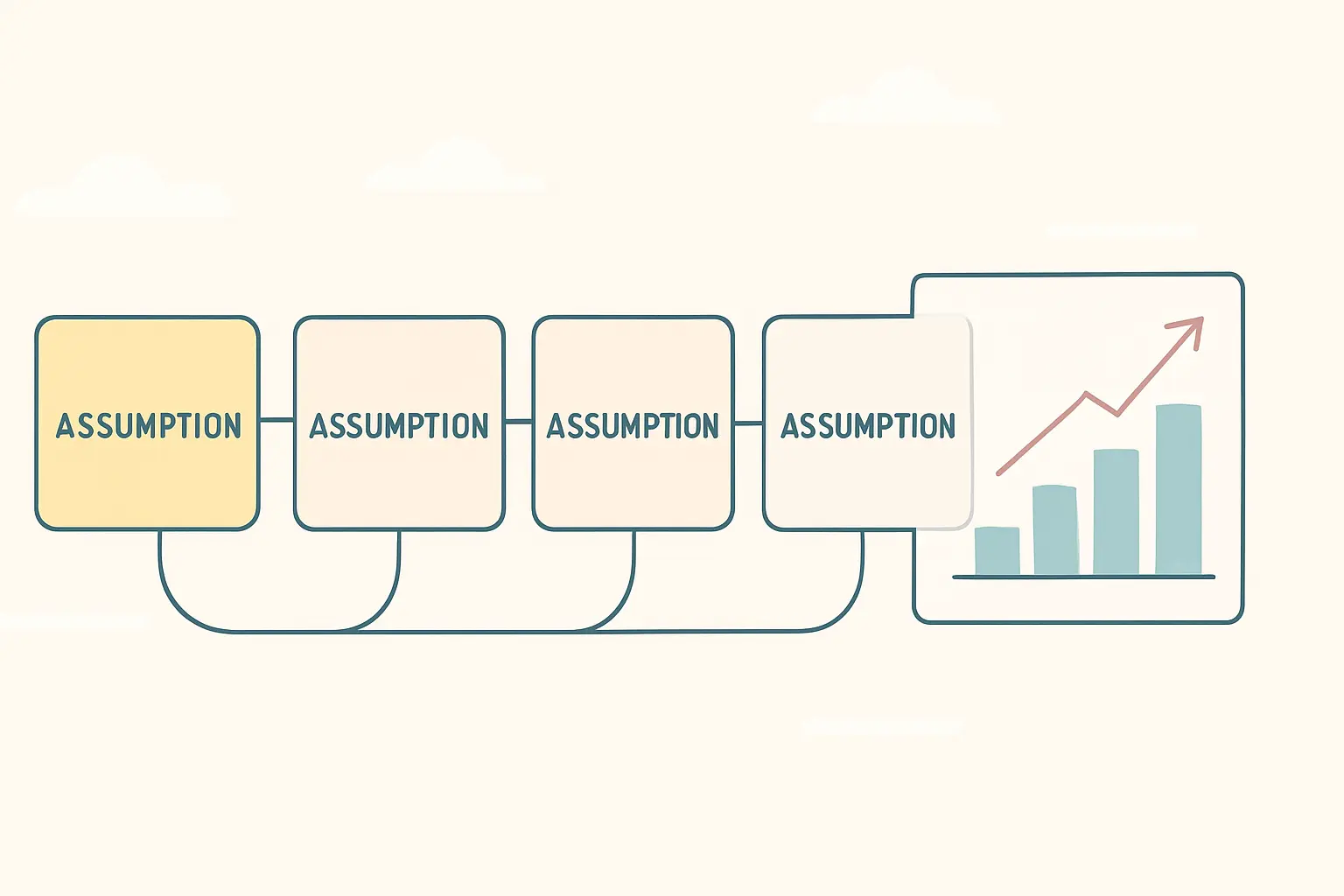
This is the single highest-value thing you can do, and most students skip it.
Put an assumptions table in the plan: conversion rate, average order value, unit cost, customer acquisition cost, churn, payment terms, staffing. Give each one a source or a stated basis. Then every figure in your financials is traceable, and your marker can follow the reasoning instead of guessing at it.
It also protects you. A marker who disagrees with a 3% conversion assumption but can see it stated and sourced is disagreeing with one input. A marker who cannot find where your revenue came from concludes you invented it.
Step 4: Build financials that reconcile
You will normally need a sales forecast, a profit and loss projection, a cash flow forecast and a break-even analysis. The technical requirement is simply that they agree: revenue in the forecast must be the revenue in the profit and loss, and the cash flow has to reflect when money actually arrives rather than when it is invoiced.
Two things distinguish strong financial sections. The first is a sensitivity analysis — showing what happens if your central assumption is half as good as expected. The second is knowing the difference between profit and cash: most plans that fail in reality do so on cash flow while profitable on paper, and demonstrating you understand that is worth more than an optimistic bottom line.
Keep the detailed spreadsheets in appendices and put the summary tables in the body, referring to each appendix from the text.
Step 5: Treat risk as analysis, not as a formality
Risk sections are usually the weakest part of a student plan: a generic table listing “competition” and “economic downturn” with a mitigation of “monitor closely”.
A strong risk section names risks specific to this venture, assesses likelihood and impact, and states a mitigation that actually changes something — a different supplier arrangement, a staged launch, a pre-order to validate demand before committing capital. And it names the risk you cannot mitigate, because every venture has one and pretending otherwise reads as naivety rather than confidence.
The strongest move available here is to identify the assumption on which the whole venture depends, and say what you would do if it proved false.
Step 6: Keep the theory in
Because the output resembles a commercial document, students often drop the academic apparatus entirely. That is a mistake on an assessed plan: the frameworks you use to analyse the market and position the venture are part of what is being marked, and they need citing like anything else.
Use frameworks to generate insight rather than to fill space. A completed template that produces no conclusion evidences nothing; an analysis that identifies which competitive force actually constrains this venture, and what follows for pricing, is doing real work.
Referencing conventions apply in full — see our Harvard referencing guide for the style most business schools use, and expect the same academic integrity rules that apply to any other submission.
How this differs from a consulting project
Both are applied business deliverables and they are assessed differently. A consulting project analyses an existing organisation’s defined problem and recommends action; a venture project designs something that does not yet exist and has to establish that it should. If you are doing the former, our guide to writing a consulting or in-company project covers the client-facing version, including the dual-audience problem that does not arise here — on a venture plan your only real reader is your marker.
Common mistakes
| Mistake | Why it costs marks |
|---|---|
| Hockey-stick growth with no acquisition plan | Revenue with no mechanism behind it |
| “We have no competitors” | Reads as no research; there is always a substitute |
| Sections that contradict each other | The easiest defect for a marker to find |
| Generic risk table | Demonstrates no venture-specific thinking |
| Financials with no stated assumptions | Untraceable numbers read as invented |
| No mention of what would falsify the idea | Confidence without critical distance |
Frequently asked questions
Am I marked on whether the business would actually work?
No. Assessment focuses on evidential grounding and internal consistency — whether your claims are supported and your numbers follow from your assumptions. A well-evidenced plan for a modest venture outscores an exciting one built on assertion.
Does my business idea need to be original?
Rarely. Originality is not usually a criterion, and an unoriginal idea analysed rigorously is easier to evidence because comparable data exists. Check your brief, since some entrepreneurship modules do reward novelty explicitly.
How detailed do the financials need to be?
Detailed enough to be traceable. A sales forecast, profit and loss, cash flow and break-even analysis that reconcile with each other and with a stated assumptions table, with the workings in appendices.
Do I need primary research?
Check the brief, but even a small primary component strengthens the plan considerably because it is the only genuinely original evidence in it. Report the sample size and limitations honestly.
Should I include a risk section even if I think the risks are low?
Yes, and thinking the risks are low is itself a warning sign. Name risks specific to this venture, assess likelihood and impact, and state mitigations that change something concrete.
Can I use business frameworks from my modules?
Yes, and you generally should, with citations. Use them to reach a conclusion rather than to fill a section — a completed template with no insight drawn from it evidences nothing.
How is this different from a consulting project?
A consulting project solves a defined problem for an existing organisation and is written partly for that client. A venture project designs something new and is written only for your marker, so it can be fully academic in register.
The assumptions table, the reconciled financials and the citations are where marks are won and lost, and they are all mechanical work. Tesify maps an outline to your module’s assessment criteria and keeps references consistent — a starting draft to rewrite in your own words, because the judgement about whether this venture stands up has to be yours.
Write your thesis with AI
Structure, draft, cite, and format your thesis faster with Tesify’s AI writing tools, automatic bibliography, and plagiarism checker. Free to start, no credit card required.






Leave a Reply