
Quick answer: Yes, with limits. AI can help you brainstorm, outline, summarize literature and tighten prose, but it cannot generate your clinical data, invent citations, or write sections that report your own patient outcomes or PICOT findings. Every program requires disclosure, and PHI can never touch a public AI tool.
What do nursing organizations actually say about AI?
Nursing has moved faster than most disciplines to put a position in writing. The American Nurses Association’s position statement on the ethical use of artificial intelligence in nursing practice, revised in 2022, states plainly that “systems and technologies that assist in clinical practice are adjunct to, not replacements for, the nurse’s knowledge and skill.” The nurse — not the tool — remains accountable, even when a system fails.
The ANA statement organizes its guidance around four considerations: the methodological soundness of the system itself, justice and equity in how it was trained, protection of data and informatics, and regulatory accountability. On equity specifically, the statement warns that “population- and system-level data mined from domains with significant systemic racism and bias will likely carry this same bias” — a line worth quoting directly if your project touches health disparities. The American Academy of Nursing has published a companion position statement framing AI as a tool meant to “support, rather than supplant, human wisdom and nursing clinical judgment,” and AACN’s 2025 guidance for nursing education focuses on curriculum redesign and faculty readiness rather than a single blanket rule for students.
None of these statements is a program-level academic integrity policy — they describe AI in clinical and educational practice broadly. Your own DNP handbook or graduate catalog is still the document that governs what you may submit, and it is the one your project team will actually enforce.
Is a DNP project different from a PhD dissertation or a BSN/MSN thesis?
Yes, and the difference changes where AI is actually useful. A DNP project is a practice-focused, applied deliverable — usually a quality improvement initiative or an evidence-based practice change — built on data from a real clinical site, often under an IRB determination of “not human subjects research” rather than a full protocol. A PhD dissertation or an MSN research thesis is closer to conventional empirical work, with its own data collection, analysis and contribution to generalizable knowledge.
That distinction matters for AI. A DNP project team wants to see your own unit’s pre- and post-implementation metrics, your own stakeholder interviews, your own PICOT-driven intervention — none of which an AI tool can supply, because none of it exists until you collect it. A PhD or MSN thesis carries the same restriction on your original data and analysis, but has more room for AI to help synthesize a literature base that already exists in the public record.
The practical effect is that AI use in a DNP project clusters almost entirely in the front and back ends of the process — refining the problem statement, organizing the literature that justifies the practice change, and polishing the write-up — while the middle, the implementation and measurement, has to stay entirely yours because it describes something that happened in a real clinical setting on a real date with real staff and patients involved.
What can AI legitimately help with?
Four uses show up across nearly every graduate nursing program’s guidance, whether or not the program has written an AI-specific policy yet:
- Brainstorming and outlining. Turning a PICOT question into a chapter outline, or a rough project idea into a structured aim, objectives and outcome-measure list.
- Literature triage. Summarizing an abstract you have already read to decide whether the full text is worth pulling — never generating a summary of a source you have not opened yourself.
- Sentence-level editing. Improving clarity, fixing grammar, tightening passive voice — the same job a writing center tutor does.
- Formatting mechanics. Building an APA 7 reference list from sources you have already verified, or checking a table against APA table formatting rules.
Tesify’s own workflow is built around this boundary: it drafts structure and prose around the sources and data you provide, and it will not invent a citation, a statistic or a quote — every reference has to trace back to something you uploaded or verified yourself.
What crosses the line into an academic integrity violation?
Three uses are treated as misconduct at essentially every school of nursing, AI-specific policy or not, because they violate rules that predate AI entirely:
- Fabricated data or findings. Asking a tool to “generate realistic results” for a QI initiative you have not run yet, or to invent survey responses. This is research fraud, not a shortcut.
- Fabricated citations. Large language models routinely produce plausible-looking references to articles that do not exist. Every citation in your reference list must be one you opened and read.
- Submitting AI prose as your own without disclosure. Even where AI-assisted editing is permitted, passing an undisclosed AI draft off as entirely your own writing violates the same authorship rule that governs a ghostwritten paper.
What about patient data and PHI?
This is the rule with zero exceptions in nursing, and it is federal law, not a style preference. Protected health information under HIPAA’s Privacy Rule (45 CFR Parts 160 and 164) cannot be pasted into a public AI chatbot, even de-identified snippets, unless your institution has a signed business associate agreement covering that specific tool — something almost no consumer AI product offers a student. If your DNP project or thesis touches real patient records, chart data, or clinical narratives, that material stays inside your institution’s secured systems and out of any AI conversation, full stop. Aggregate, de-identified summary statistics you have already calculated yourself (not raw records) are the only patient-adjacent material that is ever safe to discuss with an AI tool, and even then only after you have confirmed your institution’s data-use agreement allows it.
How do you disclose AI use in APA 7?
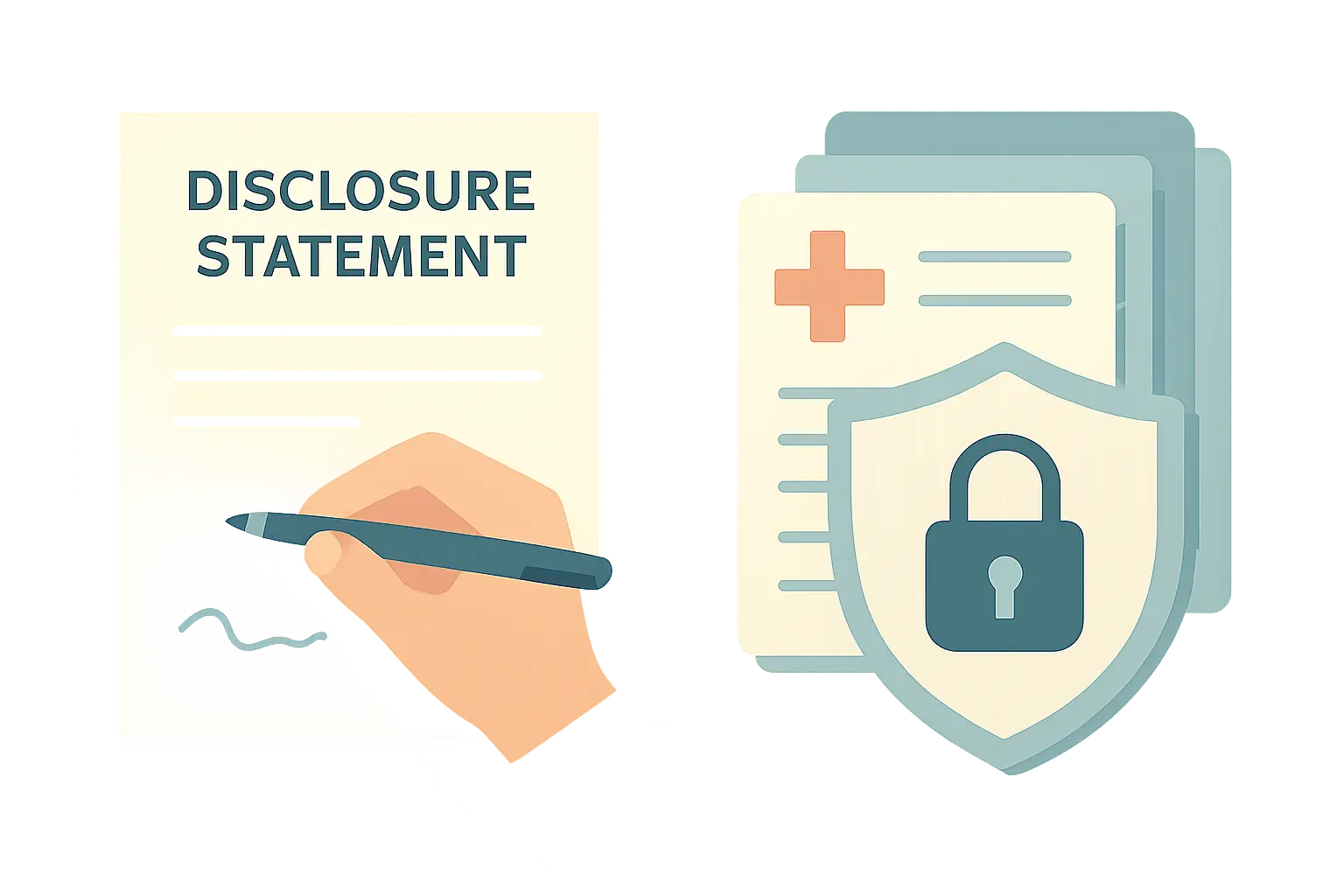
APA treats generative AI output as non-retrievable “personal communication” for citation purposes and, since the 2023 style-team guidance most nursing programs now follow, as a work needing both an in-text citation and a reference-list entry naming the tool, developer and version, plus a description of how it was used. Our guide to writing an AI use declaration covers the exact template — a short statement, usually placed after the acknowledgments or in a methods footnote, naming the tool, the task (editing, brainstorming, formatting) and confirming that all data, analysis and conclusions are the student’s own. Attach it even when your program has no explicit AI policy yet; a disclosed, limited use is defensible in a way an undisclosed one never is.
A minimal disclosure statement for a DNP project might read: “Generative AI (ChatGPT, OpenAI, GPT-4o, accessed March 2026) was used to check grammar and suggest section headings during drafting. All clinical data, analysis, interpretation and conclusions are the author’s own.” That single paragraph, placed where your program’s style guide expects an acknowledgment, is usually enough — the specificity is what makes it credible, not the length.
What does the DNP Project Team or thesis committee expect to see?
Committees are not trying to catch you — they are trying to confirm the project is yours. In practice, that means three things at your proposal meeting and again at your final defense: you can explain your own PICOT question and design choices without notes, you can walk through your data collection and analysis methods step by step, and your AI use declaration (if any) matches what the committee sees in your drafts. A project team that finds an undisclosed AI-written results section will treat it the same way it treats a plagiarized one — because from an authorship standpoint, it is the same problem.
Frequently asked questions
Will my nursing program have an AI policy by the time I submit?
Increasingly, yes — AACN’s 2025 guidance is pushing schools toward written policies, but many programs are still operating on general academic-integrity language written before generative AI existed. When in doubt, ask your program director directly and get the answer in writing before you use any AI tool on your project.
Can I use AI to write my literature review?
You can use it to organize and summarize sources you have already read in full, and to help you see thematic patterns across a stack of abstracts. You cannot let it write the synthesis paragraphs from scratch or generate citations for articles you have not opened.
Does using an AI grammar checker like Grammarly count as “using AI”?
Most programs treat basic grammar and spell-check tools as they always have — as editing aids that do not require disclosure. Generative rewriting, paraphrasing or drafting tools are the category that needs a declaration. If you are unsure which category a tool falls into, disclose it anyway.
What happens if I use AI for something my program hasn’t addressed yet?
Default to the most conservative reading of your institution’s existing academic integrity policy, disclose the use in writing, and confirm with your chair before you rely on it for anything that affects your results or conclusions. A conversation now is far cheaper than a misconduct hearing after your defense.
Can my DNP Project Team require me to run my draft through an AI detector?
Some programs do, though AI detectors are known to produce false positives, especially on writing by multilingual students. If your program uses one, keep your drafting history (outlines, notes, earlier versions) so you can demonstrate your own authorship if a detector flags your work incorrectly.
Is it safe to use AI to help format my reference list?
Yes, for mechanics — indentation, alphabetization, italics — as long as you have already verified every source exists and you supply the reference details yourself. Never ask a tool to generate a reference list from a topic; ask it only to format a list you provide.
Do I need to disclose AI use for a grammar pass on a nearly-finished draft?
Check your program’s language first, since practice varies. When policies are silent, a short, honest disclosure costs you nothing and protects you if the question ever comes up at defense.
Can I use AI to help write my patient case narrative for a DNP project?
No. A case narrative describes a real patient encounter and must be written from your own clinical documentation and observation, never generated or substantially rewritten by an AI tool, and never with identifiable patient details entered into the tool in the first place.
Draft with your sources, never with fabricated ones
Tesify builds your nursing thesis or DNP project around the literature and data you provide — every citation traces back to a source you verified, and nothing is generated about patients or findings you haven’t collected. Auto Bibliography keeps every reference APA 7 clean as you go.
Start your DNP project or nursing thesis with Tesify, free to begin
Write your thesis with AI
Structure, draft, cite, and format your thesis faster with Tesify’s AI writing tools, automatic bibliography, and plagiarism checker. Free to start, no credit card required.






Leave a Reply