
DNP Final Project Defense (2026): What the Project Team Expects, and How It Differs From a PhD Viva
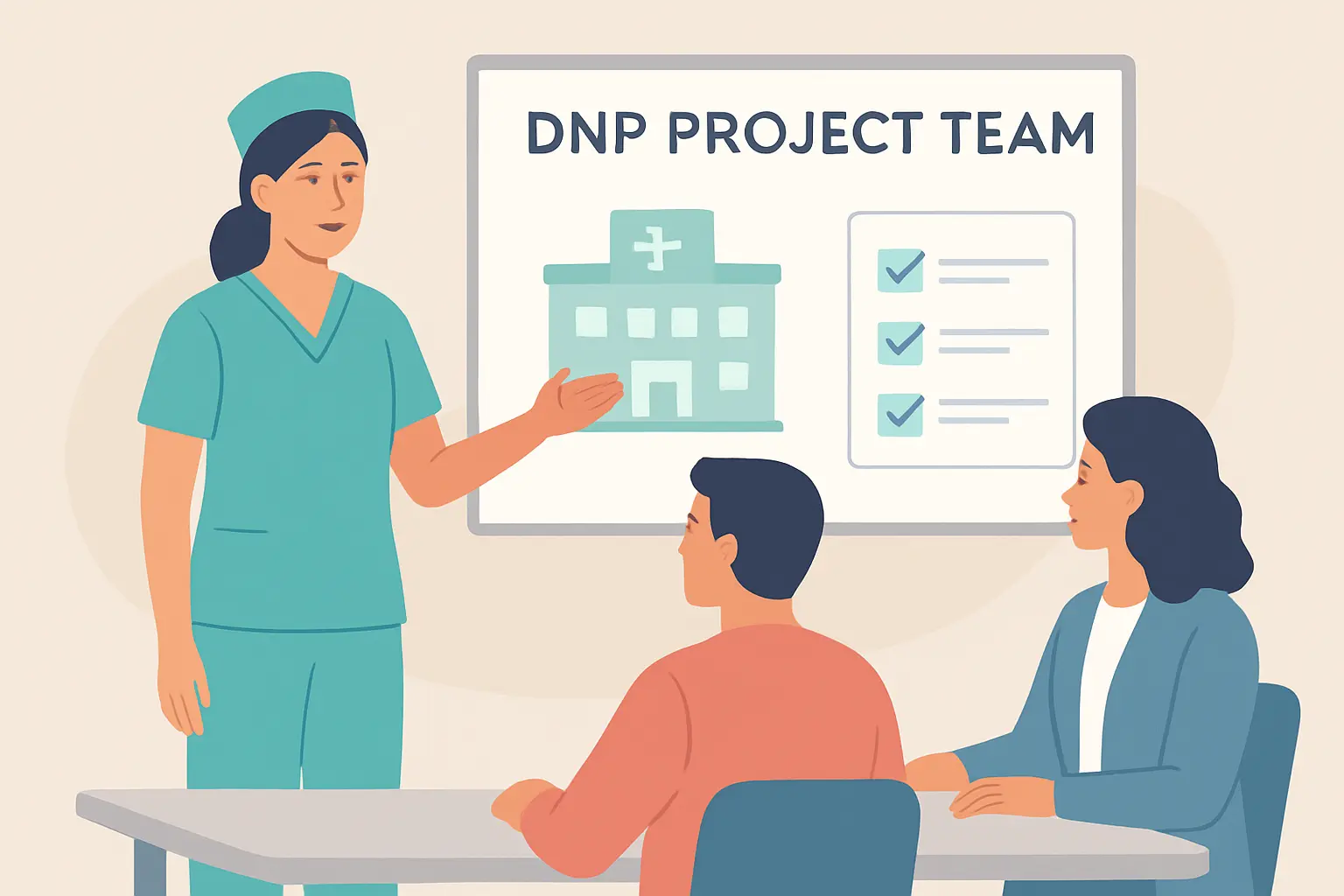
Search “DNP defense” and most of what comes back describes a PhD viva — two external examiners, a closed oral exam, minor or major corrections. That is not what a DNP student actually faces. The American Association of Colleges of Nursing (AACN) deliberately replaced the word “committee” with “DNP Project Team” in its Essentials guidance precisely to separate the DNP final presentation from the PhD dissertation defense, and the two events are evaluated on different grounds. This guide explains what the DNP Project Team actually is, what a strong final presentation includes, the dissemination formats AACN recognises, and the failure modes that most often cost students a clean pass.
1. The DNP Project Team, Not a Committee
AACN’s 2015 Essentials guidance is explicit about terminology: schools should “replace the term ‘committee’ with ‘DNP Project Team’ to minimize confusion between the PhD dissertation committee and the faculty and mentors who oversee the DNP final project.” The composition is deliberately practice-oriented rather than purely academic. At minimum, the team includes a doctoral-prepared faculty member and a practice mentor, who may come from outside the university entirely — a clinical director, a quality-improvement lead, or a health-system executive with a direct stake in the project’s outcome. Additional experts, partners or facilitators can join as intermittent collaborators through the project’s stages.
This composition changes what the final presentation is actually testing. A PhD committee is assessing whether you have produced original, generalisable knowledge. A DNP Project Team is assessing whether your practice-change project was rigorously planned, competently implemented, honestly evaluated, and disseminated in a way that could inform practice beyond your own site — a different, and in some ways more demanding, standard because it is judged partly by people who will actually use the result.
2. How This Differs From a PhD Viva

The contrast is worth stating plainly, because so much generic “thesis defense” advice online assumes the PhD model and will mislead a DNP student who applies it uncritically.
| Feature | PhD viva (UK model) | DNP final presentation |
|---|---|---|
| Evaluating body | Two examiners, one external, testing original contribution | DNP Project Team: doctoral faculty + practice mentor(s) |
| Standard applied | Original, generalisable contribution to knowledge | Rigor, applicability and impact of a practice-change project |
| Non-academic input | Not typically involved in outcome | Stakeholder review outside academia is expected |
| Required output | Bound thesis, examined orally | A disseminated product, not only an internal presentation |
The DNP itself sits alongside other practice-focused doctorates that make the same trade — depth of practice impact over generalisable theory. Our guide to what a professional doctorate is (DBA, EdD and DProf explained) covers how those parallel degrees structure their own final assessment, which is useful context if your programme borrows conventions from a business or education doctorate rather than a pure PhD model.
For comparison, see our guide on how the DNP Project differs from a PhD dissertation in nursing at the proposal stage — oversight, required elements and IRB route — since the differences documented there carry through directly to how each is defended at the end.
3. What the Final Presentation Must Cover

AACN’s guidance ties dissemination to a specific content requirement: the disseminated product should describe the purpose, planning, implementation and evaluation components of the project. A final presentation that skips straight to results without walking the Project Team through why the practice problem mattered, how the intervention was planned, and how implementation actually unfolded on the ground is missing exactly what evaluators are told to look for.
- Purpose — the practice problem, its scope at the site, and why it justified a doctoral-level intervention rather than a routine quality fix.
- Planning — the evidence base and framework behind the chosen intervention, and how feasibility, stakeholder buy-in and resourcing were assessed before implementation began.
- Implementation — what was actually done, on what timeline, with fidelity to the plan noted honestly where reality diverged from it.
- Evaluation — the outcome measures, the data collected, and an honest account of what changed and what did not.
Underneath all four sections sits a classification question the Project Team will expect you to answer without prompting: is this a quality-improvement initiative, an evidence-based-practice change, or a research study, and which IRB pathway follows from that determination? Our guide to the methodology chapter of a nursing dissertation or DNP project walks through exactly how that classification is made and reported — get it wrong in your written methodology and the same confusion will resurface as the first hard question in the room.
4. Dissemination Formats AACN Recognises
AACN’s Essentials appendix on dissemination lists a working set of formats programmes accept, and it is worth knowing the range before assuming only one form is legitimate:
- Publication in a peer-reviewed print or online journal
- Poster and podium presentations at a conference
- A written or verbal executive summary delivered to stakeholders or practice-site leadership
- A webinar presentation or video for a public platform
- Submission to a non-refereed lay publication
- An oral presentation to the public at large
- A digital poster, grand rounds presentation, or formal slide presentation
One point AACN states explicitly and that catches students out: a reflective portfolio documenting professional development is not considered a DNP Project or an acceptable form of dissemination on its own. At minimum, an executive summary or written report shared beyond the academic setting is expected.
5. Questions the Project Team Actually Asks
Because evaluation explicitly covers rigor, applicability and impact — and because stakeholder review from outside academia is part of the process — the questions a DNP Project Team raises tend to cluster around implementation reality and transferability rather than theoretical originality:
- “What would you change about the implementation if you started again tomorrow?” — probing honest reflection over defensive certainty.
- “How do you know the change you observed is attributable to your intervention rather than something else happening at the site during the same period?”
- “What happens to this practice change after you leave — who owns it, and is it funded to continue?”
- “Which of your outcome measures would a unit manager actually track next quarter, and which were mainly for the project itself?”
- “If another unit wanted to replicate this, what part of your plan would not transfer, and why?”
6. Common Failure Modes
Programmes that publish assessment guidance converge on a similar short list of what separates a struggling final presentation from a strong one:
- Portfolio mistaken for dissemination — presenting reflective journal material as if it satisfied the dissemination requirement, when AACN treats it as a separate developmental tool.
- No stakeholder voice — a presentation built entirely from the student’s own perspective, with no evidence the practice site’s leadership or staff were consulted on the evaluation.
- Outcome measures chosen too late — metrics bolted on after implementation rather than planned alongside it, leaving no credible before/after comparison.
- Confusing a QI project with a research study — over-claiming generalisability language (“this proves…”) appropriate to a PhD dissertation rather than a bounded, site-specific practice-change project.
- No sustainability plan — a project that visibly ends when the student graduates, with no named owner for the practice change afterward.
7. How to Prepare
Rehearse the presentation in front of at least one person who is not academic staff — ideally someone resembling your practice mentor’s role — since the Project Team model deliberately includes non-academic judgment. Walk through the purpose–planning–implementation–evaluation structure explicitly rather than assuming it will emerge naturally from your slides. Bring a one-page executive summary even if your primary dissemination format is a poster or podium talk; several accepted formats on AACN’s list are explicitly written outputs, and having one ready signals that dissemination, not just presentation, was part of your plan from the start. If your methodology chapter still needs the QI-versus-research classification spelled out clearly, our guide on writing a research methodology chapter for your thesis covers how to justify a design choice in exactly the terms a mixed academic–practice audience expects, and our guide on writing a research limitations section covers how to frame implementation shortfalls honestly rather than defensively.
8. A Worked Scenario (Illustrative)
To see how the purpose–planning–implementation–evaluation structure plays out, consider an illustrative DNP project on reducing catheter-associated urinary tract infections (CAUTIs) on a 30-bed medical-surgical unit.
- Purpose: The unit’s CAUTI rate had run above the hospital’s internal benchmark for three consecutive quarters, triggering the practice problem the student proposed to address rather than a generic “improve infection control” framing.
- Planning: The intervention bundled a nurse-driven catheter-removal protocol with a daily necessity checklist, built on existing CDC and evidence-based-practice guidance rather than an untested idea, with buy-in secured from the unit’s charge nurses and infection-prevention lead before rollout.
- Implementation: Rolled out over eight weeks with weekly audits; the student documented honestly that checklist compliance lagged in week one until a shift-huddle reminder was added, rather than presenting a smooth, frictionless timeline that did not happen.
- Evaluation: Catheter-days and CAUTI incidence were tracked against the three prior quarters as a comparison baseline, with the unit’s own surveillance data as the source — the same data the practice site would keep watching after the student graduated.
Notice what makes this defensible to a Project Team specifically: the outcome measure (CAUTI incidence per catheter-day) was already something the unit tracked, so continuation after graduation requires no new infrastructure, and the honest week-one compliance dip is exactly the kind of implementation reality reviewers say they want to see acknowledged rather than smoothed over.
Frequently Asked Questions
Is a DNP final presentation the same as a PhD viva?
No. A PhD viva is examined by two academic examiners testing an original contribution to knowledge. A DNP final presentation is evaluated by a “DNP Project Team” — AACN’s own term, replacing “committee” — consisting of at least one doctoral-prepared faculty member and a practice mentor, often from outside the university, judging rigor, applicability and impact of a practice-change project rather than theoretical originality.
Does a DNP project have to be published in a journal?
No. AACN recognises a range of dissemination formats beyond journal publication, including poster and podium presentations, an executive summary to stakeholders, a webinar or video, and an oral presentation to the public. Journal publication is one accepted option among several, not a universal requirement.
Can my reflective portfolio count as my DNP Project dissemination?
No. AACN states explicitly that a student’s portfolio is a tool for documenting professional development, not a DNP Project or a form of dissemination. At minimum, an executive summary or written report shared beyond the academic setting is expected in addition to any portfolio work.
Who is on a DNP Project Team?
At minimum, a doctoral-prepared faculty member and a practice mentor, who may be based outside the university — for example, a clinical director or quality-improvement lead at the project’s practice site. Additional experts, partners or facilitators can join as intermittent collaborators through the project’s stages.
What is the biggest reason a DNP final presentation gets sent back for revision?
Treating dissemination as an afterthought or as satisfied by portfolio material, and presenting outcome measures that were not planned alongside implementation — leaving no credible way to show the practice change caused the result observed. A visible sustainability plan naming who owns the change after graduation is the fix evaluators most often ask for when it is missing.
Prepare Your DNP Project Documentation With Confidence
Whether you are drafting the executive summary, structuring the methodology chapter, or writing up your evaluation results, Tesify’s AI-powered academic writing tool helps you produce clear, well-organised documentation for every stage of your DNP Project.
Write your thesis with AI
Structure, draft, cite, and format your thesis faster with Tesify’s AI writing tools, automatic bibliography, and plagiarism checker. Free to start, no credit card required.



Leave a Reply