

What Is a Professional Doctorate? DBA, EdD and DProf Explained (2026)
A professional doctorate is a Level 8 research degree, equal in academic standing to a PhD, designed for experienced practitioners who investigate a problem inside their own field of practice. It combines taught modules with a supervised thesis, and is usually studied part-time while working.
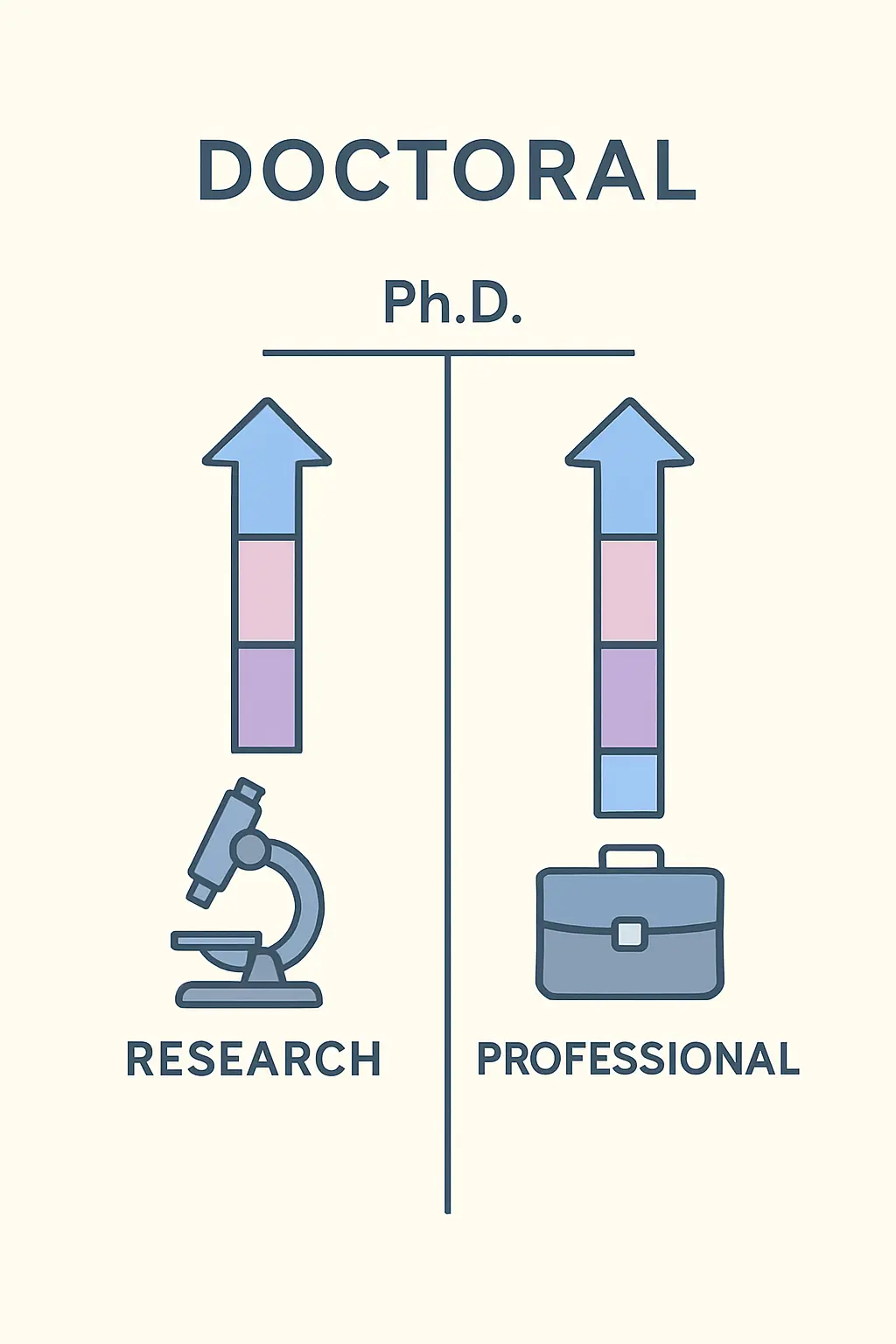
Is a professional doctorate the same level as a PhD?
Yes. Both sit at Level 8 of the Frameworks for Higher Education Qualifications maintained by the QAA — Level 12 on the Scottish Credit and Qualifications Framework. There is no junior tier of doctorate in the UK system.
This matters more than it sounds. Because the level is identical, a professional doctorate carries the title “Doctor”, meets the doctoral entry requirement for academic posts, and satisfies the same threshold descriptors for originality and independent research.
What differs is emphasis. The QAA’s characteristics statement for doctoral degrees describes professional doctorates as developing practice alongside knowledge — the research is expected to change something in the candidate’s professional world, not only to add to a literature.
What are the main types of professional doctorate?
The UK has a settled family of them, each tied to a profession. The naming convention is usually the letter D plus the field.
| Award | Field | Typical candidate |
|---|---|---|
| DBA | Business administration | Senior manager, consultant, founder |
| EdD | Education | Teacher, head, lecturer, policy lead |
| DProf | Cross-disciplinary professional practice | Practitioner whose field has no dedicated award |
| DClinPsy | Clinical psychology | Assistant psychologist entering the profession |
| DSW | Social work | Experienced practitioner or manager |
| EngD | Engineering | Engineer embedded with an industrial sponsor |
| DNurs / DHSci | Nursing and health sciences | Advanced practitioner, clinical lead |
Two of these behave differently from the rest. The DClinPsy is a route into a profession rather than a mid-career qualification — in England it is commissioned by NHS England, trainees are salaried, and applications run through a central clearing house. The EngD is closer to a PhD delivered in partnership with an industrial sponsor.
How is a professional doctorate structured?
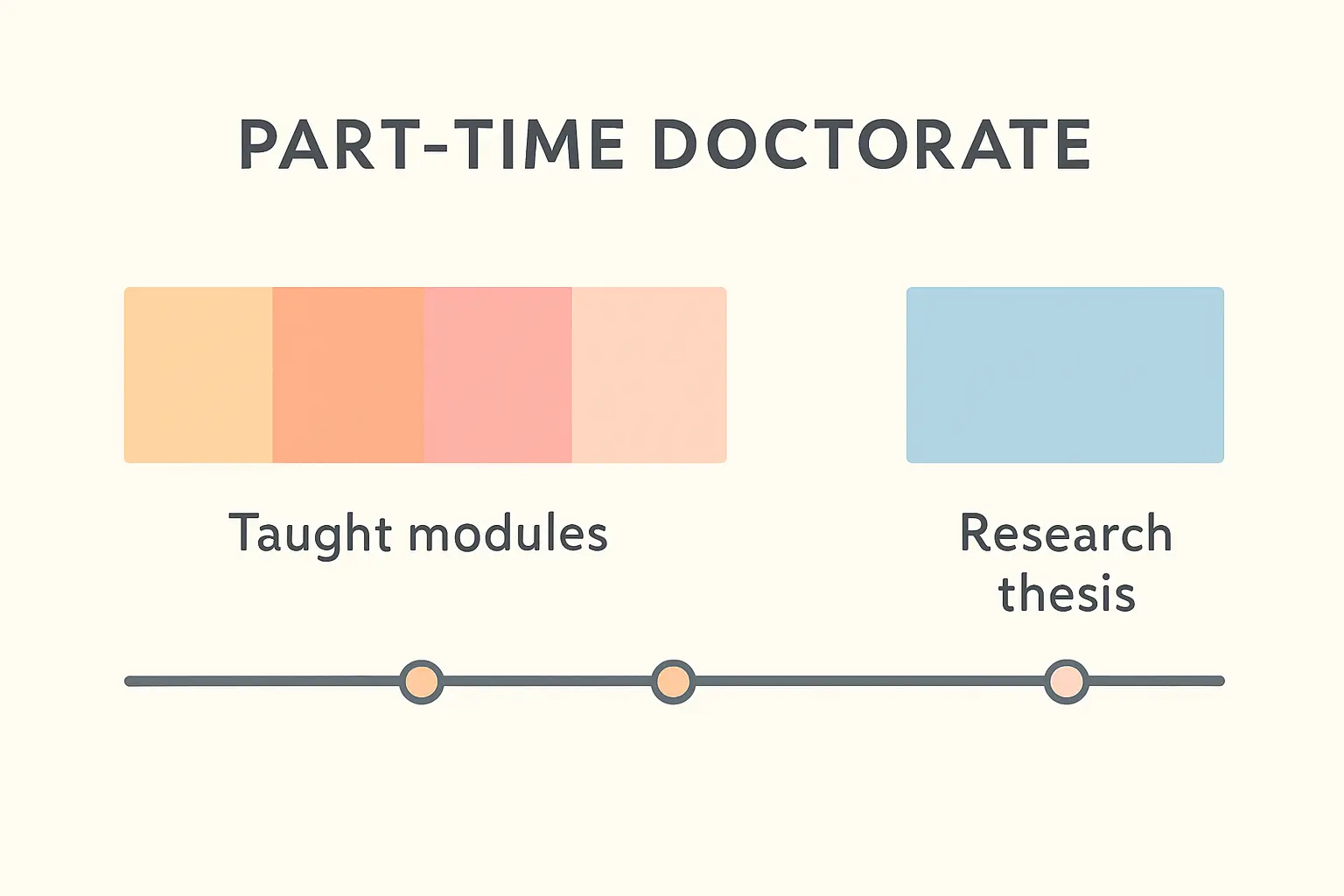
Almost all professional doctorates run in two phases. The first is a taught, assessed component — typically research methods, professional ethics, and a subject core — often delivered to a cohort in intensive blocks so that people in full-time work can attend.
The second is the supervised research phase, ending in a thesis and a viva. Because credit has already been earned in the taught phase, the thesis is commonly shorter than a PhD thesis: many UK programmes set 40,000 to 60,000 words, against a PhD thesis that is commonly capped at 80,000 words at UK institutions.
Treat those figures as the common institutional pattern rather than a national rule. Word limits are set programme by programme, and the only authoritative number is the one in your own university’s research degree regulations. For how thesis length varies more broadly, see our data on average dissertation length by degree and discipline.
What are the entry requirements?
The distinguishing requirement is professional experience. Where a PhD admissions panel weighs research potential and a strong master’s, a professional doctorate panel usually expects several years of substantive practice, and often current employment in the field.
A master’s degree is the standard academic baseline, though some programmes admit candidates with an exceptional professional record instead. That is a meaningful contrast with the PhD route, where the master’s question is more contested — we cover it in can you do a PhD without a master’s degree.
Many programmes also ask for employer awareness or consent at application, because the research site is frequently the candidate’s own organisation. That has consequences for ethics approval and for data access that are worth resolving before you apply, not after.
How does the research differ from a PhD?
The sharpest difference is where the question originates. A PhD question typically comes from a gap in the literature. A professional doctorate question typically comes from a problem the candidate has encountered at work, which is then positioned against the literature.
That changes the shape of the contribution. A professional doctorate is expected to make an original contribution to knowledge and to practice — the dual criterion. An examiner will ask not only what is new, but what changes as a result, and for whom.
It also changes your relationship to the setting. Insider research brings access most external researchers would envy, and brings problems they never face: power asymmetries with colleagues who are also participants, consent that may feel less than free, and findings that could be unwelcome to the employer funding your fees. Programmes expect you to address this explicitly through a positionality statement.
Which route should you choose?
| Consideration | PhD | Professional doctorate |
|---|---|---|
| Qualification level | FHEQ Level 8 | FHEQ Level 8 |
| Typical mode | Full-time or part-time | Predominantly part-time |
| Taught component | Minimal or optional | Substantial and assessed |
| Cohort | Largely individual | Cohort-based |
| Source of question | Gap in the literature | Problem in practice |
| Contribution tested | Knowledge | Knowledge and practice |
| Typical thesis length | Commonly capped at 80,000 words | 40,000–60,000 words |
| Common funding | Studentship or self-funded | Self-funded or employer-supported |
A reasonable decision rule: choose the PhD if you want to move into research or academia and your question is driven by the literature. Choose the professional doctorate if you intend to stay in practice, and the thing you most want to change is something in your own sector.
If you are still weighing degree levels rather than doctoral types, our master’s versus PhD decision guide is the better starting point. Candidates already publishing in their field should also look at the thesis by publication route, which some professional doctorates now permit.
How long does a professional doctorate take?
Part-time study is the norm, and part-time doctorates take longer in calendar time. Four to six years is the usual planning assumption, with the taught phase occupying roughly the first third.
The realistic risk is not the academic work but the collision between a full-time job, a research site that is also your workplace, and a thesis. Programmes that run in cohorts mitigate this partly through peer accountability, which is one of the underrated advantages of the format.
Frequently asked questions
Can you call yourself Doctor with a professional doctorate?
Yes. A professional doctorate is a doctoral award at FHEQ Level 8 and confers the title Doctor in exactly the same way a PhD does. There is no distinction in the title itself, though the postnominal letters differ — EdD or DBA rather than PhD.
Is a DBA respected as much as a PhD?
In business and management practice, a DBA is well regarded and often more relevant, because the research is grounded in organisational problems. For a research-track academic post, hiring panels frequently still favour a PhD, particularly in research-intensive departments. Choose according to where you intend to work.
Can you do a professional doctorate while working full-time?
That is what the format is designed for. Taught sessions are usually delivered in intensive blocks or at weekends, and the research is normally conducted in or around the candidate’s own workplace. Most candidates remain in full-time employment throughout.
Do you have to defend a professional doctorate in a viva?
Yes. Professional doctorates are examined by viva voce in the same way as a PhD, with internal and external examiners. The questioning typically probes the practice contribution and your positionality as an insider researcher alongside the usual tests of originality and rigour.
Is a professional doctorate cheaper than a PhD?
Not usually. Fees are broadly comparable, and professional doctorates are less likely to attract research council studentships, so more candidates self-fund or seek employer sponsorship. The offsetting factor is that most candidates keep earning throughout.
What is a DProf and how is it different?
A DProf, or Doctorate in Professional Practice, is the generalist member of the family. It exists for practitioners whose field has no dedicated award, and it is typically the most flexible in negotiating a research programme around an individual’s practice context.
Planning your doctoral proposal?
Tesify helps you build the artefacts around your research — a chapter outline, a formatted bibliography, cited references, and an AI-use declaration you can submit alongside your work. You write the thesis; Tesify handles the scaffolding.
Write your thesis with AI
Structure, draft, cite, and format your thesis faster with Tesify’s AI writing tools, automatic bibliography, and plagiarism checker. Free to start, no credit card required.






Leave a Reply