

Research Variables: Independent, Dependent and Control Variables with Thesis Examples (2026)
Every quantitative thesis is, underneath, a set of claims about how some things change when other things change. The things are the research variables, and a committee will expect you to name each one, say what role it plays, and keep those roles consistent from the research question in Chapter 1 to the regression table in Chapter 4. This guide sets out the six roles a variable can play, gives a three-step method for extracting them from your research question, and shows ten worked examples across disciplines in the table form supervisors like to see.
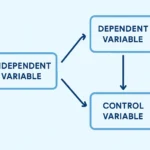
The independent variable is the presumed cause or predictor; the dependent variable is the outcome you measure. Control variables are held constant or statistically adjusted so they do not distort the relationship. Confounding variables are the uncontrolled ones that could. A mediating variable explains how the independent variable affects the dependent one; a moderating variable changes how strong that effect is. Creswell and Creswell’s Research Design (6th ed., SAGE, 2023) uses this taxonomy, and most US dissertation templates ask for an explicit variables subsection in Chapter 1.
The Six Roles a Research Variable Can Play
A variable is anything that can take more than one value across the units you study: a score, a category, a count, a yes or no. Its role is not a property of the variable itself but of the question you are asking. Age is a dependent variable in a study of what predicts age at first diagnosis and a control variable in a study of what predicts recovery. Committees care about the role because the role decides the analysis.
| Role | What it does in the study | Also called | How it appears in analysis |
|---|---|---|---|
| Independent | The presumed cause, treatment or predictor | Predictor, explanatory, treatment, factor | Grouping factor or main predictor |
| Dependent | The outcome you measure | Outcome, response, criterion | Left-hand side of the model |
| Control | Held constant by design or adjusted for statistically | Covariate | Additional predictor whose coefficient you do not interpret |
| Confounding | Related to both cause and outcome, not controlled | Extraneous, lurking | Named in limitations if it could not be measured |
| Mediating | Lies on the causal path; explains how | Intervening, mechanism | Indirect effect in a mediation model |
| Moderating | Changes the strength or direction; explains when | Interaction, boundary condition | Interaction term |
Two roles are often confused. A mediator sits between cause and outcome (training raises perceived usefulness, which raises intention to use). A moderator sits beside the relationship and changes it (the effect of hybrid days on engagement is stronger when the manager also works hybrid). If you can say “because of,” it is mediation; if you can say “depending on,” it is moderation. Each variable also has a level of measurement (nominal, ordinal, interval or ratio) that decides which test applies; our quantitative research methods guide covers that mapping.
Three Steps to Extract Variables From a Research Question
- Underline the verb. “Affect,” “predict,” “differ by,” “is associated with” mark the relationship. What comes before the verb is usually the independent variable; what comes after is the dependent variable.
- List what else could move the outcome. Anything that plausibly relates to both the independent and dependent variables is a confounder. Decide which you will control (by design or by measurement) and which you cannot; the second list becomes a limitation.
- Ask “how” and “when.” If theory says the effect works through something, that something is a candidate mediator. If theory says the effect should be stronger for some people or settings, that condition is a candidate moderator. Only include one if your design can actually estimate it.
Work the steps on a real question: “Does a two-week self-compassion intervention reduce dissertation anxiety among final-year undergraduates?” Verb: reduce. Independent: intervention (received or waitlist). Dependent: dissertation anxiety score at post-test. Controls: baseline anxiety, gender, whether the student is an international student. Uncontrolled confounder: informal peer support during the two weeks. Mediator, if measured: self-compassion score. Moderator, if theory supports it: baseline perfectionism. That is a complete variable specification, and it maps directly onto the hypotheses in our research hypothesis examples.
Ten Worked Variable Tables by Discipline
Each row follows the same study a committee would recognise from a Chapter 1 problem statement. Controls are the ones a master’s student could realistically measure.
| Discipline and question | Independent | Dependent | Control | Mediator or moderator |
|---|---|---|---|---|
| Nursing: does boarding duration predict bundle adherence? | Hours boarded in the emergency department | Bundle adherence (proportion of required elements documented) | Shift, patient risk score, nurse-to-patient ratio | Moderator: night versus day shift |
| Education: do retrieval quizzes raise mathematics scores? | Weekly retrieval quiz (yes/no) | End-of-unit test score | Prior attainment, class size, teacher | Moderator: prior attainment band |
| Business: do hybrid days predict engagement? | Hybrid days per week | Work engagement scale score | Tenure, role level, firm | Moderator: manager’s working pattern |
| Psychology: does a self-compassion intervention reduce anxiety? | Condition (intervention/waitlist) | Post-test anxiety score | Baseline anxiety, gender | Mediator: self-compassion score |
| Computer science: do LLM tests detect fewer faults? | Test-suite origin (LLM/developer) | Mutation score | Repository size, line coverage | Moderator: dependency count |
| Public health: does deprivation predict attendance after booking? | Deprivation quintile | Attended (yes/no) | Age, sex, practice | Mediator: days between booking and appointment |
| Engineering: does envelope condition predict heat-pump performance? | Measured air-leakage rate | Seasonal coefficient of performance | Outdoor temperature, house floor area, unit model | Moderator: duct location (conditioned or unconditioned space) |
| Economics: are grants capitalised into regional prices? | Grant threshold change (before/after) by area type | Median sale price | Interest rate, dwelling type, area fixed effects | Moderator: regional versus metropolitan |
| Marketing: do sustainability labels raise purchase intention? | Label shown (yes/no) | Purchase-intention scale score | Price shown, product category | Mediator: perceived brand trust |
| Information systems: does training predict intention to use? | Training hours | Intention-to-use score | Prior system experience, job role | Mediator: perceived usefulness |
Notice that the dependent variable is always stated as something measured (a score, a proportion, a yes/no), never as a concept. “Engagement” is a concept; “work engagement scale score” is a variable. The measurement decision has its own section in most theses and its own guide here on operational definitions and measures; for psychology-specific instruments see hypotheses and variables for a psychology dissertation.
Keep Your Variable Roles Consistent From Chapter 1 to Chapter 4
Tesify holds your variable table beside the hypotheses and the analysis plan, so a control variable in the methods chapter is never quietly reinterpreted as a predictor in the results. Every sentence is written by you.
Model Paragraph for the Variables Subsection
Many US templates, including the quantitative Chapter 1 outline in Saint Peter’s University’s dissertation guide, ask for a subsection called “Identification of Variables” or “Variables and Operational Definitions.” Here is a complete example for the business study above.
The independent variable is the number of days per week the employee works away from the office, self-reported as an integer from 0 to 5. The dependent variable is work engagement, measured as the total score on a validated nine-item engagement scale. The moderating variable is the line manager’s working pattern, coded as hybrid or office-based from the manager’s own survey response. Tenure in years, role level (junior, senior, manager) and firm are included as control variables because each is associated with both hybrid arrangements and engagement in prior studies. Household composition could not be measured for privacy reasons and is treated as a potential confounder in the limitations.
Six sentences, six variables, every role named, every control justified. Once the roles are fixed, the same list becomes the codebook for your dataset; our guide to building a data dictionary for your thesis shows how to carry it into the analysis files. If your outcome is a yes/no rather than a score, the model changes, as explained in linear versus logistic regression.
Five Mistakes Committees Flag
- Naming a concept as the dependent variable. “Student success” is not measurable. Say what you will score, count or classify.
- Calling every extra variable a “control.” A control is included for a stated reason. Listing ten demographics without justification is data dredging in advance.
- Swapping roles between chapters. If gender is a control in Chapter 1 it cannot become a “key finding” in Chapter 4 without an explicit exploratory label.
- Testing a mediator with a cross-sectional design and claiming a mechanism. Mediation implies order in time. Without it, report the indirect effect as consistent with mediation, not as proof.
- Ignoring confounders you cannot measure. Name them. A committee would rather read “household composition could not be measured” than discover it in the viva. Threats of this kind are catalogued in our guide to construct, internal and external validity.
Frequently Asked Questions
Can a variable be both independent and dependent in one thesis?
Yes, across different hypotheses. Self-compassion can be the dependent variable in H1 (does the intervention raise it?) and the mediator in H2 (does it carry the effect on anxiety?). State the role per hypothesis.
How many control variables should a master’s thesis include?
As many as the literature justifies and the sample size can carry, which for most master’s studies means three to six. A common rule of thumb is at least ten to fifteen observations per predictor in a regression model, so a sample of 120 supports a handful of controls, not twenty.
Do qualitative studies have variables?
Qualitative designs work with concepts, themes and cases rather than variables, and Creswell and Creswell describe them as using a central phenomenon instead. Mixed-methods studies specify variables for the quantitative strand only.
What is the difference between a control variable and a confounding variable?
Both are third variables that could distort the relationship. A control is one you measured and adjusted for, or held constant by design. A confounder is one you did not or could not handle, so it remains a threat to internal validity and belongs in the limitations.
Where do variables go in the thesis?
They are introduced in Chapter 1 beside the research questions and hypotheses, defined operationally in the methodology chapter, and summarised in a variable or codebook table before the results. Many committees like to see the same table in all three places.
Is a demographic variable always a control?
No. It is a control only when it plausibly relates to both the independent and dependent variables. If the research question is about gender differences, gender is the independent variable, not a control.
Next Step
Write your research question, underline the verb, and fill a five-column row like the ones above for each hypothesis. When each cell holds something measurable, the variables subsection almost writes itself. To draft it beside your hypotheses and analysis plan, start your thesis in Tesify.
Write your thesis with AI
Structure, draft, cite, and format your thesis faster with Tesify’s AI writing tools, automatic bibliography, and plagiarism checker. Free to start, no credit card required.




Leave a Reply