
How to Write a Research Methodology Chapter for Your Thesis (2026)
The methodology chapter is the chapter where students most commonly lose marks they did not expect to lose. Many students approach it as a description of what they did — a kind of research diary. Examiners approach it as a test of whether you understand why you did it. This distinction is the difference between a chapter that passes and one that earns distinction-level marks.
This guide explains how to write a research methodology chapter that is rigorous, well-justified, and examiner-ready — covering everything from philosophical foundations to ethical considerations and limitations.
What the Methodology Chapter Must Achieve
According to Grad Coach’s methodology guide, the primary purpose of the methodology chapter is to convince your examiner that your chosen approach is the most appropriate way to answer your research question — not just that you followed a sensible set of steps. This requires engaging with the literature on research methodology directly, not just describing your procedures.
The methodology chapter must be:
- Justified: Every decision must be explained and supported with references to methodological literature
- Coherent: Your philosophy, approach, design, and analysis methods must align logically
- Transparent: Detailed enough that another researcher could replicate your study
- Honest: Limitations and constraints must be acknowledged openly
The Eight-Section Structure
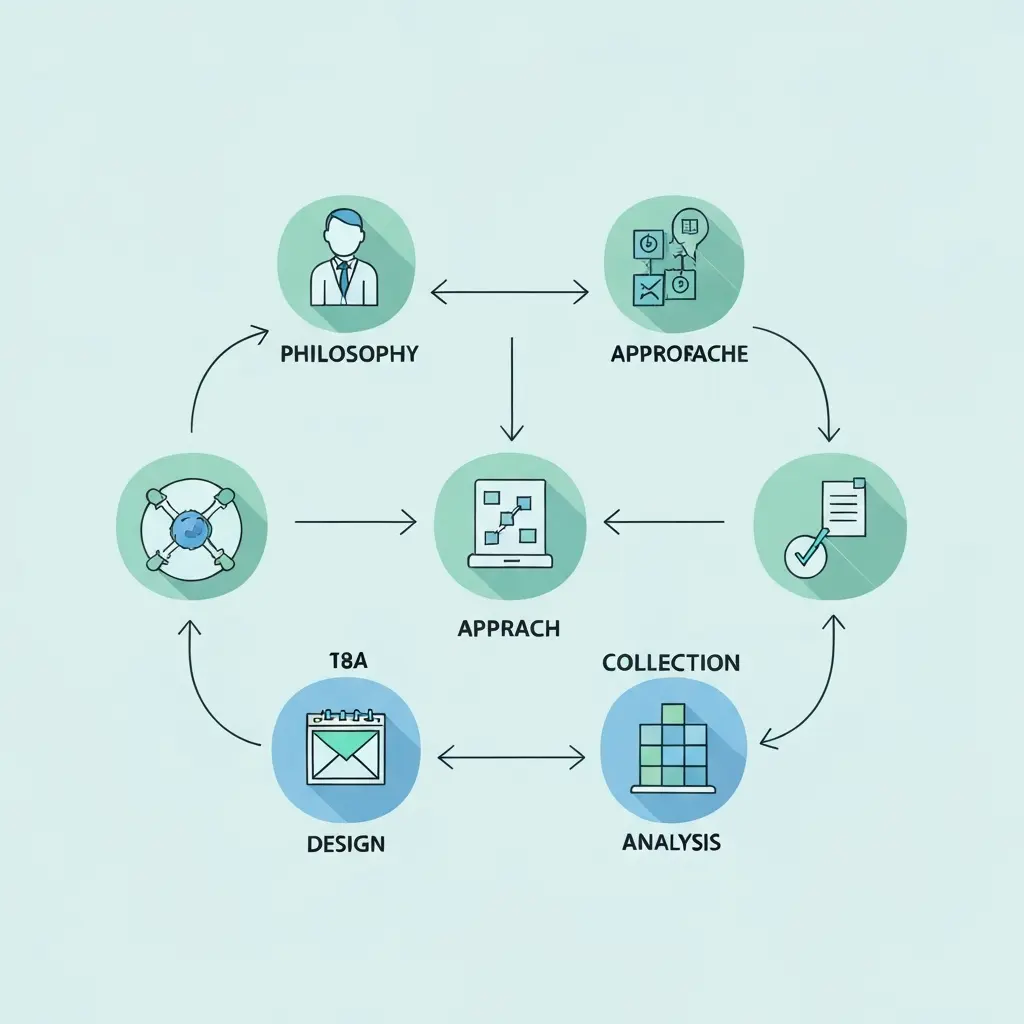
Most methodology chapters at master’s and PhD level cover eight core areas. These do not need to be separate numbered sections — many students integrate them under disciplinary conventions — but all eight must be addressed:
| Section | Core Question | Approx. Length |
|---|---|---|
| Research philosophy | What are your underlying assumptions about knowledge? | 300–500 words |
| Research approach | Deductive, inductive, or abductive? | 200–300 words |
| Research design | What is your overall study architecture? | 400–600 words |
| Data collection | How did you gather your data? | 600–1,000 words |
| Sampling | Who/what did you study and why? | 400–600 words |
| Data analysis | How did you make sense of your data? | 400–800 words |
| Ethical considerations | How did you protect participants and comply with regulations? | 300–500 words |
| Limitations | What are the constraints of your approach? | 300–500 words |
Research Philosophy
Research philosophy sits at the deepest level of your methodology — it reflects your assumptions about the nature of reality (ontology) and how we can know things (epistemology). Many students skip this section as too abstract, but examiners — especially in social sciences, education, and humanities — use it to evaluate your methodological literacy.
The four main research philosophies you will encounter:
- Positivism: Reality is objective and can be measured. Knowledge comes from observable, quantifiable data. Associated with quantitative methods.
- Interpretivism: Reality is socially constructed. Knowledge comes from understanding subjective meanings. Associated with qualitative methods.
- Critical realism: Reality exists independently but can only be known imperfectly through socially conditioned inquiry. Works with both quantitative and qualitative.
- Pragmatism: The best approach is whatever addresses the research question most effectively. Underpins mixed methods research.
Research Approach
Your research approach determines whether you start with theory (deductive), start with data (inductive), or move back and forth between the two (abductive):
- Deductive: Develop a hypothesis from existing theory, collect data to test it. Common in quantitative research.
- Inductive: Collect data, identify patterns, develop new theory. Common in qualitative research.
- Abductive: Start with incomplete observations, develop the most likely explanation, refine through iteration. Common in grounded theory and mixed methods.
Research Design
Your research design is the architectural plan for your study. Key design options include:
- Experimental: Randomly assign participants to conditions; manipulate independent variables
- Quasi-experimental: Non-random assignment; natural experiments
- Survey: Large-scale data collection via questionnaire
- Case study: In-depth investigation of a bounded unit (organisation, event, individual)
- Ethnographic: Extended immersive observation in a natural setting
- Phenomenological: Exploring lived experience of a phenomenon
- Grounded theory: Building theory inductively from systematic data collection and analysis
For each design choice, explain why it is the most appropriate way to answer your specific research question — citing methodological texts such as Creswell, Bryman, or Saunders as you do so. For a deeper exploration of qualitative research designs specifically, see our qualitative research methods guide.
Data Collection Methods
Describe your data collection instruments and procedures in detail. For each method, cover:
- What it is and why it is appropriate for your research question
- How it was designed or selected (e.g., existing validated scale vs. custom questionnaire)
- How data was collected (online survey, face-to-face interview, document review)
- How data was recorded (audio recording, field notes, database)
Pilot testing your instruments before the main data collection phase is standard practice and should be mentioned if you did it.
Sampling Strategy
Your sampling section must cover: who you sampled (or what), how many, how you recruited them, and why this sample is appropriate for your research question. Distinguish between your sampling strategy and your actual sample:
- Probability sampling (random, stratified, systematic): Used in quantitative research to support generalisation
- Non-probability sampling (purposive, snowball, convenience, theoretical): Common in qualitative research where depth matters more than breadth
Justify your sample size. Quantitative studies require power analysis to justify sample size. Qualitative studies use saturation — the point at which no new themes are emerging from additional data — as the primary justification.
Data Analysis
Explain in detail how you analysed your data. Be specific about the analytical procedure:
- Quantitative: Name the specific statistical tests used (t-test, regression, ANOVA), the software (SPSS, R, Stata), and how you checked assumptions
- Qualitative: Name the analytical framework (thematic analysis, discourse analysis, grounded theory coding), whether software was used (NVivo, ATLAS.ti), and how you ensured rigour (member checking, peer debriefing, reflexive journals)
- Mixed methods: Explain how you integrated or triangulated the quantitative and qualitative strands
Ethical Considerations
All research involving human participants requires ethical approval and explicit discussion in the methodology chapter. Cover: informed consent (how it was obtained, what participants were told), confidentiality and anonymisation, data storage and security (especially GDPR compliance for UK/EU studies), the right to withdraw, and any specific vulnerabilities of your participant group.
Reference your institution’s ethics committee approval and any relevant professional codes of conduct.
Reliability, Validity, and Trustworthiness
In quantitative research, address reliability (consistency of measurement) and validity (internal, external, construct). In qualitative research, address Lincoln and Guba’s four trustworthiness criteria: credibility, transferability, dependability, and confirmability — and what strategies you used to address each.
Limitations
End your methodology with an honest limitations section. Acknowledge constraints that affected your data collection, analysis, or generalisability. Frame limitations constructively: what does each limitation mean for how your findings should be interpreted?
Common Methodology Mistakes
| Mistake | Fix |
|---|---|
| Describing without justifying | For every decision: “I chose X because…” |
| Omitting research philosophy | Add 300–500 words on ontological/epistemological position |
| Confusing methodology with method | Methodology = why; method = how. Include both. |
| Insufficient sampling justification | Run power analysis (quant) or justify saturation (qual) |
| Not citing methodological literature | Reference Creswell, Bryman, Saunders, or discipline-specific texts |
For related guidance on types of research methods and choosing between qualitative and quantitative approaches, see our research methodology types guide and our quantitative research methods guide.
Frequently Asked Questions
What is the difference between methodology and methods in a thesis?
Methodology refers to the theoretical framework and rationale behind your research design — the philosophical and conceptual justification for your overall approach. Methods refers to the specific practical techniques you used to collect and analyse data (e.g., semi-structured interviews analysed using thematic analysis). Both must be included in your methodology chapter. Many students describe their methods clearly but neglect the methodological justification — which is what distinguishes strong work from merely adequate work.
How long should a methodology chapter be?
For a master’s thesis (15,000–20,000 words total), the methodology chapter is typically 2,000–4,000 words. For a PhD thesis (80,000–100,000 words), the methodology chapter is typically 8,000–15,000 words. The length should reflect the complexity of your research design — a multi-method study warrants more detailed explanation than a single-method design.
Do I need to discuss research philosophy in my methodology chapter?
This depends on your discipline and institution. In social sciences, education, management, and humanities, research philosophy (positivism, interpretivism, pragmatism, critical realism) is almost always expected. In sciences and engineering, it is often implied rather than stated explicitly — check your programme handbook and examples of past theses in your department. When in doubt, include a brief philosophical framing paragraph: it costs little effort and signals methodological sophistication.
How do I write a methodology chapter if my research is purely secondary (literature-based)?
Secondary or library-based research still requires a methodology chapter. You should explain your literature search strategy (databases searched, search terms used, date ranges, inclusion/exclusion criteria), how you evaluated the quality and relevance of sources, and how you synthesised them. A systematic literature review methodology (PRISMA protocol) is one formal approach; a more flexible narrative review methodology is another. Both require explicit description and justification.
Should the methodology chapter be written in past or present tense?
The data collection and analysis sections are usually written in the past tense because they describe completed actions (“Participants were recruited through…”). The research philosophy and design rationale sections are sometimes written in the present tense because they represent ongoing philosophical positions rather than historical actions. Check your supervisor’s and institution’s conventions, as practices vary.
Write a Methodology Chapter That Impresses Examiners
Tesify guides you through every methodology section with structured templates, citation management, and AI-powered feedback that keeps your argument coherent and your justifications solid.
Write your thesis with AI
Structure, draft, cite, and format your thesis faster with Tesify’s AI writing tools, automatic bibliography, and plagiarism checker. Free to start, no credit card required.






Leave a Reply