
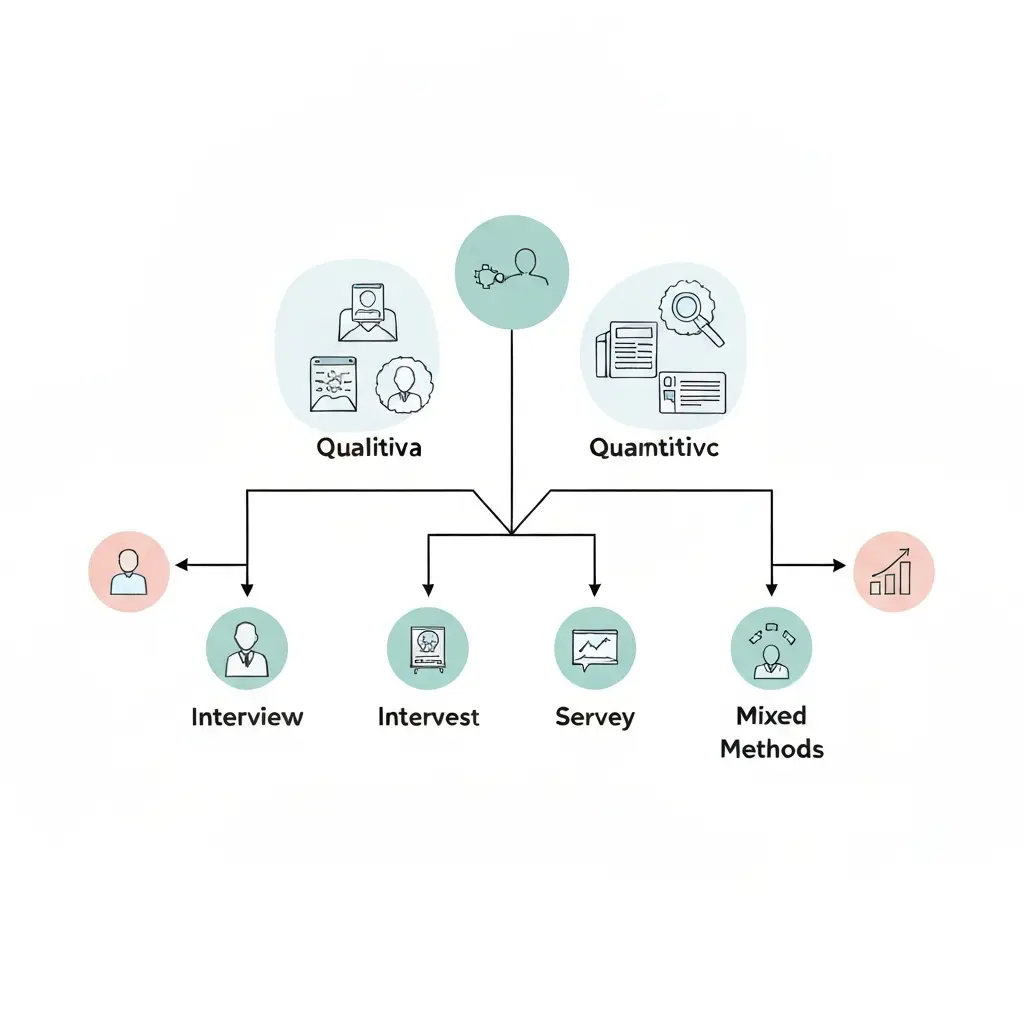
Research Methodology Types: Choosing the Right Approach for Your Thesis 2026
Choosing between research methodology types is one of the most consequential decisions you will make in your dissertation. Get it right, and your methodology chapter practically writes itself. Get it wrong, and no amount of clever writing will rescue a mismatch between your research question and your method. The good news is that the “right” methodology is not a mystery — it follows logically from your research question, once you understand the options.
This guide covers every major research methodology type used in UK and US universities in 2026: from qualitative and quantitative approaches to mixed methods, experimental designs, case studies, surveys, and action research. For each type, we explain what it is, when to use it, and what it looks like in a real dissertation example. We also provide a decision framework to help you choose confidently.
Research published in the Journal of Mixed Methods Research found that 40% of methodology chapter corrections in master’s theses are due to a mismatch between the stated philosophical position (e.g., positivism) and the actual data collection method (e.g., open-ended interviews). This guide helps you avoid exactly that.
Research Philosophy: The Foundation
Before choosing a data collection method, you need to establish your research philosophy — your assumptions about the nature of reality (ontology) and how it can be known (epistemology). Your philosophy constrains and justifies your method choices.
| Philosophy | Core Belief | Typical Method | Example Discipline |
|---|---|---|---|
| Positivism | Reality is objective and measurable; knowledge is derived from observable facts | Quantitative, experimental | Natural sciences, economics |
| Interpretivism | Reality is socially constructed; meaning is subjective and context-dependent | Qualitative, ethnographic | Sociology, education, anthropology |
| Pragmatism | The research question should determine the method; both objective and subjective knowledge are valid | Mixed methods | Business, health research, education |
| Critical Realism | Reality exists independently but is imperfectly known through social structures | Mixed methods, case study | Social science, management |
You do not need to choose a philosophy you personally believe in — you need to choose one that is consistent with how you are going to collect and analyse your data. If you are running surveys and doing statistical analysis, positivism is the natural fit. If you are conducting in-depth interviews about lived experience, interpretivism is appropriate.
Research Approach: Deductive vs Inductive
Deductive research starts with existing theory and tests whether it holds for your specific case. You develop hypotheses from theory, collect data, and use results to confirm or refute the hypotheses. Common in quantitative research.
Inductive research starts with observations and builds toward theory. You collect data without a pre-formed hypothesis, identify patterns, and develop new theoretical insights from those patterns. Common in qualitative research.
Abductive research moves back and forth between data and theory, developing explanations that are plausible given the evidence. Common in mixed methods and case study research.
Quantitative Research Methodology
Quantitative research collects numerical data and uses statistical analysis to identify patterns, test hypotheses, and make generalisable claims.
When to Use Quantitative Research
- Your research question asks “how much,” “how many,” or “to what extent”
- You want to test a specific hypothesis derived from existing theory
- You need results that can be generalised to a larger population
- You have access to a sufficiently large sample (typically n ≥ 30 for simple analyses)
Quantitative Data Collection Methods
- Surveys/questionnaires: Structured, closed-ended questions to large samples. Best for measuring attitudes, behaviours, or characteristics across populations.
- Experiments: Controlled manipulation of variables to establish causal relationships. The gold standard for causation claims.
- Secondary data analysis: Analysing existing datasets (government statistics, university records, company data).
- Structured observation: Counting and categorising observable behaviours using pre-defined coding schemes.
Quantitative Example
Research question: “Does regular aerobic exercise reduce self-reported anxiety in UK university students?”
Method: Survey of 200 first-year students measuring exercise frequency and anxiety (GAD-7 scale). Statistical analysis using regression to control for confounding variables.
Philosophy: Positivism. Approach: Deductive.
Qualitative Research Methodology
Qualitative research collects non-numerical data — words, images, observations — to explore meanings, experiences, and social processes.
When to Use Qualitative Research
- Your research question asks “why,” “how,” or “what is the experience of”
- You are exploring a new or poorly understood phenomenon
- You need rich, contextual understanding rather than broad generalisation
- Your topic is sensitive and requires in-depth conversation rather than tick-box responses
Qualitative Data Collection Methods
- Semi-structured interviews: Open-ended conversations guided by a topic list. Allow participants to raise topics the researcher did not anticipate. The most common qualitative method in master’s research.
- Focus groups: Facilitated group discussions. Useful for exploring shared experiences and group norms.
- Ethnography/participant observation: Immersion in a setting to observe natural behaviour. Used in anthropology, sociology, and education research.
- Document/content analysis: Analysis of texts, media, policy documents, or social media content.
Qualitative Example
Research question: “How do first-generation university students in the UK experience the transition from secondary school to higher education?”
Method: Semi-structured interviews with 12 first-generation students, analysed using Braun and Clarke’s thematic analysis.
Philosophy: Interpretivism. Approach: Inductive.
Mixed Methods Research
Mixed methods research combines quantitative and qualitative data collection and analysis. It is more complex than either single approach but offers the strengths of both.
Common Mixed Methods Designs
- Sequential explanatory: Quantitative data first, followed by qualitative data to explain the quantitative findings. (Survey → Interviews)
- Sequential exploratory: Qualitative first to develop theory, then quantitative to test it. (Interviews → Survey)
- Concurrent triangulation: Quantitative and qualitative data collected simultaneously to provide a more complete picture of the research question.
Mixed Methods Example
Research question: “What factors predict employee retention in UK tech startups?”
Method: Survey of 150 employees (quantitative) to identify which factors are most strongly associated with retention intention, followed by interviews with 10 leavers (qualitative) to understand why they left despite positive survey scores.
Philosophy: Pragmatism. Approach: Sequential explanatory.
Specific Research Designs
| Design | Best for | Limitation |
|---|---|---|
| Experimental | Establishing causation with high internal validity | Artificial conditions may not reflect real world |
| Survey | Collecting standardised data from large samples | Cannot explain why respondents answered as they did |
| Case Study | Deep understanding of a specific context or phenomenon | Limited generalisability; researcher bias risk |
| Systematic Review | Synthesising all available evidence on a question | Only as good as the literature it reviews |
| Action Research | Practitioners studying their own practice to improve it | Researcher is both participant and observer; bias risk |
| Ethnography | Understanding culture, norms, and lived experience | Very time-intensive; not suitable for tight deadlines |
How to Choose Your Methodology
Work through these questions in order:
- What type of knowledge are you seeking? If you want to measure, count, or test: quantitative. If you want to understand experience, meaning, or process: qualitative. If you need both: mixed methods.
- What does your research question require? “How many students experience X?” = quantitative. “What is it like to experience X?” = qualitative. “How much of X is there, and why?” = mixed methods.
- What data can you realistically access? No access to a large sample = qualitative. No access to willing interview participants = quantitative. Honest assessment of feasibility prevents methodology that looks good on paper but cannot be executed.
- What does your discipline typically use? Following disciplinary norms is not intellectually lazy — it is pragmatic. Using an unusual methodology requires extra justification.
- What skills do you have? Statistical analysis requires competence with software (SPSS, R, Stata). Qualitative analysis requires familiarity with frameworks (thematic analysis, grounded theory, IPA). Choose a method you can execute rigorously.
How to Justify Your Methodology in Your Dissertation
Every methodological choice must be justified in your methodology chapter. The formula is simple: state the choice, explain why it is appropriate for your research question, and acknowledge what it cannot do.
Example justification (qualitative): “Semi-structured interviews were selected as the primary data collection method because the research question sought to understand participants’ subjective experiences of career transition — a phenomenon that survey instruments cannot adequately capture (Bryman, 2016). Although this approach limits generalisability to the broader population of career changers, the depth and contextual richness of interview data are better suited to the exploratory nature of this study.”
For how the methodology chapter fits into the full thesis, see our thesis structure guide. For the full writing process from research question to submission, see our complete thesis writing guide.
Frequently Asked Questions
Which research methodology is best for a master’s thesis?
There is no universally “best” methodology — the right choice depends entirely on your research question and field. For business and social science master’s theses, qualitative methods (particularly semi-structured interviews with thematic analysis) are the most common because they are feasible within a master’s timeframe, do not require large samples, and align with the interpretivist tradition of these disciplines. For science and health master’s theses, quantitative survey-based or secondary data approaches are more common. Mixed methods are ambitious but achievable if your research question genuinely requires both approaches.
What is the difference between research design and research methodology?
Methodology is the broader philosophical framework guiding your research — your assumptions about knowledge, your overall approach (deductive/inductive), and your choice of qualitative, quantitative, or mixed methods. Research design is the specific plan for how you will answer your research question — including the type of study (experimental, survey, case study), sampling strategy, data collection instruments, and analysis methods. In short: methodology is “why you are doing it this way”; research design is “exactly how you are doing it.”
How many participants do I need for a qualitative study?
Qualitative research uses purposive (not random) sampling and aims for saturation — the point at which additional interviews stop producing new themes. For master’s dissertations using semi-structured interviews, 8–15 participants is the typical range. Studies using interpretive phenomenological analysis (IPA) may use as few as 4–6 participants for a focused, in-depth analysis. The key is not statistical representativeness but whether your sample is appropriate for your research question. Justify your sample size explicitly in your methodology chapter with reference to established norms (e.g., Creswell, 2014; Mason, 2010).
Do I need to get ethical approval for my dissertation?
If your research involves human participants — interviews, surveys, observation, or access to personal data — you almost certainly need ethical approval from your university’s ethics committee or institutional review board (IRB). Most universities require this before any data collection begins. The approval process typically involves submitting a research protocol, explaining how you will obtain informed consent, how you will protect participant confidentiality, and how you will store and dispose of data. Start this process early — ethics approval can take 2–6 weeks and is a hard prerequisite for data collection.
What is triangulation in research methodology?
Triangulation involves using multiple data sources, methods, or theoretical perspectives to increase the credibility of your findings. The most common form is methodological triangulation — using both qualitative and quantitative data to examine the same research question from different angles. If both methods point to the same conclusion, confidence in the finding increases. If they diverge, the divergence itself is interesting and worth exploring. In qualitative research, triangulation can also involve member checking (sharing findings with participants), peer debriefing, or using multiple coders to analyse the same data.
Write your thesis with AI
Structure, draft, cite, and format your thesis faster with Tesify’s AI writing tools, automatic bibliography, and plagiarism checker. Free to start, no credit card required.






Leave a Reply