
Academic CV Template: What to Include and How to Format Yours for 2026
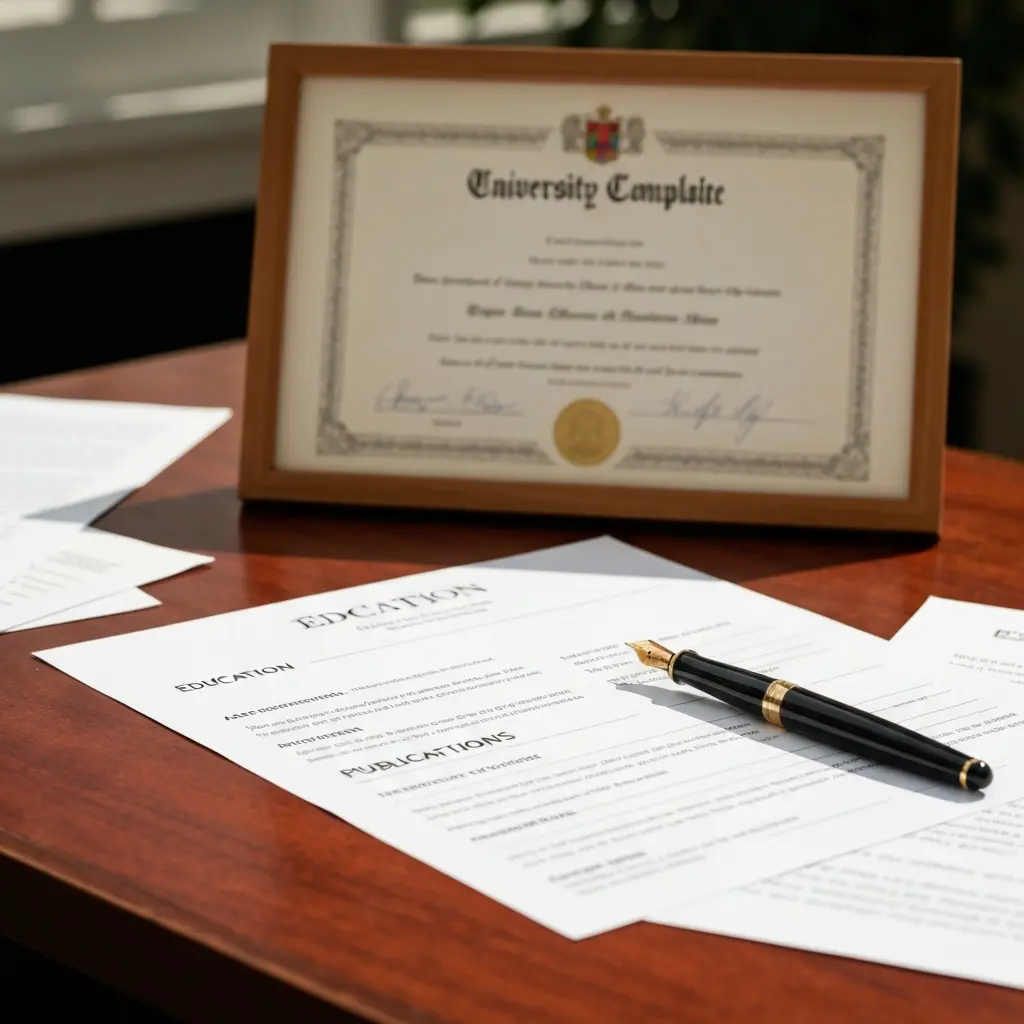
An academic CV template looks very different from a standard job-application CV — and using the wrong format for the wrong context is one of the most common mistakes graduate students make. Applying for a PhD programme, postdoctoral fellowship, or research position with a two-page industry CV will often result in rejection before the content is even considered. Academic CVs are comprehensive, structured documents that prioritise publications, research experience, teaching, and scholarly contributions over the work-history-and-skills format of a standard resume.
This guide provides a complete academic CV template, section-by-section guidance on what to include at each career stage, formatting rules, and common mistakes to avoid. Whether you are applying to your first masters programme or your third postdoc, the structure here applies.
Academic CV vs Standard Resume: Key Differences
| Dimension | Academic CV | Standard Resume |
|---|---|---|
| Length | Unlimited (grows with career) | 1–2 pages maximum |
| Priority sections | Education, research, publications, teaching | Work history, skills, achievements |
| Objective statement | Optional; if included, is a research objective | Often included; career-focused |
| Publications | Prominently listed; essential | Rarely relevant; omitted |
| Design | Clean, minimal, text-focused | Can use design elements; columns, icons |
Academic CV Template: Full Section Structure
[FULL NAME]
[Institution] | [Department]
[Email] | [Phone] | [LinkedIn / Academic website / ORCID]
[City, Country]
EDUCATION
PhD [Subject], [University], [Expected Year]
Thesis: [Working title]
Supervisor: [Name]
MSc/MA [Subject], [University], [Year]
Dissertation: [Title] | Grade: [X]
BSc/BA [Subject], [University], [Year]
[Honours class / GPA if relevant]
RESEARCH EXPERIENCE
[Role], [Laboratory/Group], [University], [Dates]
– [Specific research activity / dataset / method used]
PUBLICATIONS
[Author(s)]. ([Year]). [Title]. [Journal], [Volume](Issue), [Pages]. DOI:
Conference papers, book chapters, preprints — subsectioned if multiple.
TEACHING EXPERIENCE
Teaching Assistant, [Course name], [Department], [University], [Dates]
AWARDS AND FUNDING
[Award name], [Body], [Year] — £/$/€ [Amount if appropriate]
CONFERENCE PRESENTATIONS
[Title], [Conference], [Location], [Date]
PROFESSIONAL SERVICE
[Peer reviewer for X], [Committee member], [Departmental representative]
SKILLS
Methods: [Qualitative/quantitative methods]
Software: [R, SPSS, NVivo, Python, etc.]
Languages: [Languages and proficiency level]
REFERENCES
Available on request. [OR list 2–3 referees with contact details]
Contact Information and Header
Use your institutional email address, not a personal Gmail. Include your ORCID iD if you have one — it is free to register at orcid.org and increasingly expected in academic applications. Include a link to your institutional profile, Google Scholar page, or personal academic website if you have one. Do not include a photo, date of birth, or nationality unless specifically requested (conventions vary by country — UK and US do not use photos; France and Germany traditionally do).
Education Section
Education always comes first in an academic CV — this is universal. List degrees in reverse chronological order (most recent first). For your PhD or master’s, include: thesis title (or “working title” if in progress), supervisor name, and expected or actual submission/award date. For bachelor’s degrees, include class of honours or GPA only if it is strong (2:1/First in UK; 3.5+ GPA in US).
Research Experience
Include all research roles — laboratory assistant, research assistant, research intern, independent research projects. For each role, list the specific research activities: “Conducted semi-structured interviews (n=24) and analysed data using NVivo” is far more informative than “Assisted with data collection.” Committees want to see your hands-on research competence.
Publications
List publications in your discipline’s citation style (APA for social sciences, Vancouver for biomedical, Chicago for humanities). Use subsections if you have multiple publication types: peer-reviewed journal articles, book chapters, conference proceedings, working papers, preprints.
If you have no publications yet (common for master’s students), omit this section entirely rather than listing “publications in preparation.” Include conference presentations instead — these demonstrate academic engagement. As Resumelab’s academic CV guide advises: “You can make your name bold to highlight your authorship” — this is standard academic practice.
Teaching Experience
Include all teaching experience: undergraduate tutorials, lab supervision, online instruction, guest lectures. For each, list the course name, your role (Teaching Assistant, Graduate Teaching Fellow, Seminar Leader), the institution, and the date range. If you received positive student evaluation scores, these can be noted briefly.
Awards and Funding
Include scholarships, research grants, bursaries, prizes, and named fellowships. You may include the monetary value for significant awards — this contextualises their competitiveness for reviewers unfamiliar with specific programmes. List in reverse chronological order.
Conference Presentations
Distinguish between paper presentations (you spoke), poster presentations, and panel discussant roles. All are valid academic activities and worth including. Note whether the conference was international, national, or institutional.
Formatting and Design Rules
- Font: 11–12pt serif (Times New Roman, Georgia) or clean sans-serif (Calibri, Arial)
- Margins: 2.5 cm on all sides; 1.5 cm for longer CVs
- Spacing: Consistent throughout; use white space to separate sections clearly
- Headings: Bold, all caps, or larger font — consistent across all section headings
- No graphics, columns, or icons — academic CVs are plain text documents; design elements interfere with ATS parsing and look out of place
- Save as PDF — always submit as PDF to preserve formatting
- File name: LastName_FirstName_AcademicCV_2026.pdf — never “CV_final_v3_revised.pdf”
Academic CV by Career Stage
Final-year undergraduate / applying to masters (1–2 pages): Education, any research experience (dissertations, summer projects, lab work), relevant employment, skills, references.
Masters student / applying to PhD (2–3 pages): Education, master’s research project, any publications or conference presentations, teaching if any, awards, skills.
PhD student / applying for postdoc (3–5 pages): Education, research experience, publications, teaching, conference presentations, awards, service, skills, references.
Postdoc / applying for lecturer/assistant professor (5–8+ pages): Full academic record; research statement may accompany CV separately.
Once your CV is ready, pair it with a strong application for a relevant scholarship or graduate programme. Our guide on scholarship application tips and our overview of US graduate school applications cover the full application context. For help writing your research statement or personal statement, Tesify provides academic writing assistance tailored to exactly this kind of high-stakes document.
Frequently Asked Questions
How long should an academic CV be?
There is no maximum length for an academic CV — it grows throughout your career. A master’s student’s academic CV is typically 1–2 pages. A completed PhD student’s is 3–5 pages. A senior academic’s may run 10+ pages. Unlike a standard resume, you should never truncate your academic CV to hit a page limit — include all relevant scholarly activity.
Do I need publications to have a strong academic CV?
No — not at masters or early PhD level. Many successful PhD applicants have no publications. What matters at masters and early PhD stage is demonstrating research experience, strong academic performance, relevant skills, and clear intellectual direction. Conference presentations, poster sessions, undergraduate dissertations, and research assistant roles all demonstrate academic engagement without requiring a publication record.
What is the difference between a CV and a resume for academic jobs?
In the US, “resume” is the standard term for industry jobs, while “CV” (curriculum vitae) is used for academic positions. Outside the US, “CV” is used broadly. For any academic position (PhD programme, lectureship, postdoc, fellowship), always submit a CV — never a resume. The structure and content are fundamentally different.
Should I include my undergraduate thesis in my academic CV?
Yes, particularly for applications to masters or PhD programmes. Include the title under your bachelor’s degree entry, optionally with a one-sentence description of the research question and method. If you received a strong grade or award for it, include that. A distinction-level undergraduate dissertation is a meaningful signal of research capability at early career stage.
Should references be included in an academic CV?
For most applications, “References available on request” is sufficient — you will provide referee details in the application form. For some academic positions, listing 2–3 specific referees with contact details on the CV itself is expected. Check the job or programme application requirements; when in doubt, include “available on request” and provide full details separately if asked.
Sharpen Your Academic Writing with Tesify
A strong academic CV needs equally strong supporting documents — research statements, personal statements, and cover letters. Tesify helps you write them with academic precision and clarity.
Write your thesis with AI
Structure, draft, cite, and format your thesis faster with Tesify’s AI writing tools, automatic bibliography, and plagiarism checker. Free to start, no credit card required.





Leave a Reply