
Thesis Structure Guide: Every Section Explained with Examples 2026
If you have ever stared at a blank document wondering what goes where in a thesis, this thesis structure guide is for you. Getting the structure right is not bureaucratic box-ticking — it is the skeleton that holds your argument together. A well-structured thesis is easier to read, easier to examine, and far easier to write. A poorly structured one loses marks before the examiner has even absorbed your ideas.
This guide walks you through every section of a standard thesis or dissertation from the front matter to the back, with annotated examples from institutions including Oxford, Cambridge, UCL, Harvard, MIT, and the University of Edinburgh. Whether you are writing an undergraduate dissertation, a master’s thesis, or the opening chapters of a PhD, this structure applies to you.
Research from the University of Reading’s Writing Development Centre shows that structural problems account for approximately 30% of examiner comments on returning theses — more than any single content issue. This guide helps you eliminate structural errors before you submit.
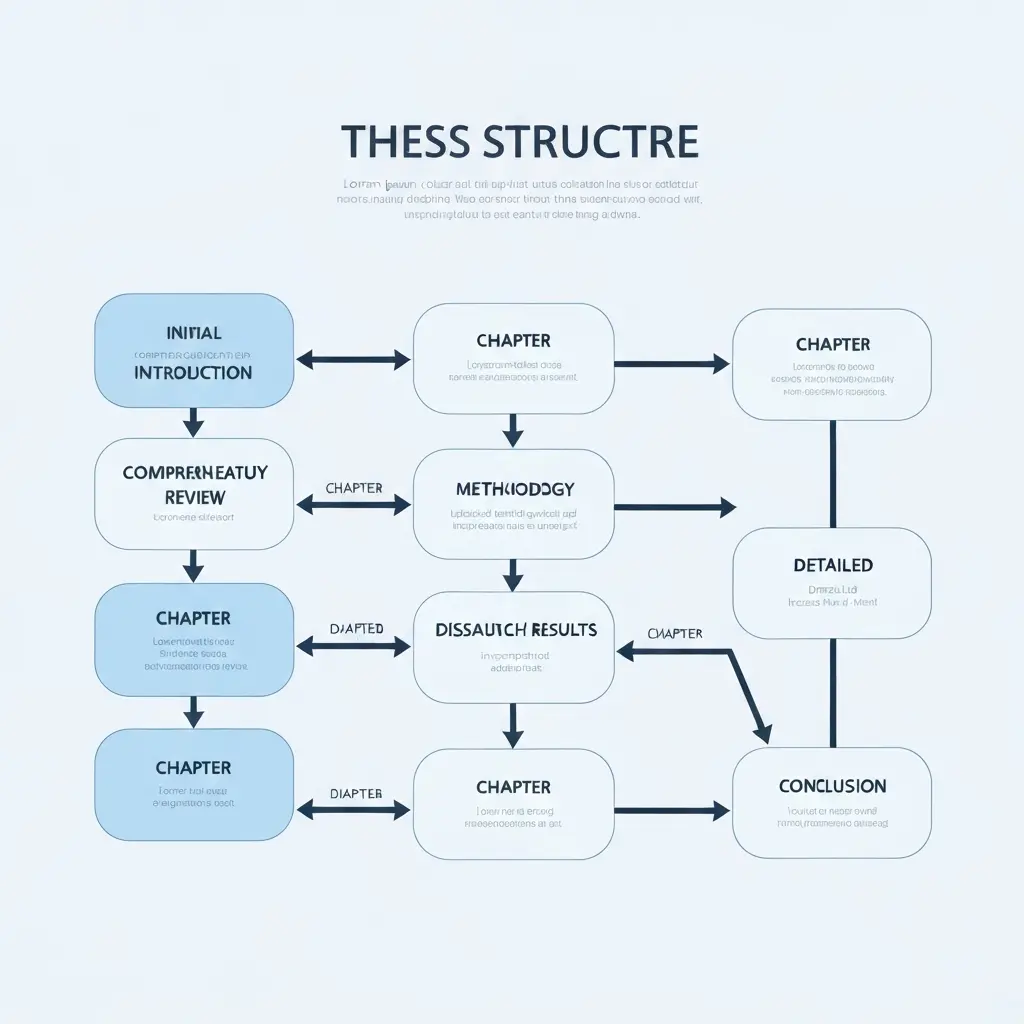
The Full Thesis Structure at a Glance
| Section | Purpose | Typical Word Count (Master’s) |
|---|---|---|
| Title Page | Identifies the work formally | Not counted |
| Abstract | Summarises the entire thesis | 150–300 words |
| Acknowledgements | Thanks supervisors, participants, supporters | 100–300 words |
| Table of Contents | Navigation | Not counted |
| Introduction | Establishes context and research question | 1,500–2,500 |
| Literature Review | Reviews existing research; identifies gap | 3,000–5,000 |
| Methodology | Explains how data was collected and analysed | 2,000–3,500 |
| Results / Findings | Presents data without interpretation | 2,000–4,000 |
| Discussion | Interprets findings in context of literature | 2,500–4,000 |
| Conclusion | Summarises contributions and recommendations | 1,000–2,000 |
| References | Full bibliography of all cited sources | Not counted |
| Appendices | Supplementary material (often not counted) | Variable |
Front Matter: Title Page to List of Tables
Title Page
The title page is the first thing an examiner sees. It must include: the full title of your thesis, your full name, the degree for which it is submitted (e.g., “Submitted in partial fulfilment of the requirements for the degree of Master of Science”), your department and university, the academic year, and sometimes your student number and supervisor’s name. Your university’s formatting guide will specify the exact layout.
Good title example: “The Effect of Sleep Deprivation on Procedural Memory Consolidation in University Students: A Mixed-Methods Investigation” — specific, clear, and methodologically informative.
Weak title example: “Sleep and Memory in Students” — too vague; tells the reader almost nothing.
Abstract
The abstract is the most-read part of any thesis. Write it last. A strong abstract includes four elements: (1) the research problem, (2) the methodology, (3) the main findings, and (4) the key conclusions. In 150–300 words.
Abstract structure example: “This thesis investigates [problem] by examining [subject] using [method]. Data from [sample] were analysed using [analysis approach]. Findings indicate that [key result 1] and [key result 2]. These results suggest [implication] and contribute to [field] by [novel contribution]. Practical implications for [audience] are discussed.”
Acknowledgements
The acknowledgements section is where you thank the people who supported your research: your supervisor, colleagues, participants, family, and funding bodies. Keep it professional but warm. For templates and tone guidance, see our guide on how to write thesis acknowledgements.
Table of Contents
Generate this automatically using Word or LaTeX — never type it manually. Update it as your final formatting step. Include chapter titles, subheadings (to at least H2 level), and page numbers.
List of Figures and Tables
Required if you have three or more figures or tables. Listed separately with figure/table number, title, and page number. Again, generate automatically.
Chapter 1: Introduction
The introduction is not a warm-up — it is an argument. Every paragraph must earn its place by directly setting up your research question.
What a Strong Introduction Includes
- Opening hook: A striking fact, question, or observation that establishes why your topic matters.
- Background and context: Briefly situate the research topic — what is already known, and why it matters in 2026.
- Research problem: Clearly state the gap, contradiction, or unanswered question your thesis addresses.
- Research question(s): State them explicitly. One primary question; one to three sub-questions.
- Research objectives: The specific steps you took to answer the research questions.
- Significance: Why does this matter? Who benefits from this research?
- Thesis outline: A brief “roadmap” paragraph: “Chapter 2 reviews the literature on X. Chapter 3 describes the methodology…”
For annotated examples, see our thesis introduction example guide.
Chapter 2: Literature Review
The literature review is your scholarly conversation with the field. It demonstrates that you know the landscape of existing research, can evaluate its quality, and have identified a meaningful gap that your thesis fills.
How to Structure a Literature Review
The most effective structure is thematic — organised by the major debates or themes in your field, not by author or chronology. Here is a template:
- Opening paragraph: State the scope and organisation of the review
- Theme 1: What does existing research show about [first key concept]? What are the agreements and disagreements?
- Theme 2: What about [second key concept]? How does it relate to Theme 1?
- Theme 3: The intersection or contested space between themes
- Gap statement: “Despite this body of research, no study has examined [specific gap]. This thesis addresses that gap by…”
Avoid the “shopping trolley” approach — piling references together without analysis. Each paragraph should make an argument, not just list studies.
Chapter 3: Methodology
The methodology chapter is the most methodical chapter to write because it describes what you did, in what order, and why. It is written in the past tense and should be detailed enough for replication.
Standard Methodology Structure
- Research philosophy: Positivism, Interpretivism, or Pragmatism — and why
- Research approach: Deductive, Inductive, or Abductive
- Research design: Experimental, case study, survey, ethnographic, etc.
- Data collection methods: What instruments did you use and why?
- Sampling strategy: Who/what did you study, and how did you select them?
- Data analysis: How did you process and interpret the data?
- Ethical considerations: Consent, confidentiality, and approval
- Validity and reliability: How did you ensure quality?
- Limitations: What constraints affected your methodology?
Chapter 4: Results / Findings
Present your findings here without interpretation. This chapter is factual, data-led, and clear. Use tables and figures where they communicate more efficiently than prose. Each table and figure should have a title and be referenced in the text (“As shown in Table 4.2…”).
Organising Your Results
Mirror the structure of your research questions. If you had three research questions, organise your results into three sections, one for each question. This makes your thesis easier to read and easier to examine.
In quantitative studies, report descriptive statistics first (means, standard deviations, frequencies), then inferential statistics (t-tests, ANOVA, regression). Always report effect sizes and confidence intervals alongside p-values.
In qualitative studies, present themes with illustrative quotes. Clearly distinguish between your words and participants’ words.
Chapter 5: Discussion
This is the most intellectually demanding chapter — and often the most interesting one to write. Here you answer the “so what?” question. Your findings are interesting; your discussion makes them meaningful.
Discussion Structure
- Restate your research question briefly
- Answer it directly based on your findings
- Interpret each key finding in relation to the literature: Does it confirm, contradict, or extend what other researchers found?
- Address unexpected findings — explain potential reasons for surprising results
- State theoretical implications — what does your work add to theory?
- State practical implications — what should practitioners do with this knowledge?
- Acknowledge limitations — be honest about what your study cannot claim
Chapter 6: Conclusion
The conclusion is shorter than the discussion and does not introduce new analysis or new references. It synthesises everything and closes the thesis.
What the Conclusion Includes
- Summary of the research question and why it mattered
- Summary of key findings (two to four sentences each)
- Contributions to the field — what new knowledge does this thesis add?
- Limitations of the study
- Recommendations for future research
- Closing statement — a final sentence that resonates
Back Matter: References and Appendices
References
Every source cited in the body of the thesis must appear here; nothing that was not cited should appear here. Use your institution’s required referencing style consistently throughout. Common styles include Harvard, APA 7, Chicago, Vancouver, and MLA. Use reference management software (Zotero, Mendeley, or EndNote) to avoid errors.
Appendices
Appendices contain supplementary material that is relevant but too detailed or lengthy for the main text: survey questionnaires, interview transcripts, consent forms, extended datasets, statistical output tables, or permission letters. Label them Appendix A, B, C and reference them in the text (“see Appendix B for the full interview protocol”).
Structural Variations by Discipline
| Discipline | Common Variation |
|---|---|
| Sciences and Engineering | Lit review often integrated into introduction; Results and Discussion sometimes merged |
| Humanities | May have no separate “methodology” chapter; analysis woven through thematic chapters |
| Law | Research chapters structured around legal arguments; case analysis replaces data |
| Creative Practice PhDs | The creative work itself forms part of the submission alongside a critical commentary |
| Publication-based PhDs | Three to five published or publishable papers with a “kappa” (introduction and synthesis chapter) |
Always confirm the expected structure with your department or supervisor before you begin writing. When in doubt, ask — it is far easier to plan correctly than to restructure after writing.
How to Allocate Word Count Across Chapters
As a general guide for a 15,000-word master’s thesis:
| Chapter | Approximate % | Words |
|---|---|---|
| Introduction | 10–12% | 1,500–1,800 |
| Literature Review | 25–30% | 3,750–4,500 |
| Methodology | 15–20% | 2,250–3,000 |
| Results / Findings | 15–20% | 2,250–3,000 |
| Discussion | 20–25% | 3,000–3,750 |
| Conclusion | 8–10% | 1,200–1,500 |
These are proportions, not rigid rules. A thesis with complex data may have a longer results chapter; a highly theoretical humanities thesis may have minimal methodology and a longer literature review. For the full step-by-step writing process, see our guide on how to write a thesis in 2026.
Frequently Asked Questions
Does a thesis have to follow this exact structure?
The standard IMRaD structure (Introduction, Methods, Results, Discussion) is widely accepted across sciences and social sciences. Humanities theses often use thematic chapters rather than a separate methodology chapter. Always check your department’s guidelines and ask your supervisor what structure they expect. The structure shown in this guide works for the majority of UK and US master’s and undergraduate dissertations.
Should the results and discussion be separate chapters?
In most social science and science theses, they are kept separate — results first, then discussion. This is cleaner and easier to examine because it separates factual reporting from interpretation. Some supervisors in certain disciplines prefer a combined “Results and Discussion” chapter, particularly in shorter dissertations. Follow your supervisor’s guidance, but if you have no specific instruction, keep them separate.
What is the difference between the conclusion and the abstract?
The abstract is a 150–300 word standalone summary of the entire thesis, placed at the front. The conclusion is a full chapter (1,000–2,000 words) at the end of the thesis that synthesises findings, states contributions, acknowledges limitations, and recommends future research. The abstract is meant to help readers decide whether to read the thesis; the conclusion is part of the thesis itself.
Where does a theoretical framework go in a thesis?
The theoretical framework can sit at the end of the literature review chapter or as a standalone chapter between the literature review and methodology. It explains the theoretical lens or conceptual framework through which you interpret your data. In practice-based disciplines it is often integrated into the literature review; in more theoretically heavy social science work it may be a standalone chapter.
Does a thesis need a hypothesis?
Not always. Quantitative, deductive research (testing existing theory) typically uses formal hypotheses. Qualitative, inductive research (building new theory from data) uses research questions rather than hypotheses. Mixed-methods studies may use both. If your methodology is experimental or heavily statistical, you will likely need hypotheses. If it is interpretive, interview-based, or exploratory, research questions are sufficient.
How many chapters does a typical master’s thesis have?
Most master’s theses have five to six chapters: Introduction, Literature Review, Methodology, Results, Discussion, and Conclusion. Some combine Results and Discussion into one chapter, giving five chapters. Some include a standalone Theoretical Framework chapter, giving seven. The exact number is less important than whether each chapter has a clear, distinct purpose.
Write your thesis with AI
Structure, draft, cite, and format your thesis faster with Tesify’s AI writing tools, automatic bibliography, and plagiarism checker. Free to start, no credit card required.





Leave a Reply