
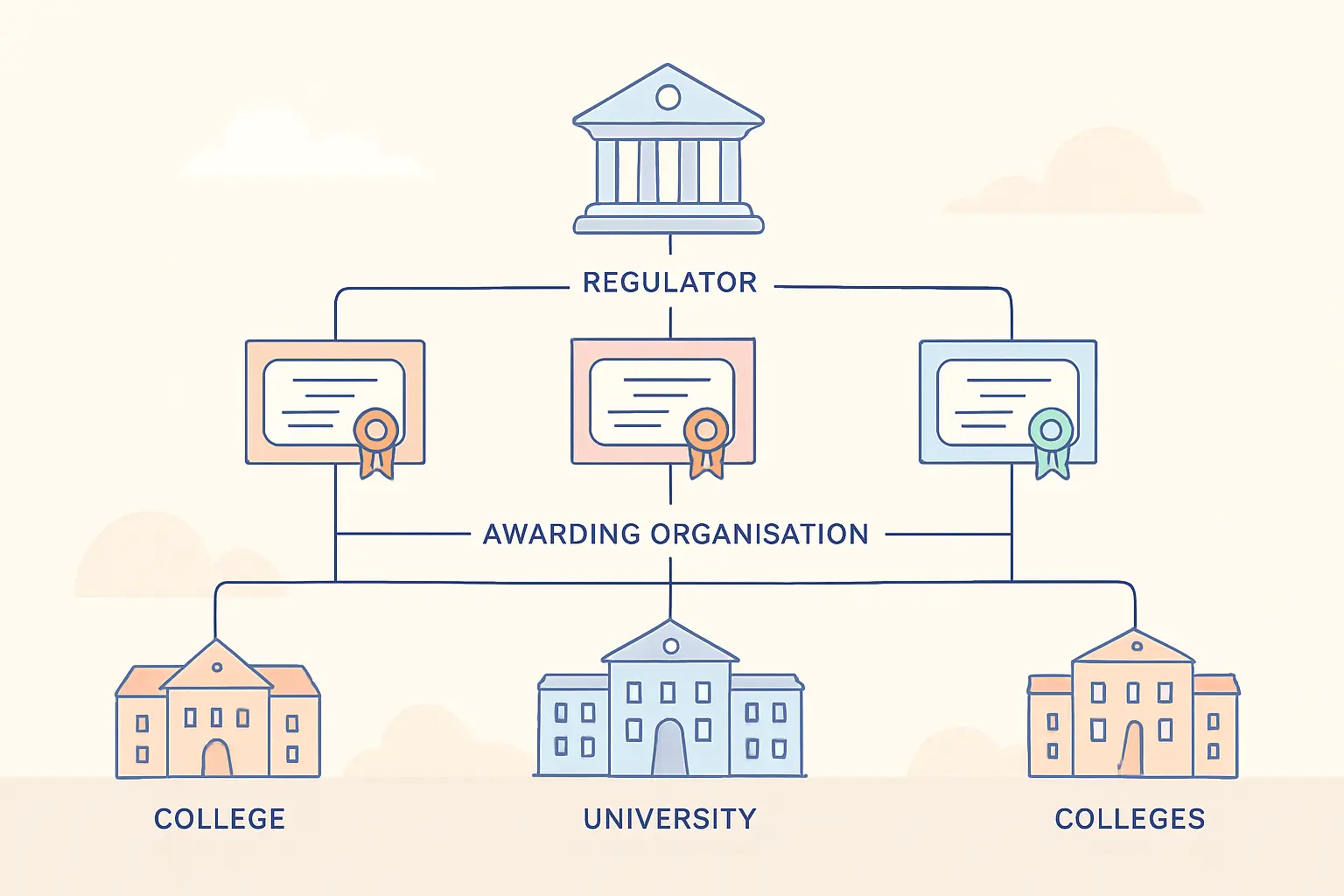
UK qualifications run through three separate tiers: a regulator that sets and polices standards, an awarding organisation that owns and issues the qualification, and a centre — a college, university or training provider — that delivers and assesses it. Your certificate carries the awarding organisation’s name, not your college’s, and that catches people out.
Each UK nation regulates separately, so the answer to “who regulates my qualification” depends on where you study as much as on what you study. This page maps the whole structure.
The three tiers
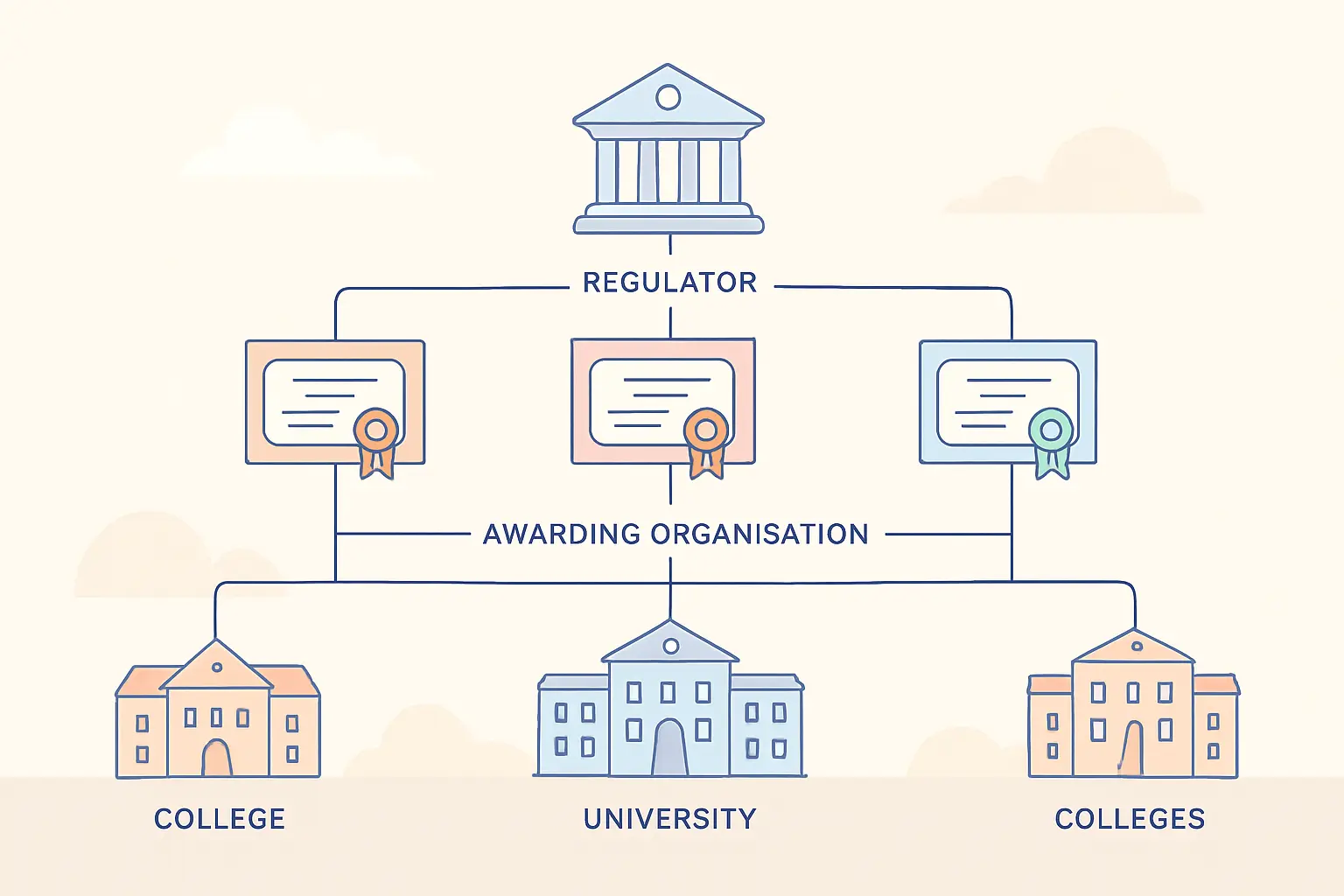
| Tier | What it does | Examples |
|---|---|---|
| Regulator | Sets standards, recognises awarding organisations, maintains public confidence | Ofqual (England), QAA (UK higher education quality) |
| Awarding organisation | Owns the qualification specification, sets the assessment rules, issues the certificate | Pearson, Qualifications Scotland, Access Validating Agencies |
| Centre | Delivers teaching, assesses learners, internally verifies | Your college, university or training provider |
The practical consequence: if your qualification is awarded by Pearson and taught at a local college, the rules that govern how you are assessed come from Pearson, and your college applies them. When your tutor says “that is the awarding body’s rule”, they are usually right.
Regulators, nation by nation
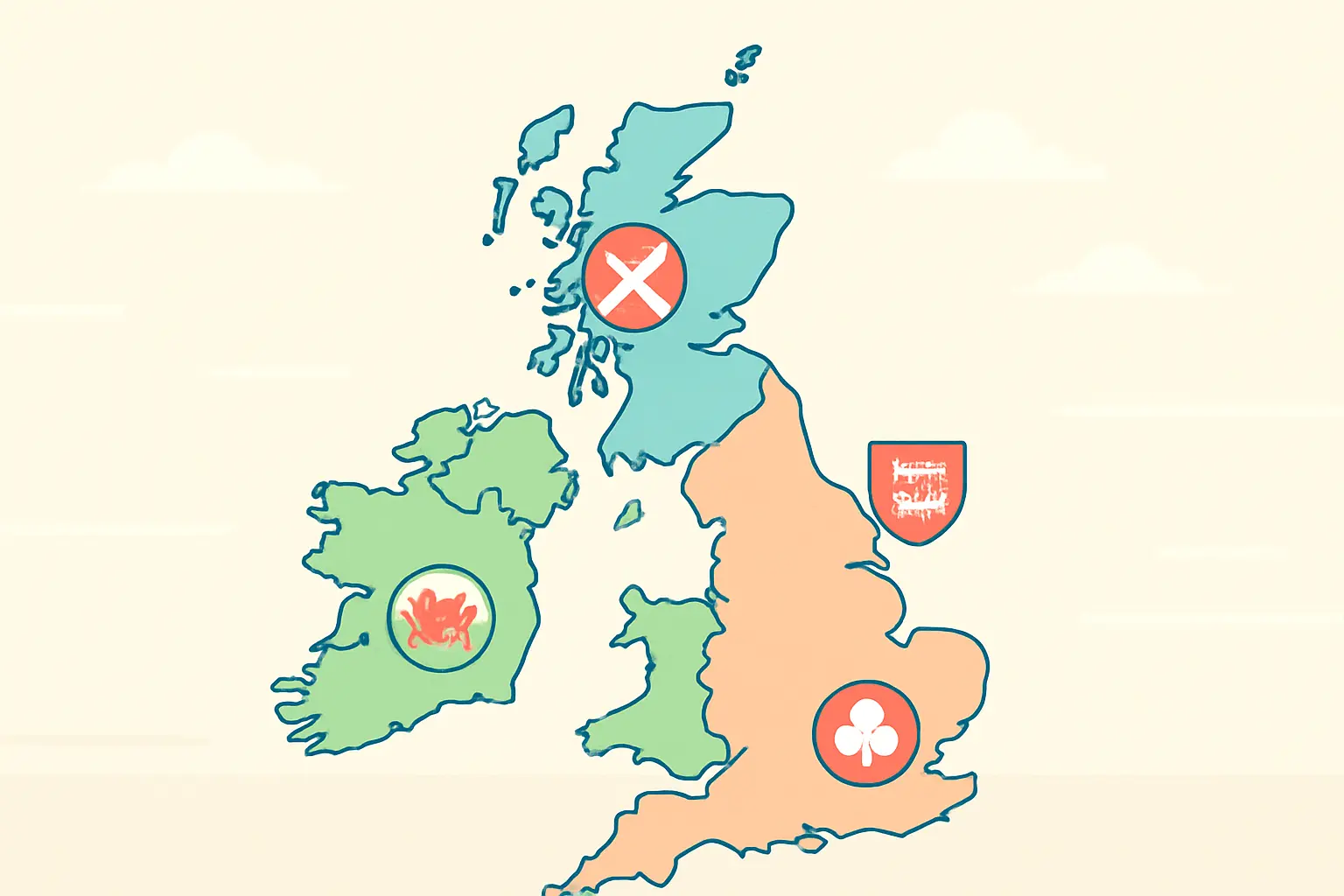
England — Ofqual. The Office of Qualifications and Examinations Regulation “regulates qualifications, examinations and assessments in England”. It is a non-ministerial government department with jurisdiction in England, based in Coventry, with 348 permanent employees as of March 2025. Ofqual publishes accredited official statistics on regulated qualifications — we cover its quarterly certificate figures in our vocational qualification statistics.
Scotland — a separate system entirely. Scotland uses the Scottish Credit and Qualifications Framework, maintained by the SCQF Partnership, which runs to 12 levels rather than England’s nine. Scottish national qualifications and Higher Nationals are awarded by Qualifications Scotland — the body formerly known as the Scottish Qualifications Authority, which still appears as SQA across a great deal of published material.
Wales and Northern Ireland each have their own regulator: Qualifications Wales and CCEA Regulation. Sourcing note: the Qualifications Wales website did not respond when this page was compiled, so no further detail is asserted here.
Higher education across the UK — QAA. The Quality Assurance Agency maintains the UK Quality Code and the qualifications frameworks for higher education, and also has a distinct role as the regulator of the Access to HE Diploma.
Technical education — Skills England. T Levels are based on the same standards as apprenticeships, designed by employers and approved by Skills England. This is a genuine change worth noting: much published material still credits the Institute for Apprenticeships and Technical Education with this role.
Awarding organisations: who actually issues your certificate
Awarding organisations own the qualification. A handful account for most regulated vocational provision in England — Pearson (which awards BTECs and BTEC Higher Nationals), City & Guilds, NCFE and others — while Qualifications Scotland performs the equivalent role north of the border.
The distinction that matters to you is that the same subject at the same level can be awarded by different organisations with different assessment rules. A Level 5 qualification from one awarding organisation may be assessed by portfolio and from another by examination. Check the specification, not the course title.
Access to HE has its own layer: Access Validating Agencies
The Access to HE Diploma works differently again. Rather than one national syllabus, courses are devised locally by Access Validating Agencies licensed by QAA — which is why students studied on 176 different Diploma titles in 2022-23.
The AVAs are: Agored Cymru, AIM Qualifications and Assessment Group, Ascentis, Cambridge Access Validating Agency, Gateway Qualifications, LASER Learning Awards, OCN London, Open Awards, and Skills and Education Group Access.
If you are choosing an Access course, the AVA determines the unit structure and grading of your particular Diploma. Our Access to HE Diploma statistics cover who takes these courses and where they lead.
Professional bodies are a separate system again
Professional registration is not a qualification in the regulated sense, and it is not governed by Ofqual. Professional bodies set their own competence standards and run their own assessment.
The Engineering Council is the clearest example: it maintains four registers — EngTech, IEng, CEng and ICTTech — sets the standard in UK-SPEC, and delegates assessment to licensed professional engineering institutions. We cover that assessment in our guide to the Professional Review report for CEng or IEng. Bodies such as CIPD combine both models, offering regulated qualifications alongside their own membership grades.
How to check who governs your qualification
- Find the awarding organisation on your course page or specification — not the college name.
- Find the qualification number if it has one. Regulated qualifications carry a reference on the regulator’s public register.
- Check the level against the framework for the nation you are studying in. Our guide to RQF and FHEQ levels covers this, including why a Scottish HND is SCQF Level 8.
- Treat marketing language with suspicion. “Accredited”, “certified” and “recognised” are not protected terms. A qualification is regulated or it is not, and the register is the only thing that answers that.
This matters most for career-change courses sold online. An unregulated certificate can still be useful — many vendor and industry certifications are highly valued — but it will not carry a level, will not appear on a framework, and cannot be assumed to count for university entry.
Frequently asked questions
Who regulates qualifications in England?
Ofqual — the Office of Qualifications and Examinations Regulation — which regulates qualifications, examinations and assessments in England as a non-ministerial government department.
Is my college the awarding body?
Usually not. Colleges are centres that deliver and assess; the awarding organisation owns the qualification and issues the certificate. Universities are the main exception, as they award their own degrees.
Who awards Scottish qualifications?
Qualifications Scotland, previously the Scottish Qualifications Authority. Both names remain in circulation, and Scottish qualifications sit on the 12-level SCQF rather than on the framework used in England, Wales and Northern Ireland.
Who approves T Levels?
Skills England. T Levels are based on the same standards as apprenticeships and designed by employers. Material naming the Institute for Apprenticeships and Technical Education is out of date on this point.
What is an Access Validating Agency?
An organisation licensed by QAA to validate Access to HE Diplomas. Because courses are devised locally rather than nationally, students studied on 176 different Diploma titles in 2022-23.
Does QAA regulate degrees?
QAA maintains the UK Quality Code and the higher education qualifications frameworks, and regulates the Access to HE Diploma. Universities award their own degrees under their own degree awarding powers.
How do I know if a course is regulated?
Find the awarding organisation and the qualification number, then check the regulator’s public register. Words such as “accredited” and “recognised” are not protected and do not establish that a qualification is regulated.
Once you know which awarding organisation owns your qualification, its specification is the document your assignments are actually assessed against. Tesify maps an outline to those stated learning outcomes, keeps references consistent and produces an AI-use declaration for submission — a starting draft to rewrite in your own words.
Write your thesis with AI
Structure, draft, cite, and format your thesis faster with Tesify’s AI writing tools, automatic bibliography, and plagiarism checker. Free to start, no credit card required.






Leave a Reply