

The Access to HE Diploma is a Level 3 qualification that prepares adults without traditional entry qualifications for degree-level study. In 2022-23 — the most recent year the Quality Assurance Agency has published — 38,220 students registered for one, and 19,320 Access students were accepted into higher education for September 2023 entry.
This page sets out what the published figures actually say: how many people take the Diploma, how many progress, who they are, what they go on to study and where. It also explains why the headline demographic numbers depend heavily on which instrument you read.
How many people take the Access to HE Diploma?
Registrations fell between the two most recent published years. QAA’s Key Statistics 2022-23 records 38,220 students registered to study an Access to HE Diploma, against 40,855 in 2021-22 — a drop of 2,635, or about 6.5%. The same publication marks a milestone in the other direction: 2022-23 was the year the one millionth student was registered under QAA’s custodianship of the qualification.
Provision remains unusually varied for a single named qualification. Students studied on 176 different Diploma titles in 2022-23, because Access courses are devised locally by Access Validating Agencies rather than issued as one national syllabus.
How many Access to HE students get into higher education?
19,320 Access to HE students who applied through UCAS were accepted for September 2023 entry, down from 22,630 the year before. Read alongside the registration figures, both measures moved in the same direction across the period.
| Measure | 2021-22 | 2022-23 | Change | Source |
|---|---|---|---|---|
| Students registered for an Access to HE Diploma | 40,855 | 38,220 | −2,635 | DfE / AVAs |
| Access students accepted into higher education | 22,630 | 19,320 | −3,310 | UCAS |
A caution on arithmetic: these two rows count different populations at different stages, and the acceptance figure covers only applicants who went through UCAS. Dividing one by the other does not give a progression rate, and QAA does not publish one.
Who takes an Access to HE Diploma?
This is where the published data needs care, because QAA reports demographics from two separate instruments that disagree — and on two characteristics they point in opposite directions.
| Characteristic | Entrants to HE (UCAS) | Other Level 3 (UCAS) | Registered students (DfE/AVAs) | Other Level 3 (DfE/AVAs) |
|---|---|---|---|---|
| Female | 74% | 56% | 76% | 59% |
| Aged over 25 | 52% | 11% | 60% | 58% |
| From ethnic minorities | 39% | 34% | 24% | 27% |
| With a disability | 28% | 21% | 17% | 19% |
| From a disadvantaged area | 24% | 11% | 39% | 24% |
On the UCAS measure, Access entrants are more likely than other Level 3 entrants to be from an ethnic minority (39% against 34%) and to have a disability (28% against 21%). On the DfE/AVA measure of everyone registered, both comparisons reverse (24% against 27%, and 17% against 19%).
The explanation is in the comparison group, not in the Access cohort. “Other Level 3 qualifications” means something different in each dataset. In UCAS data it is dominated by school-leavers holding A-levels, which is why only 11% of that group is over 25. In the DfE/AVA registration data it includes the whole adult further education population, where 58% are over 25. The two datasets are answering different questions, so the honest reading is to name the instrument every time you quote a figure — and never to mix a numerator from one with a denominator from the other.
What both instruments agree on is the core profile: Access to HE is a predominantly female, predominantly adult route. Female representation sits at 74-76% on either measure, and a majority of students are over 25 on either measure. That profile has implications for how the qualification is studied — often part-time, alongside work and caring responsibilities — which is a pattern that continues into degree study for many of the same students. Our data on first-generation university students covers the wider widening-participation picture.
What do Access to HE students go on to study?
Destinations are heavily concentrated in health. Among Access students accepted for September 2023 entry, nursing and midwifery alone accounted for 7,105 — more than the next four subject groups combined.
| Subject group | Access students accepted, September 2023 |
|---|---|
| Nursing and midwifery | 7,105 |
| Allied health | 2,065 |
| Health and social care | 1,100 |
| Business and management | 995 |
| Psychology | 990 |
The practical consequence is that a large share of Access students are heading for programmes with placement hours, professional body requirements and reflective assessment built in from year one. If that is your route, the writing you will be set looks rather different from a standard essay — our guide to writing a midwifery dissertation shows where those programmes end up.
Where do Access to HE students study?
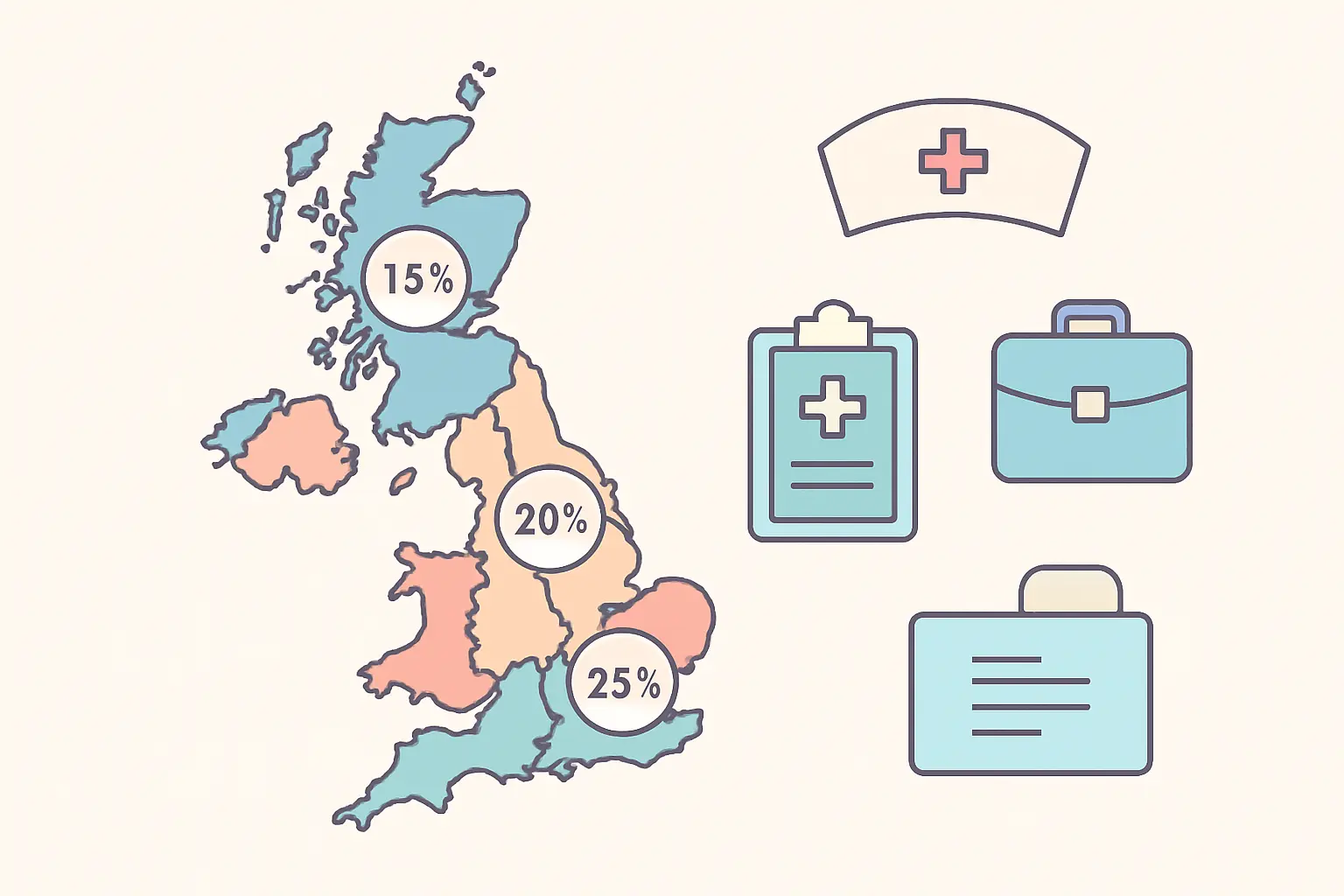
Access students are markedly local. 77% stayed in their own region for higher education, and provider nations break down as England 11,310 (93% of Access entrants), Wales 755 (6.2%), Scotland 75 (0.6%) and Northern Ireland 20 (0.2%).
Regional retention varies more than the headline suggests, from 89% in the North East down to 58% in the South East:
| Region | Stayed in region | Region | Stayed in region |
|---|---|---|---|
| North East | 89% | London | 78% |
| Scotland | 86% | Yorkshire & the Humber | 78% |
| North West | 85% | Northern Ireland | 75% |
| Wales | 82% | South West | 75% |
| West Midlands | 79% | East Midlands | 69% |
| East | 68% | South East | 58% |
Low mobility is what you would expect from a cohort that is mostly over 25 and often working locally. It also means the choice of Access provider effectively narrows the realistic list of universities before any application is made — worth knowing before you enrol rather than after. The UCAS application process and student finance rules both work differently for mature applicants than for school-leavers.
Why is the most recent data from 2022-23?
Because that is what has been published. QAA’s Key Statistics 2022-23 appeared in June 2024 and explicitly notes that entrant data depended on Jisc publishing the HESA Student bulletin and open data, with a commitment to update once that became available. Anyone quoting an “Access to HE 2026” figure is either using 2022-23 data or has a source QAA does not.
This matters for referencing. If you cite these numbers in an assignment, give the academic year the data covers rather than the year you read it, and name the collecting body — DfE and the Access Validating Agencies for registrations, UCAS for entry.
Frequently asked questions
How many people do an Access to HE Diploma each year?
38,220 students registered in 2022-23, the most recent year QAA has published, down from 40,855 in 2021-22.
What percentage of Access to HE students get into university?
QAA does not publish a progression rate, and the published figures do not support calculating one. Registrations and acceptances come from different collectors and cover different populations, so dividing 19,320 by 38,220 would not give a meaningful percentage.
What do most Access to HE students study at university?
Health subjects dominate. Nursing and midwifery accounted for 7,105 accepted applicants for September 2023 entry, ahead of allied health (2,065), health and social care (1,100), business and management (995) and psychology (990).
Is the Access to HE Diploma mostly taken by mature students?
Yes. A majority are over 25 on both published measures — 52% of UCAS-recorded entrants and 60% of all registered students. It is designed as a return-to-education route for adults.
Do Access to HE students move away to study?
Mostly not. 77% entered higher education in their home region, ranging from 89% in the North East to 58% in the South East.
Which countries do Access to HE students study in?
Overwhelmingly England, with 11,310 entrants (93%). Wales took 755 (6.2%), Scotland 75 (0.6%) and Northern Ireland 20 (0.2%).
Using these figures in your own work
Statistics like these are most useful in an introduction or a rationale, where you need to establish that a population matters before you say anything about it. Two rules keep you out of trouble: quote the academic year the data covers, and name the instrument. Both of the reversals in the demographic table above come from ignoring the second rule.
Tesify builds the scaffolding around an assignment — a section outline, formatted references and an AI-use declaration you can submit. It gives you a starting draft to rewrite in your own words and defend, not a finished piece of work; the argument and the understanding have to be yours.
Write your thesis with AI
Structure, draft, cite, and format your thesis faster with Tesify’s AI writing tools, automatic bibliography, and plagiarism checker. Free to start, no credit card required.






Leave a Reply