
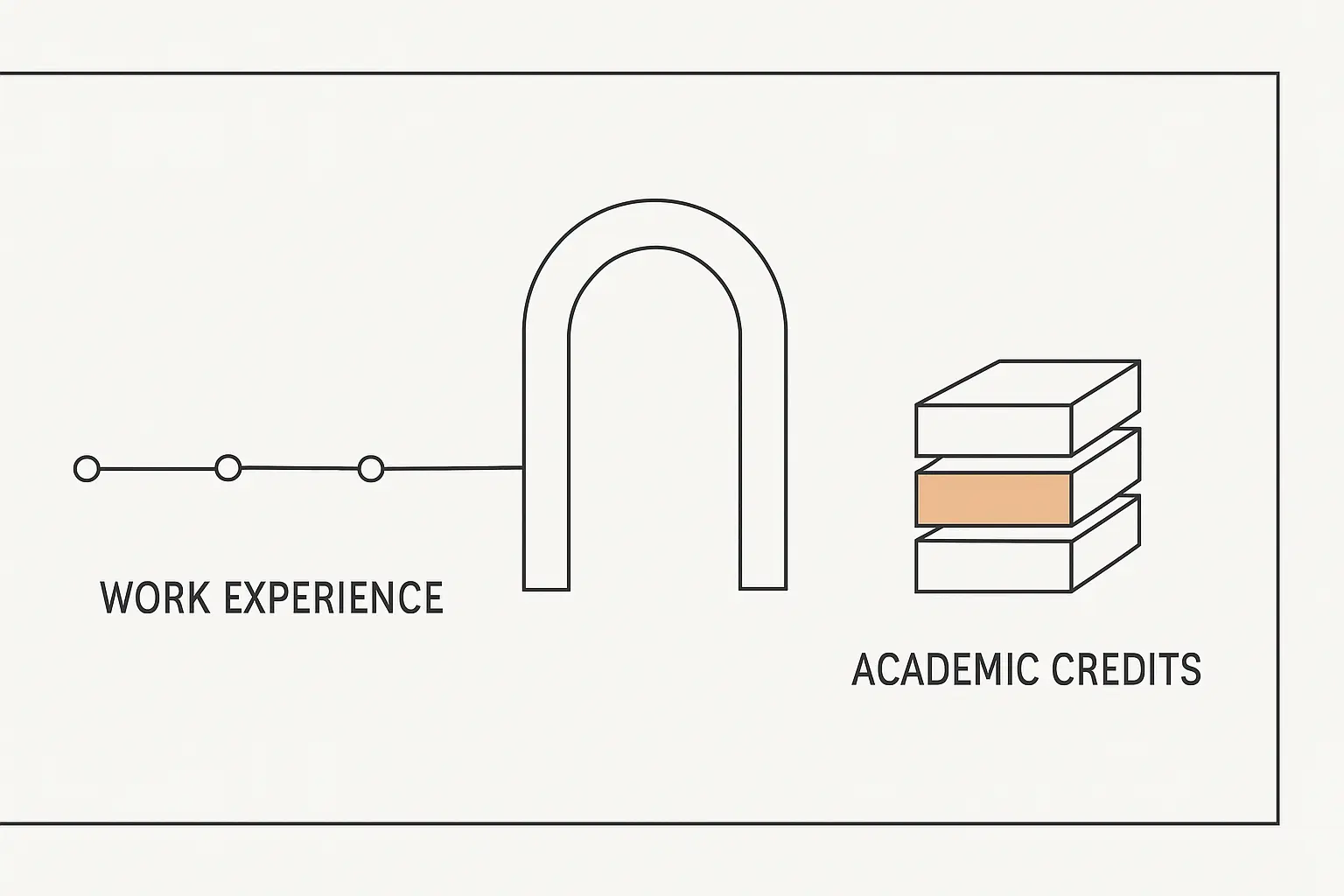
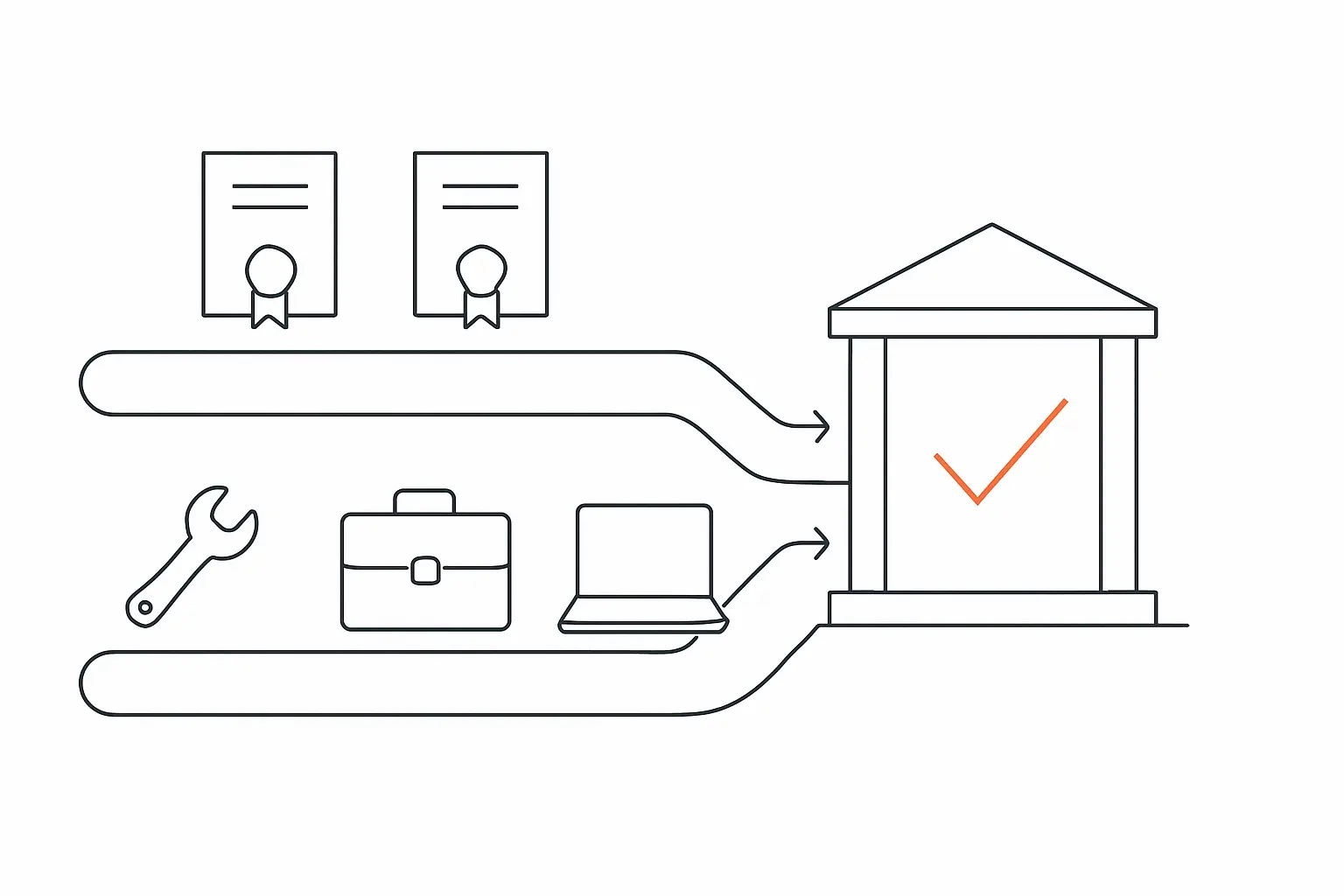
Recognition of prior learning is the process by which an institution awards credit, or waives a requirement, for learning you did before you enrolled. It divides into two kinds: certificated prior learning, where you already hold a qualification, and experiential prior learning, where the knowledge came from work rather than from a course.
The second kind is the one worth understanding, because it is more widely available than most people assume and almost never advertised. It is also assessed rather than granted — the burden of evidence sits with you.
The two kinds, and why the distinction matters
| Certificated prior learning | Experiential prior learning | |
|---|---|---|
| Source of the learning | A completed qualification | Work, voluntary or life experience |
| Evidence | Transcript and specification | A claim you construct and evidence |
| Main question asked | Does this map onto our module? | Can you demonstrate the learning outcomes? |
| Effort required | Low — mostly administrative | High — often equivalent to an assignment |
| How often it is granted | Routinely | Less often, largely because fewer people ask |
The critical thing to understand about the experiential route is what is actually being recognised. It is not your years of service, your job title or your responsibility. It is the learning those produced — and you have to show it maps onto specific learning outcomes.
“I managed a team of twelve for eight years” evidences nothing on its own. “I can evaluate competing approaches to performance management and justify a selection against organisational context, as demonstrated by these three decisions” is a claim against a learning outcome. The first is a career fact; the second is an academic argument about it.
The principle is well established, not a favour
It is worth knowing that this is a recognised route rather than an exception someone might grant you if they are feeling generous.
The Engineering Council states the position plainly for professional registration: formal education is one way of demonstrating the necessary underpinning knowledge and understanding, but it is not the only way. Many potential registrants have not had formal training to the required level but are able to demonstrate they acquired the necessary underpinning knowledge through substantial work experience, and applicants who acquired it through experiential learning or other qualifications can submit that information for an initial assessment.
That is a regulator saying, in its own published guide, that the experience route to a chartered title is legitimate. Our guide to the Professional Review report for CEng or IEng covers how that assessment works in practice.
Three systems, three different mechanics
The term covers genuinely different processes, and confusing them wastes time.
In higher education, recognition of prior learning typically produces credit towards a named award, or exemption from specific modules, or admission with advanced standing. It is decided by the institution against its own regulations — there is no national entitlement, and two universities will treat identical evidence differently.
In professional registration, prior learning is assessed against a competence standard rather than converted into credit. You are not exempted from anything; you are demonstrating you already meet the requirement.
In vocational qualifications, existing competence can often be evidenced directly rather than retrained, because the assessment model already asks whether you can do the thing. Our guide to what an NVQ is covers that evidence model, which is close to what an experiential claim looks like in any system.
The trap nobody mentions: funding

This is where good decisions go wrong, and it is worth checking before you accept an offer of credit.
GOV.UK is clear that you will usually only get student finance for your first higher education qualification, even if you funded the previous one yourself, with limited funding available in certain circumstances and for some courses. If you already hold a qualification at the same or a higher level, that rule may bite regardless of how much credit you are offered.
There is also a subtler interaction. Entering a programme with advanced standing shortens it, which changes the number of years you are funded for. That is usually good — less debt, less time — but it is worth confirming the arithmetic with the institution’s funding team rather than assuming, because part-time intensity thresholds and entitlement calculations do not always behave the way the shortened timetable suggests. Our guide to HNC, HND, foundation degree and year one routes covers the related funding asymmetries at Levels 4 and 5.
How to make a claim that succeeds
- Ask before you apply, not after you enrol. Most institutions have a deadline tied to the start of the programme, and a claim made in week six is often simply out of time.
- Get the module specifications first. You are writing against stated learning outcomes, so you need the exact wording. Working from a prospectus summary loses the detail your evidence has to match.
- Map outcome by outcome. Take each learning outcome and name the evidence that demonstrates it. Gaps are fine to find at this stage; they tell you which modules to claim for and which to simply take.
- Evidence learning, not employment. Job descriptions, appraisals and reference letters establish that you did a role. They do not establish what you learned. Pair them with your own analytical account.
- Expect to write. A serious experiential claim is often comparable in length and difficulty to the assignment it replaces. People abandon claims when they discover this; if the module is one you would find easy, taking it may genuinely be less work.
- Check currency. Institutions commonly discount learning beyond a certain age, particularly in fast-moving fields. Ten-year-old technical knowledge may not be accepted where ten-year-old management experience would be.
When not to claim
Three cases where the honest answer is to take the module.
If the credit sits in the final stage of your award, some institutions restrict how much of the final level can be claimed, precisely because the award has to mean something about work done with them. If the module is foundational to everything after it, exemption can leave you missing shared vocabulary the rest of the programme assumes. And if your evidence is thin, an unsuccessful claim costs you the effort of making it and gains nothing.
There is also a self-knowledge question worth being honest about. Experiential learning tends to be deep but narrow — you know your organisation’s way of doing something extremely well. A module may be teaching the range of approaches and the reasoning for choosing between them, which is a different thing from the one you have mastered.
Frequently asked questions
What is recognition of prior learning?
A process by which an institution awards credit or grants exemption for learning completed before enrolment. It covers both certificated learning from previous qualifications and experiential learning from work or life experience.
Can I get credit for work experience without any qualifications?
Potentially, through an experiential claim. It is a recognised route rather than an exception — the Engineering Council, for example, states that formal education is not the only way to demonstrate the required underpinning knowledge.
Is recognition of prior learning guaranteed?
No. It is assessed against learning outcomes and decided by the institution under its own regulations. There is no national entitlement, and different institutions reach different decisions on identical evidence.
How much credit can I claim?
It varies by institution, and most place limits, particularly on the final stage of an award. Ask for the specific regulations rather than assuming a proportion.
Will claiming credit affect my student finance?
It can. You will usually only receive student finance for your first higher education qualification, and entering with advanced standing changes the length of the programme you are funded for. Confirm the position with the institution’s funding team before accepting.
What evidence do I need for an experiential claim?
Evidence of learning rather than of employment. Job descriptions and appraisals show you held a role; you also need your own analytical account demonstrating that you meet the specific learning outcomes.
Does old experience still count?
Often, but institutions commonly apply currency limits, particularly in technical fields where practice has moved on. Management and interpersonal learning tends to be treated as more durable than technical knowledge.
An experiential claim is a piece of academic writing: outcome-by-outcome, evidenced, and argued. Tesify can map an outline against the learning outcomes you are claiming and keep supporting references consistent — a starting draft to rewrite in your own words, because the claim is about your experience and only you can evidence it.
Write your thesis with AI
Structure, draft, cite, and format your thesis faster with Tesify’s AI writing tools, automatic bibliography, and plagiarism checker. Free to start, no credit card required.




Leave a Reply