
Where to Find Primary Legal Sources for Your Law Dissertation (2026)
A law dissertation is judged on whether you read the law correctly, not on whether you found a lot of commentary about it. That makes your source list different from almost every other discipline: your primary data is the statute book and the law reports, and both are available free, in official versions, from the bodies that publish them.
The problem is rarely access. It is that the free official services publish several versions of the same provision, and citing the wrong one is a substantive legal error rather than a formatting slip. This guide lists the repositories that matter, states what each one actually covers, and flags the version traps that quietly cost marks.
Why primary sources decide a law dissertation’s grade
Most disciplines treat sources as evidence about the object of study. Law is unusual because the source frequently is the object of study. When you argue that section 3 of an Act requires a particular reading, the text of section 3 is not supporting material — it is the thing your argument is about. A textbook’s paraphrase of it cannot do that work.
This is the practical meaning of the primary/secondary distinction in a legal context, and it is stricter here than elsewhere. Our guide to the difference between primary and secondary sources covers the general principle; in law, the consequence is that a paragraph resting entirely on a textbook citation is usually a paragraph that has not yet made its argument.
1. legislation.gov.uk — the official statute book
Operated alongside The National Archives, legislation.gov.uk is the official home of UK legislation. Two things about it are worth knowing before you cite anything from it.
The version trap: original vs revised
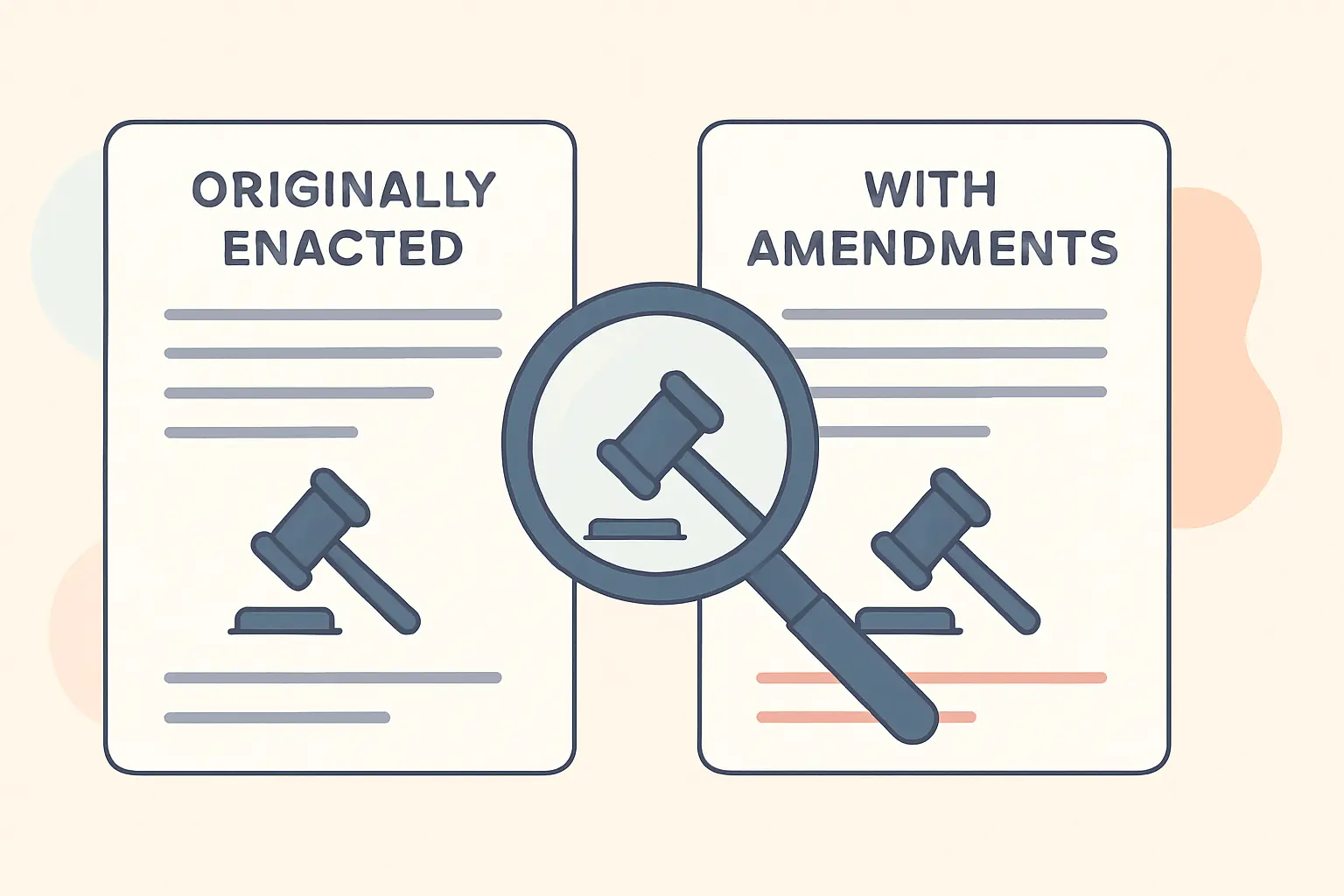
The service distinguishes the legislation as it was originally made from the legislation as it stands now. In its own words, “by ‘revised’ we mean that amendments made by subsequent legislation are incorporated into the text.” An Act passed in 1998 and amended six times since has an original text and a current text, and they can differ substantially.
If your argument concerns what the law requires today, you need the revised version. If it concerns what Parliament enacted at the time — a common move in historical or interpretive argument — you need the original. Stating which one you are working from, and why, is a mark of competent legal research. Silently mixing them is the single most common sourcing error in undergraduate legal writing.
Extent and commencement: two questions students skip
The service defines geographical extent as “the geographical area within the UK to which a piece of legislation (or part/section of a piece of legislation) applies.” Extent operates at provision level, not just at Act level — so a single Act can apply differently in England, Wales, Scotland and Northern Ireland, section by section.
Commencement is separate again: an Act “may come into force immediately, on a specific future date, or in stages.” A provision that has been enacted but never commenced is not yet law, and building an argument on it without saying so is a serious error.
Knowing which kind of legislation you are citing
legislation.gov.uk’s own search taxonomy is a useful map of what “legislation” covers. Under primary legislation it lists UK Public General Acts, UK Local Acts, UK Private and Personal Acts, Acts of the Scottish Parliament, Acts of Senedd Cymru, Church Measures and Acts of the Northern Ireland Assembly, among others. Under secondary legislation it lists UK Statutory Instruments, Welsh Statutory Instruments, Scottish Statutory Instruments, Northern Ireland Statutory Rules and Church Instruments.
| Check | Question it answers | Why it matters to your argument |
|---|---|---|
| Version | Original or revised? | Determines whether you are describing past or present law |
| Extent | Which UK nations does this provision apply to? | A claim about “UK law” may only hold in England and Wales |
| Commencement | Is it in force, and since when? | Uncommenced provisions are not yet operative law |
| Type | Primary or secondary legislation? | Changes the interpretive approach and the citation form |
2. Find Case Law (The National Archives) — judgments and tribunal decisions
Find Case Law is The National Archives’ service for judgments. It states its coverage directly: it provides “free access to court judgments and tribunal decisions from England and Wales, plus UK-wide cases from the Supreme Court and Privy Council.”
Read that scope carefully, because it defines the limits of what you can source there. It is an England and Wales service with UK-wide coverage only for the Supreme Court and the Privy Council. Scottish and Northern Irish first-instance and appellate decisions are not within that stated scope, so a comparative or devolution-focused dissertation will need additional routes.
The service is published as a Beta and organises its own guidance around understanding case law, reading judgments, courts and coverage, and a separate permissions and licensing section — worth reading before you reproduce long extracts, since reuse of judgments carries licensing terms.
You can search by neutral citation as well as by keyword and party name. Neutral citations are the court-assigned, publisher-independent references, which makes them the reliable way to pin a judgment that appears in several places.
3. The Law Commission — where live reform questions live
The Law Commission is the statutory body that reviews the law of England and Wales and recommends reform. For a dissertation writer it serves a purpose no case database can: it tells you which legal questions are currently considered unsettled enough to be worth official review.
Its 14th Programme of Law Reform was launched on 4 September 2025. The Commission states that “the ten new projects in the 14th Programme are”: agricultural tenancies; commercial leasehold; consent in the criminal law; deeds; the defence of insanity; desecration of a corpse; management of housing estates; ownerless land; product liability; and public sector automated decision-making. It notes that “the timetable for each new project will be announced in due course,” so check the individual project pages rather than assuming a publication date.
Consultation papers are particularly useful source material because they set out the existing law, identify its defects and canvass options — which is close to the structure of a reform-oriented dissertation chapter.
4. Explanatory Notes and impact assessments
legislation.gov.uk identifies the explanatory material that accompanies legislation — Explanatory Notes, Explanatory Memoranda and Impact Assessments — as documents published to make legislation more accessible.
These are genuinely useful and frequently misused. They can illuminate the purpose and intended operation of a provision. They are not the enacted text, they do not bind a court, and quoting an Explanatory Note as though it were the statute is an error an examiner will notice immediately. Treat them as authoritative evidence of context, not of legal meaning.
5. Official statistics, for socio-legal work
If your dissertation makes any empirical claim about how the legal system behaves — delay, volumes, outcomes, appeal rates — that claim needs an official data series rather than a news report. The Ministry of Justice publishes court and justice statistics through GOV.UK collections, including a quarterly civil justice statistics series.
Use the publisher’s own stated figure and the publisher’s own stated change. Do not compute a trend by subtracting two rounded percentages from different releases: published changes are usually derived from unrounded data, so your subtraction and the publisher’s figure will disagree, and yours will be the one that is wrong.
For quantitative work drawing on wider social data, our list of free datasets and open data repositories covers the cross-disciplinary archives.
6. United States sources, for comparative chapters
Two free, openly accessible services are worth knowing if your comparative chapter reaches the United States. GovInfo is run by the U.S. Government Publishing Office and provides official federal government publications. CourtListener describes itself as a non-profit free legal search engine and alert system, covering court opinions.
If you cite US material you will also need the right citation format — our Bluebook citation guide for law students covers the conventions, which differ substantially from OSCOLA.
A note on sources you cannot open
Some well-known legal databases sit behind bot protection or subscription walls, and some university-recommended links rot. Two rules save time here. First, a page returning a success status is not necessarily the page you wanted — check the title before you trust it, because error pages and bot challenges are frequently large and superficially complete. Second, if you cannot open a source, you cannot cite it. Find an official alternative or drop the claim; do not cite a database entry you have only seen summarised.
This applies with particular force to AI-assisted research. Fabricated case citations that look entirely plausible are a documented failure mode, and in law they are unusually damaging because a fake authority can invalidate an entire argument. Our guide on using AI for a law dissertation sets out where the line sits.
Citing what you find
In the UK, legal writing overwhelmingly uses OSCOLA, which is footnote-based and has specific forms for cases, statutes and secondary sources. Our OSCOLA referencing guide covers how to cite cases, statutes and legal sources, including the neutral citation format you will have used to find the judgment in the first place.
Frequently asked questions
Are free official legal sources good enough for a dissertation?
Yes — for primary law they are the best available, because they are the official versions published by the bodies responsible for them. Subscription databases add editorial commentary, case summaries and citator tools, which are conveniences rather than authority.
Should I cite the original or the revised version of an Act?
Whichever your argument is actually about, and say which. Use the revised text for claims about current law and the original for claims about what was enacted. State the version you relied on and the date you consulted it.
Does a doctrinal dissertation need ethics approval?
Research using only published legal materials normally does not involve human participants and so usually falls outside the ethics approval requirement — but the decision belongs to your institution, and empirical socio-legal work involving interviews certainly does need approval. See whether you need ethical approval for the general rules.
What is a neutral citation?
A court-assigned reference to a judgment that does not depend on any particular law report series, which makes it the stable way to identify a case across services.
Can I rely on Explanatory Notes to interpret a section?
They are evidence of context and intended operation, not of legal meaning, and they are not part of the enacted text. Use them to explain purpose; never substitute them for the words of the provision.
Turn your sources into a chapter
Finding the law is the first half of a doctrinal dissertation. The second is building an argument from it that holds together across chapters. Tesify helps you draft, structure and reference that argument while keeping every word your own — 100% written by you.
Write your thesis with AI
Structure, draft, cite, and format your thesis faster with Tesify’s AI writing tools, automatic bibliography, and plagiarism checker. Free to start, no credit card required.






Leave a Reply