
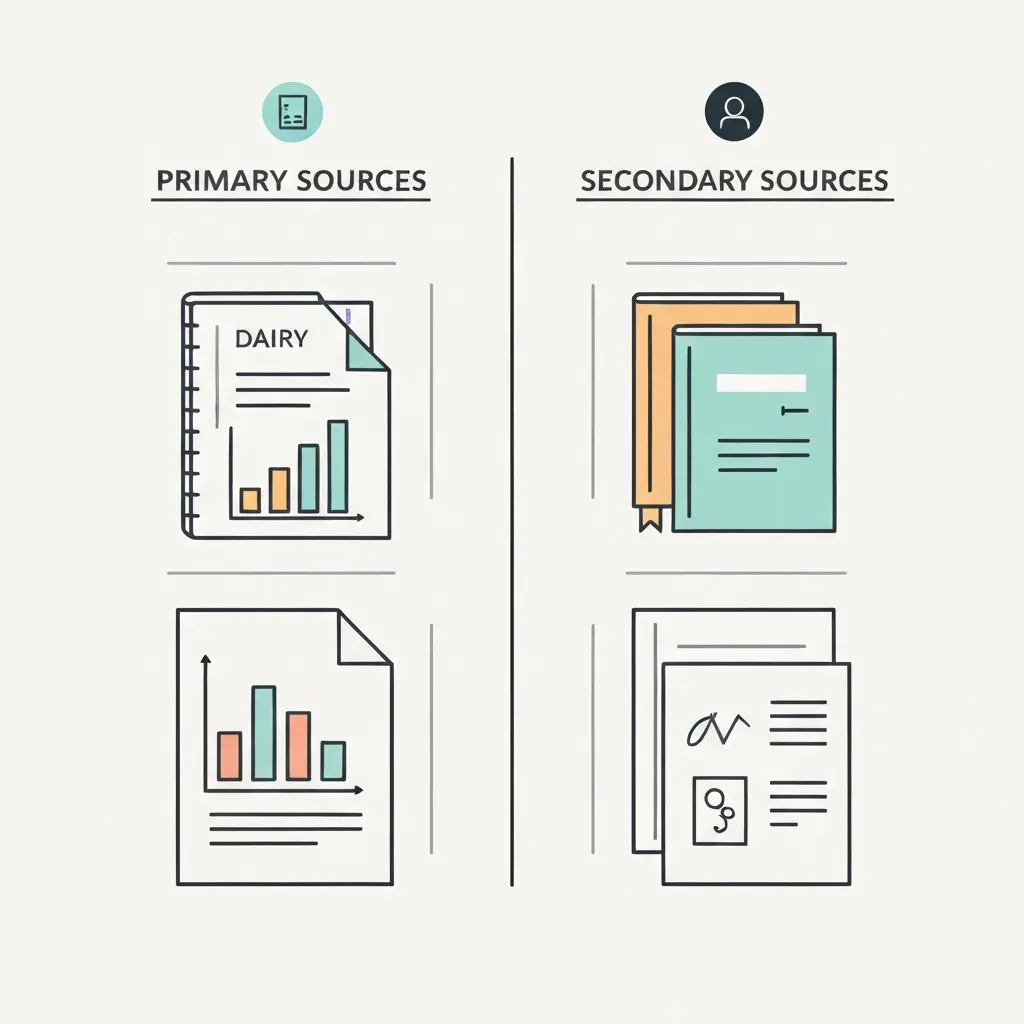
What Is the Difference Between Primary and Secondary Sources?
Understanding what is the difference between primary and secondary sources is one of the foundational skills of academic research — and one that many students discover they only partly understood when their supervisor marks up their literature review. The distinction sounds simple: primary sources are original; secondary sources are interpretations of originals. But the application is more nuanced than the definition suggests, and misclassifying your sources can create real problems in a thesis literature review, where demonstrating your command of the evidence base is part of what is being assessed.
This guide gives you precise definitions, concrete examples across multiple disciplines, a set of tests you can apply to any source to classify it correctly, and clear guidance on how to use both types strategically in your thesis. It also addresses the important point that the primary/secondary distinction is not absolute — the same document can be a primary source in one research context and a secondary source in another.
Core Definitions: Primary and Secondary Sources
Primary Sources
A primary source is the original, first-hand record of a subject. It was produced by someone with direct experience of, or direct involvement in, the thing being studied. Primary sources offer raw evidence that has not yet been filtered through another researcher’s interpretation.
Key characteristics of primary sources:
- Created at the time of the event or phenomenon being studied, or by someone who experienced it directly
- Present original data, testimony, or creative expression
- Have not been interpreted or analysed by a third party (within the source itself)
- Require the researcher to analyse and interpret them
Secondary Sources
A secondary source analyses, interprets, summarises, or synthesises primary sources. The author of a secondary source was not a direct witness to the events or phenomena being studied — they are one step removed, working with primary sources to build an argument or explanation.
Key characteristics of secondary sources:
- Created after the fact, drawing on primary evidence
- Provide analysis, interpretation, or synthesis of primary material
- Allow you to understand the existing scholarly conversation in your field
- Are your foundation for the literature review
Examples by Academic Discipline
The same categories of source can be primary or secondary depending on the discipline. This table shows how the distinction plays out across different fields:
| Discipline | Primary Sources | Secondary Sources |
|---|---|---|
| History | Diaries, letters, government documents, newspapers of the period, photographs, maps, census data | Academic histories, biographies, documentary films, textbooks |
| Literature | Novels, poems, plays, author’s letters and diaries | Literary criticism, biographies of authors, comparative studies |
| Psychology | Original experimental data, interview transcripts, survey responses, case studies | Literature reviews, meta-analyses, textbooks, review articles |
| Sociology | Original ethnographic fieldnotes, interview data, statistical datasets (e.g., census), survey results | Sociological monographs, journal articles that synthesise existing research, textbooks |
| Natural Sciences | Original research articles reporting experimental results, laboratory notebooks, datasets | Systematic reviews, meta-analyses, review articles, textbooks |
| Law | Statutes, case law, treaties, constitutions, legislative debates (Hansard) | Legal textbooks, journal articles, commentaries on legislation |
| Business / Management | Company annual reports, financial statements, interview data, original surveys, internal documents | Business strategy textbooks, case study analyses, industry reports |
| Philosophy | Original philosophical texts (Kant’s Critique of Pure Reason, Aristotle’s Ethics) | Commentaries, interpretive texts, philosophical encyclopaedias |
Tertiary Sources: What Are They?
Tertiary sources compile or index primary and secondary sources without adding original analysis. They include encyclopaedias (including Wikipedia), bibliographic databases, library catalogues, and textbooks that summarise established knowledge. Tertiary sources are useful for getting an initial orientation to a field, but they are rarely citable in a thesis because they do not offer original analysis or research.
Why the Classification Depends on Context
The same document can be a primary source in one research context and a secondary source in another. This is the most conceptually important aspect of the distinction — and the one most commonly misunderstood.
Consider a newspaper article reporting on a political speech in 1940:
- For a historian researching how the speech was received by the contemporary public, the newspaper article is a primary source — it is a direct record of how people responded at the time.
- For a researcher studying the speech itself and what the politician meant, the newspaper article is a secondary source — it is a journalist’s interpretation of what was said.
A more contemporary example: a published meta-analysis of studies on reading interventions is:
- A secondary source for a researcher studying the effectiveness of reading interventions — it synthesises primary research.
- A primary source for a researcher studying how meta-analyses in education are conducted or how research synthesis methods have evolved.
The practical implication: when you are classifying a source for your thesis, always ask “primary or secondary relative to my research question?” — not “primary or secondary in the abstract?”
How to Use Primary and Secondary Sources in Your Thesis
Most master’s theses use a combination of primary and secondary sources, but the balance differs significantly by discipline and methodology:
Literature Review
Your literature review is predominantly built from secondary sources — journal articles, academic books, and review papers that map the existing conversation in your field. The literature review demonstrates that you know the field, not that you have done primary research. Some disciplines (history, philosophy, literature) incorporate primary sources directly into the literature review; empirical disciplines (psychology, medicine, social science) generally do not.
Methodology and Data Chapters
If you are conducting original research, your data chapters are built from primary sources you generate yourself — your survey responses, interview transcripts, experimental results, field observations, or textual analyses. The novelty of your thesis typically lies here: your original contribution is primary evidence that did not previously exist.
Discussion and Conclusion
The discussion connects your primary findings to the existing secondary literature. This is where you explain what your primary evidence means in the context of what other scholars have found — and where the quality of your literature review pays off.
Common Mistakes Students Make
- Citing only secondary sources when the discipline and research question require primary evidence. In history, for instance, a thesis that relies entirely on what other historians have written without engaging with primary documents is unlikely to be considered original research.
- Treating peer-reviewed journal articles as primary sources by default. A journal article reporting original experimental data is a primary source; a journal article that reviews and synthesises other studies is a secondary source. The format does not determine the classification.
- Using tertiary sources (Wikipedia, encyclopaedias) as citable evidence. These are research starting points, not citable scholarly sources.
- Quoting secondary sources without reading the primary sources they cite. This is sometimes called “secondary citation” and is frowned upon in most academic contexts. If a secondary source references a primary document that seems important to your argument, locate and read the primary document directly.
For guidance on building a thorough reference list, see our article on the best citation generators compared for 2026 — which includes tools that help you manage both primary archival sources and standard secondary literature.
Evaluating Source Quality: Beyond the Classification
Knowing whether a source is primary or secondary is only the first step. You also need to evaluate its quality and reliability. A primary source can be biased, incomplete, or unrepresentative; a secondary source can be methodologically weak, outdated, or poorly evidenced. The same evaluation criteria apply to both types:
- Authority: Who produced this source? What are their credentials and institutional affiliation?
- Accuracy: Is the information verifiable? Are claims supported by evidence or reasoning?
- Currency: Is this source recent enough to be relevant? (In fast-moving fields like medicine or AI research, a source from 2020 may already be superseded.)
- Coverage: Does the source address your research question specifically, or only tangentially?
- Purpose: Was this source produced to inform, persuade, or sell something? What biases might that introduce?
For a complete framework on evaluating and citing sources correctly, see our guides on qualitative research methods for dissertation students and the literature review methodology guide.
Tesify Write structures your thesis chapters in a way that helps you balance primary and secondary sources appropriately — flagging sections where your analysis should be drawing on primary evidence rather than relying solely on secondary synthesis.
Frequently Asked Questions
Is a journal article a primary or secondary source?
It depends on the type of article. A journal article reporting original experimental results or fieldwork is a primary source. A journal article that reviews, synthesises, or meta-analyses the findings of other studies is a secondary source. The format (peer-reviewed journal) does not determine the classification — the content does.
Is a textbook a primary or secondary source?
Textbooks are usually secondary or tertiary sources. They synthesise and explain established knowledge in a field, drawing on primary and secondary literature rather than generating original evidence. In most academic contexts, textbooks are not considered strong citable sources for a thesis because they are written for teaching rather than research purposes — prefer the original studies the textbook summarises.
Is a biography a primary or secondary source?
A biography is typically a secondary source — the biographer interprets and analyses the life of their subject using primary sources (diaries, letters, interviews, official records). An autobiography, however, is a primary source — it is a first-hand account by the subject themselves. An autobiography studied as a literary text is a primary source; an autobiography cited for factual historical information is a more complex case that depends on your research question.
Should a thesis have more primary or secondary sources?
This depends entirely on your discipline and methodology. In history, literary studies, and philosophy, primary sources are central to the argument; secondary literature provides context and the scholarly conversation. In empirical disciplines like psychology, sociology, and natural sciences, the literature review is built from secondary sources, while the original contribution comes from primary data you collect yourself. Neither type is universally “better” — the right balance depends on your research question.
Is a documentary film a primary or secondary source?
A documentary film is typically a secondary source because it is made after the events it depicts and involves editorial choices about what to include and how to frame it. However, if the documentary was filmed contemporaneously (e.g., wartime footage), those segments may be treated as primary sources. Similarly, if you are studying the documentary as a cultural artefact or analysing how it constructs a particular narrative, it becomes a primary source for that specific research question.
Can I use Wikipedia as a source in my thesis?
No. Wikipedia is a tertiary source that should not be cited in academic work. It can be useful for quickly orientating yourself in an unfamiliar topic and for finding references in the “References” section at the bottom of articles, but those references should be located and read directly. Cite the original sources, not Wikipedia’s summary of them.
What is a secondary citation, and should I use it?
A secondary citation (or “cited in”) occurs when you cite a primary source that you have not read directly, based on a secondary source’s description of it. For example: “Smith (1987, cited in Jones, 2019) found that…” Most style guides and supervisors discourage secondary citation because it means you are relying on Jones’s (potentially selective or inaccurate) representation of Smith. Try to locate the original source; use secondary citation only when the original is genuinely inaccessible.
Are government statistics primary or secondary sources?
Original government datasets (e.g., census data, national statistics) are primary sources — they represent raw, collected data. Government reports that analyse or interpret those statistics are secondary sources. When citing government statistics, try to reference the original dataset or statistical bulletin rather than a news article’s summary of it.
Manage All Your Sources in One Place
Tesify Write helps you track, cite, and balance primary and secondary sources across every chapter of your thesis — with automatic bibliography generation in APA, MLA, Harvard, Chicago, and more.
Write your thesis with AI
Structure, draft, cite, and format your thesis faster with Tesify’s AI writing tools, automatic bibliography, and plagiarism checker. Free to start, no credit card required.






Leave a Reply