
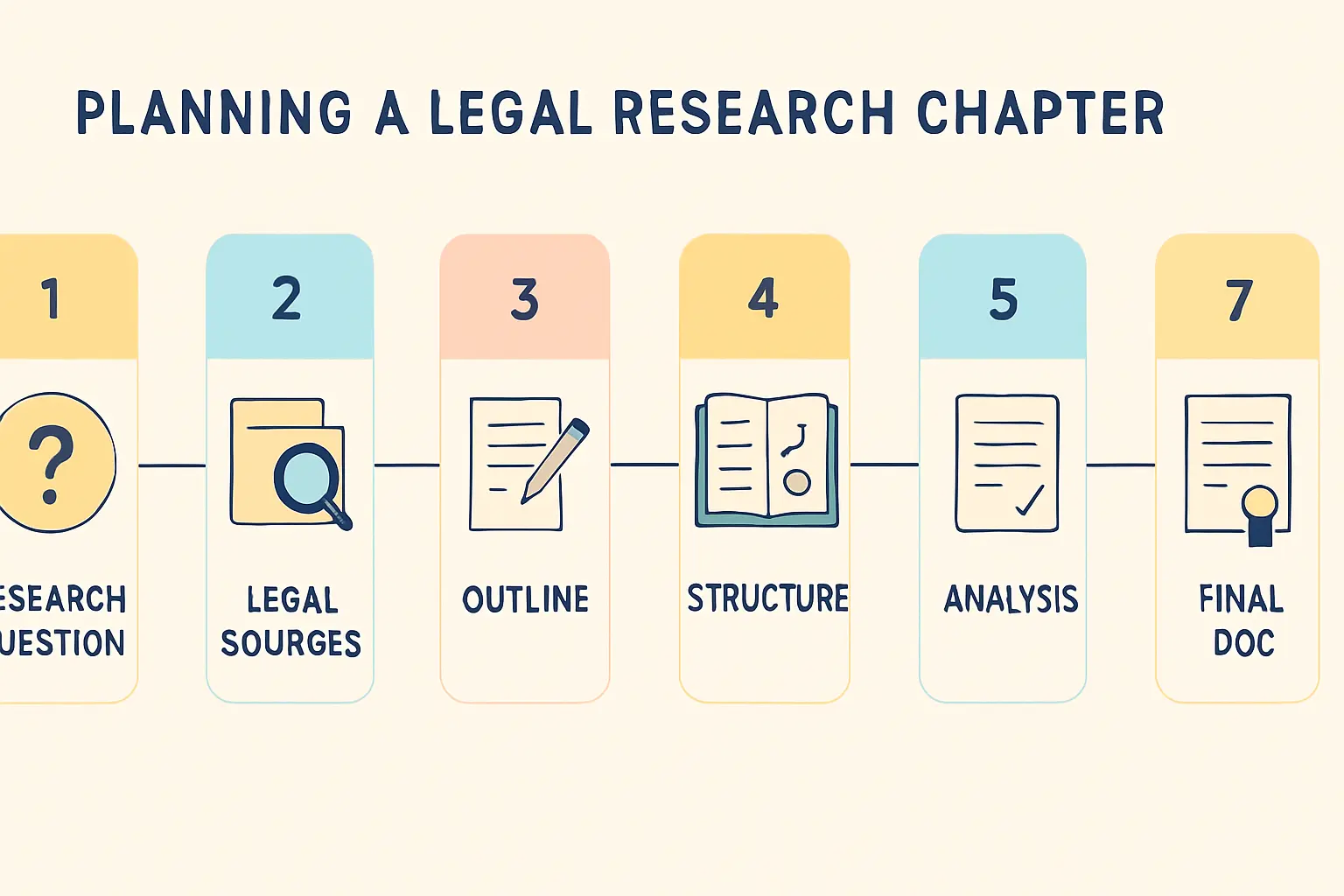
How to Write the Methodology Section of a Doctrinal Law Dissertation Step by Step (2026)
You have chosen a doctrinal topic, your supervisor has asked for a methodology section, and every template you can find asks for your sampling strategy and your data analysis plan. You have neither. This guide is for that situation.
A doctrinal methodology section does exist and it does have content — it is just not the content an empirical template asks for. Instead of describing how you gathered data, you are describing which legal materials count for your question, how you selected them, and what analytical framework you apply to them. Done well, it is short, precise and one of the easiest sections to score well on.
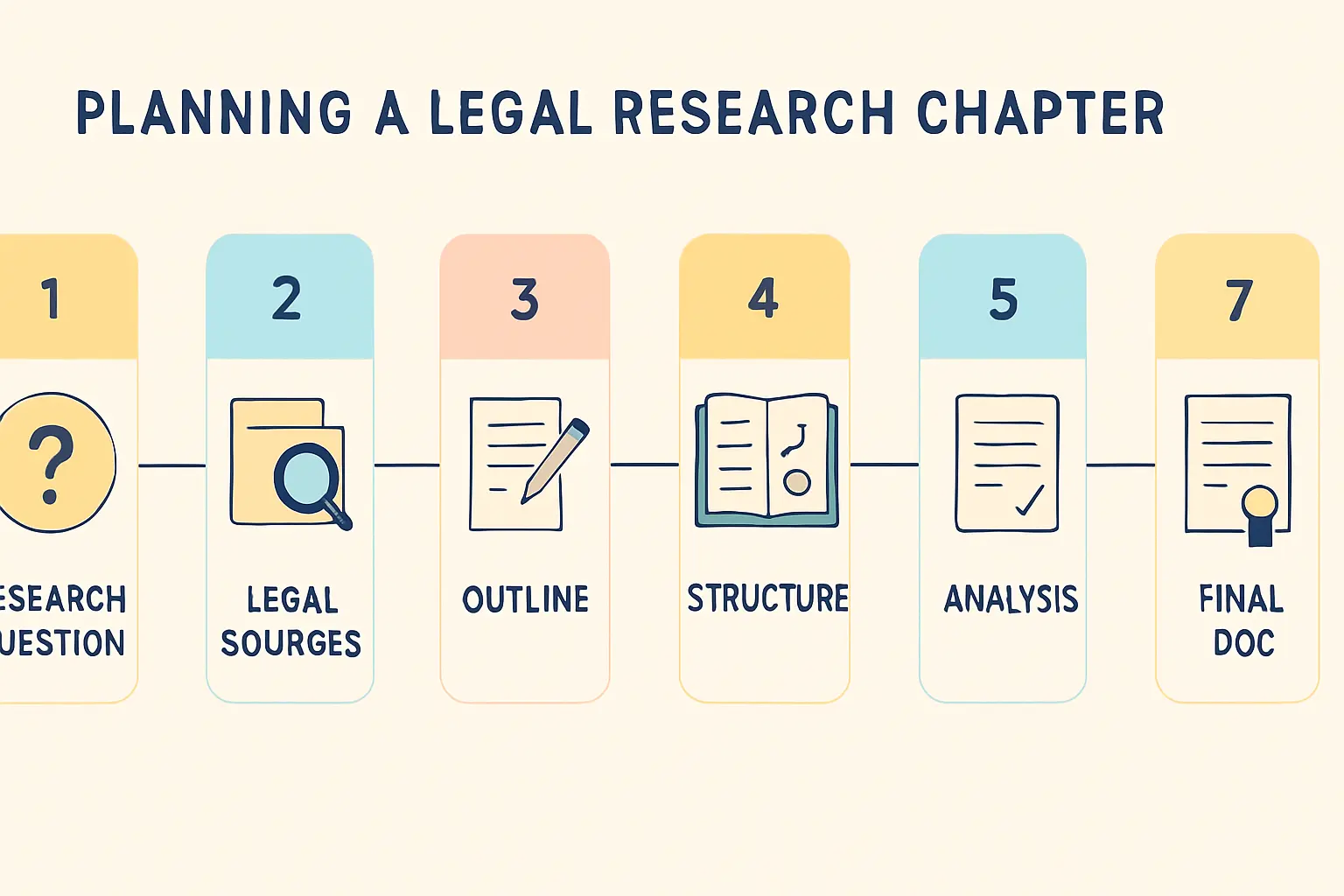
Before you start: does your programme even require one?
Doctrinal dissertations frequently have no separate methodology chapter at all. The legal method is carried in the substantive chapters, and the analytical framework is stated in the introduction. That is a legitimate and conventional structure, not a gap.
So the first step is to find out which convention applies to you, because it changes everything downstream. Check your programme handbook and marking criteria, and confirm with your supervisor. If a chapter is required you write the full version below; if it is not, the same material becomes two or three paragraphs in your introduction. Do not decide this by analogy with a friend on a different programme.
If you have not settled on doctrinal work yet, our comparison of doctrinal, socio-legal and comparative legal research covers how the choice changes your whole structure. This guide assumes the choice is made.
Step 1: State the method and why it fits the question
Open by naming the method and tying it to your research question in two or three sentences. The examiner wants evidence that you chose doctrinal analysis because it answers your question, not because it avoids ethics forms.
The link should be explicit: your question asks what the law is, whether it is coherent, or how it should be interpreted, and those are questions answerable from authoritative legal materials. If your question actually asks how people behave, doctrinal analysis is the wrong method and no amount of framing will fix it.
Step 2: Define the scope of your legal materials
This is the heart of the section and the part students most often skip. Scope has four dimensions, and you should state each one:
- Jurisdiction. Which legal system? “UK law” is usually imprecise — much law extends only to England and Wales, and it operates at provision level, so a single Act can apply differently across the four nations.
- Courts and level. Are you analysing appellate authority only, or first-instance decisions too?
- Date range. From which point, and why that point? A statutory reform or a leading judgment usually supplies a principled start date.
- Subject boundary. Which doctrine, and what adjacent material you are deliberately excluding.
Stating a boundary is not admitting a weakness. An unstated boundary looks like an oversight; a stated one looks like a decision.
Step 3: State your analytical framework
In a doctrinal dissertation, your analytical framework does the work that a methodology does elsewhere. It is the lens you apply consistently across the substantive chapters — the statutory test whose elements you take in turn, the set of criteria against which you evaluate the doctrine, or the principle whose application you trace through the authorities.
Name it explicitly and say how it structures the analysis. “I will assess the case law against the three limbs of the statutory test, in order” is a framework. “I will critically analyse the case law” is not; it is a promise to do something unspecified.
Step 4: Explain your source hierarchy and version policy
Two sentences here demonstrate real competence, and almost nobody writes them.
First, the hierarchy: primary materials — legislation and judgments — carry authority, and secondary materials such as textbooks and articles are used for argument and context, not as evidence of what the law is.
Second, the version policy. Legislation exists in more than one version: the original text as enacted, and the revised text into which subsequent amendments have been incorporated. State which you rely on and why. If your argument is about current law, you use the revised text; if it is about what Parliament originally enacted, the original. Note the date you consulted it, since revised text changes as amendments take effect. Our guide to primary legal sources for a law dissertation covers the official repositories and the extent and commencement checks that belong alongside this.
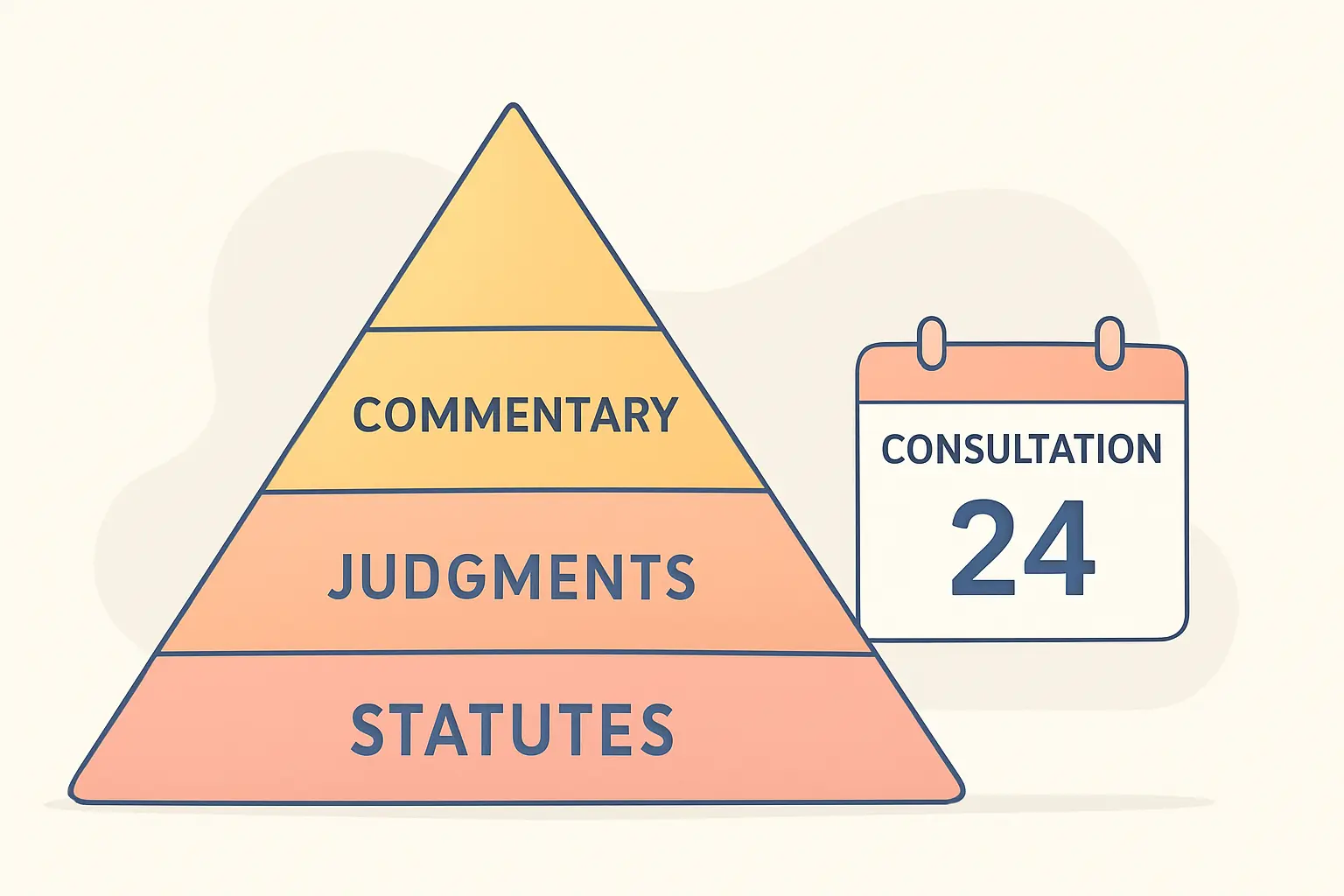
Step 5: Justify your case selection
You cannot analyse every relevant judgment, so say how you chose. Acceptable and common criteria include authority level, whether a case is treated as leading in the field, whether it is the most recent statement of the test, and whether it represents a distinct line of reasoning.
The failure to avoid is selecting only the cases that support your argument. If there is authority running against your position, the methodology section is where you commit to addressing it, and the substantive chapters are where you do. Examiners notice a suspiciously tidy set of authorities.
Step 6: Handle comparative or theoretical elements explicitly
Many doctrinal dissertations include one comparative chapter or draw on a theoretical framework. If yours does, say so here and justify it briefly.
For a comparative element, justify the comparator: why that jurisdiction, on what basis it is genuinely comparable for this problem, and which materials you use. Also check availability before committing — free official judgment services are jurisdiction-bounded, so your second jurisdiction needs a source route you have actually opened.
For a theoretical element, name the theory and state what you use it to do: organise the critique, supply evaluative criteria, or explain the doctrine’s development.
Step 7: State limitations honestly
Close with the real constraints on your analysis. Genuine doctrinal limitations include jurisdictional scope, the date at which you stated the law, reliance on translation for comparative material, and areas where authority is sparse or unsettled.
Include the currency point specifically: state the date to which the law is stated. Law moves, and an examiner reading three months after submission needs to know your cut-off rather than assume you missed a development.
What limitations are not is an apology. “This dissertation is limited by the author’s inexperience” tells the examiner nothing except that you were unsure what to write.
A model shape
| Element | Typical length | What it establishes |
|---|---|---|
| Method and fit to the question | 1 paragraph | The method was chosen, not defaulted to |
| Scope of materials | 2–3 paragraphs | Jurisdiction, courts, dates, subject boundary |
| Analytical framework | 1–2 paragraphs | The lens applied consistently across chapters |
| Source hierarchy and versions | 1 paragraph | Command of authority and of legislative versions |
| Case selection criteria | 1 paragraph | Selection was principled, not convenient |
| Comparative or theoretical elements | 1 paragraph if present | Comparators and theory are justified |
| Limitations and date of law | 1 paragraph | Honest constraints and a stated cut-off |
Frequently asked questions
How long should a doctrinal methodology section be?
Where a full chapter is required it is usually the shortest chapter. Where it sits in the introduction, a few hundred words is normal. Length is set by your institution’s requirements, so check them rather than padding to match an empirical chapter.
What do I write if I collected no data?
Scope, framework, source hierarchy, version policy and selection criteria — everything above. “No data” does not mean “no method”; it means your material is authoritative legal text rather than observations.
Do I need ethics approval for a doctrinal dissertation?
Research using only published legal materials normally does not involve human participants and usually falls outside the requirement, but the decision is your institution’s. See whether you need ethical approval.
Should I use the words “black-letter” or “doctrinal”?
Either is understood; doctrinal is the more common term in formal writing. Whichever you pick, define it once and use it consistently.
Where does the methodology section go if there is no methodology chapter?
In the introduction, after the research question and before the chapter outline. Keep it compact and signpost that the legal method is developed in the substantive chapters.
How do I cite the sources I discuss?
UK legal writing uses footnote-based OSCOLA, with specific forms for cases and statutes — see our OSCOLA referencing guide.
Draft it once, properly
A doctrinal methodology section is short enough to get right and specific enough that vagueness shows. Tesify helps you draft and structure it, and keep your framework consistent across every chapter that follows — 100% written by you.
Write your thesis with AI
Structure, draft, cite, and format your thesis faster with Tesify’s AI writing tools, automatic bibliography, and plagiarism checker. Free to start, no credit card required.






Leave a Reply