

Doctrinal vs Socio-Legal vs Comparative Legal Research 2026: Which Method for Your Law Dissertation?
Law students are routinely told to write a methodology chapter using guidance built for empirical research — sampling strategy, instruments, data analysis. Then they discover their dissertation has no participants, no dataset and no statistics, and conclude they have done something wrong.
They have not. Legal scholarship has its own methods, and most law dissertations use one that collects no data at all. The decision you actually need to make is which of them you are using, because that choice determines your chapter structure, your sources and what counts as a finding.

The four methods at a glance
| Doctrinal | Socio-legal / empirical | Comparative | Theoretical | |
|---|---|---|---|---|
| Question it answers | What is the law, and is it coherent? | How does the law operate in practice? | How do other systems solve this? | How should we understand or justify this law? |
| Primary material | Statutes, judgments, secondary commentary | Interviews, case files, official statistics | Two or more legal systems | Legal and philosophical literature |
| Data collected | None | Yes | Usually none | None |
| Ethics approval | Normally not required | Almost always required | Normally not required | Normally not required |
| Methods chapter | Often none; framework stated in the introduction | Full chapter, empirical conventions | Short section justifying the comparators | Often none |
| What a finding looks like | The doctrine is inconsistent / the test should be reformulated | The rule produces an unintended effect | Jurisdiction B’s solution is transplantable, or is not | The justification fails on its own terms |
| Main risk | Description without argument | Underestimating access and approval time | Comparing systems that are not comparable | Losing contact with the law |
1. Doctrinal research (also called black-letter)
Doctrinal research analyses authoritative legal texts — legislation, case law and the commentary around them — to establish what the law is, how its parts fit together and where it is incoherent. It is the default method for most taught law dissertations, and it is a genuine research method, not the absence of one.
What makes it research rather than summary is the second half: systematising and evaluating. Setting out the current test from four leading cases is description. Showing that the four cases apply the test inconsistently, identifying which reading is doctrinally preferable and explaining what follows — that is a doctrinal contribution.
Choose it when your question is about the content, coherence or correct interpretation of a body of law, and the answer is available from published legal materials.
The failure mode is a dissertation that reads like an extended textbook chapter: accurate, comprehensive and argument-free. If your chapters could be retitled “Chapter 3: The Law On X” without loss, you have described rather than argued.
2. Socio-legal and empirical legal research
Socio-legal research asks what the law does in practice rather than what it says. It borrows social science methods — interviews, surveys, case-file analysis, statistical work on official data — and applies them to legal institutions and legal actors.
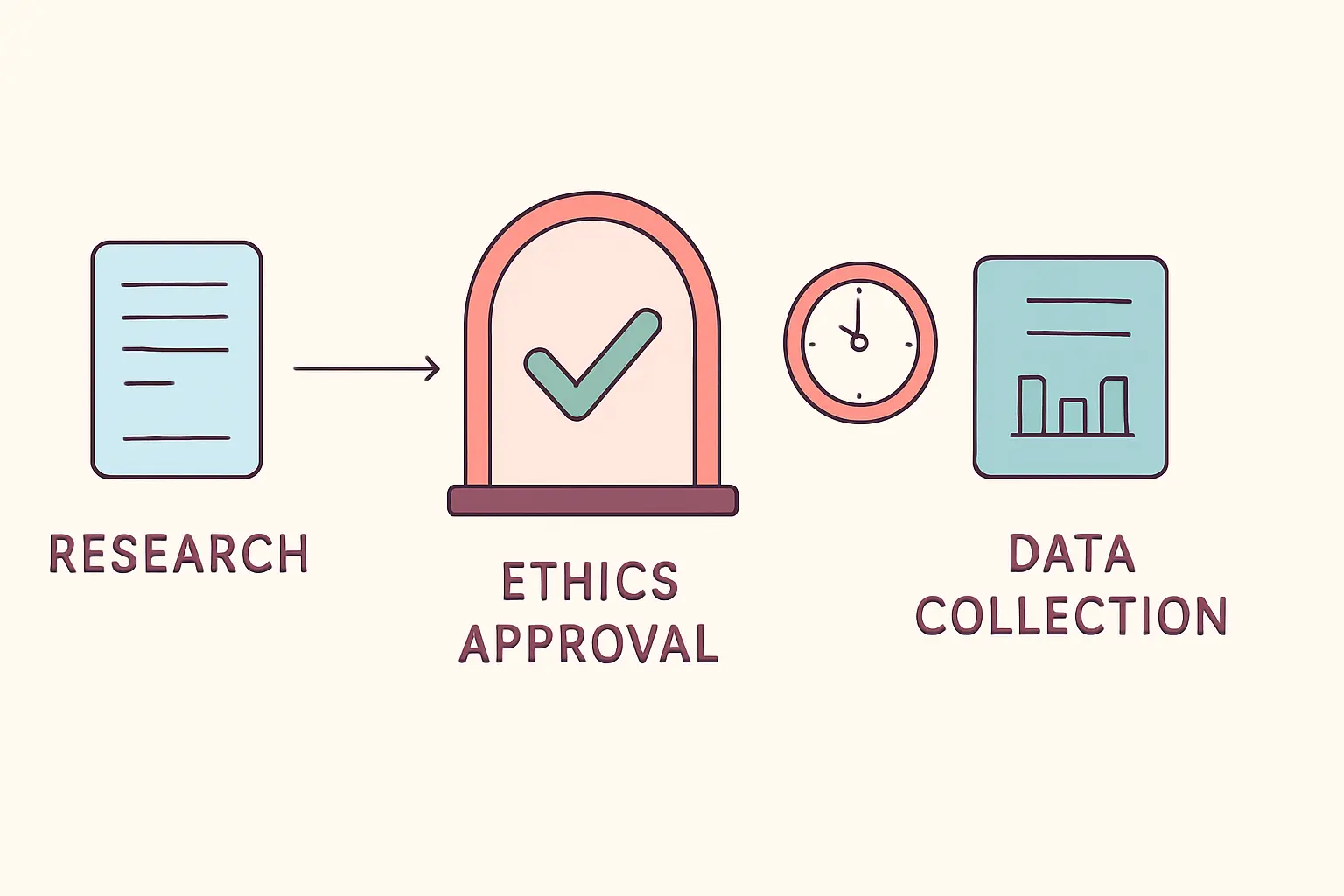
This is the one legal method that does require the full empirical apparatus. You will need a real methodology chapter covering design, sampling, instruments and analysis, and you will almost certainly need ethics approval. Our guide on whether you need ethical approval covers the process and, importantly, how long it takes.
Choose it when your question is about behaviour, effect or experience — whether a duty is complied with, how a discretion is exercised, what happens to litigants in practice.
The failure mode is timing. Access to courts, practitioners, regulators or case files takes longer to negotiate than students expect, and ethics approval sits in front of data collection rather than beside it. A socio-legal design chosen in month one is feasible; the same design chosen in month five usually is not.
If you cannot obtain access, official statistics offer a genuine empirical route that requires no participants — the Ministry of Justice publishes court and justice statistics through GOV.UK, including a quarterly civil justice series.
3. Comparative legal research
Comparative work examines how two or more legal systems address the same problem, usually to argue that one approach is preferable or that a solution could be transplanted.
Its central difficulty is establishing that the comparison is meaningful. Two jurisdictions may use the same word for institutions that do quite different work, and a rule that functions well in one system may depend on procedural or constitutional features the other lacks. Serious comparative work therefore justifies its comparators explicitly — why these systems, on what basis, and what makes them genuinely comparable on this question.
There is also a practical constraint worth checking before you commit. Free official judgment databases are jurisdiction-bounded: The National Archives’ Find Case Law service provides free access to judgments and tribunal decisions from England and Wales, plus UK-wide cases from the Supreme Court and Privy Council. Sources for your second jurisdiction need to be identified — and opened — before you build a chapter on them. Our guide to primary legal sources for a law dissertation covers which official repositories are freely available.
Choose it when your problem is genuinely shared across systems and you can read the other system’s materials, in its language, competently.
4. Theoretical and jurisprudential research
Theoretical work analyses the concepts and justifications underlying law — rights, obligation, authority, punishment — rather than the content of any particular rule. It is closest in method to philosophy: the argument is conceptual, and the sources are scholarly literature rather than primary legal materials.
Choose it when your question is normative or conceptual and cannot be settled by finding out what a rule says.
The failure mode is drift — a dissertation that stops engaging with law altogether. Most law schools expect theoretical work to remain anchored to legal material, applying the theory to a doctrine or institution rather than discussing it in the abstract.
Which one should you choose?
Work from your research question, not from the method you would prefer to use.
- If the question begins “What is the legal position on…” or “Is the law on X coherent…” → doctrinal.
- If it begins “How do courts/regulators/parties actually…” → socio-legal, and start the access and ethics process immediately.
- If it begins “How does jurisdiction B handle…” → comparative, and justify the comparators.
- If it begins “Is it justifiable that…” or “What does it mean to say…” → theoretical.
Combinations are common and usually strongest when one method leads. A doctrinal core with a comparative chapter is a well-established shape. A dissertation that is equally doctrinal, comparative and empirical is usually three shallow dissertations.
What your choice does to your chapter structure
The most visible consequence is whether you have a methodology chapter at all. Doctrinal and theoretical dissertations frequently do not; the analytical framework is stated in the introduction and the legal method is carried in the substantive chapters. Empirical socio-legal dissertations follow the standard social-science architecture instead.
Law is also unusual in chapter organisation: rather than the introduction–literature review–methods–results–discussion sequence, doctrinal dissertations are typically organised topically, by legal principle, issue or jurisdiction. Our guide to how many chapters a thesis should have covers how disciplines diverge here.
Whichever route you take, the citation conventions are the same in the UK: footnote-based OSCOLA, covered in our OSCOLA referencing guide.
Frequently asked questions
Is doctrinal research a real methodology?
Yes. It has an object, a body of authoritative material and criteria for a good argument. What it does not have is data collection, which is why empirical methodology templates fit it badly.
Do I need a methodology chapter for a doctrinal dissertation?
Often not, but this is set by your institution’s regulations and your supervisor, so confirm it rather than assuming. Where no chapter is required, state your analytical framework and the scope of materials in the introduction.
Can I combine doctrinal and empirical methods?
Yes, and mixed designs are common in socio-legal scholarship. Let one method lead and use the other to answer a defined sub-question, rather than splitting the dissertation evenly.
Does comparative research require me to read foreign languages?
If your argument depends on the precise wording of the other jurisdiction’s provisions, working from translations is a real limitation and should be acknowledged as one. Choosing a comparator whose materials you can read directly is usually the stronger decision.
Which method is easiest?
Doctrinal has the lowest logistical overhead — no approval, no access negotiation, no participants. That is not the same as easy: the analytical bar is high precisely because the material is available to everyone.
Write the argument, not just the law
Once your method is settled, the work is sustaining an argument across chapters without slipping into description. Tesify helps you structure, draft and reference that argument while every word stays your own — 100% written by you.
Write your thesis with AI
Structure, draft, cite, and format your thesis faster with Tesify’s AI writing tools, automatic bibliography, and plagiarism checker. Free to start, no credit card required.






Leave a Reply