
How Many Chapters Should a Thesis Have? Typical Structures by Degree and Discipline (2026)
Knowing how many chapters a thesis should have is one of the first structural decisions you face — and the answer depends on your degree level and discipline. Most theses contain 4 to 7 chapters. The standard five-chapter IMRaD structure (Introduction, Literature Review, Methodology, Results, Discussion/Conclusion) applies across most empirical disciplines. Bachelor’s theses commonly use 4–5 chapters; master’s theses 5–6; PhD theses 5–8, shaped by discipline, research design, and institutional requirements.
What is the standard thesis chapter structure?
The most widely recognised framework is the five-chapter IMRaD model, used at institutions from Oxford and Cambridge to Harvard and the University of Melbourne. IMRaD stands for Introduction, (Literature Review), Methodology, Results, and Discussion. The literature review functions as a distinct standalone chapter in most social science and humanities theses, producing the canonical five-chapter spine that most supervisors and examiners expect.
Each chapter carries a precise epistemic role: the introduction frames the research problem and states aims and objectives; the literature review positions your work within existing scholarship; the methodology chapter justifies your design choices; the results chapter presents data without interpretation; and the discussion chapter interprets findings against the literature. Many theses add a standalone conclusion as a sixth chapter, particularly where recommendations or reflective sections require dedicated space. If you are planning the complete journey from research proposal to submission, the complete step-by-step dissertation guide on Tesify Pro covers every stage in depth.
How many chapters does each degree level require?
Chapter count scales with degree complexity because the expected scope, word count, and original contribution all increase at each level. A bachelor’s dissertation addresses a narrower question within a shorter word limit. A PhD thesis must make a genuine contribution to knowledge, typically demanding more structural depth to present multiple studies or sustained analytical threads.
| Degree level | Typical chapters | Common structure |
|---|---|---|
| Bachelor’s dissertation (BSc / BA) | 4–5 | Introduction · Literature Review · Methodology · Results & Discussion (merged) · Conclusion |
| Integrated master’s (MEng / MPharm) | 5 | Full IMRaD + standalone Conclusion |
| Taught master’s (MSc / MA / MBA) | 5–6 | Introduction · Literature Review · Methodology · Findings · Discussion · Conclusion |
| Research master’s (MRes / MPhil) | 5–7 | Full IMRaD; Results may split into two chapters if data strands differ substantially |
| PhD / doctoral thesis | 5–8 | Introduction · Literature Review · Methodology · Results (2–3 chapters) · Discussion · Conclusion |
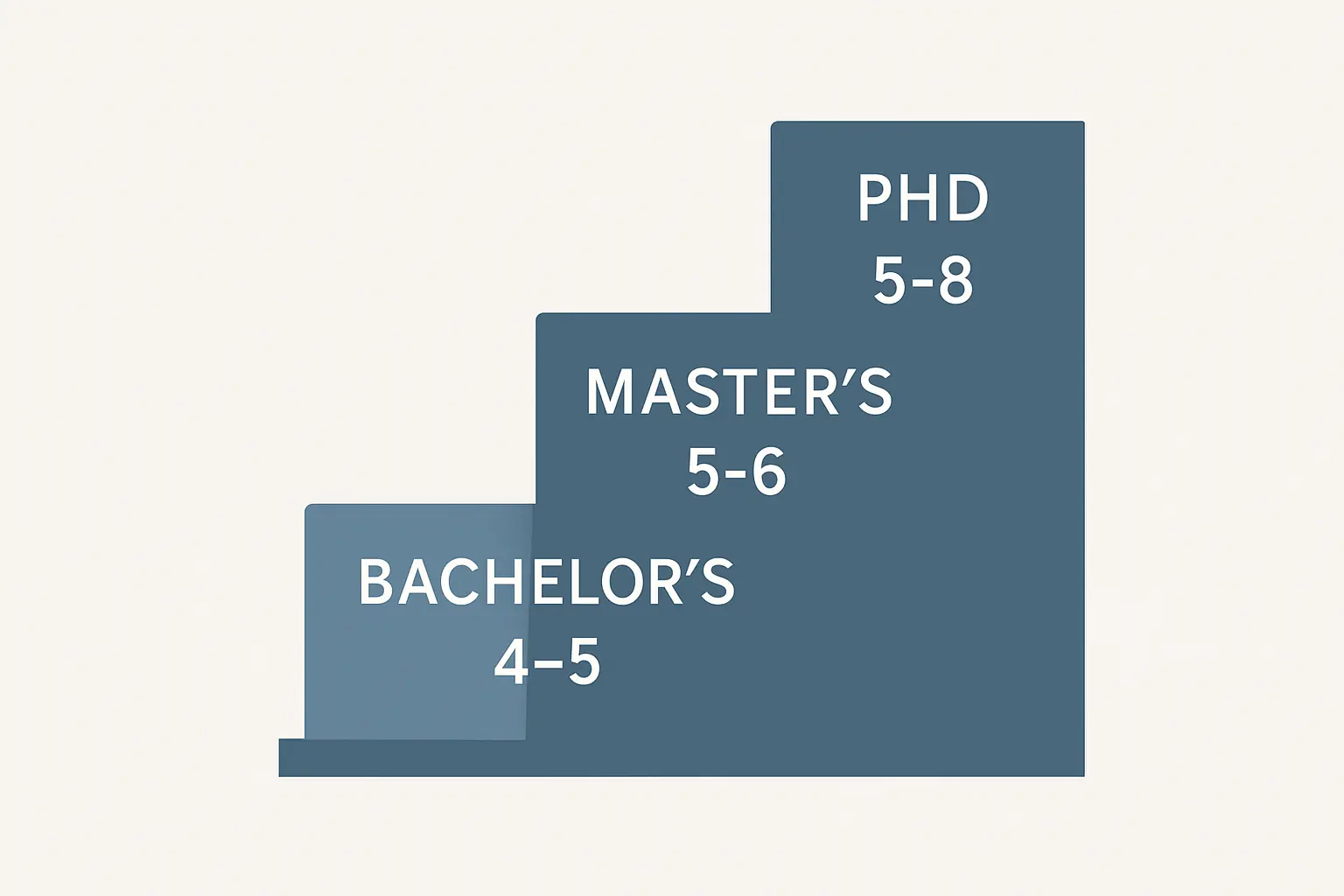
At doctoral level, splitting Results into two or three chapters is standard practice when the research design encompasses multiple studies, each with its own data, analysis, and sub-findings. Supervisors at institutions including UCL, the University of Edinburgh, and the University of Manchester routinely approve this expansion where data complexity warrants it.
For the word-length targets that typically accompany these chapter counts, our data article on average thesis word counts by discipline and degree level provides a detailed breakdown.
Does chapter count vary by discipline?
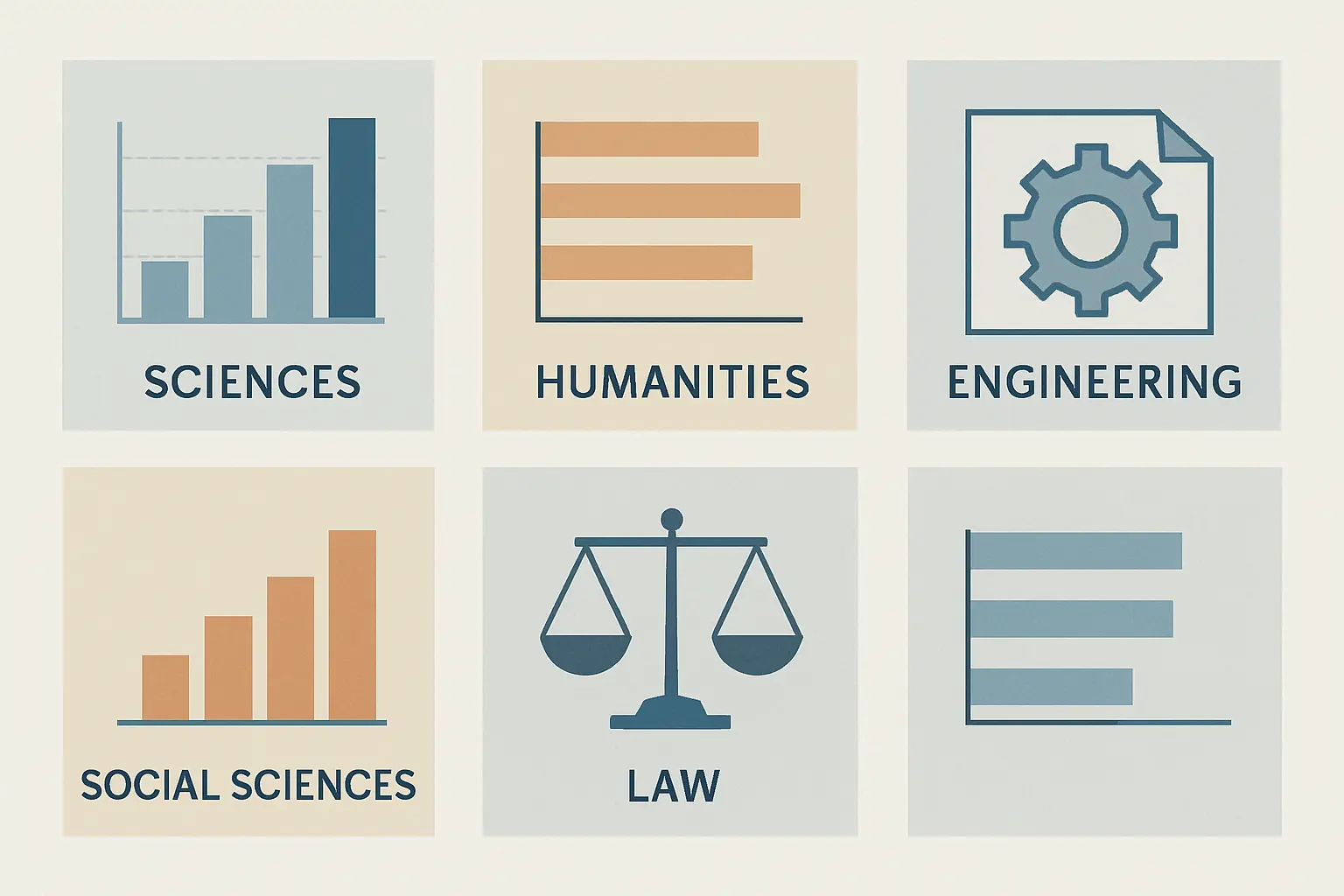
Substantially. Discipline determines whether you follow a scientific IMRaD convention or a more flexible topic-based framework. STEM subjects use fewer, tightly defined chapters with generic headings. Humanities and qualitative social sciences typically require more chapters with descriptive headings, because each analytical thread warrants its own dedicated treatment rather than being compressed into a single Results chapter.
| Discipline | Typical chapters (PhD) | Structural preference |
|---|---|---|
| Natural Sciences (Biology, Chemistry, Physics) | 5–7 | IMRaD; Results chapters split by experiment or study |
| Engineering & Computer Science | 5–6 | IMRaD with a dedicated Background / Related Work chapter |
| Social Sciences (Psychology, Sociology, Education) | 5–7 | IMRaD or mixed-methods; may separate quantitative and qualitative results chapters |
| Humanities (History, Literature, Philosophy) | 6–8 | Topic-based; each analytical chapter develops a distinct theme or argument |
| Business & Management | 5–6 | IMRaD or case-study-based; may include a separate Conceptual Framework chapter |
| Law | 6–8 | Topic-based; doctrinal chapters organised by legal principle or jurisdiction |
| Creative Arts & Practice | 4–6 | Mixed; contextual review, practice documentation, and critical reflection chapters |
For a chapter-by-chapter breakdown of the full writing process across disciplines, see our complete dissertation writing guide.
What is the difference between IMRaD and topic-based structures?
IMRaD organises the thesis by methodological function: each chapter plays a defined role in the research process — introduce, review, design, collect, interpret. Chapter headings are often generic because the content type defines the chapter rather than its specific subject matter. This structure works best for empirical research with discrete phases of data collection and analysis, where separating the presentation of data from its interpretation is logically necessary.
Topic-based structure organises the thesis by argument: each chapter advances a distinct analytical claim that builds cumulatively toward the thesis’s central argument. Chapter headings are descriptive and specific — for example, “Chapter 3: Colonial Land Policy and the Legal Construction of Terra Nullius, 1788–1835.” The findings are embedded in the argument itself rather than collected in a standalone results chapter. This is the standard approach in history, literary criticism, philosophy, and legal scholarship.
Mixed approaches are common in education research and mixed-methods social science, which may apply IMRaD framing to quantitative strands while giving qualitative analytical chapters their own thematic headings. The choice of structure is ultimately disciplinary convention first, supervisor preference second, and personal argument logic third.
When should you add an extra chapter?
Add a chapter when a distinct phase of your research cannot be integrated into an existing chapter without making it logically incoherent or unmanageably long. The clearest trigger is a second empirical study: if your doctoral research involves two separate data-collection phases — for example, a qualitative scoping study followed by a large-scale survey — those results belong in separate chapters, not compressed into one.
Other justified reasons to add a chapter include: a Background chapter to distinguish technical or historical context from the theoretical content of the Literature Review; a standalone Theoretical or Conceptual Framework chapter when that framework is itself a novel contribution requiring extended defence; or a Pilot Study chapter where examination regulations mandate it. Always confirm with your supervisor before expanding beyond the conventional structure — some universities impose a chapter ceiling in their thesis regulations or submission handbooks.
Chapter count and writing time are connected decisions. For realistic estimates of how long each chapter takes to draft and revise, our article on how long each thesis chapter takes to write provides timelines you can map directly to your submission deadline.
When should you merge two chapters?
Merge chapters when the content of each is too thin to stand independently, or when forcing a separation creates artificial redundancy. At bachelor’s level, Results and Discussion are routinely merged into a single “Findings and Discussion” chapter because a 10,000–15,000-word dissertation cannot sustain two full chapters without one becoming a superficial echo of the other.
The Conclusion is the other common merger candidate. If your Discussion chapter already interprets findings fully and addresses implications, a standalone Conclusion may add only a brief summary that contributes little value as a separate chapter. Integrating the conclusion as a final section of the Discussion is widely accepted at master’s level. At doctoral level, however, most examining boards expect a standalone Conclusion — particularly where contributions to knowledge, limitations, and recommendations each require extended treatment that would crowd a discussion chapter.
The guiding test is structural necessity: if a chapter needs to exist for the argument to be coherent and complete, keep it separate. If it exists only to match a checklist, merge it.
How does a thesis by publication change the chapter structure?
A thesis by publication — also called a paper-based or article-format thesis — replaces the traditional monograph chapters with a curated collection of published or publishable journal articles. The typical structure is: an Introduction (framing the research programme and its coherence), three to five paper chapters (each a standalone article), and an integrating Synthesis or Conclusion chapter that explains how the papers collectively advance an original argument beyond what any single paper achieves.
This format is now accepted at most Russell Group universities, all Go8 institutions in Australia, and many North American research universities. It is especially prevalent in the natural sciences, where publication speed is professionally important and supervisors routinely co-author papers with doctoral students during the PhD. For a full explanation of the requirements, advantages, and risks of this format, see our guide on what a thesis by publication is and how it works.
Frequently Asked Questions
Can a thesis have only 3 chapters?
Only in limited circumstances. Some very short undergraduate project reports and certain creative practice submissions — where a brief contextual essay accompanies a creative artefact — use a three-chapter framework. Most examining boards require at least four chapters; any fewer typically signals insufficient coverage of the research process to merit a degree-level qualification.
Is the literature review always a separate chapter?
Not always. In many STEM PhD theses, the literature review is embedded within the Introduction chapter, giving a four-chapter IMRaD rather than five. In most social science and humanities dissertations, it is a standalone chapter. Your departmental handbook is the definitive source — confirm the expectation before finalising your structure.
Do American and British PhD theses use the same chapter structure?
Broadly similar, with some differences in convention. US doctoral theses in the sciences frequently follow a five-chapter model influenced by NIH reporting standards. UK and Australian theses give supervisors and students more structural discretion; UK theses sometimes combine Results and Discussion, while US programmes more often keep them separated. Both systems typically allow 5–8 chapters at doctoral level.
Does the number of chapters affect the thesis grade?
Not directly. Examiners assess coherence, argument quality, methodological rigour, and contribution to knowledge — not chapter count. A well-argued five-chapter thesis will outperform a disorganised eight-chapter one every time. The structure should serve the argument; it should never be inflated to create an appearance of thoroughness.
Should the discussion and conclusion always be separate chapters?
At PhD level, most examining boards expect separate Discussion and Conclusion chapters, because the conclusion must address original contributions, limitations, and recommendations — each of which requires sufficient space. At master’s and bachelor’s level, merging them into a single “Discussion and Conclusions” chapter is common and generally accepted by examiners.
Can each chapter of a monograph thesis be read independently?
In a monograph thesis, chapters are interdependent — each builds on the preceding one. If your chapters read as entirely self-contained essays with no cross-referencing, this usually signals that the overarching argument needs strengthening. In a thesis by publication, by contrast, each paper chapter is designed to stand alone as a journal article.
Do appendices and front matter count as chapters?
No. Front matter (abstract, acknowledgements, table of contents, lists of figures and tables) and back matter (references or bibliography, appendices, glossary) are excluded from the chapter count. When supervisors and examination guidelines refer to “chapters,” they mean the numbered main-body chapters only.
Can AI help me plan my thesis chapter structure?
Academic AI tools such as Tesify can generate a chapter-by-chapter outline tailored to your research question, degree level, and discipline — providing a structured starting point to review and refine with your supervisor rather than beginning from a blank page.
Build Your Chapter Structure Before You Write a Word
Knowing the right number of chapters is step one. The harder part is deciding what goes in each one. Tesify generates a complete, degree-level-appropriate thesis outline — chapter headings, sub-section structure, and word count targets per chapter — so you can start writing with a clear plan rather than a blank page. Your argument, your research, your integrity.
Write your thesis with AI
Structure, draft, cite, and format your thesis faster with Tesify’s AI writing tools, automatic bibliography, and plagiarism checker. Free to start, no credit card required.






Leave a Reply