
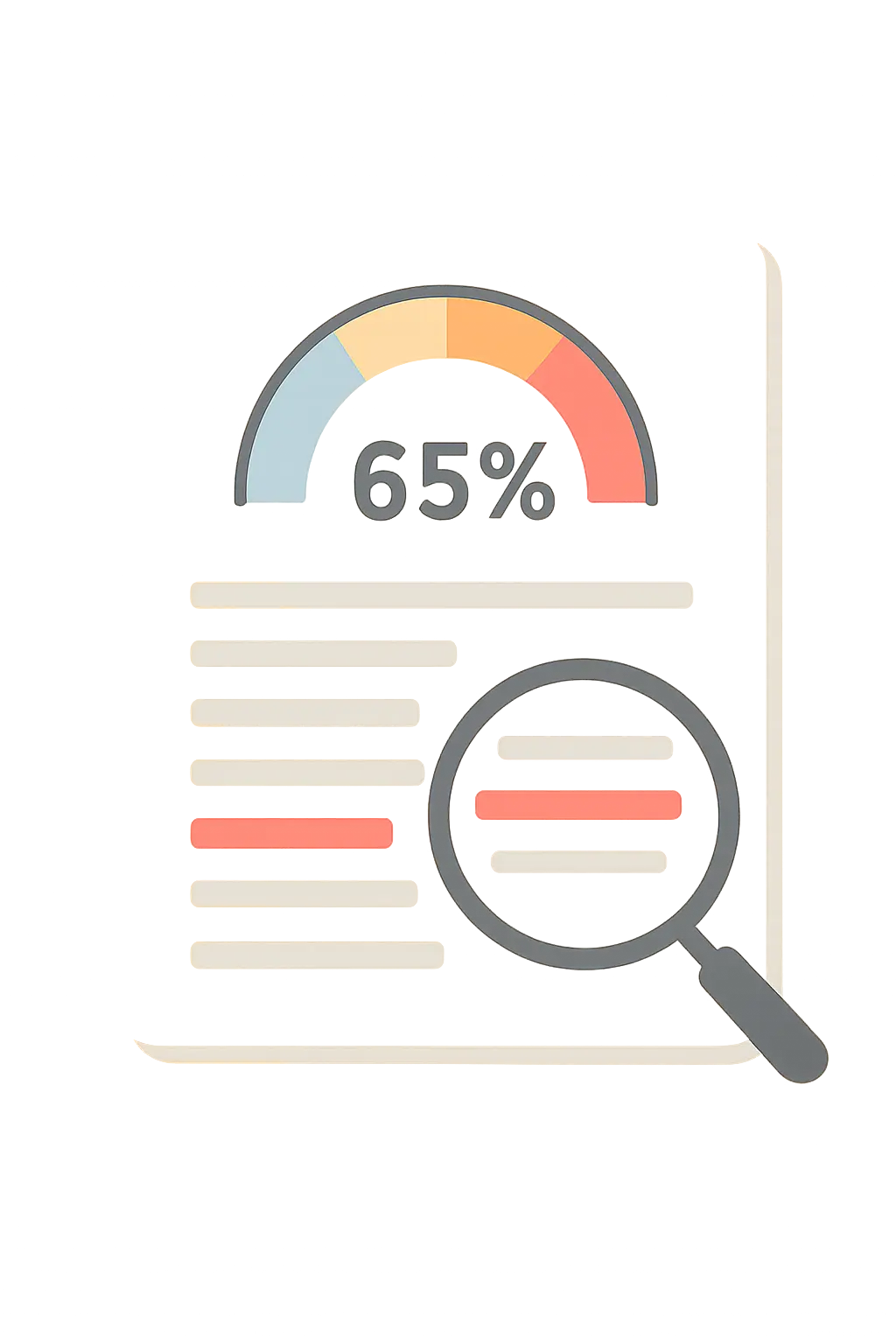
What Is a Good Turnitin Similarity Score?
There is no universally good Turnitin similarity score, and no percentage that Turnitin or any single authority defines as automatically “safe.” Turnitin’s own guidance is explicit that the similarity score is “neither good nor bad on its own” — it is a starting point for review, not a verdict. What actually determines whether your submission is acceptable is whether the matched text is properly quoted and cited, which is a judgment made by your instructor or your institution’s policy, not a number generated by the software.
What Does the Similarity Score Actually Measure?
The similarity score is the percentage of your submitted text that textually matches content already indexed in Turnitin’s databases — other students’ submitted papers, academic journals and publisher content, and the open web. Critically, this match detection is purely textual: it flags overlapping strings of words regardless of whether you used them correctly. A properly quoted sentence with quotation marks and a citation will show up as a “match” in exactly the same way as an uncredited copy-paste, because Turnitin is comparing text strings, not judging intent or attribution.
This is why your reference list alone can contribute a meaningful chunk of your score. If you cite twelve sources using APA format, the formatting conventions of those citations often overlap with how other authors format the same or similar references, and Turnitin’s matching algorithm can pick that up as similarity even though there is nothing improper happening. The same applies to standardised phrases in your discipline — terms of art, named tests, or common instrument descriptions that appear near-identically across many papers because there simply is not another accurate way to phrase them.
Does a High Similarity Score Mean I Plagiarised?
Not necessarily. Several entirely legitimate features of academic writing routinely produce high raw similarity percentages: long block quotations used for close textual analysis, a standard methods section that closely resembles the wording used in other papers describing the same established procedure, a lengthy bibliography, or appendices containing survey instruments or interview transcripts that appear elsewhere. This is precisely why university guidance consistently instructs markers to open the Similarity Report and inspect the individual highlighted matches rather than acting on the percentage figure alone. A report showing 35% similarity that consists mostly of correctly quoted and cited material is a very different situation from a report showing 15% similarity concentrated in three uncredited paragraphs in your discussion section.
What Is Considered a Low Similarity Score?
Published guidance from university libraries on interpreting similarity reports generally notes that a figure below roughly 20% is unlikely, on its own, to indicate widespread plagiarism across an entire document — but this is offered as a rough orientation point, not a rule, and the same guidance is careful to add that even a low overall score does not rule out a serious, concentrated instance of plagiarism confined to one section. There is no threshold percentage that reliably distinguishes an acceptable submission from a problematic one across all institutions, disciplines, and assignment types; the appropriate benchmark for a systematic literature review with extensive quoted material is simply not the same as the benchmark for an original data-analysis chapter.
How Do Exclusions Change the Score?
Most Turnitin configurations allow instructors, and in some cases students, to generate a report that excludes specific categories of matched text: quoted material (text inside quotation marks), the bibliography or reference list, and “small matches” below a configurable word-count threshold. Excluding these categories typically produces a lower percentage that focuses more narrowly on your own analytical prose, which many markers consider the more informative figure. If your institution shows you two percentages — one with exclusions and one without — the excluded figure is usually the more relevant one for judging originality of your actual argument, though your specific department’s policy on which figure they use is what ultimately matters for you.
Similarity Score vs AI Writing Detection: Not the Same Feature
Students sometimes conflate the similarity score with Turnitin’s separate AI writing indicator, but the two measure entirely different things and are generated by different underlying processes. The similarity score is a text-matching comparison against existing sources. The AI writing indicator, where enabled by an institution, is a probabilistic estimate of how much of the submitted text resembles patterns typical of AI-generated writing, and it is reported as its own separate percentage on a different part of the report — not folded into the similarity score. A document can have a low similarity score and a flagged AI writing indicator, or vice versa. If your institution has enabled AI detection, check whether your supervisor is looking at one figure or both before assuming a clean similarity score is the whole picture.
What Happens When a Score Triggers Review?
Similarity scores do not automatically fail or flag a submission in most institutional workflows; they simply prompt a human marker to open the report and read the highlighted matches in context. If a marker identifies matches that appear to be uncited or improperly used, the typical next step is referral to a formal academic integrity or misconduct process, which usually gives the student an opportunity to respond and explain the matched sections before any decision is made. The exact procedure — who reviews it, what evidence is required, what the possible outcomes are — is set by institutional policy rather than by Turnitin itself, and it varies significantly between universities and even between departments at the same university, which is another reason a single “safe” percentage cannot exist across the board.
Does My University Have Its Own Threshold?
Many institutions provide internal guidance to markers about how to interpret similarity reports for grading and academic integrity purposes, and that internal guidance varies considerably by institution, department, and even assignment type — a dissertation and a weekly problem set are not held to identical standards, even within the same department. Some universities publish general orientation ranges for staff use; others deliberately avoid publishing any number at all, precisely to prevent students and staff from treating the percentage as a pass/fail line rather than a prompt for closer review. The only way to know what applies to your specific submission is to check your own department’s assessment handbook or ask your supervisor directly — a percentage you have seen quoted on a blog or forum, including this one, should not be assumed to apply to your institution.
Three Common Myths About Similarity Scores
A few misconceptions circulate persistently among students preparing to submit. First, that 0% is the goal — in practice, a 0% score on a thesis with proper citations is almost impossible and would itself be unusual, since correctly quoted and referenced material is expected to register as a match. Second, that the score is comparable across tools — a similarity percentage from a free online checker and an official Turnitin score are not directly comparable, because each tool compares against a different underlying database of indexed content. Third, that paraphrasing software guarantees a lower, safer score — mechanically swapping synonyms without restructuring the underlying argument can produce a lower percentage while creating a new problem (patchwriting), which many institutions treat as seriously as direct copying once identified.
How Can I Responsibly Lower My Similarity Score?
The legitimate way to reduce a similarity score is to reduce your reliance on direct quotation in favour of properly cited paraphrase and original synthesis, tighten overly long block quotes to only the essential wording, and make sure every source you reference is actually cited in-text as well as listed in your bibliography. What you should not do is attempt to defeat the matching algorithm through superficial synonym-swapping or invisible-character tricks — both are widely recognised by instructors and increasingly flagged by updated detection systems, and both convert what might have been an honest citation issue into a deliberate integrity violation. Running a check before your final submission with a tool such as Tesify’s plagiarism checker lets you see and fix problem matches — missing quotation marks, an uncited paraphrase, an over-long quote — while you still have time to revise, rather than discovering them for the first time in your supervisor’s feedback.
FAQ
What is a good Turnitin similarity score?
There is no universally good Turnitin similarity score. Turnitin’s own guidance states the score is neither good nor bad on its own — it simply shows what percentage of your text matches other sources. What matters is whether those matches are properly quoted and cited, which is a judgment your institution makes, not a fixed number Turnitin sets.
What does the Turnitin similarity percentage actually measure?
It measures the percentage of submitted text that textually matches content in Turnitin’s database, including student papers, journals, and the open web. This includes properly quoted material, correctly cited paraphrases, and your own reference list, not just plagiarised text.
Does a high similarity score mean I plagiarised?
Not necessarily. A high score can result from long block quotes, an extensive reference list, common phrases, or a standard methodology section that resembles other papers in your field. Instructors are trained to open the Similarity Report and examine each match individually rather than acting on the percentage alone.
What is considered a low similarity score?
Guidance published by university libraries generally notes that a score below roughly 20% is unlikely to indicate widespread plagiarism across a whole document, though this is not a fixed rule and even a low overall score does not rule out a serious, concentrated issue in one section.
Can I exclude quotes and the bibliography from my similarity score?
Yes, in most Turnitin configurations, instructors or students (depending on settings) can generate a report that excludes quoted material, the bibliography, and small matches below a set word count. This produces a lower, arguably more meaningful percentage focused on the body text.
Why did my similarity score change after resubmitting?
Turnitin compares your submission against its live, growing database, which includes other students’ submitted papers. If your score changes on a later resubmission, it may be because new matching content was added to the database, or because your document itself changed.
Does my university have its own similarity threshold?
Many institutions set internal guidance for markers rather than a hard cutoff for students, and that guidance varies by institution, department, and assignment type. Check your own department’s assessment handbook or ask your supervisor directly rather than assuming a percentage you have seen online applies to your submission.
For a broader look at how detection tools compare and how to prepare a thesis for submission, see our guides to the best plagiarism checkers for students and academic integrity and plagiarism. If you’re specifically checking for plagiarism before submission, tesify.pro’s guide on how to check for plagiarism in 2026 covers tool selection and report interpretation in more depth.
Write your thesis with AI
Structure, draft, cite, and format your thesis faster with Tesify’s AI writing tools, automatic bibliography, and plagiarism checker. Free to start, no credit card required.






Leave a Reply