
How to Write a Strong Thesis Acknowledgements Section: Tone, Order & Etiquette (2026)
The thesis acknowledgements section is one of the most personal pages you will write — and, paradoxically, one of the most fraught. Get the order wrong and you risk inadvertently slighting the supervisor who shaped your research. Strike a tone that is too casual and you undermine the formality of your submission. Lean too heavily into heartfelt prose and examiners will quietly wince. Knowing how to write thesis acknowledgements well means understanding the unwritten rules of academic etiquette just as much as the written formatting guidelines from your institution.
This guide covers everything: the correct order of acknowledgements (supervisors, committee members, funders, participants, then personal supporters), how to calibrate formal versus personal tone, what funder bodies like UKRI and Wellcome Trust specifically require you to say, how to handle AI-use disclosure in 2026, what to avoid, and ready-to-use templates at three different tonal registers. Whether you are writing a master’s thesis or a PhD dissertation, this page will take you from blank page to polished acknowledgements in under an hour.
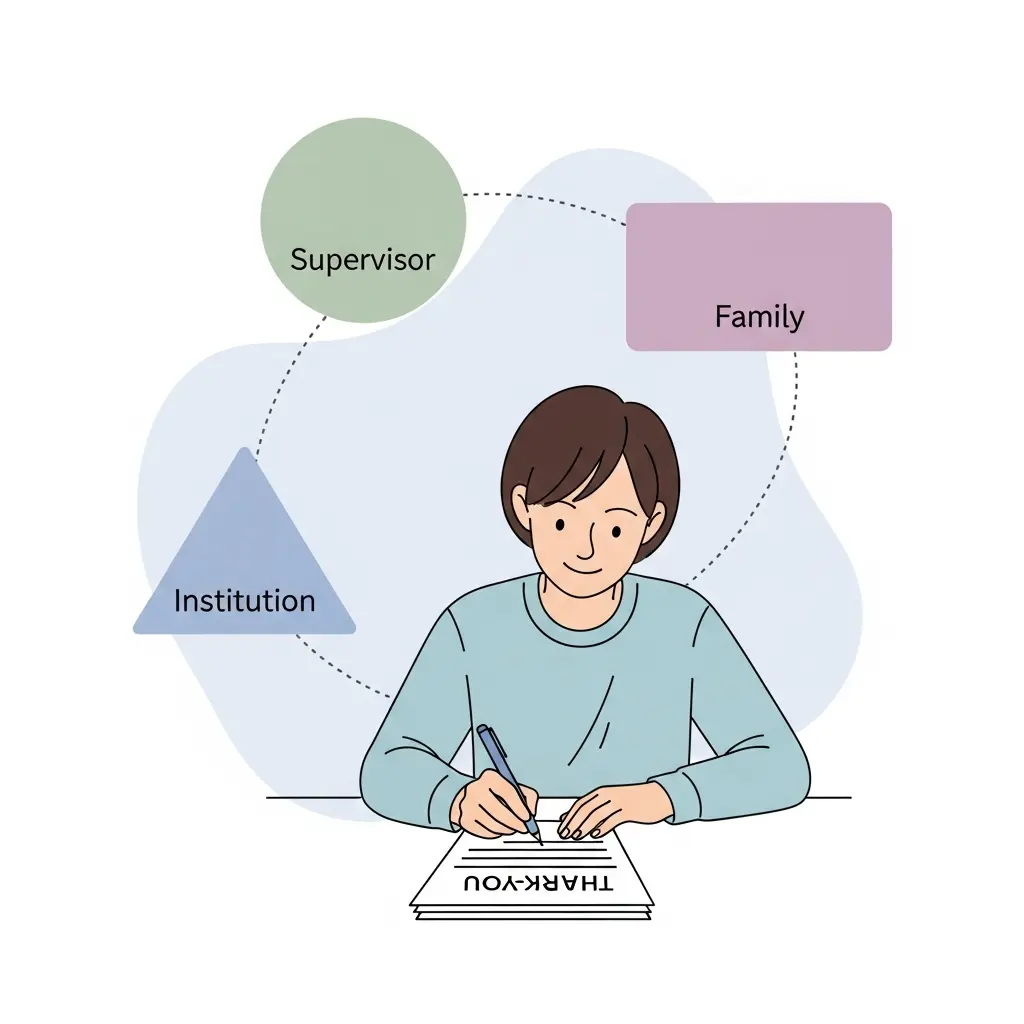
Write thesis acknowledgements in three tiers: (1) academic contributors — supervisor first, then committee, then other academics; (2) institutional contributors — funders with grant numbers, technical staff, libraries; (3) personal contributors — family, friends, partner. Keep tone formally warm: professional enough for an examiner, genuine enough that the people named actually feel appreciated. Aim for 200–400 words on a single page.
What Are Thesis Acknowledgements — and Are They Compulsory?
The acknowledgements section is a brief statement, traditionally one page or fewer, in which you thank the individuals and organisations who supported your research. It sits in the front matter of your thesis, before the main intellectual content begins. Unlike the abstract or the introduction, the acknowledgements are not formally assessed — examiners do not mark them for content or style. That said, they are read, and they do form part of the overall impression your thesis makes.
At most UK universities — including Oxford, Cambridge, UCL, and Edinburgh — and at the major US and Australian institutions, acknowledgements are strongly expected for doctoral theses and recommended for master’s. They are not strictly compulsory in every case, but omitting them entirely is unusual enough to be noticed. For funded research, funder acknowledgement is typically a contractual obligation of the grant, not merely a courtesy.
The acknowledgements are also distinct from the thesis dedication page. A dedication is a single short statement directed at a specific person (“For my grandmother”) and has no structural role. The acknowledgements, by contrast, document the professional and personal support network behind the work. Many theses include both, with the dedication appearing first.
Placement, Length, and Formatting Basics
Where acknowledgements sit in the front matter
The standard front-matter sequence for a UK or Australian doctoral thesis is:
- Title page
- Abstract
- Declaration / Statement of originality
- Acknowledgements
- Table of contents
- List of figures / tables / abbreviations (if applicable)
Some institutions place acknowledgements before the declaration. Check your university’s specific submission guidelines — this is typically available in your postgraduate research handbook or on the library’s thesis submission page. For a full breakdown of front-matter sequencing, the thesis structure guide is worth reading before you finalise your layout.
How long should thesis acknowledgements be?
| Level | Recommended length | Maximum |
|---|---|---|
| Undergraduate dissertation | 100–200 words | Half a page |
| Master’s thesis | 150–350 words | One page |
| PhD / doctoral thesis | 250–500 words | One to two pages |
Running beyond two pages is almost always a sign that the acknowledgements need editing, not expanding. The goal is warmth and accuracy, not comprehensiveness. You do not need to thank every person you have ever spoken to about your research.
Formatting conventions
- Match the body font and spacing of your thesis (typically 11–12pt, 1.5 or double spacing)
- Use a section heading — “Acknowledgements” — on a new page, formatted consistently with your other front-matter headings
- No bullet points or numbered lists in the acknowledgements themselves; write in continuous prose paragraphs
- Page numbering: use lowercase Roman numerals (continuing from the abstract) if your institution uses this convention for front matter
Who to Thank and in What Order
The single most common mistake students make with acknowledgements is getting the order wrong — specifically, putting personal thanks before academic and professional ones. The correct sequence moves from formal to personal, reflecting the professional nature of the thesis as a whole.
Tier 1 — Academic supervisors and committee members
Your primary supervisor always comes first. This is the person who gave the most sustained intellectual and professional support to your research, and the acknowledgements should reflect that centrality. Name them with their full title and explain, briefly, how they helped — not just that they helped.
Weak: “I would like to thank my supervisor, Professor Smith, for their guidance.”
Stronger: “I am deeply grateful to my supervisor, Professor Jane Smith, whose methodological rigour and patience with my early drafts shaped this thesis in fundamental ways.”
After your primary supervisor, list in this order:
- Co-supervisors or second supervisors, with brief note of their role
- Advisory or thesis committee members, who contributed to your research design or progress reviews
- External collaborators or academic mentors who contributed substantially (e.g., co-authored a chapter you adapted)
- Examiners — only thank examiners after your viva, in the final version, if their feedback genuinely improved the work
Tier 2 — Institutional and funding contributors
This tier covers organisations rather than individuals. The correct order here is:
- Funding bodies — with grant number (required by most funders; see the funder section below)
- Research institutions or host departments that provided resources, lab access, or hosting
- Libraries and archives if they provided significant access to materials
- Technical and administrative staff — lab technicians, IT support, graduate school administrators — especially if they played a named role in your methodology
- Research participants — if your research involved human participants, acknowledging them is both ethical and courteous, even if anonymously (“I am grateful to the thirty participants who gave their time to this study”)
Tier 3 — Personal acknowledgements
Personal thanks come last. This is a convention, not a reflection of emotional priority — your family may matter to you far more than your committee, and everyone reading knows that. The convention simply recognises that a thesis is a professional document and should lead with professional context.
Personal acknowledgements typically include:
- Partner or spouse
- Parents and immediate family
- Close friends or fellow students who provided moral support or peer feedback
Keep this tier brief but genuine. “My parents, who never once asked when I would finish” is more memorable and human than three sentences of generic gratitude.
For the supervisor relationship that often dominates the acknowledgements section, our guide on how to manage your supervisor relationship through your thesis covers everything from setting expectations at the first meeting to handling the end of the working relationship productively.
Tone Guide: Formal, Balanced, and Personal Registers
There is no single correct tone for thesis acknowledgements — the appropriate register depends on your field, institution, and the relationships you are describing. What matters is internal consistency. Do not open with a formal, measured paragraph about your supervisor and then pivot to effusive personal language two sentences later.
The formal register (common in STEM and law)
In quantitative science, medicine, engineering, and law, acknowledgements tend to be measured and factual. The goal is to be respectful and accurate without emotional flourish.
“I wish to acknowledge the guidance of my supervisor, Professor David Chen, and my advisory committee, Dr Sarah Okonkwo and Dr Marcus Webb, throughout this project. This work was supported by an EPSRC Doctoral Training Partnership grant [EP/T517988/1]. I am grateful to the technical staff of the Centre for Advanced Imaging for their assistance with data acquisition.”
The balanced register (most common; social sciences, humanities)
The balanced register — professional in structure, warm in language — is the most widely applicable. It acknowledges that the thesis involved real human relationships without becoming a personal essay.
“This thesis would not exist without the intellectual generosity of my supervisor, Professor Aisha Patel, who consistently asked harder questions than I was ready for, and who helped me find my way back when the argument lost its shape. I am also grateful to Dr Liam Brophy and Professor Ruth Nkosi for their sharp engagement during progress reviews. Fieldwork for this project was funded by the Economic and Social Research Council [ES/R001234/1], and I am indebted to the staff at the National Archives for their patient assistance. My deepest thanks go to my parents and to Freya, whose steadiness made this possible.”
The personal register (creative arts, ethnographic research)
In disciplines where the researcher’s subjectivity is part of the methodology — creative writing PhDs, ethnography, arts practice research — a more personal tone is not only acceptable but can be considered appropriate. Even here, the professional tier should appear before the personal one.
“Writing this thesis felt, at times, like archaeology — excavating something I didn’t quite understand yet. Professor Yuki Tanaka helped me trust the process. She gave me room to fail and then helped me see what I’d actually found. I also owe a great deal to Dr Jerome Osei, who asked the questions I was avoiding. My parents held me steady across seven years of this; my sister read every draft I sent at 2am and asked ‘but what do you actually mean here?’ more times than I can count. Thank you all.”
Funder Acknowledgement Requirements (UKRI, Wellcome, NSF)
If your research was funded by a public or charitable body, acknowledging that funding correctly is not optional — it is typically a condition of the grant. Getting the wording or grant number wrong, or omitting it entirely, can be flagged during the publication of any work arising from the thesis.
UKRI (UK Research and Innovation)
UKRI’s official guidance on acknowledging funding requires you to include the name of the funding council (e.g., EPSRC, AHRC, MRC) and the grant reference number. Where multiple grants were involved, list them separated by a semicolon. The standard format is:
“This work was supported by the [Council name] [grant number(s)].”
Example: “This work was supported by the Engineering and Physical Sciences Research Council [EP/T517988/1].”
Wellcome Trust
Wellcome Trust requirements are stricter, particularly for work that will be published. For theses acknowledging Wellcome funding, include:
“This research was funded in whole, or in part, by the Wellcome Trust [Grant number xxxxx]. For the purpose of open access, the author has applied a CC BY public copyright licence to any Author Accepted Manuscript version arising from this submission.”
The second sentence about CC BY licensing applies to publications derived from the thesis, not the thesis document itself, but including it in your thesis acknowledgements preemptively aligns with Wellcome’s open-access policy and is recommended by university research offices including UCL Library Services.
US National Science Foundation (NSF) and NIH
NSF-funded research must acknowledge NSF support with the grant number, and include this disclaimer where applicable: “Any opinions, findings, and conclusions or recommendations expressed in this material are those of the author(s) and do not necessarily reflect the views of the National Science Foundation.” NIH grants should be listed in a similar format with the NIH grant number. Always check your Notice of Award for any funder-specific language requirements.
Funder Acknowledgement Quick Reference
| Funder | Required elements | Grant number format |
|---|---|---|
| EPSRC / AHRC / MRC (UKRI) | Council name + grant reference | EP/T517988/1 |
| Wellcome Trust | “Funded in whole or in part” + CC BY statement | 6-digit number |
| NSF (US) | Grant number + NSF disclaimer | NSF-XXXXXXX |
| NIH (US) | Grant number per Notice of Award | R01XXXXXXXX |
| ERC / Horizon Europe | EU emblem + agreement number | 101XXXXXX |
AI-Use Disclosure in 2026
One question that was essentially absent five years ago now frequently comes up in supervisor meetings: should you disclose AI tool use in your thesis acknowledgements? By 2026, the answer at most institutions is: yes, if you used it, say so — and here is how.
Where to put the disclosure
Most universities that have issued guidance on AI transparency in 2026 require or recommend one of the following:
- A brief statement in the acknowledgements if AI was used for proofreading, grammar correction, or structural review
- A standalone AI-use declaration page (increasingly common for STEM PhDs) if AI tools were used in data analysis or literature searching
- A statement in the methods section if AI tools were part of the research methodology itself
For most students using AI as a writing aid — grammar checking, clarity editing, formatting — a brief acknowledgements statement is sufficient. For example, see how institutions like those discussed in the guide to AI editors and institutional policies are framing this.
What the disclosure should say
Be specific about the tool and its purpose. Vague or evasive language will not satisfy an examiner who asks about it at the viva. A clear disclosure template:
“Portions of this thesis were proofread using [Tool name, version if applicable] for grammar and clarity. All intellectual content, arguments, and conclusions are my own. No AI tool was used to generate text, interpret data, or produce original analysis.”
If your institution prohibits AI tools entirely, do not mention them in the acknowledgements — do not acknowledge something that would constitute a violation. If you are uncertain whether your use of an AI tool was permitted, speak with your supervisor before submitting, not after. Proactive disclosure consistently results in lighter sanctions than concealment when questions arise later.
What not to include in AI disclosure
- Do not name AI tools as co-authors or intellectual contributors (“ChatGPT helped develop the argument in Chapter 3”) — this misrepresents the nature of AI assistance and attributes intellectual ownership incorrectly
- Do not use AI-disclosure language as a shield for work that went beyond permitted use
- Do not include an AI disclosure if you genuinely did not use AI tools — this looks defensive without cause
What to Avoid: Etiquette Pitfalls
The acknowledgements page is short, but there are several ways to get it meaningfully wrong. These are the most common pitfalls, based on the concerns examiners and supervisors raise most frequently.
Putting personal thanks before professional ones
This is the most common structural error. Starting with “First and foremost I want to thank my mum…” before acknowledging your supervisor signals a misunderstanding of the professional context. The convention is professional first, personal last — always.
Thanking people who should not be in the acknowledgements
The acknowledgements are not a social media post or a wedding speech. Avoid thanking casual acquaintances, people you feel you should thank rather than genuinely need to, or anyone whose inclusion might raise ethical questions (e.g., a person who provided data informally without institutional sign-off). If someone’s contribution was formal enough to influence the research, it belongs in the methodology, not the acknowledgements.
Over-effusive language for supervisors
Describing your supervisor as “the most brilliant mind I have ever encountered” or “a true genius who transformed my understanding of everything” is uncomfortable to read — especially for the examiner who knows your supervisor personally. Be warm and specific, not hyperbolic. “Professor Chen’s insight into spatial statistics fundamentally shaped Chapter 4” is more useful and more credible than generic praise.
Forgetting to thank funded participants
If your research involved human participants — interview subjects, survey respondents, case-study organisations — thank them, even if anonymously. Omitting participants is ethically tone-deaf and noticed by ethics committees who review theses.
Not including grant numbers
Thanking your funder by name but omitting the grant number is a common oversight that can create problems when you submit publications derived from the thesis. Always include it, even if it seems like administrative clutter.
Writing acknowledgements as a list rather than prose
Using bullet points or a numbered list for your acknowledgements is a formatting error. The convention across all disciplines is continuous prose paragraphs. Lists feel transactional; prose conveys genuine reflection.
Repeating acknowledgements from papers already published
If your thesis includes published or submitted chapters, the acknowledgements in those papers will typically have named your supervisor and funder already. In the thesis-level acknowledgements, it is fine — and expected — to do so again in the appropriate place.
Ready-to-Use Templates by Tone
The following templates can be adapted directly. Sections in [square brackets] should be replaced with your own content. These cover the three most common scenarios: a master’s thesis with no funding, a PhD with UKRI funding, and a PhD with more personal disclosure of the research journey.
Template 1 — Master’s thesis, balanced tone, no external funding
Acknowledgements
I am grateful to my supervisor, [Full name with title], for [specific contribution — e.g., their guidance in shaping the research design and their detailed feedback on each chapter draft]. I would also like to thank [Second reader or seminar tutor, Full name], whose comments at the proposal stage helped me focus the scope of this project significantly.
This research was conducted using resources provided by [Department/Library name], and I am particularly grateful to [specific staff member if applicable] for their assistance.
Finally, I thank my family and [partner/friends] for their patience and support throughout this process.
Template 2 — PhD thesis, formal tone, UKRI funded
Acknowledgements
This thesis was completed under the supervision of [Full name with title], to whom I am deeply indebted for [specific: e.g., sustained intellectual challenge, methodological rigour, and support during fieldwork complications]. I am also grateful to my second supervisor, [Full name], and to the members of my Thesis Advisory Committee — [Names] — for their guidance and critical engagement at each progress review.
This work was supported by [Council name] [grant number]. I am grateful to [any collaborative institution] for providing [specific resource: data access, laboratory facilities, archival materials].
I thank the [number] participants who contributed their time and perspectives to this research. Their openness made this thesis possible.
My sincere gratitude also goes to [family members/partner/colleagues] for [specific: e.g., reading drafts, tolerating disrupted holidays, or simply being there].
Template 3 — PhD thesis with AI-use disclosure
Acknowledgements
I am grateful above all to my supervisor, [Full name with title], for [specific contribution]. [Committee members] provided invaluable critique throughout. This research was supported by [Funder name] [grant number].
I would like to acknowledge the technical staff of [department or facility] for their assistance with [specific: data processing, imaging, transcription].
AI-use statement: Portions of this thesis were checked for grammar and clarity using [Tool name]. All intellectual content, arguments, analysis, and conclusions are entirely my own. No generative AI tool was used to write, paraphrase, or synthesise any part of this thesis.
My deepest thanks to [family and personal supporters], without whom none of this would have been worth finishing.
Adapting these templates
The goal when adapting these templates is to replace the bracketed placeholders with specific, concrete language. “Their patient guidance” is weaker than “their ability to identify precisely where my argument was circular, and their refusal to let me paper over it.” Specificity makes acknowledgements feel genuine rather than formulaic. For more annotated examples at different academic levels, the thesis acknowledgements examples guide has five fully annotated samples worth reviewing before you write your final version.
If you are also working on the broader structure of your front matter, the PhD thesis structure guide covers how acknowledgements, abstracts, and declarations interlock across the full document.
Frequently Asked Questions
How long should thesis acknowledgements be?
Thesis acknowledgements should typically be one page or fewer — around 200 to 400 words for a master’s thesis, and up to 500 words for a PhD. Longer is not better; examiners value concision. A half-page acknowledgements section is entirely acceptable.
Who do you thank first in thesis acknowledgements?
Always thank your primary supervisor first. Then list co-supervisors, advisory committee members, and other academic contributors in descending order of involvement. Funding bodies come next, followed by technical and administrative staff, then personal acknowledgements (family, friends, partner) at the very end.
Should I use first names or titles in thesis acknowledgements?
Use full names with academic titles (e.g., “Professor Jane Smith”) for supervisors and committee members. For close colleagues or lab mates, first name only is acceptable. For family and friends, first names are standard and expected.
Do I need to disclose AI use in my thesis acknowledgements?
This depends on your institution’s policy, but many universities in 2026 require a brief AI-use statement either in the acknowledgements or a standalone declaration page. If you used an AI tool for proofreading, grammar checking, or structural feedback, state the tool and purpose clearly. Never imply AI contributed to original intellectual work unless your policy explicitly permits it.
Do funders require specific wording in thesis acknowledgements?
Yes. UKRI requires you to include the funder’s name and your grant number. Wellcome Trust funded research must include the statement: “This research was funded in whole, or in part, by the Wellcome Trust [Grant number xxxxx].” Always check the specific terms and conditions of your grant before writing your acknowledgements.
Where does the acknowledgements section go in a thesis?
Acknowledgements belong in the front matter, typically after the abstract and before the table of contents. In some UK university formats they appear after the declaration page. Check your institution’s specific submission guidelines, as placement conventions vary.
Conclusion
The acknowledgements section will take you an hour to write and will be read for thirty seconds — but those thirty seconds matter. A well-ordered, appropriately toned acknowledgements page signals that you understand the professional and ethical context of your research, that you are aware of your obligations to funders, and that you have the judgment to calibrate between formality and humanity. Start with your supervisor. Include your grant number. Mention your participants. End with the people who kept you going. Keep it to a page.
If you are working through the remaining sections of your thesis and want structured support at every stage, Tesify’s AI-assisted thesis writing tool walks you through every chapter with prompts calibrated to your level and discipline — so you can focus on writing the thesis itself, not on second-guessing the format.
Write your thesis with AI
Structure, draft, cite, and format your thesis faster with Tesify’s AI writing tools, automatic bibliography, and plagiarism checker. Free to start, no credit card required.




Leave a Reply