
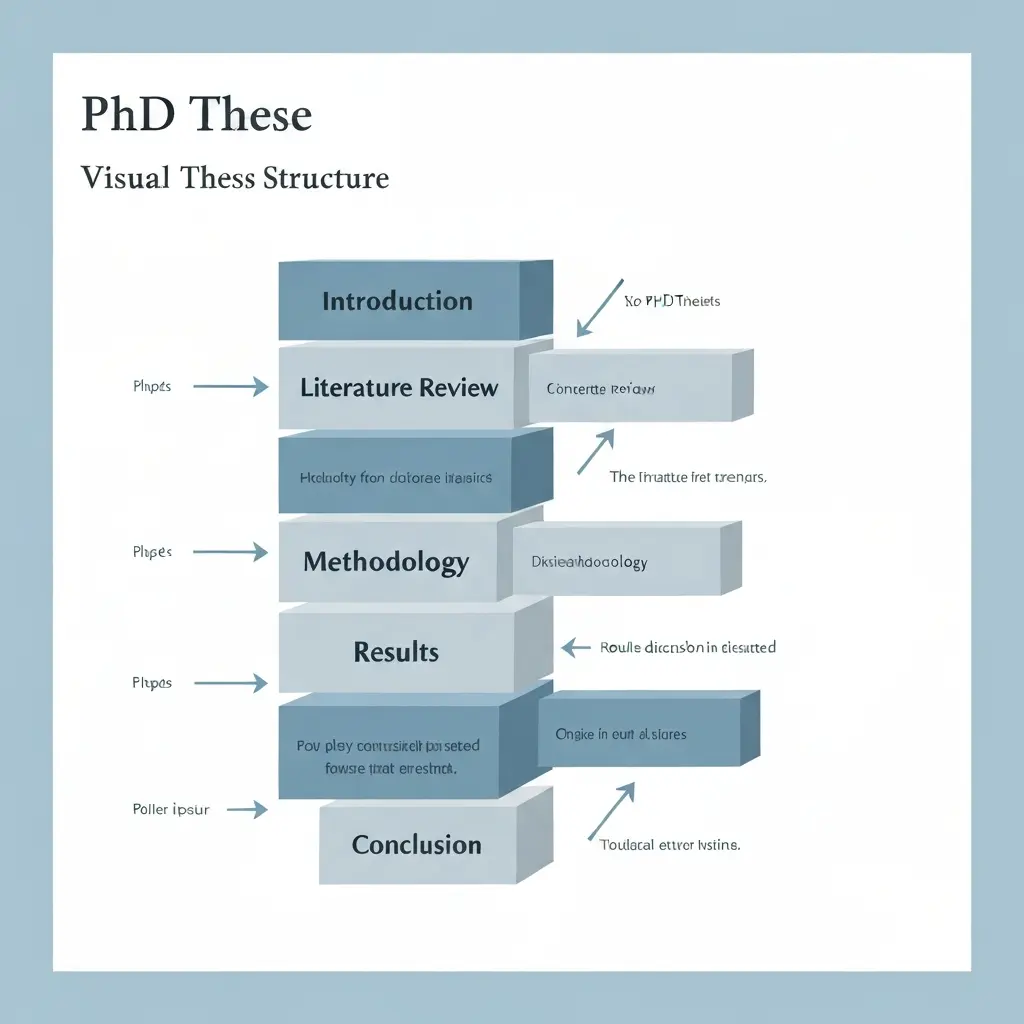
PhD Thesis Structure: A Complete Chapter-by-Chapter Guide (2026)
The structure of a PhD thesis is not arbitrary — it is a logical architecture designed to carry your examiner from problem to contribution without losing them along the way. Yet surprisingly few doctoral programmes provide explicit instruction on what belongs in each chapter, how long each section should be, or what examiners are actually looking for when they open the binding. This guide fills that gap.
Whether you are at the planning stage or mid-way through writing, understanding the standard PhD thesis structure — and how to adapt it for your discipline — will sharpen every chapter you produce. We draw on guidance from UCL, Oxford, Cambridge, MIT, and leading academic writing researchers to give you the most complete picture available.
PhD Thesis Structure Overview
A standard PhD thesis in the UK, US, and Australia follows the IMRAD model (Introduction, Methods, Results, and Discussion) at its core, with additional chapters and sections depending on the discipline. Oxbridge Essays notes that most PhD theses contain between five and nine chapters, with the exact number determined by the complexity of the research design and the requirements of the examiners. Humanities and social science theses, in particular, often use more chapters because findings and discussion are woven together rather than separated.
| Component | Typical Position | Approx. Length |
|---|---|---|
| Title page, declarations | Front matter | 1–2 pages |
| Abstract | Front matter | 250–350 words |
| Acknowledgements | Front matter | 1–2 pages |
| Table of contents | Front matter | 1–3 pages |
| Chapter 1: Introduction | Chapter 1 | 5,000–12,000 words |
| Chapter 2: Literature Review | Chapter 2 | 10,000–20,000 words |
| Chapter 3: Methodology | Chapter 3 | 8,000–15,000 words |
| Chapter 4: Results/Findings | Chapter 4 | 10,000–20,000 words |
| Chapter 5: Discussion | Chapter 5 | 8,000–15,000 words |
| Chapter 6: Conclusion | Chapter 6 | 4,000–8,000 words |
| References / Bibliography | Back matter | Varies widely |
| Appendices | Back matter | As required |
Front Matter: Title Page, Abstract, Acknowledgements
The front matter establishes the formal identity of your thesis. Most UK universities require a title page that includes your full name, thesis title, degree sought, department, institution, and year of submission. A declaration of originality — confirming that the work is your own and has not been submitted elsewhere — is required at almost every institution.
The abstract (250–350 words) is the most-read section of any thesis. It must summarise your research problem, methodology, key findings, and contribution to knowledge. Write it last, after all other chapters are complete. Every word must earn its place. For detailed guidance on writing this section, see our guide on thesis structure: every section explained with examples.
The acknowledgements are optional but nearly universal. Thank supervisors, funding bodies, participants, and personal supporters. Keep it to one page. Examiners read acknowledgements — a warm, specific acknowledgement can humanise a technical thesis. See thesis acknowledgements examples and templates for ready-to-use models.
Chapter 1: Introduction
The introduction is your thesis in miniature. A strong PhD introduction does seven things:
- Establishes the broad context and significance of your research area
- Identifies the specific problem or gap your thesis addresses
- States your research question(s) or hypotheses clearly
- Outlines your aims and objectives
- Briefly describes your methodology and why it is appropriate
- Summarises your key findings and contribution
- Maps the structure of the thesis chapter by chapter
Examiners assess whether your introduction creates a coherent narrative that runs through the entire thesis. A common error is writing an introduction that promises a thesis the rest of the document does not deliver. Write a draft introduction early, but revise it substantially after all other chapters are complete.
Chapter 2: Literature Review
The literature review chapter is not a summary of everything written on your topic — it is a critical, synthesised argument for why your research is necessary. According to Grad Coach, the most common examiner criticism of literature reviews is that they describe rather than synthesise. Every paragraph should advance your argument that a specific gap exists and that your chosen methodology is the right tool to address it.
A strong PhD literature review:
- Is organised thematically or conceptually, not chronologically
- Identifies key theoretical frameworks and positions your work within them
- Shows where studies agree, where they conflict, and why
- Leads logically to your research question in the final paragraph
- Is fully up to date (typically within five years for fast-moving fields)
For a comprehensive walkthrough, see our literature review examples and analysis templates.
Chapter 3: Methodology
The methodology chapter is where you demonstrate research competence. It must justify every significant decision you made in designing your study. Examiners are looking for evidence that you understand the epistemological basis for your approach, not just the practical steps you followed.
A well-structured methodology chapter typically covers:
- Research philosophy: Positivism, interpretivism, pragmatism, or critical realism — and why it fits your questions
- Research approach: Deductive, inductive, or abductive
- Research design: Experimental, case study, ethnographic, survey-based, etc.
- Data collection methods: Interviews, questionnaires, observation, documents, secondary data
- Sampling strategy: Purposive, random, theoretical, snowball — and sample size justification
- Data analysis methods: Thematic analysis, regression, discourse analysis, etc.
- Ethical considerations: Consent, confidentiality, potential harms, ethics board approval
- Reliability and validity (quantitative) or trustworthiness (qualitative)
- Limitations: What your methodology cannot do
Each decision must be justified with reference to the literature on research methodology — not just pragmatic convenience.
Chapter 4: Results / Findings
In the results chapter, you present your data without interpretation. Every finding must be directly relevant to your research questions. In quantitative theses, this chapter typically contains tables, graphs, and statistical outputs. In qualitative theses, it contains rich descriptive passages, quotations, and thematic maps.
A common structural error is mixing presentation and interpretation — saving all discussion for Chapter 5 requires discipline but produces a far more logically coherent thesis. Some supervisors prefer a combined Results and Discussion chapter, particularly in social science and humanities: discuss this preference explicitly with your supervisor before writing.
Chapter 5: Discussion
The discussion is the intellectual heart of your PhD thesis. Here, you interpret your findings in light of the existing literature, explain unexpected results, discuss theoretical and practical implications, and — crucially — articulate your original contribution to knowledge.
A high-scoring PhD discussion chapter:
- Opens by restating your key findings concisely (two to three paragraphs)
- Interprets each finding with reference to prior literature (does it confirm, challenge, or extend it?)
- Explains surprising or unexpected results rather than downplaying them
- Articulates theoretical implications clearly
- Discusses practical implications for the relevant profession, policy area, or industry
- Acknowledges limitations honestly without undermining the value of the research
- Identifies avenues for future research
Chapter 6: Conclusion
Many students underestimate the conclusion, treating it as a brief summary after the intellectual work is done. In fact, examiners pay close attention to the conclusion because it is where your contribution to knowledge is most explicitly stated.
A strong PhD conclusion:
- Restates the research problem and why it mattered
- Summarises your key findings and how they addressed your research questions
- Articulates your specific original contribution to knowledge (this is what PhDs are judged on)
- Draws out the implications for theory, practice, and policy
- Identifies the limitations of your research honestly
- Proposes clear directions for future research
- Closes with a reflective statement on the significance of the work
For conclusion writing guidance with real examples, see our thesis conclusion examples guide.
Back Matter: References and Appendices
The reference list must be complete, consistent in format, and formatted according to your university’s required citation style (APA, Harvard, Chicago, Vancouver, etc.). Many examiners check references carefully — an inconsistent or incomplete reference list is a mark of carelessness that reflects poorly on the entire thesis.
Appendices contain material that is too detailed or bulky for the main text but that supports your arguments — interview transcripts, survey instruments, data tables, ethics approval letters, or additional analyses. Every appendix must be referenced explicitly in the main text (“see Appendix A for the full interview schedule”).
Discipline-Specific Variations
| Discipline | Typical Variation | Chapter Count |
|---|---|---|
| Sciences & Engineering | IMRAD structure; multiple results chapters for multi-study designs | 5–7 |
| Social Sciences | Often combined Results + Discussion; strong positionality section | 5–8 |
| Humanities | Thematic chapters instead of IMRAD; argument-driven structure | 6–9 |
| Business & Management | IMRAD + dedicated theoretical framework chapter | 5–7 |
| Creative Arts (practice-led) | Substantial portfolio with contextualising written thesis | 3–5 |
Typical Word Counts by Chapter
UK doctoral theses are typically between 70,000 and 100,000 words, though practice-led and some STEM theses may be shorter (45,000–70,000). US doctoral dissertations range from 70,000 to 150,000 words depending on the field and committee requirements. Always verify your institution’s specific requirements.
Frequently Asked Questions
How many chapters should a PhD thesis have?
Most PhD theses have between five and nine chapters. The core structure (Introduction, Literature Review, Methodology, Results, Discussion, Conclusion) gives you six. Complex multi-study designs, theoretical frameworks warranting a dedicated chapter, or discipline conventions in humanities may push the number higher. Avoid padding with unnecessary chapters — every chapter must earn its place by advancing your overall argument.
Can I combine the results and discussion chapters in my PhD thesis?
Yes. Combined Results and Discussion chapters are common in social sciences, education, and humanities. The decision should be based on your research design: if your findings are naturally interpretive (as in qualitative studies), combining is often cleaner. If your data is primarily statistical, separating them keeps presentation and interpretation distinct and easier for examiners to follow. Discuss this structural choice explicitly with your supervisor.
How long should the introduction chapter of a PhD thesis be?
Typically between 5,000 and 12,000 words, representing roughly eight to twelve percent of the total thesis word count. Introductions that run significantly longer often contain material that properly belongs in the literature review. Those that are much shorter typically fail to adequately establish context, justify the research, or map the thesis structure — all of which examiners expect.
What is the difference between a PhD thesis and a master’s dissertation in terms of structure?
The chapter structure is broadly similar, but the depth, length, and originality requirements differ substantially. PhD theses require a demonstrable original contribution to knowledge — new findings, new theory, or new methodology. Master’s dissertations demonstrate that you can apply existing methods rigorously; original contribution is valued but not strictly required. PhD theses are typically twice as long (70,000–100,000 words vs 15,000–30,000 for master’s) and expected to generate publishable findings.
Does every PhD thesis need a separate theoretical framework chapter?
Not in every discipline. Science and engineering theses rarely have a dedicated theoretical framework chapter — theory is woven into the introduction and literature review. Business, management, social science, and education theses more frequently include a standalone theoretical framework chapter, especially when the research draws on a specific theory (e.g., social constructivism, institutional theory). Check what is standard in your field and discuss with your supervisor.
Write Every Chapter with Confidence
Tesify gives you a chapter-by-chapter writing system built for PhD and master’s students. From structuring your literature review to formatting your references, Tesify keeps your entire thesis coherent, properly cited, and on schedule.
Write your thesis with AI
Structure, draft, cite, and format your thesis faster with Tesify’s AI writing tools, automatic bibliography, and plagiarism checker. Free to start, no credit card required.






Leave a Reply