
Literature Review Example: Step-by-Step Analysis and Templates 2026
A strong literature review is the chapter that separates good dissertations from outstanding ones. Yet most students write literature reviews that read like annotated bibliographies — a list of what other people found, in no particular order, with no analytical thread connecting them. This guide shows you, through fully annotated examples, exactly what a high-scoring literature review looks like and how to build one yourself.
We analyse literature review extracts from three fields — social science, environmental science, and business — with line-by-line commentary explaining what works and why. We also provide templates, sentence starters, and the gap statement formula used by researchers at UCL, the University of Manchester, and Harvard.
According to feedback data from the UK’s Higher Education Academy, the literature review is the chapter most frequently flagged for revision in dissertation assessments — typically for being “descriptive rather than analytical.” This guide addresses exactly that problem.
What Is a Literature Review and What Is It Not?
A literature review is a critical synthesis of existing research on your topic. It demonstrates that you understand the intellectual landscape of your field, can evaluate the quality of existing work, and have identified a specific gap that your research addresses.
| A literature review IS | A literature review is NOT |
|---|---|
| A critical synthesis and evaluation of sources | A list of summaries of what each paper found |
| Organised by themes and arguments | Organised by author or publication date |
| An argument that builds toward your gap | A neutral overview of the field |
| Evidence of your judgment about source quality | Uncritical acceptance of everything you read |
| 50–120 sources for a master’s thesis | Everything you read, regardless of relevance |
How to Structure Your Literature Review
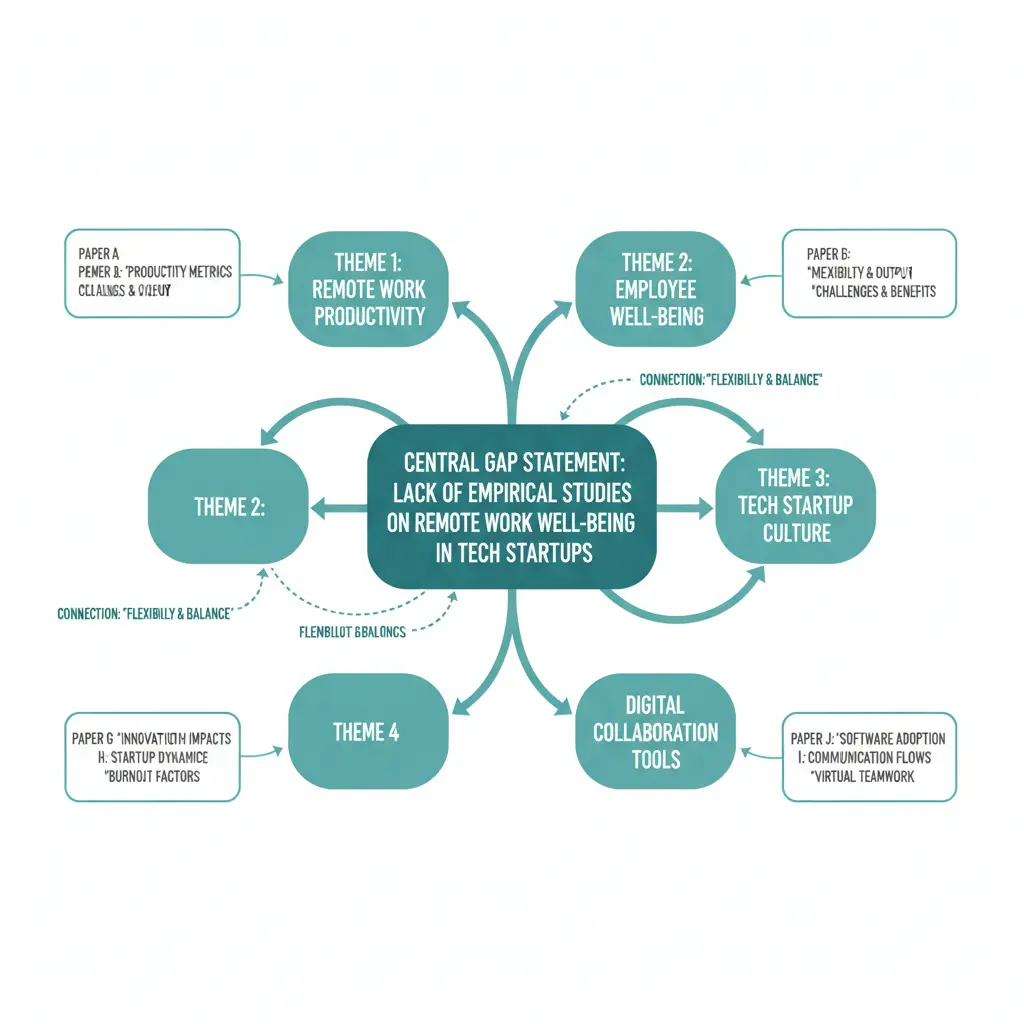
The most effective structure for a dissertation literature review is thematic. You identify three to five major themes or debates in your field and dedicate one section to each, building toward your gap statement.
Thematic Structure Template
- Opening paragraph: State the scope of your review — what you cover, what you do not cover, and why.
- Theme 1: Establish the foundational concepts. What do researchers agree on? What are the definitions?
- Theme 2: The main body of research. What are the key findings? Where do researchers agree and disagree?
- Theme 3: The contested frontier. Where is the ongoing debate? What methodological or conceptual disagreements exist?
- Gap statement: What specifically has not been studied? This must connect directly to your research question.
Social Science Literature Review Example: Annotated
The following extract is from a master’s dissertation in education studies examining the relationship between growth mindset interventions and academic achievement in secondary school students. Annotations in square brackets explain what the writer is doing at each point.
“The concept of implicit theories of intelligence — the belief that intelligence is either fixed (entity theory) or malleable (incremental theory) — was first systematically examined by Dweck and Leggett (1988), whose foundational work established that students holding incremental beliefs displayed greater persistence on challenging tasks. [Establishes the foundational concept and its origin.]
This distinction was later operationalised as ‘mindset’ by Dweck (2006), whose popular synthesis attracted both widespread adoption in educational policy and significant academic scrutiny. While Dweck’s experimental studies reported consistent positive effects of growth mindset interventions on effort and persistence (Blackwell, Trzesniewski, and Dweck, 2007), subsequent large-scale replication studies have produced more mixed results. Yeager et al. (2019), in a pre-registered study of 12,000 US secondary students, found modest but significant effects on academic performance (d = 0.10), though notably only for struggling students — suggesting that context and student characteristics moderate the relationship. [Introduces a key debate — enthusiastic early findings versus more cautious replications. Uses specific effect sizes and study details, demonstrating critical engagement.]
In the UK context, the Education Endowment Foundation (2020) found inconsistent effects across five randomised controlled trials of growth mindset programmes, concluding that implementation quality was the primary mediating variable. This finding, however, was contested by Claro, Paunesku, and Dweck (2016), who demonstrated strong positive effects specifically in low-socioeconomic-status students, arguing that universal implementation studies obscure differential effects. [Extends the debate geographically and introduces a moderating variable — socioeconomic status — that is relevant to the specific research question.]
Despite this extensive body of research, no study has examined the effect of growth mindset interventions in UK independent secondary schools, where the socioeconomic and motivational profile of students differs substantially from the state school samples used in most existing research. This gap is significant given the policy interest in evidence-based wellbeing programmes in the independent sector (ISC, 2024). [Clear, specific gap statement connecting directly to the research question.]”
What to learn from this example: Notice how the writer moves from establishing a concept to mapping the debate to identifying the specific gap. Every paragraph advances the argument rather than simply adding more information. The gap statement is specific (UK independent schools) and explains why the gap matters (policy context).
Business Literature Review Example: Annotated
This extract is from a dissertation on employee turnover intention in the UK hospitality sector. Note how it synthesises across studies rather than summarising each one individually.
“Employee turnover in the hospitality sector has been consistently identified as one of the industry’s most significant management challenges, with annual turnover rates in the UK ranging from 30% to 75% depending on sector segment (CIPD, 2023). [Opens with industry context and credible data — immediately establishes why the topic matters.] Theoretical explanations for this pattern have drawn primarily on Mobley’s (1977) intermediate linkages model and its successors, which identify job dissatisfaction as the primary precursor to turnover intention, mediated by job search behaviour and perceived ease of movement (Lee and Mitchell, 1994).
More recent scholarship has complicated this linear model by identifying the role of organisational factors. Tracey and Hinkin (2008) found that supervisory behaviour explained 30% of variance in turnover intention, a finding replicated in UK hotel contexts by Knox and Walsh (2005) and most recently by Thite, Kavanagh and Johnson (2022), who additionally identified psychological safety as a significant moderator. However, these studies share a common limitation: they examine turnover intention rather than actual turnover, assuming (reasonably but not universally) that intention predicts behaviour. [Identifies a methodological limitation shared across studies — this is critical evaluation, not description.]
A further gap concerns temporal dynamics. With the exception of Hom et al. (2012), who conducted a longitudinal study over 18 months, the vast majority of turnover research is cross-sectional, capturing a single moment rather than tracking how intentions evolve across a typical hospitality contract cycle. [Identifies a methodological gap — longitudinal data — that positions the current study’s approach.]”
What to learn: The writer synthesises multiple studies per paragraph rather than dedicating one paragraph per study. They also evaluate methodology, not just findings — noting that cross-sectional designs limit what existing research can claim.
Science Literature Review Example: Annotated
This extract is from an environmental science dissertation on urban heat island effects in UK cities. Notice how empirical data is used to establish the significance of the problem.
“Urban heat islands (UHIs), defined as metropolitan areas that are measurably warmer than surrounding rural environments due to human activity, were first documented systematically by Howard (1818) in London. Contemporary measurements confirm that UHI intensities in major UK cities range from 2°C to 8°C above surrounding rural temperatures, with London’s mean UHI intensity of approximately 4.1°C being among the highest in Northern Europe (Jones et al., 2020). [Establishes the phenomenon with both historical context and current data.]
Mitigation strategies have centred on two principal approaches: green infrastructure (urban trees, parks, and green roofs) and cool surfaces (high-albedo pavements and building materials). Meta-analyses of cooling efficiency favour green infrastructure, with Bowler et al. (2010) reporting mean temperature reductions of 1.2°C within 100m of urban parks, and more recently Ziter et al. (2019) demonstrating nonlinear scaling effects in which tree canopy coverage above 40% produces disproportionate cooling. [Compares two approaches and cites meta-analytic evidence — the strongest form of empirical evidence.]
Despite this body of work, research has focused predominantly on large metropolitan areas. Small and medium-sized UK cities (population 50,000–300,000) have received comparatively little attention, despite collectively housing 28% of the UK population (ONS, 2023). Whether the threshold effects identified in metropolitan contexts apply to smaller urban forms remains empirically unresolved. [Precise, data-supported gap statement — tells the reader exactly what is unknown and why it matters.]”
Synthesis Techniques: How to Compare and Contrast Sources
The core skill in literature review writing is synthesis — bringing multiple sources together to make a point rather than summarising each one individually. Here are the four main synthesis moves with templates:
1. Agreement Synthesis
Multiple studies point to the same conclusion. Use when establishing consensus.
Template: “A consistent finding across [discipline] research is that [claim]. [Author A (year)], [Author B (year)], and more recently [Author C (year)] all report [evidence], suggesting that [interpretation].”
2. Contrastive Synthesis
Studies reach different conclusions. Use when mapping a debate.
Template: “While [Author A] found [X] in [context], this finding has been challenged by [Author B], who reports [Y] in [different context]. The discrepancy may reflect differences in [variable: methodology / sample / context].”
3. Limitation Synthesis
Multiple studies share the same methodological weakness. Use when positioning your own methodology.
Template: “A shared limitation of existing research on [topic] is [limitation]. [Author A], [Author B], and [Author C] all use [method], which means that [what cannot be claimed]. [Your study] addresses this by using [your method].”
4. Gap Synthesis
The existing literature collectively fails to address something. Use as your gap statement.
Template: “Despite extensive research on [broad area], the specific relationship between [variable A] and [variable B] in [specific context] remains underexplored. [Author A] examined [aspect], while [Author B] addressed [different aspect], but neither study investigated [precise gap]. This thesis addresses that gap.”
How to Write the Gap Statement
The gap statement is the single most important paragraph in your literature review. It directly justifies your research. A strong gap statement has three parts:
- What we know — briefly summarise the state of existing research in two to three sentences
- What we do not know — identify the specific gap, contradiction, or unresolved question
- Why it matters — explain the consequences of this gap: practical, theoretical, or methodological
Weak gap statement: “However, there is limited research on this topic and more research is needed.”
Strong gap statement: “While existing research has established the relationship between X and Y in adult populations (Smith, 2020; Jones, 2021; Brown, 2022), no study has examined this relationship in adolescent populations, for whom developmental factors may substantially alter the mechanism. This gap is particularly significant given the policy focus on [issue] in secondary education (DfE, 2024).”
Sentence Starters for Literature Reviews
These sentence starters help you signal the analytical move you are making in each sentence:
| Move | Sentence Starters |
|---|---|
| Establishing consensus | There is broad agreement that… / A consistent finding across… / Multiple studies confirm… |
| Introducing debate | However, this view has been challenged by… / A competing perspective argues… / This finding has been contested in… |
| Evaluating a source | A limitation of this study is… / While influential, this work was conducted in… / The sample size of [n] limits generalisability to… |
| Making a connection | This finding is consistent with… / Building on this, [Author] found… / This complements earlier work by… |
| Identifying the gap | Despite this body of research… / What remains unclear is… / No study has yet examined… |
Common Errors and How to Fix Them
- “Shopping trolley” review: Listing sources without connecting them. Fix: every paragraph must make an argument, not just report findings.
- Over-reliance on one source: Citing the same textbook or paper repeatedly. Fix: use at least 3 different sources per key claim; prioritise peer-reviewed journal articles.
- No critical evaluation: Accepting everything you read as equally valid. Fix: note sample sizes, methodological approaches, and contextual limitations explicitly.
- Chronological structure: Reviewing literature in date order rather than by theme. Fix: reorganise by the arguments and debates, not the publication years.
- No gap statement: The review ends without connecting to your research question. Fix: add an explicit gap statement paragraph that begins “Despite this research…”
For the full context of how the literature review fits into your thesis, see our thesis structure guide and our complete thesis writing guide. For related guidance on German-language academic writing, see Tesify.io’s guide to Literaturrecherche.
Frequently Asked Questions
How long should a literature review be?
For a 10,000-word undergraduate dissertation, aim for 2,500–3,500 words. For a 15,000–20,000 word master’s thesis, aim for 4,000–6,000 words. For a PhD thesis, the literature review or relevant chapters may run to 15,000–25,000 words. As a rough proportion, the literature review typically represents 25–30% of the thesis total. Always check your institution’s guidelines — some specify chapter word counts explicitly.
How many sources do I need in a literature review?
There is no fixed minimum, but as a guide: undergraduate dissertations typically cite 25–50 sources in the literature review; master’s dissertations typically cite 50–100 sources. Quality matters more than quantity — 40 well-understood, critically engaged sources are far more impressive than 100 superficially cited ones. Prioritise peer-reviewed journal articles published in the last five to ten years, supplemented by key foundational texts and official reports.
Can a literature review be a standalone piece of research?
Yes. Systematic literature reviews and scoping reviews are legitimate, publishable research in their own right — particularly in healthcare, education, and social policy fields. A systematic review follows a pre-registered protocol (PRISMA or PROSPERO) to comprehensively identify and synthesise all relevant studies on a question. Some master’s and all-but-dissertation (ABD) students conduct systematic literature reviews as their primary research design, without collecting original data.
Should I include sources I disagree with in my literature review?
Absolutely yes. A strong literature review engages with contradictory and contested evidence rather than cherry-picking studies that support your hypothesis. Ignoring inconvenient findings is a form of confirmation bias that examiners will notice and penalise. When you include studies with conflicting findings, use them to demonstrate your critical thinking: explain why studies might reach different conclusions (different samples, different methodologies, different definitions) and what this means for your own approach.
What databases should I search for my literature review?
The most important databases vary by discipline: for social sciences and education, use JSTOR, Web of Science, ERIC, and PsycINFO; for business, use Business Source Complete and ABI/Inform; for sciences, use PubMed, Scopus, and Web of Science; for engineering, use IEEE Xplore and Engineering Village. Google Scholar is a useful starting point for all disciplines but should not be your only source, as it lacks the filtering and quality controls of specialist databases. Access all databases through your university library portal.
When should I write the literature review?
The literature review is typically the second chapter written in the optimal sequence (after methodology and results). However, you should read the literature continuously throughout your research process — from before you finalise your research question to after you have collected your data (to check if new relevant studies have been published). A first draft of the literature review is usually written during or just after your data collection phase, when you know exactly what your findings are and can therefore select the most relevant literature to contextualise them.
Write your thesis with AI
Structure, draft, cite, and format your thesis faster with Tesify’s AI writing tools, automatic bibliography, and plagiarism checker. Free to start, no credit card required.






Leave a Reply