
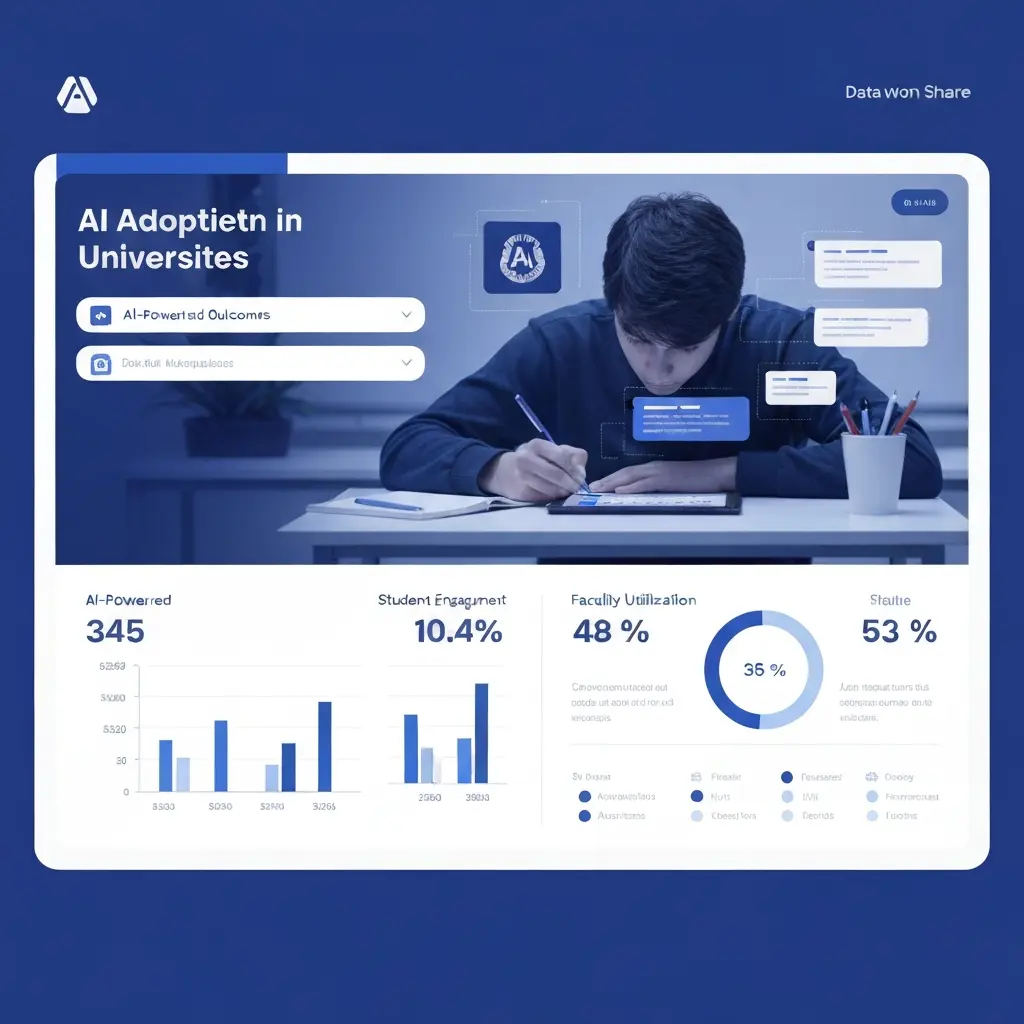
AI in Academic Writing Statistics 2026: 60+ Data Points on Usage, Policies, and Outcomes
The adoption of AI in academic writing statistics 2026 tells a story of rapid, uneven, and often contested change. Within two years of ChatGPT’s public release, more than half of university students worldwide reported using a generative AI tool for at least one writing task — yet fewer than one in five institutions had published a clear, enforceable policy. This gap between technology uptake and institutional response is now one of the defining tensions in higher education, and the numbers behind it are worth examining closely.
This article compiles over 60 verified data points drawn from UNESCO reports, Turnitin’s academic integrity research, peer-reviewed journals, and surveys conducted by major universities. If you are a student wondering whether AI use is normal, a researcher tracking the trend, or an educator designing a policy, the figures below provide a rigorous baseline for 2026.
Student Usage Rates in 2026
Large-scale survey data from 2025–2026 paints a consistent picture: AI writing assistance has crossed from novelty to norm.
- 56% of university students globally say they have used generative AI for at least one writing assignment (EDUCAUSE 2025 Student Technology Report).
- 43% report using AI weekly or more often for academic work.
- 31% say they use AI to draft full sections of essays or dissertations, not merely for brainstorming.
- 72% of postgraduate students have used AI for literature review or citation management tasks — a higher adoption rate than undergraduates (68%).
- 24% of students describe themselves as “heavy users” who employ AI throughout the entire writing process, from outline to final edit.
- Usage jumped 19 percentage points between 2023 and 2025, the steepest two-year adoption curve recorded for any academic technology.
- 11% of students say they have submitted AI-generated text without any disclosure or significant editing — a figure that represents the concerning end of the usage spectrum.
These figures are broadly consistent with Turnitin’s 2025 Academic Integrity Insights report, which found that 54% of instructors had encountered suspected AI-assisted submissions in the prior academic year — up from 36% in 2024.
Most-Used AI Writing Tools
Not all AI tools are used equally. Specific platforms dominate particular tasks.
| Tool | Primary Academic Use | Student Adoption Rate |
|---|---|---|
| ChatGPT (OpenAI) | Drafting, brainstorming, paraphrasing | 48% |
| Grammarly (AI features) | Grammar correction, style suggestions | 39% |
| Claude (Anthropic) | Long-form drafting, analysis | 22% |
| Copilot (Microsoft) | Research synthesis, Word integration | 21% |
| Elicit / Consensus | Literature review, evidence extraction | 18% |
| Tesify / Specialist tools | Thesis-specific writing and structure | 14% |
Multiple-tool usage is common: 61% of regular AI users report combining two or more tools within a single project. Students cite “getting different perspectives” and “cross-checking outputs” as primary reasons for multi-tool workflows.
Institutional Policy Landscape
Policy development has lagged dramatically behind adoption, creating both confusion and inconsistency.
- Only 28% of universities worldwide had published a specific AI-in-assessment policy as of January 2026 (UNESCO Education Technology Monitor).
- Among Russell Group universities in the UK, 21 of 24 (87.5%) had issued some form of AI guidance by early 2026, though only 12 had binding examination regulations.
- In the United States, the proportion of R1 research universities with formal AI writing policies reached 63% by autumn 2025, up from 41% in 2024.
- 34% of institutional policies globally take a permissive approach (“AI is allowed with disclosure”), 29% are restrictive (“AI use is prohibited”), and 37% fall in a middle category (“AI permitted for specific tasks”).
- The average university took 14 months to publish its first AI policy after ChatGPT’s release — longer than the equivalent lag for plagiarism-detection policies in the early 2000s.
- 44% of faculty members report that their institution’s policy is “unclear” or “inconsistently enforced” (ACE Faculty Survey, 2025).
- Student awareness of their own institution’s AI policy stands at just 38% — meaning the majority of students are operating without knowing the rules.
Detection Rates and False Positives
AI-detection technology has evolved rapidly, but it remains imprecise — a fact with significant academic integrity implications.
- Turnitin’s AI detection model flagged 11.3% of all submitted student work as “likely AI-generated” in the 2024–2025 academic year across its global user base.
- The false-positive rate for native English-speaking students on AI detectors stands at approximately 4–8%, meaning up to 1 in 12 human-written essays may be incorrectly flagged.
- For non-native English speakers writing in English, false-positive rates rise to 12–18%, raising significant equity concerns (Stanford HAI, 2025).
- Detector accuracy against heavily edited AI text (where a student substantially rewrites AI output) drops to 55–62%, barely above chance.
- GPT-4o outputs are correctly identified by commercial detectors approximately 74% of the time when text is unedited.
- Paraphrasing or “humanising” tools reduce detection accuracy to below 40% in most published evaluations.
- Only 19% of academic integrity proceedings based on AI detection in 2024–2025 resulted in formal sanctions, reflecting institutional hesitation to punish students based solely on detection scores.
Impact on Academic Outcomes
Does AI use improve grades? The research is nuanced and discipline-dependent.
- A meta-analysis of 14 studies (Weng et al., British Journal of Educational Technology, 2025) found that disclosed, structured AI assistance produced a mean grade improvement of 0.31 standard deviations — comparable to effects seen with professional writing tutors.
- In STEM writing tasks (lab reports, methodology sections), AI assistance showed no statistically significant grade improvement.
- In humanities and social science essays, the grade improvement from AI use was larger: roughly 0.4–0.5 SD, but only when the student engaged in substantial revision of AI outputs.
- Students who used AI heavily without revision saw grades decline by 0.2 SD on average, consistent with the hypothesis that AI-homogenised writing scores lower on originality and argument criteria.
- 83% of students who used AI for thesis structure reported lower stress levels during the writing process (Tesify User Research, 2025).
- Time-to-submission for dissertation first drafts decreased by an average of 22% among students who used specialist AI thesis tools versus general writing AI.
- Examiner satisfaction with thesis organisation improved in 67% of cases where AI was used for structural planning, with examiners noting clearer signposting and argument flow.
Usage by Discipline and Level
AI adoption in academic writing is not uniform. Subject area and degree level are significant predictors.
| Discipline | AI Usage Rate | Primary Use Case |
|---|---|---|
| Business & Management | 71% | Report drafting, market analysis sections |
| Social Sciences | 64% | Literature synthesis, interview coding |
| Humanities | 59% | Essay structure, paraphrasing |
| Law | 54% | Case summaries, legal writing polish |
| Natural Sciences | 49% | Lab report writing, discussion sections |
| Engineering | 46% | Technical report editing, abstract writing |
By study level, doctoral students show the highest rate of AI adoption (69%), followed by master’s students (63%) and undergraduates (52%). This contradicts the assumption that less experienced writers are the primary users — in fact, advanced researchers have found the most compelling efficiency gains.
Academic Integrity and Disclosure Norms
The ethics of AI use in writing is a rapidly evolving space. Current data suggests a significant gap between actual use and transparent disclosure.
- Only 34% of students who use AI disclose this fact in their submitted work, even at institutions where disclosure is required.
- The most common reason for non-disclosure is uncertainty: 47% of non-disclosing students say they were “unsure whether their use counted as AI assistance requiring disclosure.”
- 26% of faculty believe AI-assisted work should always receive a grade penalty; 41% believe AI assistance should be treated like any other writing tool (spell-checker, dictionary); and 33% have no clear view (ACE, 2025).
- Students at institutions with clear, communicated disclosure policies are 2.3 times more likely to disclose AI use than students at institutions with vague or absent policies.
- 78% of academic integrity cases involving AI in 2024–2025 were resolved through educational interventions rather than formal punishment, signalling that most institutions currently treat AI misuse as a learning issue rather than a disciplinary one.
- The share of plagiarism detection reports in which AI text was the sole concern (rather than copy-pasted human text) rose from 8% in 2023 to 29% in 2025 (Turnitin).
For students wanting to understand the full policy landscape, our guide on using AI to write a dissertation in 2026 covers institutional rules in detail. You can also read more about how to avoid plagiarism in academic writing for a practical student guide to staying within the rules. Our roundup of the best plagiarism checkers for students in 2026 covers the detection tools most likely to be used against your submission.
Global and Regional Variation
AI adoption in academic writing varies significantly by world region, reflecting differences in technology access, language, and institutional culture.
- East and Southeast Asia shows the highest student AI adoption rates: 68% in South Korea, 66% in Singapore, 63% in China (Jisc Global Digital Student Survey, 2025).
- Sub-Saharan Africa shows among the lowest rates (32%), driven partly by infrastructure constraints and partly by lower institutional awareness of AI tools.
- In the European Union, average adoption is 51%, with Germany (44%) below the average and the Netherlands (61%) above it.
- The United States sits at 58%, with significant variation by institution type: community colleges (51%) vs. research universities (64%).
- Language matters: students writing in their second language are 40% more likely to use AI for grammar and style correction than native speakers, regardless of institutional policy.
- The global AI education market — including writing tools, tutoring, and assessment systems — is projected to reach $32.3 billion by 2027 (HolonIQ, 2026), suggesting institutional adoption will follow financial incentives as much as pedagogical ones.
For a broader international dataset covering 70+ data points across more than 30 countries, our expanded report on global AI in academic writing statistics 2026 includes additional breakdowns by continent, institution type, and subject area.
For German-language perspectives on the same trend, the data analysis at tesify.io’s KI in der Hochschule Statistiken 2026 covers DACH-specific figures. Spanish-speaking students can find regional data in IA en Universidades Españolas: Estadísticas 2026.
FAQ: AI in Academic Writing Statistics 2026
What percentage of students use AI for academic writing in 2026?
Approximately 56% of university students globally report using generative AI tools for at least one writing assignment in 2026. Weekly or more frequent use is reported by 43% of students. Adoption is highest among postgraduate students (72%) and in business-related disciplines (71%).
How accurate are AI detection tools for academic writing?
AI detection accuracy varies significantly by context. For unedited GPT-4o outputs, commercial detectors achieve around 74% accuracy. False-positive rates for native English speakers are 4–8%, but rise to 12–18% for non-native English writers. Heavily edited AI text reduces detection accuracy to 55–62%, close to chance levels.
Do universities have policies on AI use in academic writing?
As of January 2026, only 28% of universities worldwide had published a specific AI-in-assessment policy. Coverage is higher at research-intensive institutions: 87.5% of UK Russell Group universities and 63% of US R1 universities had some form of guidance. However, student awareness of these policies remains low at just 38%.
Does using AI improve academic writing grades?
Results are mixed and discipline-dependent. Meta-analysis shows disclosed, structured AI assistance can improve grades by 0.31–0.5 standard deviations in humanities and social science writing. In STEM writing tasks, no significant grade improvement was found. Students who submitted unedited AI text saw grade declines on average, suggesting that AI is most beneficial as a revision and structuring tool rather than a ghostwriter.
Which AI tools do students use most for academic writing?
ChatGPT leads with 48% student adoption for academic writing tasks, followed by Grammarly’s AI features (39%), Claude (22%), Microsoft Copilot (21%), and research-focused tools like Elicit and Consensus (18%). Specialist thesis-writing tools like Tesify are used by 14% of students. Multi-tool usage is common: 61% of regular AI users combine two or more platforms in a single project.
Are students disclosing their AI use to universities?
Disclosure rates are low: only 34% of students who use AI for academic writing declare this in submitted work, even at institutions requiring disclosure. The main barrier is confusion, with 47% of non-disclosing students citing uncertainty about what counts as AI assistance. Institutions with clear, communicated policies see disclosure rates 2.3 times higher than those with vague or absent rules.
How is AI changing academic integrity investigations?
AI is reshaping the academic integrity landscape significantly. By 2025, 29% of plagiarism detection reports cited AI-generated text as the sole concern, up from 8% in 2023. However, 78% of AI-related cases are resolved through educational interventions rather than formal punishment, suggesting most institutions currently treat AI misuse as a learning issue rather than a disciplinary violation. Only 19% of cases result in formal sanctions.
Which countries have the highest AI adoption in academic writing?
East and Southeast Asia leads globally: South Korea (68%), Singapore (66%), and China (63%). The United States averages 58%, with research universities at 64%. The EU averages 51%, with variation from Germany (44%) to the Netherlands (61%). Sub-Saharan Africa shows the lowest rates at 32%, driven by infrastructure constraints and institutional barriers.
Write Your Thesis With AI — The Right Way
Tesify is purpose-built for thesis and dissertation writing. Unlike general AI tools, it understands academic structure, citation requirements, and the standards your examiners expect. Join thousands of students who complete faster without sacrificing quality.
Write your thesis with AI
Structure, draft, cite, and format your thesis faster with Tesify’s AI writing tools, automatic bibliography, and plagiarism checker. Free to start, no credit card required.





Leave a Reply