

Research, Service Evaluation or Audit? The Classification That Decides Your Ethics Route (2026)
Before any question about consent forms or committee deadlines, a project involving health or care services faces a prior question that most students have never been asked: is this research at all? In the UK, the Health Research Authority (HRA) formally distinguishes research from service evaluation, clinical audit and health surveillance — and the classification, not the topic, decides whether your project needs Research Ethics Committee (REC) review. Misclassify it and you either burn months in a review you never needed, or start collecting data without the governance you did need. This guide sets out the HRA’s own defining characteristics, what each classification means for approvals, and how to place a student project honestly.

The definition that does the work
The UK Policy Framework for Health and Social Care Research defines research as “the attempt to derive generalisable or transferable new knowledge to answer or refine relevant questions with scientifically sound methods”, and adds, in terms: “This excludes audits of practice and service evaluations” (paragraph 3.1). Generalisability is the load-bearing concept. Research deliberately uses methods intended to produce findings that apply beyond the setting in which they were generated — statistically, in quantitative work, or through transferable conclusions in qualitative work. Evaluation and audit, by contrast, are designed to say something about this service, here, now.
One clause in the framework matters enormously for students and is widely missed: projects “whose primary purpose is educational to the researcher” — a dissertation, exactly — but which also meet the definition of research, are in scope of the framework. Being a student project does not exempt you from the classification; it only adds an educational purpose on top of whatever the project actually is.
The four project types, in the HRA’s own terms
The HRA publishes a defining-characteristics table (October 2022) precisely because the boundary confuses people. Condensed to the distinctions that decide classifications:
| Research | Service evaluation | Clinical audit | Health surveillance | |
|---|---|---|---|---|
| Question | Generates or tests a hypothesis | “What standard does this service achieve?” | “Does this service reach a predetermined, recognised or pre-established standard?” | “Is there a need to start, continue or stop public health interventions?” |
| Measures against | Clearly defined research questions | Current service, without reference to a standard | A standard (for example, a NICE guideline) | Historical or geographical comparators and triggers for action |
| Interventions | May evaluate or compare interventions, particularly new ones | Intervention or service already in use only | Intervention already in use only | Intervention in use, based on public health evidence |
| Allocation | May allocate participants to an intervention | No allocation — care chosen independently of the evaluation | No allocation — care chosen before the audit | No allocation to intervention |
| Randomisation | May involve randomisation | Only for sampling, never for treatment | Only for sampling, never for treatment | Only for sampling, never for treatment |
| NHS REC review? | Normally required (not always) | Not required | Not required | Not required |
The HRA’s design principle is stated on the table itself: each individual project should sit clearly under one column. If yours seems to span two, the HRA’s diagnosis is that the scope and purpose are not defined clearly enough — revise the design until the project declares what it is.
What each classification means in practice
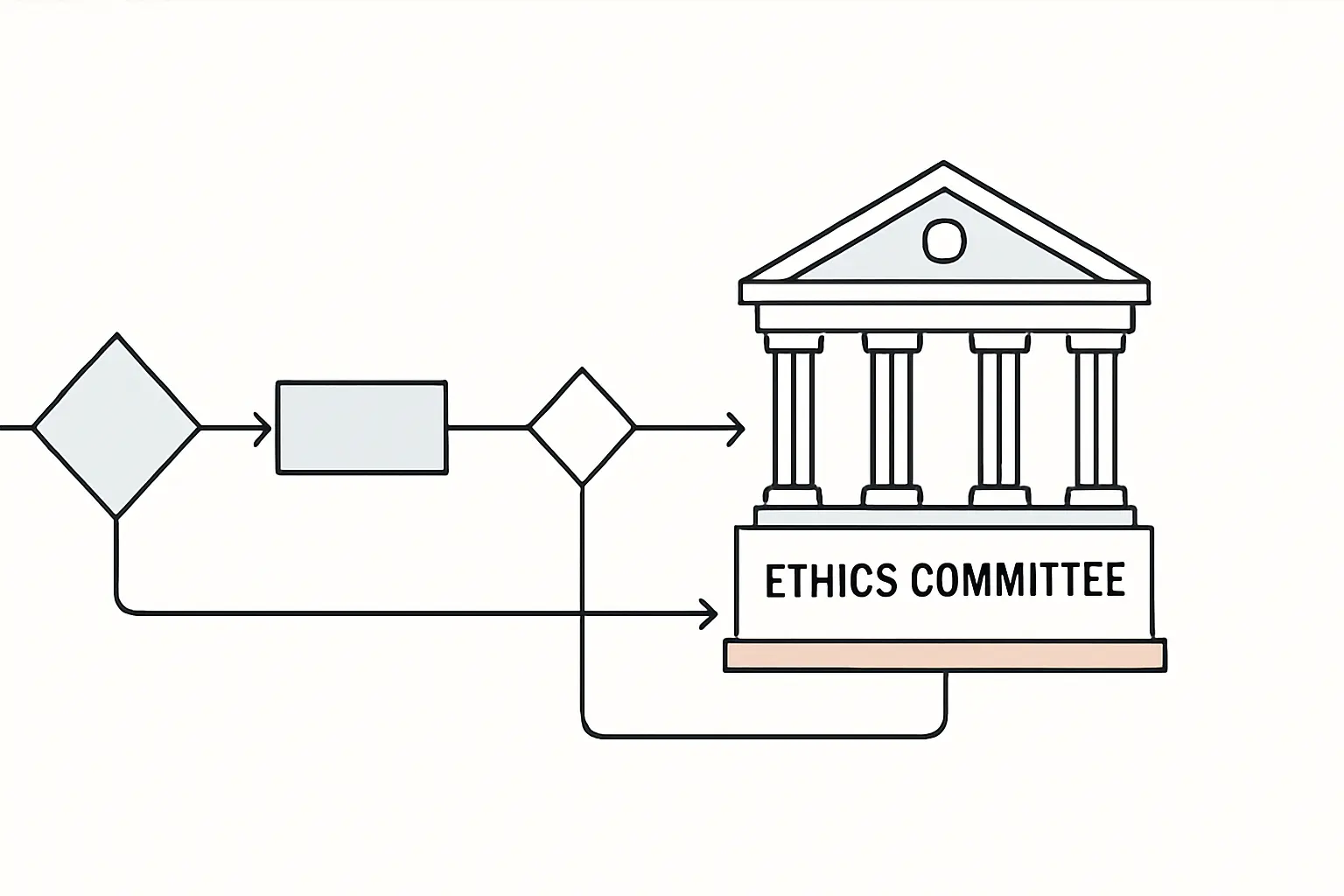
If it is research involving NHS patients, staff or NHS-held data, it normally goes through the NHS research governance route — a materially longer process with its own timelines, described in our guide to whether you need ethical approval. The definitive answer for any specific project comes from the HRA’s own online decision tool (“Is my study research?”), which exists to give exactly that answer, and which supervisors will expect you to have used before your first meeting about approvals.
If it is service evaluation or audit, it does not require REC review — but “no REC” is not “no governance”. Evaluations and audits of NHS services typically require sign-off from the relevant NHS Trust’s R&D or clinical governance office, plus your university’s own approval route. Each project type, in the HRA’s words, “has their own separate governance requirements which you will need to arrange before starting the work”.
The classification also constrains your design. The moment you introduce a new intervention, allocate participants to treatments, or randomise anything other than sampling, you have left the evaluation and audit columns entirely. You cannot bolt a small experiment onto an audit and keep the audit’s lighter governance.
Why dissertations drift across the boundary
The most common drift is ambition in the conclusions. A student audits one ward’s compliance with a NICE guideline — squarely an audit — and then writes a discussion chapter recommending practice change across the sector. The data collection was audit; the claims are now generalisable knowledge. The classification is about intent and design, so decide at the design stage what the project is, and keep the write-up’s claims inside that column. The reverse drift also happens: projects labelled “evaluation” to avoid ethics review while being designed, in substance, to produce transferable findings. The framework anticipates this — activities that are not research “should not be presented as research”, and the converse presentation is a governance breach, not a shortcut.
Healthcare students juggling this alongside placements will find the workload angle covered in our guide to writing assignments around clinical placement; the discipline-specific expectations for midwifery — where service evaluation and audit are common dissertation designs — are set out in our midwifery dissertation guide.
The grey zones, handled
Three designs generate most of the borderline cases. A pilot study for a larger investigation is research — the framework explicitly includes activities carried out in preparation for research. A quality-improvement project using iterative plan–do–study–act cycles sits under service improvement so long as the changes are to a service already chosen by care professionals and the aim is local improvement; the moment the project is designed to show that the approach would work elsewhere, it is deriving transferable knowledge. And health surveillance — monitoring against historical or geographical comparators with defined triggers for action — is its own column, relevant to public health students who might otherwise force outbreak-monitoring projects into the research box. In every grey case the tiebreaker is the same question: is the project’s purpose to produce knowledge that travels beyond this setting?
How to state the classification in your dissertation
Examiners increasingly expect the classification to be explicit. Three sentences in the methodology chapter do it: name the project type, cite the defining framework, and state the governance route actually followed. For example: “This project was designed as a service evaluation under the UK Policy Framework for Health and Social Care Research, as it measures the current service against no external standard and involves no allocation to intervention. It therefore did not require NHS REC review; approval was obtained from the Trust’s clinical governance office and the university ethics committee.” That paragraph belongs near the ethics statement — the structure of which is covered in our guide to writing a research ethics statement.
Frequently asked questions
Who decides whether my project is research?
Formally, the classification follows the UK Policy Framework definition, and the HRA decision tool applies it; practically, your university ethics office and (for NHS-adjacent work) the Trust R&D office will expect you to arrive with the tool’s output and a design that sits in one column.
Does a service evaluation need any ethics approval at all?
It does not require NHS REC review, but it usually requires NHS Trust R&D sign-off and your university’s governance approval. University processes commonly review evaluations and audits through a proportionate route.
Can a dissertation be an audit?
Yes — audits measuring practice against an established standard are common dissertation designs in healthcare disciplines, and examiners respond well to their direct relevance. The constraint is that the design must stay in the audit column: existing interventions only, no allocation, randomisation for sampling at most.
What if my project involves interviewing staff about a service?
Asking those in receipt of or delivering a service what standard it achieves is characteristic of service evaluation; designing interviews to build transferable theory about, say, professional behaviour in general is research. The purpose and the intended reach of the conclusions decide it, not the method.
Is secondary analysis of service data research?
It can be either: analysing existing data to judge the current service is evaluation or audit; analysing it to derive generalisable knowledge is research. The same dataset can sit under different columns depending on the question asked of it.
Where is the official guidance?
The HRA’s “Defining Research” table (October 2022) and its online decision tool at hra-decisiontools.org.uk/research, which the UK Policy Framework itself points to as giving “a definitive answer”.
Classify first, design second
The classification is not paperwork — it is the first design decision, and everything from your timeline to your discussion chapter’s permissible claims follows from it. Tesify helps you build the methodology chapter around that decision and keep the governance trail documented as you write — 100% written by you.
Write your thesis with AI
Structure, draft, cite, and format your thesis faster with Tesify’s AI writing tools, automatic bibliography, and plagiarism checker. Free to start, no credit card required.






Leave a Reply