
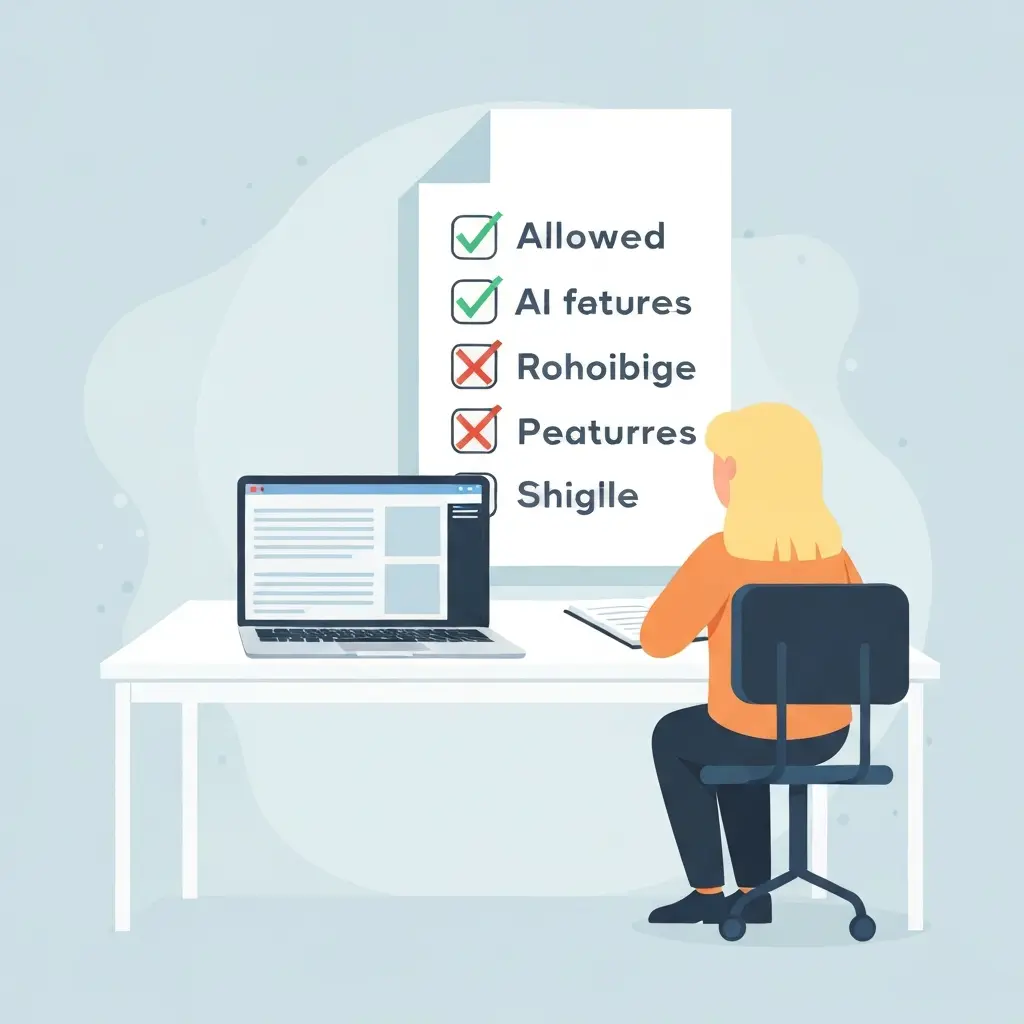
Is It OK to Use Grammarly or AI Editors on a Thesis in 2026? What Universities Actually Allow
Whether Grammarly is allowed for a thesis is one of the most searched questions among dissertation students in 2026 — and the answer depends entirely on which features you use and what your institution’s policy says. A basic spell-checker and a generative AI rewriter are not the same thing, even if both live inside the same app.
The stakes have risen sharply. Several students have faced academic misconduct proceedings not because they used ChatGPT to write chapters, but because an AI-detection system flagged their Grammarly-edited prose as machine-generated. Meanwhile, other universities explicitly encourage using grammar tools as part of good scholarly practice. The gap between these two positions defines the challenge every thesis writer now faces.
What counts as acceptable proofreading help on a thesis?
Academic institutions have long permitted students to have their work proofread. The QAA’s guidance on proofreading establishes that a proofreader may assist with identifying typographical, spelling, and punctuation errors, as well as grammatical and syntactical issues, but may not add, edit, rewrite, rearrange, or restructure content, alter meaning, or edit to comply with word limits. This definition predates AI writing tools, but it maps precisely onto the feature distinction inside Grammarly and every competing editor.
The boundary, then, is not about tools — it is about function. Correcting “recieved” to “received” is proofreading. Having an AI suggest a restructured paragraph with stronger academic tone is copyediting that crosses into authorship. University policies written in 2024 and 2025 have broadly converged on this same line, even if they express it in different language.
For a deeper look at how this question intersects with plagiarism rules and the full spectrum of AI use cases, see the guide to self-plagiarism and reusing your own work in a thesis — the disclosure principles that apply to recycled text map closely onto those that govern AI-assisted editing.
Which Grammarly features are allowed and which are not?
Grammarly bundles several distinct capabilities into one interface, and universities treat them very differently. Understanding the feature map is essential before opening the tool on a thesis draft.
Features that are generally acceptable
- Spelling and typo correction — Flags and corrects misspelled words. This is identical to a word processor’s built-in spellcheck and is universally considered acceptable.
- Basic punctuation — Inserting missing commas, correcting apostrophes, and fixing quotation marks. This falls within traditional proofreading.
- Grammar error detection — Flagging subject-verb agreement errors, incorrect tense usage, or dangling modifiers. The tool identifies the problem; you decide whether and how to fix it.
- Passive voice flagging — Highlighting overuse of passive constructions so the writer can decide whether to revise.
Features that are typically prohibited or require disclosure
- Generative rewrite suggestions — Grammarly Premium and Grammarly Pro offer full-sentence AI rewrites. At Stanford’s Program in Writing and Rhetoric, using features that “suggest substitutions related to word choice or organization” violates policy because the software “actively rewrites/revises student prose.”
- Tone adjustment — Changing the emotional register or formality of a passage is a substantive editorial intervention, not proofreading.
- GrammarlyGO / generative prompts — The generative AI layer introduced in 2023 produces original text from prompts. Using this on thesis content is prohibited at virtually every institution.
- Clarity and engagement rewrites — Even when framed as “suggestions,” AI-generated alternative sentences constitute AI-authored text entering the thesis.
AI in Academic Writing — 2025 Snapshot
- 92% of UK full-time undergraduates use AI tools in some form (HEPI 2025), up from 66% in 2024
- 88% used generative AI to complete assessments in 2025, up from 53% in 2024
- 68% of educators now use AI detection tools to identify academic dishonesty
- 25% of UK students believe it is acceptable to include edited AI-generated text in final assignments
- 95% of the academic community believes AI is being misused at their institutions (Turnitin & Vanson Bourne, 2025)
Sources: HEPI 2025 Student Academic Experience Survey · Turnitin & Vanson Bourne 2025
What do major UK universities say in 2026?
UK universities have moved quickly to formalise AI policies since 2023, and by 2026 most Russell Group institutions have specific guidance for postgraduate researchers submitting theses.
UCL
UCL’s Doctoral School states clearly that using AI to improve grammar and writing structure in a purely corrective capacity may not require disclosure. However, if AI is used to draft any text, including copyediting rather than proofreading, that use must be declared on the Doctoral Candidate Thesis Declaration Form. The university’s core principle is “ethical and transparent engagement” rather than outright prohibition.
University of Bristol
Bristol’s guidance for postgraduate researchers draws a precise distinction: AI may correct typos and grammatical errors, but it may not suggest specific rewrites or restructure text for improved readability. Bristol explicitly states that “the ability to write about your research in your own words” is a critical research skill being assessed by the thesis. Any AI use for translations, code, or diagrams must be acknowledged.
Oxford
Oxford’s Faculty of Classics (in its November 2025 policy update) confirms that basic AI tools such as spelling and grammar checkers may be used for supporting tasks to identify errors, provided the use is explicitly acknowledged — for example with a note stating “Grammarly used to correct typos and grammar.” This acknowledgement requirement applies even to tool use that falls well within the accepted proofreading boundary.
The broader UK picture
A 2025 survey published by Universitio found that UK universities are broadly converging on a framework in which surface-level grammar tools are treated comparably to a human proofreader, while generative AI features require disclosure or are prohibited. The QAA has advised institutions to distinguish between “assistive AI use (e.g., basic grammar checks)” which may not need disclosure, and “substantive AI use (e.g., generating or interpreting data)” which must be declared.
What do major US universities say in 2026?
American universities have produced some of the most specific guidance on this question, partly because several high-profile cases — including a student put on academic probation for Grammarly use that was flagged by an AI detector — forced institutions to publish clearer rules.
Stanford
Stanford’s Program in Writing and Rhetoric prohibits features that suggest substitutions related to “tone, structure, content, concision, or addressing a specific audience.” Grammarly’s free-tier autocorrect functions — which highlight typos, punctuation errors, and grammar issues without generating replacement text — are explicitly permitted. Using Grammarly Pro features that actively rewrite or revise student prose violates Stanford’s policy.
Harvard
Harvard’s Graduate School of Design identifies “proofreading or correcting existing text similar to what is provided by tools such as Grammarly” as an acceptable use of AI in teaching and learning. Harvard emphasises that users are responsible for all AI-generated content they publish or submit, and cautions against sharing sensitive research data with external AI platforms.
University of Notre Dame
Notre Dame’s position, reported by Inside Higher Ed, is that AI-powered editing tools including Grammarly “work by using AI to suggest revisions to your writing,” and therefore where an instructor prohibits generative AI, that prohibition includes editing tools unless explicitly stated otherwise. Notre Dame allows individual instructors to ban Grammarly use entirely — a more restrictive position than most UK research universities take for doctoral theses.
When comparing tools that operate across this spectrum of risk and permission, the detailed breakdown in Grammarly vs QuillBot vs Tesify for Academic Writing: Which Wins in 2026? is a useful reference point.
When do you have to disclose AI tool use?
Disclosure rules are converging across institutions, but the threshold varies by the nature of the use. The following framework reflects the majority position among research universities in 2026.
| Type of use | Example | Disclosure required? |
|---|---|---|
| Spellcheck / autocorrect | Word, Google Docs, Grammarly typo flagging | Generally no |
| Grammar error detection | Grammarly Free flagging subject-verb errors | Usually no; Oxford requires a note |
| AI-suggested rewrites accepted | Accepting a Grammarly Premium sentence suggestion | Yes — almost universally |
| Generative AI text production | GrammarlyGO, ChatGPT, Claude drafting paragraphs | Yes — mandatory; may be prohibited |
| Paraphrasing tools | QuillBot paraphrase mode on thesis paragraphs | Yes — and check if permitted |
The safest approach at any institution is to keep a brief log of every AI tool used and for what purpose, then review your university’s declaration form requirements before submission. At UCL, this disclosure goes on the formal Doctoral Candidate Thesis Declaration Form. At Oxford, it appears at the end of the submitted work. Formats differ, but the principle is consistent: you must be able to account for all AI assistance.
When using AI-generated content as a source or reference, you will also need to cite it correctly. The full rules for citing ChatGPT, Claude, and Gemini output in APA 7th, MLA 9th, and Harvard are covered in the guide to how to cite AI-generated content in 2026.
Can AI detectors flag Grammarly-edited text as AI-written?
Yes — and this is the most practically dangerous risk for students using grammar tools in 2026. AI detection systems such as Turnitin’s AI writing indicator and Copyleaks work by identifying statistical patterns in prose that differ from typical human writing. The same stylistic uniformity that makes AI-generated text detectable can also appear in heavily Grammarly-edited text, particularly when a student accepts many AI-generated sentence rewrites.
The risk is especially high when students use Grammarly Premium’s “clarity” and “engagement” suggestions extensively, accept tone adjustments across a full chapter, or use the GrammarlyGO generative features and then submit the resulting text as their own. In each of these cases, the statistical fingerprint of machine-generated prose can emerge even though the student believes they are simply “polishing” their work.
A false positive from an AI detector does not prove misconduct. Most universities, including UCL and Bristol, require a full investigation and give students the opportunity to produce evidence of their drafting process — notes, earlier drafts, supervisor correspondence. However, an investigation is an extremely stressful process that students can largely avoid by restricting tool use to the grammar-flagging tier and keeping their own drafting records. The data on how accurate these detectors actually are — and how badly they misclassify non-native English writers — is detailed in the 2026 AI detection accuracy statistics.
For a full comparison of how detection tools perform and what their accuracy rates actually are, see the detailed ranking in Best Plagiarism Checkers for Students Compared 2026.
What are the safest AI tools to use on a thesis?
The question of which tools are safe is partly about policy and partly about design. General-purpose AI tools built for consumer writing are not designed with academic integrity requirements in mind. Purpose-built academic writing assistants are.
What makes an academic AI tool safer?
- Transparent feature boundaries — Tools that clearly separate grammar assistance from generative writing help students stay within policy without needing to guess.
- No training on submitted content — Some consumer AI platforms train on user data, which creates data privacy concerns relevant to unpublished research. Academic-focused tools typically offer stricter data handling.
- Citation and reference support — Helping you format a citation correctly is unambiguously different from generating your argument for you. For citation format rules across all three major styles, the Harvard referencing guide with 2026 rules and templates is a reliable reference.
- Designed for structured academic writing — Tools that understand chapter structure, methodology sections, and literature reviews help within the research process rather than substituting for it.
Tesify — Write Your Thesis with AI is built around this distinction. Rather than generating your thesis text, Tesify helps you find sources, organise your research, review your references, and maintain correct citation formatting — tasks that assist the scholarly process without crossing into authorship. The platform is designed so that the ideas, analysis, and arguments remain entirely yours. You can explore it at Tesify.
For a full breakdown of how different AI thesis tools compare on both features and academic integrity compliance, the ranked guide Best AI Thesis Writing Tools Compared in 2026 covers the leading options including Tesify, Jenni AI, Paperpal, and Writefull.
The Tesify Plagiarism Checker is also worth noting in this context: running your thesis through a plagiarism check before submission — including checking for passages that might trigger AI-content flags — is good practice regardless of which writing tools you used. You can access it at Tesify Plagiarism Checker.
Practical guidance for any tool
Whatever tools you use, three habits will protect you: keep earlier draft versions so you can demonstrate the evolution of your writing; use AI only in ways your university policy explicitly permits; and disclose everything, even when disclosure is not strictly required. Proactive transparency is always safer than omission.
The broader context of how AI is being integrated into academic writing programmes in 2026 is covered in AI Thesis Writer: Use AI for Your Thesis Ethically 2026, which includes a step-by-step ethical workflow that applies regardless of which tools you choose.
Frequently Asked Questions
Is Grammarly allowed for a thesis?
Most universities allow Grammarly’s basic grammar and spell-checking features, which are equivalent to traditional proofreading. What is typically prohibited or must be disclosed is using Grammarly’s AI-powered rewriting features, tone adjustments, and the GrammarlyGO generative layer. Always check your institution’s specific AI policy before using any features beyond basic error flagging.
Does Oxford University allow Grammarly for thesis writing?
Oxford’s Faculty of Classics policy (updated November 2025) permits basic AI tools such as spelling and grammar checkers for identifying errors, but requires explicit acknowledgement at the end of any submitted piece of work — for example, “Grammarly used to correct typos and grammar.” Students must seek permission for thesis submissions from their department and disclose all tool use.
What is UCL’s policy on using Grammarly for a doctoral thesis?
UCL distinguishes between proofreading (generally permitted, may not require disclosure) and copyediting or drafting (must be declared on the Doctoral Candidate Thesis Declaration Form). Using Grammarly to correct grammar and improve writing structure may not require acknowledgement when used purely for proofreading. Any use that involves AI drafting or substantial copyediting must be disclosed.
Can Grammarly edits cause a thesis to be flagged as AI-generated?
Yes. AI detection tools like Turnitin’s AI writing indicator can flag text that has been heavily revised by Grammarly’s AI rewriting features, because the resulting prose carries statistical patterns associated with machine generation. The risk is low when using only grammar-flagging features and high when accepting AI-generated sentence rewrites across multiple sections. Keeping earlier draft versions of your work provides important evidence if a false-positive investigation occurs.
Is it academic misconduct to use Grammarly Premium on a thesis?
Not automatically. Whether Grammarly Premium constitutes misconduct depends on which features you use and your university’s policy. Using Premium’s grammar-detection and clarity flagging features (where you identify the issue and fix it yourself) is generally considered proofreading. Accepting AI-generated sentence rewrites from Premium, or using its generative features, crosses into territory that most universities require disclosure for, and some prohibit outright. Notre Dame, for instance, allows instructors to ban all AI-powered editing tools.
Do I need to disclose Grammarly use in my thesis submission?
It depends on your institution and the extent of use. Oxford requires acknowledgement even for basic grammar and spell-checking. UCL requires disclosure when AI has been used for anything beyond proofreading. Bristol requires acknowledgement for AI-assisted translations, code, and diagrams. The safest approach at any institution is to include a brief disclosure statement in your thesis acknowledgements or declaration form specifying which tools were used and for what purpose.
What is the difference between proofreading and copyediting with AI?
Proofreading corrects surface-level errors — spelling, punctuation, and basic grammar — without changing meaning or structure. Copyediting involves improving clarity, flow, word choice, and sentence construction. The QAA defines acceptable proofreading assistance as limited to identifying typographical, spelling, punctuation, and grammatical errors, and expressly excludes adding, rewriting, or restructuring content. When an AI tool generates new text for you to accept, that is copyediting or authorship, not proofreading — and universities treat it very differently.
Which AI thesis writing tools are safe to use under university policy?
Purpose-built academic writing assistants that help with research organisation, citation formatting, and reference management — rather than generating thesis text — generally fall within acceptable use at most institutions. Tesify, for instance, is designed so that the student’s own arguments and analysis remain central, with AI support limited to sourcing, structuring, and citing. Generic generative AI tools like ChatGPT and Claude require explicit institutional permission and full disclosure when used in thesis writing.
Does the University of Bristol allow AI grammar tools for a thesis?
The University of Bristol permits AI tools to correct typos and grammatical errors for postgraduate researchers. However, it explicitly prohibits AI from suggesting specific rewrites or restructuring text for improved readability. Bristol’s guidance emphasises that writing about research in one’s own words is a core skill being assessed by the thesis, and AI may not substitute for that capability.
What did the Notre Dame AI tool ruling mean for students using Grammarly?
The University of Notre Dame clarified in late 2024 that because AI-powered editing tools like Grammarly work by using AI to suggest revisions, they fall under a general prohibition on generative AI where one has been issued. Instructors who ban generative AI in their courses may also ban Grammarly unless they explicitly state otherwise. For doctoral thesis writers, this means checking directly with your supervisor or graduate school whether any blanket AI prohibition covers grammar tools.
Ready to write your thesis with AI support that stays within policy?
Tesify — Write Your Thesis with AI is designed specifically for students navigating exactly these rules. It helps you find and organise sources, manage your bibliography, and maintain consistent academic formatting — all without generating your arguments for you. Your research, your words, your degree.
Write your thesis with AI
Structure, draft, cite, and format your thesis faster with Tesify’s AI writing tools, automatic bibliography, and plagiarism checker. Free to start, no credit card required.





Leave a Reply