
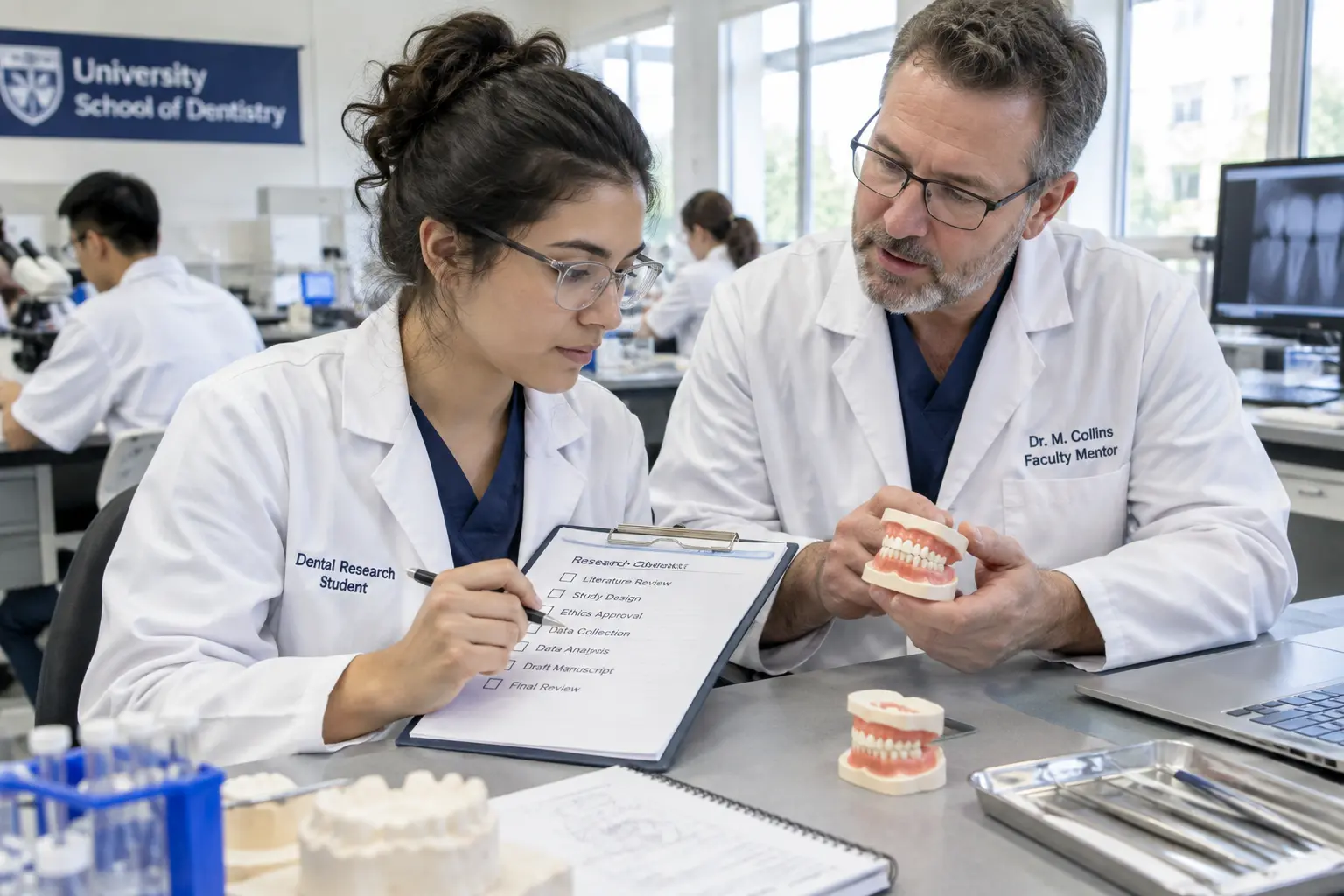
Quick answer: Dental theses and research projects are usually sent back for a short list of reasons: the design does not match the research question, the sample size is unjustified or the unit of analysis is wrong, examiner calibration and measurement reliability are not reported, ethics and consent paperwork has gaps, in vitro results are presented as clinical findings, the statistics do not fit the data, and the conclusions run past the evidence. This guide takes each objection in turn, shows what an examiner typically writes in the margin, and gives the fix you can apply before you submit.
If you are still deciding on topic and structure, start with the dentistry thesis guide for BDS and DDS students. This article is for the later stage, when a draft exists and you want to find the weak points before your committee does. The objections below are patterns common to dental and oral-health research projects, not quotations from any one institution, so check your own program’s handbook for the criteria that apply to you.
Why dental research gets a different kind of scrutiny
Dental research sits between the laboratory and the clinic. One student measures bond strength on extracted teeth, another compares two root canal irrigants in a clinic, a third surveys patient anxiety, and a fourth reviews radiographs. Each of those designs has its own failure modes, and examiners know them. A committee reading a dental thesis asks three questions repeatedly: can the design answer this question, can the measurements be trusted, and does the conclusion stay inside what was measured. Most of the objections below are one of those three questions asked in a different way.
Dental projects also have a feature that general education or business theses do not: the unit that receives the intervention is often not the unit you counted. A patient has many teeth, a mouth has many surfaces, and a split-mouth design gives each participant two treatments. If the design and the analysis disagree about what one observation is, the thesis will be sent back even when the data are good.
Objection 1: “The design does not match the research question”
What the examiner writes: “You ask whether the new desensitizing agent works better, but a cross-sectional survey cannot show that.”
This is the most common structural objection in any clinical field. A question about whether one treatment is better than another needs a comparison with allocation that does not depend on the patient or the clinician, which means a randomized trial, or at the very least a clearly described controlled design with its limits stated. A question about how common a condition is, or what is associated with it, fits a cross-sectional or cohort design. A question about how a material behaves under controlled conditions fits an in vitro experiment, but only for questions about the material.
The fix: Write the research question first, then name the design that can answer it, then state in one sentence what the design cannot show. Pick a reporting guideline that matches the design and use it as a checklist while you write: for randomized trials that is the CONSORT 2025 statement (Hopewell and colleagues, BMJ, 2025), which updates CONSORT 2010 and consists of a 30-item checklist and a participant flow diagram, and for cohort, case-control and cross-sectional studies it is STROBE. Mapping your methods chapter to the checklist for your design closes a large share of design objections before they arise.
Objection 2: “The sample size is not justified, or you counted the wrong unit”
What the examiner writes: “How many participants were needed? Forty teeth from twelve patients is not forty independent observations.”
There are two separate problems hiding here. The first is that no calculation is shown: the thesis says “30 teeth per group” because a previous student used 30. The second is the unit-of-analysis problem. Teeth within the same mouth share the same patient, the same oral hygiene, the same diet and often the same operator, so they are correlated. Analyzing them as if they came from independent patients overstates your effective sample size and makes differences look more certain than they are.
The fix: State the effect you want to detect, the variability you expect (from a pilot or from a cited study), the significance level and the power, and show the resulting number. The guide to sample size and power analysis with G*Power walks through the calculation. Then say what your unit of analysis is (patient, tooth or surface) and, where you have several teeth per patient, either analyze at the patient level or use a method that accounts for clustering, and ask your statistician which one fits your design. For in vitro work, state how specimens were assigned to groups and how many per group, and say why that number is enough to detect the difference you care about.
Objection 3: “Measurement reliability and examiner calibration are not reported”
What the examiner writes: “Who scored the radiographs? Was there any check that two examiners would agree?”
Many dental outcomes are judged by a person: a plaque or gingival index score, a caries diagnosis, a radiographic bone-level reading, the quality of a restoration margin. If one examiner makes those judgments without any reliability check, readers cannot tell whether a difference between groups reflects the treatment or the examiner’s drift. Examiners in dental schools are especially alert to this because calibration is a routine part of clinical research.
The fix: Describe how the examiner or examiners were trained and calibrated before data collection, and report an agreement statistic computed on a repeated subset. For categorical judgments the usual choice is Cohen’s kappa, and the standard reference for interpreting observer agreement on categorical data is Landis and Koch (1977), Biometrics, 33(1), 159. Report intra-examiner agreement (the same person scoring the same material twice, separated by an interval) and, where you have more than one examiner, inter-examiner agreement. Where possible, have the outcome assessed by someone who does not know which group each participant belongs to, and say so.
Objection 4: “Ethics approval, consent or data handling is incomplete”
What the examiner writes: “Where is the approval number? How were the extracted teeth obtained, and did the patients agree?”
Ethics objections are among the few that cannot be fixed by rewriting. If approval was not obtained before data collection, no wording repairs that. The Declaration of Helsinki, most recently amended by the World Medical Association General Assembly in October 2024, states that a research protocol must be submitted to a research ethics committee before the research begins, and that informed, voluntary consent is an essential component of respect for individual autonomy. Dental projects raise specific questions beyond that: use of extracted teeth, use of patient records and radiographs, photographs where a face is visible, and recruiting patients at the school’s own clinic where they may feel unable to refuse.
The fix: Put approval details in the methods chapter: the committee, the reference number and the date, which must precede data collection. Explain how participants were informed and how consent was documented. For tissue or records you did not collect yourself, state the source and what permission covers it, because the rules differ between institutions and countries and your committee decides which applies. If you are unsure whether your project needs review at all, the guide on whether you need ethical approval for a dissertation explains how the decision is usually made.
Objection 5: “The outcomes are vague, and no one was blinded”
What the examiner writes: “What exactly is ‘improvement’? Measured how, by whom, and when?”
A thesis that promises to compare “healing” or “patient satisfaction” without defining the outcome invites this comment. Outcomes need a measurement instrument, a time point and a rule for what counts as success. A primary outcome should be named in advance; if you test a dozen outcomes and report the one that came out significant, the committee will notice.
The fix: Choose one primary outcome and define it operationally, including the instrument, the unit, the time points and the scoring rule. List secondary outcomes separately and label them as such. State who was blinded (participant, operator, assessor, analyst) and, when blinding was not possible, which outcomes are therefore more exposed to bias. A simple table with one row per outcome and columns for instrument, unit, time point and scoring rule makes this explicit.
Objection 6: “In vitro results are presented as clinical findings”
What the examiner writes: “Your conclusion says this material will perform better in patients. You tested it on extracted teeth in a water bath.”
Laboratory studies are legitimate and often the right first step, but their conclusions have a ceiling. A bench test controls conditions the mouth does not: temperature cycling, saliva, occlusal forces, operator variation, years of aging. A strong result in the laboratory justifies a clinical study; it does not replace one. Theses that jump from “higher bond strength in this test” to “better clinical performance” are among the most predictable returns.
The fix: Phrase in vitro conclusions in terms of what was tested, under which conditions, and what the result suggests for further study. Add a limitations paragraph that names the gap between the test and clinical conditions. Describe the specimen preparation in enough detail for someone else to repeat it: tooth type, storage medium and duration, how specimens were standardized, which machine and settings were used. If your work involved animals, say which reporting and welfare framework your committee required rather than assuming one.
Objection 7: “The statistics do not fit the data”
What the examiner writes: “You used a t-test on ordinal scores and ran twelve comparisons without adjusting.”
Frequent statistical returns in dental theses are using parametric tests on data that are clearly not normal or not interval-level, running many pairwise comparisons without correction, reporting only p-values without effect sizes or confidence intervals, and ignoring missing data and dropouts. These are fixable but only if you notice them before analysis.
The fix: Write the analysis plan before collecting data and match each test to the measurement scale and design. Check assumptions and report how you checked them. Report effect sizes with confidence intervals alongside p-values, and say how you handled multiple comparisons. For clinical trials, state whether analysis followed the original allocation and how missing data were treated. Whichever software you use, report the test, the statistic, df, the exact p-value and the effect size in a form committees recognize.

Objection 8: “The literature review describes but does not argue”
What the examiner writes: “This lists studies. Where is the gap, and why is your question the next one to ask?”
A literature review that summarizes ten papers in sequence without comparing their designs, populations or limitations reads like an annotated bibliography. Dental topics also move quickly, and a review built on sources from many years ago can miss newer standards of care. The review must end on the specific gap your project fills.
The fix: Organize by question rather than by author. For each theme, say what is known, how strong the evidence is (design, size, risk of bias), and where it disagrees. End with a short paragraph that states the gap in one sentence and connects it to your research question. If your project is a systematic or scoping review, follow the matching reporting guideline and document the search, so the review can be reproduced.
Objection 9: “The conclusions go beyond the data”
What the examiner writes: “A statistically significant difference of this size is not a clinically meaningful one. And your sample came from one clinic.”
Two linked problems appear here. The first is confusing statistical significance with clinical importance: a very small difference can be statistically significant in a large sample and mean nothing for treatment. The second is generalizing from a convenience sample at one school or clinic to all patients. A third, related issue is writing recommendations that the results did not test.
The fix: In the discussion, state the size of the effect in clinical terms, say whether it is large enough to matter to a patient or clinician and why, and describe the population your sample can speak for. Keep recommendations to what your results support, and put the rest into a future-research paragraph. The guide to the limitations section shows how to write the limitations that make your conclusions more credible, not less.
Objection 10: “The writing and the figures are not ready to read”
What the examiner writes: “Table 3 does not match the text. The abbreviations are not defined. I cannot tell which teeth were included.”
Examiners often read the abstract, the methods, the tables and the conclusion first. Inconsistencies between those parts, such as a sample of 60 in the abstract and 58 in the table, damage trust faster than any single weak argument. Dental projects add tooth-numbering systems, radiographic images and clinical photographs, each of which has to be consistent and labeled.
The fix: State which tooth-numbering system you use and keep to it. Define each abbreviation at first use. Number every table and figure and refer to each in the text. Cross-check every number in the abstract against the results. Have someone outside the project read the methods and tell you whether they could repeat your study.
A pre-submission checklist drawn from the ten objections
- The research question, design and reporting guideline are named, and the limits of the design are stated.
- A sample size calculation is shown, and the unit of analysis is defined and respected in the analysis.
- Examiner training, calibration and agreement statistics are reported.
- Ethics committee, approval reference and date precede data collection, and consent is described.
- One primary outcome is defined; blinding is described.
- Laboratory conclusions are limited to laboratory conditions.
- The analysis plan matches the data, with effect sizes, intervals and multiple-comparison handling.
- The literature review argues toward a stated gap.
- Conclusions reflect clinical importance and the population actually sampled.
- Numbers match across abstract, tables and text.
If a draft does come back, the steps in how to respond to examiner corrections will help you answer each point in a way the committee can check.
Where Tesify fits
Once your design, outcome measures and analysis plan are settled, Tesify’s thesis workspace helps you structure and organize your thesis, and 9,000+ students have written 15,000+ chapters with Tesify. Every word stays 100% written by you, and Tesify cannot obtain your ethics approval, calibrate your examiners or collect your data.
Frequently asked questions
What is the most common reason a dental thesis is sent back?
There is no single published ranking, but a mismatch between the research question and the design, an unjustified sample size and missing reliability or ethics details are the objections committees raise most often in clinical fields.
Do I need a sample size calculation for an in vitro dental study?
Yes. State the difference you want to detect, the expected variability and the power, and show the resulting number of specimens per group, because examiners will not accept a number chosen only because earlier studies used it.
What is examiner calibration in dental research?
It is the process of training and checking the people who score outcomes so their judgments are consistent, then reporting an agreement statistic such as Cohen’s kappa for repeated scoring by one examiner and between examiners.
Can I use extracted teeth without ethics approval?
That depends on your institution and country, so ask your research ethics committee before you collect any specimens and record its decision in your methods chapter.
Which reporting guideline should I follow for a dental clinical trial?
For a randomized trial the standard guideline is the CONSORT 2025 statement, which has a 30-item checklist and a participant flow diagram, and for cohort, case-control and cross-sectional studies it is STROBE.
How do I handle several teeth from the same patient?
Treat teeth from one patient as correlated, define the unit of analysis in advance and either analyze at the patient level or use a method that accounts for clustering, after checking the choice with a statistician.
Is a statistically significant result enough for a dental thesis?
No. Examiners also ask whether the size of the difference matters clinically, so report effect sizes and confidence intervals and discuss whether the effect would change treatment decisions.
What should I do if my thesis has already been returned?
List each objection, decide whether it needs new analysis, new writing or a documented limitation, answer each in a response table, and resubmit only when every point has a visible answer.
Write your thesis with AI
Structure, draft, cite, and format your thesis faster with Tesify’s AI writing tools, automatic bibliography, and plagiarism checker. Free to start, no credit card required.






Leave a Reply