
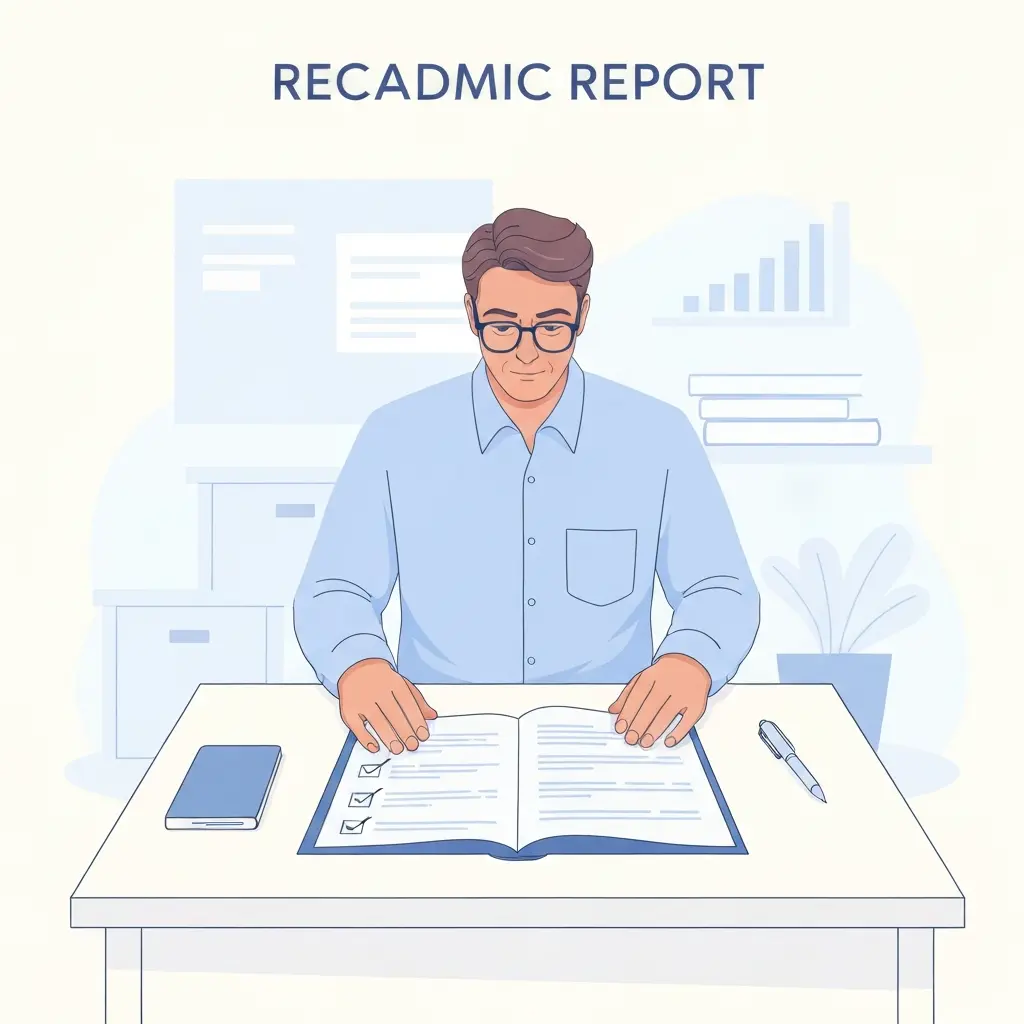
How to Respond to Examiner Corrections After Your Viva Step by Step (2026)
You have come out of your viva and been told you need to make corrections. Whether it is a list of minor typographical tweaks or a substantial set of major revisions, responding to examiner corrections is a structured process — and one that most doctoral candidates complete successfully when they treat it as a project with clear milestones. This guide walks you through every stage: reading the report, categorising what is being asked of you, building a tracking system, writing your response document, handling disagreements professionally, and getting your revised thesis formally signed off in 2026.
More than 80 percent of PhD candidates in the UK receive some form of corrections after their viva — minor corrections alone account for roughly 70 percent of outcomes according to Vitae’s researcher career guidance. Receiving corrections is therefore the norm, not the exception. The students who navigate corrections most efficiently are those who treat the examiner’s report as a structured brief rather than a personal critique, and who begin the response process with a clear plan before they write a single revised sentence.
Wait for the formal written report, then read it in full before making any changes. Build a corrections tracker listing every request with a page reference and your proposed response. Implement each change, update your tracker, then submit the revised thesis with a cover letter that maps every correction to its location in the new text. Your internal examiner reviews the response document first; for major corrections, both examiners may be involved.
Understanding the Types of Corrections
Before you begin any revisions, you need to understand exactly what category of outcome you have received. Each category carries a different deadline, a different review process, and different expectations for your response document.
Minor corrections
Minor corrections are the most common outcome. They are defined as changes that do not require you to conduct new research, re-analyse your data, or alter your fundamental argument. Typical examples include:
- Typographical and grammatical errors
- Clarifying ambiguous sentences or adding a missing definition
- Correcting or adding references in the bibliography
- Adjusting figures, tables, or captions for accuracy or consistency
- Tightening an argument that the examiner found under-developed
- Adding a brief paragraph to acknowledge a limitation
At most UK universities, the standard deadline for minor corrections is three months from the date of the viva. The University of Essex, for example, sets a three-month window with a review turnaround of approximately two weeks once corrections are submitted. Minor corrections are typically reviewed by the internal examiner alone.
Major corrections
Major corrections require substantive rework. This might mean rewriting a chapter, adding a new analysis, significantly strengthening your theoretical framework, or addressing a methodological concern that the examiners identified as a weakness in your argument. The deadline at most institutions is six months, and both examiners are often involved in reviewing the revised work. In rare cases, a second viva may be required to assess whether the revisions have addressed the examiners’ concerns.
Revise and resubmit
A revise-and-resubmit outcome (sometimes called a referral) means that the thesis requires more extensive changes than major corrections — typically six to twelve months of work followed by a full re-viva. This is a separate process and less common than either minor or major corrections. If you have received this outcome, see our detailed guide to viva outcomes and the resubmission process for a full breakdown of what happens next.
| Outcome | Typical deadline | Who reviews | Second viva? |
|---|---|---|---|
| Minor corrections | 3 months | Internal examiner | No |
| Major corrections | 6 months | Both examiners | Possibly |
| Revise & resubmit | 6–12 months | Both examiners | Yes |
Step 1 — Read the Examiners’ Report in Full Before Acting
The formal written report from your examiners is the authoritative document for your corrections. Do not rely on notes from the viva itself, on your memory of what was said orally, or on any informal conversation with your supervisor in the days immediately after the exam. Wait until you receive the formal, written examiner report — then read it in its entirety before opening your thesis to change anything.
This matters for two practical reasons. First, corrections that seem alarming in isolation often turn out to be reasonable or straightforward once you read the report holistically. Second, some corrections build on each other: addressing a conceptual concern in Chapter 2 may simultaneously resolve a related comment in Chapter 5. Reading the whole report first prevents you from making piecemeal revisions that later need to be undone.
Recommended approach:
- Read the report once without annotating anything. Get a complete picture.
- Leave it for 24–48 hours if you feel emotionally activated by the feedback. The corrections are a professional brief, not a personal verdict on your worth as a researcher.
- Read it a second time, this time annotating each distinct correction with a number in the margin or as a comment in a digital copy.
- Discuss any unclear points with your supervisor, who can liaise with the internal examiner for clarification if needed. The University of Essex explicitly provides this channel for candidates who need further explanation of a correction.
Step 2 — Build a Corrections Tracker
Every correction you need to make should be entered into a dedicated tracker before you begin revising. A tracker is simply a structured document — a spreadsheet works well — that gives you a single source of truth for the status of every requested change. It also forms the backbone of the response document you will submit alongside your revised thesis.
A good corrections tracker contains at minimum:
| Column | What to record |
|---|---|
| Correction ID | Sequential number (C1, C2, C3…) |
| Source | Report page and paragraph reference |
| Correction text | Exact wording from the examiner’s report (quoted) |
| Category | Typographic / Clarification / Structural / Analytical / Bibliographic |
| Thesis location | Chapter, section, current page number |
| Proposed action | Brief description of what you will change or add |
| New page number | Page number in the revised thesis (updated after editing) |
| Status | Not started / In progress / Complete / Queried |
Cambridge University’s guidance for corrections specifically recommends that when you submit, you provide a list “in page order, describing precisely how the earlier text has been amended — with page, paragraph and line references.” Your tracker is the tool that enables you to produce this list accurately and efficiently.
Step 3 — Categorise and Prioritise Each Correction
Once your tracker is populated, group the corrections by type before you start writing. This prevents you from jumping between chapters and losing coherence.
Category groupings that work in practice:
- Typographic and formatting: Spelling, grammar, numbering, figure labels. These are mechanical and can be batched efficiently. Do them last — editing new prose can introduce new typos, so final proofreading should come after all substantive changes are complete.
- Clarification and argument: A sentence or paragraph that the examiner found unclear, or where they want an argument developed further. These require careful thought but usually do not involve new data.
- Structural: A section that needs to be moved, split, or expanded. Map out where the change sits before you write anything — structural edits can have ripple effects on your discussion chapter and conclusion.
- Analytical or methodological: The examiner wants additional analysis, an alternative interpretation, or acknowledgement of a limitation. These are the most demanding corrections and should be scheduled early in your timeline when your attention is sharpest.
- Bibliographic: Missing references, incorrect citation formats, or a specific source the examiner wants you to engage with.
Assign each correction a priority using a simple three-tier system: high priority (the examiner has flagged this as central to approving your thesis), medium (important but not framed as gatekeeping), and low (cosmetic or incidental). This ensures that if you run into time pressure near your deadline, you have addressed the corrections that matter most to your examiners first.
Step 4 — Implement the Corrections Systematically
Work chapter by chapter, not correction by correction. Jumping between scattered items across the thesis creates inconsistencies — if you add a sentence to page 47 that changes a definition, you need to cascade that change through every subsequent reference to that concept. Working through each chapter in full, with your tracker open, keeps you coherent.
Practical implementation rules:
- Enable tracked changes in your word processor from the start. Most universities, including the University of Essex and the University of Leeds, require you to submit a version showing tracked changes so the examiner can verify each correction without re-reading the entire thesis.
- Accept or reject existing tracked changes from your pre-submission drafts before you begin — start from a clean baseline.
- Update your tracker immediately after completing each correction, including the new page number. Page numbers shift as you add or remove content, and you need the final page reference for your response document.
- Do not add unsolicited revisions beyond what the examiners have requested, unless you are correcting a clear factual error. Introducing new arguments or substantially rewriting sections that were not flagged can create confusion about what changed and may prompt the examiner to query whether the thesis is still the same piece of work they examined.
- Keep a copy of your original submitted thesis alongside your working file at all times. You may need to demonstrate that a particular passage has been amended from its original form.
If you have major structural corrections that require significant rewriting, treat each affected chapter the same way you approached writing it originally — read the relevant literature again if needed, sketch an outline of the new or expanded section, then draft. The difference is that you now have examiner guidance telling you exactly what the weakness was, which makes the revision more targeted than original composition. For a reminder of how to strengthen analytical writing at the chapter level, revisit our guide on writing a thesis discussion chapter.
Step 5 — Write Your Corrections Response Document
The response document — sometimes called a cover letter, corrections statement, or response to examiners — is the document you submit alongside your revised thesis. It is not optional, and it is not a formality. This document is what your internal examiner reads first to assess whether you have addressed the requested changes.
A strong response document does three things:
- It acknowledges every single correction from the examiner’s report, in the order the examiner listed them.
- It explains precisely what change you made in response — not just “I corrected this on page 50,” but a description of what was changed, why, and where the new text can be found in the revised thesis.
- Where relevant, it gives brief academic reasoning for how you have addressed a conceptual or analytical correction, so the examiner can understand your thinking without having to locate the passage first.
The University of Leeds states that the corrections documentation “could be in the form of tracked changes or as a separate list.” Using both is best practice: tracked changes in the thesis file allow the examiner to see exactly what moved, while the separate response letter provides the interpretive context for why you made each change.
Response document structure:
- Opening paragraph: State your name, thesis title, viva date, and correction outcome category. Confirm that all corrections listed in the formal report have been addressed.
- Numbered response table: One row per correction. Column 1: correction ID and quoted text from the examiner’s report. Column 2: your response action. Column 3: revised thesis location (chapter, section, new page number).
- Closing note: Confirm that page references correspond to the tracked-changes version submitted, and provide your contact details and supervisor’s name for any follow-up queries.
Before you finalise the response document, run a complete proofread of your revised thesis. Corrections often introduce new typographic errors, and you do not want your examiner to find them. Our guide on how to proofread your thesis with a self-editing checklist covers a structured multi-pass approach suited exactly to this stage.
Step 6 — What to Do If You Disagree with a Correction
It is legitimate to disagree with an examiner’s correction. Examiners can make requests that appear to contradict your methodological position, that are based on a misreading of a passage, or that would require you to take a theoretical stance inconsistent with your framework. You have three options when this happens.
Option A: Implement the change and note it in your response
If the correction is minor and the examiner’s reading, while not the one you intended, is not significantly wrong, it is often the most pragmatic choice to make the change and move on. Note it in your response document with a brief explanation: “I have revised this sentence to clarify that X, which I believe addresses the examiner’s concern about ambiguity in the original formulation.”
Option B: Implement a partial change with explanation
If you disagree with the examiner’s interpretation but can see merit in the underlying concern, make a targeted revision that addresses the legitimate part of the comment without endorsing an interpretation you believe is incorrect. In your response document, explain clearly what change you made and why it differs from a literal implementation of the request.
Option C: Respectfully decline the change with academic justification
For corrections that genuinely contradict your theoretical framework, your data, or your disciplinary norms, you may decline to implement the change — but you must do so in writing, with a clear and evidence-based academic rationale. Use language such as: “I respectfully maintain my original formulation here, for the following reasons: [argument]. I have added a footnote on page X to acknowledge the alternative interpretation the examiner has raised.”
The key principle, observed in guidance from both Cambridge and multiple UK PGR offices, is that you are within your rights to contest but must do so rigorously and respectfully. Do not decline a correction without providing a substantive academic reason. Before formally contesting any correction, discuss it with your supervisor, who can also help you find whether the examiner’s concern can be addressed in a way that does not compromise your argument.
Step 7 — Resubmission, Sign-Off, and Final Deposit
Once you have completed all corrections and written your response document, the final stage is formal resubmission and sign-off. The specific steps vary by institution, but the standard UK process runs as follows.
- Submit your revised thesis and response document to the address or system specified by your graduate school — typically the Research Student Administration office or a dedicated online portal. Include both the tracked-changes version and a clean final version.
- Internal examiner review. For minor corrections, your internal examiner reviews the response document and the tracked-changes thesis. The review window is typically one to two weeks. For major corrections, both examiners review, which can take up to four weeks.
- Confirmation of satisfactory completion. Your internal examiner formally confirms to the Degree Committee or Graduate School that the corrections have been made to a satisfactory standard. At the University of Essex, this triggers a notification to the Faculty Dean and a final two-week administrative approval window before the thesis is cleared for repository deposit.
- Final clean thesis deposit. Once corrections are approved, you deposit the final clean PDF to your institutional repository (e.g., EThOS via the British Library, or your university’s own research repository). This is typically submitted in PDF/A format for long-term preservation. Your award cannot be formally conferred until this deposit is complete.
- Award confirmation. The University’s Degree Committee formally ratifies the award. You will then be notified of your graduation date or the administrative confirmation of your degree.
Note that as of 1 January 2026, many institutions have adopted a maximum of three attempts at satisfactorily completing corrections. If your first submission of corrections is not approved, you will be given specific feedback on what remains outstanding and an opportunity to resubmit — but it is far preferable to get it right first time by ensuring your response document is thorough and your tracker is complete.
Before you reach the resubmission stage, make sure the groundwork you laid before and during your viva has set you up well. Our guide on how to prepare for your thesis defence covers the preparation steps that help candidates articulate their methodology clearly in the viva — which in turn tends to produce a more focused corrections report with fewer ambiguities to resolve. If a second viva is required after major corrections, our step-by-step guide to building thesis defence slides walks you through preparing a presentation that demonstrates mastery of your revisions.
Key Timelines and Deadlines to Track
Managing your time across the corrections period is critical. A common mistake is using the first two months after a viva to decompress, then scrambling in the final weeks to complete revisions. Treat your corrections deadline the same way you treated your thesis submission deadline: set a personal submission date two weeks before the institutional deadline and work backwards from there.
| Milestone | Minor corrections (3-month window) | Major corrections (6-month window) |
|---|---|---|
| Receive formal written report | Usually within 2–4 weeks of viva | Usually within 2–4 weeks of viva |
| Complete tracker and categorise corrections | Week 1 after receiving report | Week 1–2 after receiving report |
| Implement all substantive corrections | Weeks 2–7 | Months 1–4 |
| Final proofread and typography pass | Week 8 | Month 5 |
| Write response document / cover letter | Week 9 | Month 5–6 |
| Personal submission deadline (buffer) | Week 10 (2 weeks before institutional deadline) | Week 22 (2 weeks before institutional deadline) |
| Institutional deadline | Month 3 from viva date | Month 6 from viva date |
If you are struggling to complete corrections within the allocated time because of illness, caring responsibilities, or other extenuating circumstances, contact your Graduate School or Research Student Administration office as soon as possible. Most universities — including the University of Leeds, which directs candidates to apply for an extension via their GRAD system — have formal extension processes. Extensions are almost always available for documented reasons, but you must request one before your deadline passes, not after.
If you would like to revisit what the full range of possible viva outcomes means for your timeline — including what distinguishes major corrections from a revise-and-resubmit — our article on viva outcomes and resubmission routes in 2026 gives a complete breakdown of all scenarios and their implications.
How Tesify Can Help You During Revisions
Write, revise, and polish your corrections with AI support
Responding to examiner corrections is an intensive writing and editing task. Tesify is built specifically for postgraduate researchers — it helps you draft new passages for analytical corrections, restructure arguments, and maintain a consistent academic voice across a revised chapter without losing the original contribution that your examiners approved.
Use Tesify Auto Bibliography to correct and reformat your references quickly — particularly useful if the examiner has flagged missing sources or inconsistent citation formatting across chapters.
The viva itself requires you to defend your original work under pressure — a different skill from the structured, methodical process of written corrections. If you are preparing for an upcoming viva rather than post-viva corrections, our comprehensive viva voce preparation guide walks through every stage of defence preparation, from anticipating examiner questions to managing the oral examination itself. And if your second viva requires a formal presentation, our step-by-step thesis defence slides guide covers everything from slide count to design rules to Q&A handling.
Frequently Asked Questions
How long do minor corrections typically take to complete?
Most candidates complete minor corrections in four to eight weeks, well within the standard three-month deadline. The time depends on the number and complexity of corrections. A list of thirty typographic corrections can be completed in a single focused day; a set of ten analytical clarifications requiring new writing may take several weeks. Building a tracker on day one and working systematically chapter by chapter is the most reliable way to finish within six to eight weeks and leave time for a final proofread before submission.
Do I need to track changes in my revised thesis?
Most UK universities require you to submit a version with tracked changes enabled so that the internal examiner can verify each correction without re-reading the entire thesis. Check your institution’s specific requirements, but submitting both a tracked-changes version and a final clean PDF is best practice. Never submit only a clean final version without either tracked changes or a detailed response document — the examiner needs to be able to locate each correction efficiently.
What happens if my corrections are not approved?
If the internal examiner finds that corrections are incomplete or unsatisfactory, you will receive specific written feedback on what remains outstanding and a revised deadline to resubmit. As of January 2026, many UK institutions permit a maximum of three correction submission attempts before a final decision on the award is made. This situation is uncommon when candidates submit a thorough response document that maps every correction to its location in the revised thesis. If you receive feedback on a first corrections attempt, treat it as a second set of corrections and follow the same tracker-and-response-document process.
Can I add new content beyond what the examiners requested?
Generally, no. You should restrict changes to what has been explicitly requested by the examiners. Adding unsolicited new sections or substantially rewriting passages that were not flagged can cause confusion during the review — the examiner may not be able to confirm that the thesis they are now reviewing is essentially the same piece of work they examined. If you notice a clear factual error that was not in the corrections report, correct it and note it separately in your response document. For any larger additional change, discuss with your supervisor and, if necessary, seek written permission from the internal examiner before proceeding.
How do I ask for clarification on a correction I do not understand?
The standard channel for seeking clarification is through your supervisor, who can liaise directly with the internal examiner on your behalf. Do not contact the external examiner directly. When you approach your supervisor, be specific: quote the correction verbatim from the report and explain precisely what you are uncertain about. Most internal examiners are willing to provide clarification within a few days, and this is far preferable to guessing and implementing a change that does not address what was intended. Universities such as the University of Essex explicitly support this clarification process as part of their post-viva procedures.
Is a response document required for minor corrections?
Yes — a response document (cover letter or corrections statement) is expected for both minor and major corrections at the majority of UK universities. For minor corrections the document can be relatively concise: a table listing each correction by number, the change made, and the new page reference is sufficient. For major corrections, each response should include a brief explanatory note describing the nature of the change and how it addresses the examiner’s concern. Check your institution’s specific submission guidance, but submitting without any response document risks your corrections being returned for resubmission on procedural grounds alone.
Write your thesis with AI
Structure, draft, cite, and format your thesis faster with Tesify’s AI writing tools, automatic bibliography, and plagiarism checker. Free to start, no credit card required.




Leave a Reply