

You’re at the discussion chapter, your findings are written, and now you need the limitations section — the part every criminal justice thesis needs but that generic “how to write limitations” advice never quite covers, because crime data has problems no other field’s data has in quite the same way. Official statistics undercount. Self-report data over- or under-reports depending on the offence. Access to a criminal justice agency is negotiated, not guaranteed, and can be withdrawn mid-study. This is the limitations section built specifically around those field-specific realities.
1. The Dark Figure of Crime
Criminology’s foundational limitation, and the one every examiner expects to see acknowledged in some form, is the “dark figure of crime” — the gap between crime that actually occurs and crime that is recorded in any official statistic. Not all crime is reported to police, not all reported crime is recorded, and not all recorded crime is reflected identically across different data sources. If your thesis relies on official statistics of any kind — police-recorded crime, court records, conviction data — state explicitly that these figures represent recorded rather than actual offending, and reason about which specific offence types in your study are most and least likely to be affected by underreporting (crimes with an identifiable victim who reports promptly, such as vehicle theft for insurance purposes, are typically far better captured than offences involving fear, shame, or informal resolution, such as much domestic or sexual violence).
2. Which Official Data Source Did You Use?
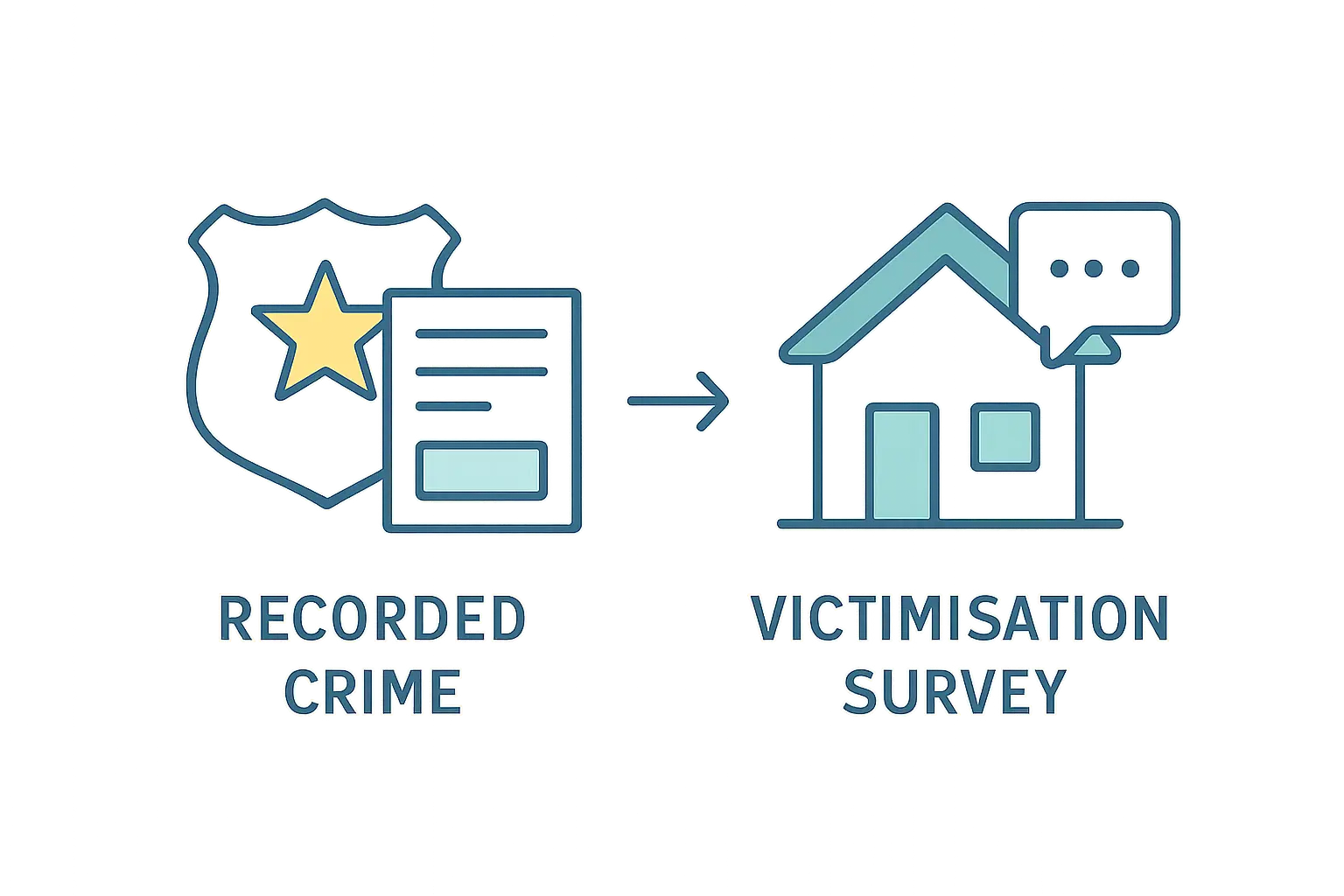
Name your specific data source and its known limitations rather than treating “official crime data” as a single undifferentiated category. Police-recorded crime reflects reporting and recording practices that can shift when a force changes its counting rules or a public campaign encourages more reporting of a specific offence — a genuine change in the underlying crime rate can become indistinguishable from a change in recording practice without careful attention to when definitional or procedural changes occurred within your study period. Victimisation survey data (such as the type collected in national crime surveys) captures unreported crime that police data misses, but carries its own limitations: recall error over the survey’s reference period, exclusion of crimes against businesses or institutions rather than households, and its own sampling and non-response patterns. State which source you used, and address its specific limitation rather than a generic caveat that applies to the other source instead.
3. Self-Report Data Limitations
If your thesis collected self-report data from offenders, victims, or criminal justice practitioners, the standard self-report limitations apply with particular force in this field: social desirability bias in either direction (under-reporting one’s own offending, or in some contexts over-reporting to appear more serious or credible within a peer group), recall accuracy over the reference period asked about, and the specific difficulty of achieving genuinely informed, voluntary consent from participants in custody or under justice-system supervision, where the power imbalance between researcher and participant is more pronounced than in most other social-science research settings. Address explicitly how you attempted to mitigate these effects (anonymised or confidential data collection, careful question wording, independent verification against official records where ethically and practically possible) and what residual uncertainty remains.
4. Jurisdiction-Specific Scope
Crime definitions, recording practices, and sentencing frameworks differ meaningfully between countries, and often between states, provinces or police force areas within the same country. A finding based on one jurisdiction’s data does not automatically generalise to another jurisdiction that defines the same offence category differently, records it under different counting rules, or sentences it within a different framework. State the specific jurisdiction your data covers explicitly in your limitations section, and reason about which of your findings are likely to be jurisdiction-specific (anything tied to a particular sentencing framework or police procedure) versus more likely to generalise (a theoretical relationship between two variables that is less dependent on the specific legal or administrative context).
5. Agency Access and Gatekeeper Constraints

Criminal justice research access is negotiated with a gatekeeper — a police force, a court, a prison, a probation service — and that negotiation shapes what your study could actually examine, often in ways worth stating explicitly rather than leaving invisible. Access may have been restricted to a specific unit, time period, or data field; a gatekeeper may have declined access to certain case types (particularly ongoing or sensitive cases); and the population you could reach may not represent the full population the agency serves. State what access was granted, what was declined or restricted, and how that shapes the scope of your conclusions — this is not a confession of a flawed study, it is the same honest boundary-setting any other field’s limitations section is expected to provide, applied to the access realities specific to justice-system research.
6. Secondary Statistics vs Primary Fieldwork Limitations
A thesis built on secondary official statistics or open datasets faces a different limitations profile than one built on primary fieldwork within an agency, and naming which applies to your design keeps the section focused rather than listing every possible criminology limitation regardless of relevance. A secondary-data thesis should focus on data-source specificity, the dark figure, and any definitional changes within the study period; a primary-fieldwork thesis should focus on access and gatekeeper constraints, self-report reliability, and the researcher’s own position relative to the agency (a former or current practitioner researching their own service carries the same dual-role considerations as insider research in any applied field). Our directory of free datasets and open data repositories by discipline lists the major open criminal-justice sources if you are still finalising which secondary dataset your study will use, which is also the point at which you should be identifying the specific limitations that dataset carries.
7. Worked Examples by Design
Official-statistics design: “This study relies on police-recorded burglary data for County X, 2020–2024. Recorded burglary reflects both actual offending and reporting/recording practices; a change in the force’s crime-recording audit in 2022 coincides with part of the study period and cannot be fully disentangled from the underlying trend reported here.”
Self-report design: “Offending data was collected via anonymous self-report survey from n=140 individuals under community supervision. Self-report offending data is subject to social desirability bias, likely producing under-reporting of more serious or stigmatised offence types; independent verification against official records was not possible under the ethics approval granted for this study.”
Practitioner-access design: “Access was granted to interview custody sergeants at two stations within Force Y; the force’s ethics gatekeeper declined access to cases involving vulnerable victims currently under safeguarding review, which limits this study’s applicability to the full range of custody decision-making the force undertakes.”
8. Common Mistakes
- Treating “crime data” as one undifferentiated category rather than naming the specific source and its distinct limitation.
- Omitting the dark figure of crime entirely when the thesis relies on any official statistic — examiners in this field specifically look for this acknowledgement.
- Generalising findings across jurisdictions without reasoning about which findings are jurisdiction-bound and which are more theoretically portable.
- Leaving access constraints implicit rather than stating explicitly what a gatekeeper restricted or declined.
For the surrounding chapter structure and access-negotiation realities of a criminology thesis more broadly, see our guide to writing a criminology dissertation, and for the general three-move limitations framework this field-specific content sits within, see our guide to writing a research limitations section.
Frequently Asked Questions
What is the “dark figure of crime,” and do I need to mention it?
The dark figure of crime is the gap between crime that actually occurs and crime captured in official statistics, since not all crime is reported or recorded. If your thesis relies on any official statistic, examiners expect this acknowledgement, along with reasoning about which offence types in your study are most affected by underreporting.
Do my findings generalise to a different country’s criminal justice system?
Not automatically. Crime definitions, recording practices and sentencing frameworks differ meaningfully between jurisdictions. State the specific jurisdiction your data covers and reason about which findings are jurisdiction-bound (tied to a specific legal or administrative framework) versus more likely to generalise (a theoretical relationship less dependent on that context).
How do I address self-report bias in offender survey data?
State the specific direction of likely bias (typically under-reporting of serious or stigmatised offences due to social desirability), describe what mitigation you used (anonymity, careful question wording, independent verification where possible), and acknowledge the residual uncertainty that remains after those mitigations.
Should I mention what a police force or court declined to give me access to?
Yes. Stating explicitly what a gatekeeper restricted or declined — a specific unit, case type, or time period — is more convincing than leaving your access constraints implicit, and directly shapes how far your conclusions can reasonably extend.
Do secondary-data and primary-fieldwork criminal justice theses have the same limitations?
No. A secondary-data thesis should focus on data-source specificity, the dark figure of crime, and any definitional or counting-rule changes within the study period. A primary-fieldwork thesis should focus on gatekeeper access constraints, self-report reliability, and the researcher’s own position relative to the agency studied. Address the profile that actually applies to your design rather than listing every possible limitation regardless of relevance.
Write Your Limitations Section With Confidence
Tesify’s AI-powered academic writing tool helps criminal justice students name the specific data-source, jurisdiction and access limitations their thesis needs — turning a generic disclaimer into the honest, field-specific account an examiner is looking for.
Write your thesis with AI
Structure, draft, cite, and format your thesis faster with Tesify’s AI writing tools, automatic bibliography, and plagiarism checker. Free to start, no credit card required.






Leave a Reply