

How to Write the Limitations Section of an Engineering Thesis (2026)
An engineering limitations section is judged against a more concrete standard than in most other disciplines: your examiner wants to know exactly which tolerances, boundary conditions, or measurement uncertainties bound your results, not a generic acknowledgement that “more testing would strengthen the study.” A design/build thesis, a simulation thesis and an experimental thesis each generate genuinely different kinds of limitations, and treating them interchangeably is the single fastest way to make this section read as an afterthought.
1. Limitations Differ by Project Type
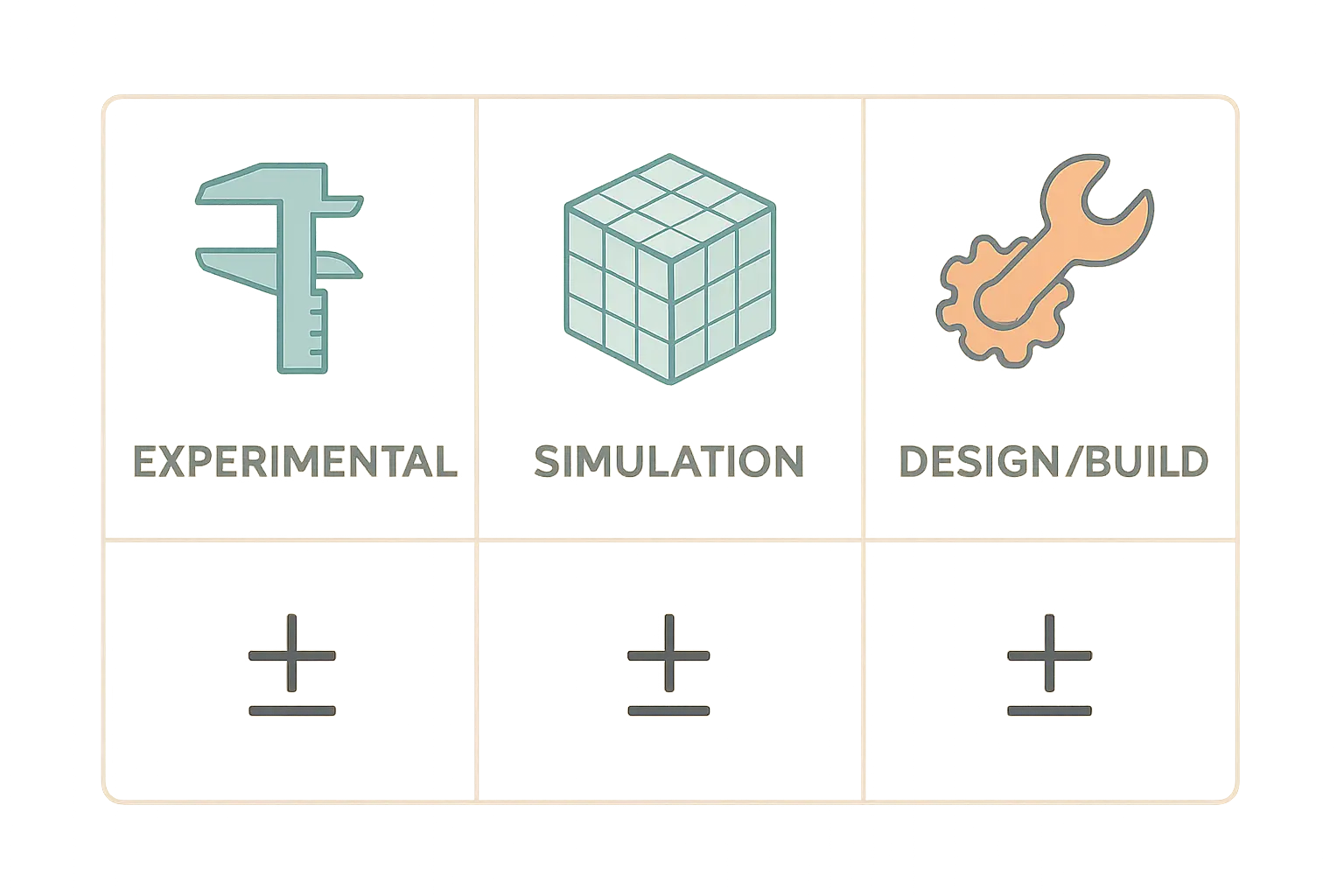
Engineering theses generally fall into one of three project types, and each generates a different profile of limitation:
| Project type | Typical limitation source |
|---|---|
| Experimental | Instrument tolerance, sensor accuracy, sample size of test runs, environmental control |
| Simulation | Model assumptions, mesh resolution, boundary-condition simplifications, solver convergence criteria |
| Design/build | Prototype-scale vs production-scale differences, manufacturing tolerance, material substitutions made for cost or availability |
2. Experimental Theses: Measurement Uncertainty and Instrument Tolerance
Every measurement instrument has a stated tolerance or accuracy specification, and reporting it is not optional context — it is the number that tells a reader how much of your observed variation could be instrument noise rather than a genuine effect. State the manufacturer-specified accuracy or your own calibration-derived uncertainty for every key measurement, and propagate that uncertainty through to your final reported values where the calculation allows it, rather than reporting a bare mean with no indication of measurement error. If your sample of test runs was smaller than ideal because of rig time, material cost or safety constraints, say so explicitly and connect it to statistical power rather than leaving the reader to infer the consequence.
3. Simulation Theses: Model Assumptions and Mesh/Discretisation Limits
A simulation is only as good as the assumptions built into it, and a strong limitations section names those assumptions explicitly rather than treating the model as a black box that produced results. Common candidates: the mesh resolution used and whether a mesh-independence study was run to confirm results had converged; simplifying assumptions about material behaviour (linear-elastic vs a more complex constitutive model); boundary conditions that approximate a real system (a fixed support standing in for a more complex real joint); and the solver’s convergence tolerance. State which of these assumptions were tested for sensitivity and which were adopted on engineering judgement without a formal sensitivity check — the honest distinction between the two is exactly what a committee is checking for.
4. Design/Build Theses: Prototype vs Production Differences
A working prototype rarely behaves identically to how a production version would, and naming the specific gap is more convincing than a general disclaimer. Common sources: manufacturing tolerances achievable with student-accessible equipment versus industrial tooling; material substitutions made for cost, availability or safety reasons (a lower-grade alloy standing in for the specification-grade material); scale differences between a bench-top prototype and a full-size system; and testing conditions that do not fully replicate the operational environment (a lab test standing in for field conditions with vibration, temperature cycling or corrosion exposure). State each substitution explicitly and reason about which of your results would plausibly transfer to the production-scale or production-material version and which would not.
5. Negative and Null Results Are Not Limitations
A result that contradicts your hypothesis, or a design that did not achieve its target performance, is a finding to interpret in your discussion chapter — not a limitation to apologise for in this section. Confusing the two is a common mistake: if your prototype achieved 85% of its target efficiency, that is a result requiring engineering explanation (where did the performance gap come from, and does your model or test method explain it), not a limitation of your study design. Reserve the limitations section for constraints on your method and measurement, not for disappointing outcomes.
6. Quantify Wherever You Can
The single habit that most improves an engineering limitations section is replacing qualitative hedges with numbers. “The sensor had limited accuracy” is weaker than “the load cell was rated to ±0.5% of full scale, meaning measured forces below approximately 2 N carried proportionally larger relative uncertainty.” A quantified limitation shows an examiner you understand the actual bound on your claims rather than gesturing vaguely at imperfection. Where you cannot attach a hard number (an unquantifiable simplification in a model, for instance), state the direction of the likely bias instead — whether the simplification would tend to overestimate or underestimate the quantity you are reporting.
7. Where This Section Sits and How to Report It
Most engineering theses place limitations at the end of the discussion chapter, immediately after interpreting the results and before the conclusion — the same convention used across most disciplines, since limitations are only meaningful once a reader has seen what the results actually showed. A typical structure runs to three to six specific limitations rather than an exhaustive list: two or three sources for your primary results chapter, plus any limitation specific to a secondary analysis or additional test. For each one, state what it is, its numeric bound or direction where possible, and one sentence on what it means for how the result should be read — the same announce-reflect-look-forward pattern that applies to a limitations section in any discipline, adapted here with engineering-specific content in the “reflect” move.
Where your thesis includes hand calculations alongside simulation or experimental work, note any simplifying assumptions in the calculation method itself (a lumped-mass approximation, a steady-state assumption for a system with transient behaviour) as a distinct limitation category from measurement or model limitations — examiners in mechanical, civil and aerospace sub-disciplines specifically look for this distinction.
8. Worked Examples by Project Type (Illustrative)
Experimental: “Strain measurements were taken using foil gauges with a manufacturer-stated accuracy of ±1.5 microstrain; propagated through the reported stress calculation, this corresponds to an uncertainty of approximately ±3% at the loads tested. Test repetitions were limited to n=5 per condition due to specimen availability, which constrains the statistical confidence of the reported mean values relative to a larger sample.”
Simulation: “A mesh-independence study confirmed convergence to within 2% of the reported deflection value between the medium and fine mesh densities; the coarse mesh, not used for final results, showed a 9% deviation and was excluded on this basis. The model assumes linear-elastic material behaviour, which is expected to underestimate deflection at loads approaching the material’s yield point — a regime outside the scope of the loads tested here.”
Design/build: “The prototype was manufactured from 6061 aluminium rather than the specification-grade 7075 alloy due to material availability; 6061 has a lower yield strength, meaning the prototype’s measured factor of safety understates what a production-material version would achieve under identical loading. Bench-top testing did not replicate the vibration environment the production system would experience, and fatigue performance was not assessed.”
Each example names a specific, bounded constraint and reasons about its direction of effect — the pattern a strong engineering limitations section follows regardless of sub-discipline. For the surrounding chapter structure and IMRaD adaptation an engineering thesis typically follows, see our complete discipline guide to writing an engineering thesis, and for the general three-move framework (announce, reflect, look forward) that applies across all disciplines, see our guide to writing a research limitations section. Each limitation you state here is also a direct seed for your future-research section — see our guide on writing recommendations for future research for how to convert a stated constraint into a specific next study.
Frequently Asked Questions
Is a lower-than-expected result a limitation or a finding?
A finding. A design that underperforms its target, or a result that contradicts your hypothesis, belongs in your discussion chapter as something to explain with engineering reasoning, not in the limitations section as something to apologise for. Limitations describe constraints on your method and measurement, not disappointing outcomes.
Do I need to report instrument accuracy even if my results looked clean?
Yes. Instrument tolerance and measurement uncertainty are properties of your method, independent of how clean your results appear. Reporting the manufacturer-specified accuracy or your calibration-derived uncertainty is expected regardless of outcome, and its absence is something examiners in experimental engineering specifically look for.
What if I cannot put a number on a simulation assumption?
State the direction of the likely bias instead of a number — whether the simplification would tend to overestimate or underestimate the reported quantity. A directional statement is still far more useful to a reader than a bare acknowledgement that “assumptions were made.”
How is a design/build limitations section different from an experimental one?
A design/build limitations section centres on the gap between the prototype and a production version — manufacturing tolerance, material substitutions, and untested operating conditions like vibration or fatigue. An experimental limitations section centres on measurement uncertainty and sample size. Both should be quantified wherever possible, but the specific sources of constraint differ by project type.
How many limitations should an engineering thesis list?
Three to six specific limitations is typical — enough to demonstrate genuine engineering judgement about where your results are bounded, without reading as a scattered list of every conceivable imperfection. Prioritise the limitations with the largest actual effect on how far your results generalise, and quantify each one where possible.
Write Your Limitations Section With Confidence
Tesify’s AI-powered academic writing tool helps engineering students state quantified, project-type-specific limitations clearly, so your thesis shows precisely how far your results generalise.
Write your thesis with AI
Structure, draft, cite, and format your thesis faster with Tesify’s AI writing tools, automatic bibliography, and plagiarism checker. Free to start, no credit card required.






Leave a Reply