
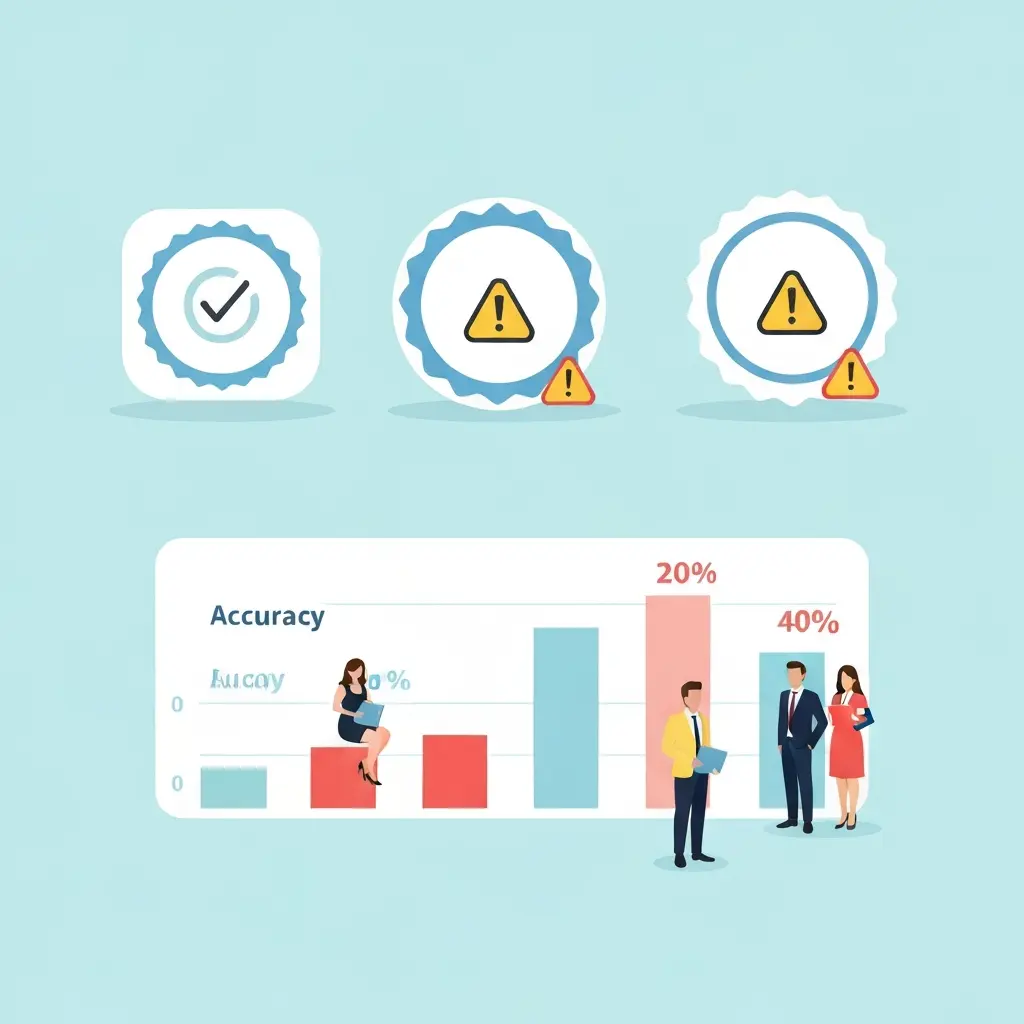
AI Detection Accuracy Statistics 2026: False-Positive Rates Across Turnitin, GPTZero, and Copyleaks
AI detection accuracy statistics matter enormously in 2026 — because the gap between a tool’s marketing claims and its real-world performance can determine whether a student faces an academic misconduct hearing for work they wrote themselves. As universities have adopted AI detectors at scale, a growing body of peer-reviewed research has documented troubling false-positive rates, systematic bias against non-native English writers, and near-complete evasion by anyone using a paraphrasing tool. This article collects the verifiable numbers from published studies and official disclosures so you can evaluate each platform on evidence, not vendor claims.
Three tools dominate institutional adoption: Turnitin’s AI writing indicator (embedded in the platform used by thousands of universities), GPTZero (popular in US higher education), and Copyleaks (used widely in corporate and academic settings). Their self-reported accuracy figures diverge sharply from what independent researchers find, and the consequences for wrongly accused students are severe enough to make that gap a serious policy problem.
Vendor Accuracy Claims vs. Independent Data
Every major AI detector publishes headline accuracy figures. The problem is that those figures come from controlled internal testing on datasets the vendor selected — not from independent audits on the messy, diverse writing that arrives in real classrooms.
Key Research Findings on AI Detection Accuracy (2023–2026)
- 61.22% average false-positive rate on TOEFL essays across 7 detectors (Liang et al., Stanford / Patterns, 2023)
- 4.6% — DetectGPT’s detection rate after paraphrase attack, down from 70.3% (Krishna et al., NeurIPS 2023)
- Turnitin self-reports <1% FP rate; independent estimates: 2–12% depending on content type
- GPTZero self-reports <1% FP rate; independent estimates: 1–3%
- ~6,000 AI misconduct referrals at Australian Catholic University in 2024 — ~90% of all integrity cases — many subsequently dismissed
Sources: Liang et al. 2023 (arXiv) · Krishna et al. 2023 (arXiv)
| Tool | Vendor Accuracy Claim | Vendor FP Rate Claim | Independent Accuracy Estimate | Independent FP Rate Estimate |
|---|---|---|---|---|
| Turnitin | 98% | <1% | 85–94% | 2–12% |
| GPTZero | 99% (pure AI vs. human) | <1% | 89–99% | 1–3% |
| Copyleaks | 99.88% | 0.2% | 85–90% | 5–10% |
The column labelled “Independent FP Rate Estimate” is the figure that matters most in practice. A false positive means a genuine human author is accused of using AI. Even a 2% false-positive rate, applied across thousands of submitted assignments, generates a substantial number of wrongful accusations each semester.
Tool-by-Tool Statistics: Turnitin, GPTZero, Copyleaks
Turnitin AI Writing Indicator
Turnitin launched its AI indicator in April 2023 and publicly claims a 98% accuracy rate with a false-positive rate below 1% at the document level, based on internal testing. Independent testing tells a different story. Across several 2024–2025 benchmarks, detection accuracy on unedited GPT-4 and Claude output fell into the 85–94% range. Sentence-level false-positive rates have been reported at approximately 4%, and on edge cases — non-native English writing, highly technical prose, or heavily edited AI drafts — false-positive rates have been estimated at 5–12%.
Turnitin itself acknowledges that its indicator should not be used as the sole evidence in an academic misconduct case. Instructors are directed to treat the score as a starting point for conversation, not a verdict. To understand the full mechanics of how the platform flags text, the companion guide on how Turnitin detection works covers the similarity algorithm and what the percentage bands actually mean.
One consistent finding across independent tests is that Turnitin performs relatively well on unedited, full-document ChatGPT output but loses reliability rapidly as human editing increases. A student who writes primarily in their own voice and uses an AI tool only for light revision may still receive an elevated AI score — while a student who submits heavily paraphrased AI content often evades detection entirely.
GPTZero
GPTZero, developed by Princeton undergraduate Edward Tian, publishes detailed self-benchmarking data that is more transparent than most competitors. According to GPTZero’s own published benchmarks:
- Pure AI vs. human detection: 99% accuracy, false-positive rate under 1%.
- Mixed-document detection (content that blends AI and human text): 96.5% accuracy, 0.9% false-positive rate, 4.4% false-negative rate.
- Against ChatGPT o1 specifically: 98.6% accuracy, 97.2% recall, 0.0% false positives in GPTZero’s own published comparison.
GPTZero states that its benchmarks are conducted in partnership with Penn State’s AI/ML Research Lab and that models are updated monthly. These figures are better documented than Turnitin’s, but they still represent internally curated test sets. Independent testing from 2025 places GPTZero’s false-positive rate in the 1–3% range on general English writing, which is meaningfully higher than the company’s near-zero claim. Evasion via paraphrasing also affects GPTZero — the Krishna et al. 2023 study at NeurIPS demonstrated that GPTZero was one of several detectors effectively bypassed when AI-generated text was run through the DIPPER paraphrase model (see Section 4 below).
Copyleaks
Copyleaks markets its AI detector using a 2023 Cornell-affiliated study that found 99.88% accuracy and a 0.2% false-positive rate on human-authored text. The study covered a specific controlled dataset, and the figures are frequently cited in Copyleaks’ own marketing materials. In GPTZero’s published head-to-head benchmarks against ChatGPT o1, Copyleaks returned 89.1% accuracy with a 5.0% false-positive rate — considerably worse than its headline claim in that test scenario. A broader independent review covering multiple content types places Copyleaks accuracy at 85–90% on edited AI content, which outperformed Turnitin (around 80%) but lagged behind GPTZero (around 70% in that same comparison). The divergence across test designs illustrates why no single benchmark should be treated as definitive.
Non-Native English Writer Bias: The Liang et al. Data
The most widely cited study on AI detector bias is “GPT detectors are biased against non-native English writers,” published in Patterns (Cell Press) in July 2023 by Weixin Liang, Mert Yuksekgonul, Yining Mao, Eric Wu, and James Zou of Stanford University. The study is available in full on arXiv (arXiv:2304.02819).
The researchers tested 91 TOEFL essays written by non-native English speakers and 88 essays by native-speaker eighth-graders through seven widely used GPT detectors. Key quantitative findings:
| Metric | TOEFL Essays (Non-Native) | 8th-Grade Essays (Native) |
|---|---|---|
| Average false-positive rate (across 7 detectors) | 61.22% | ~0% |
| Essays flagged by at least one detector | 97.80% (89 of 91) | Not reported (near zero) |
| Essays flagged unanimously by all 7 detectors | 19.78% (18 of 91) | Not reported |
| FP rate after rewriting essays with more elaborate vocabulary | 11.6% (down from 61.22%) | — |
The mechanism is the detectors’ reliance on text perplexity — how predictable or surprising the word choices are. Non-native writers at intermediate proficiency levels tend to use more common vocabulary and simpler syntactic structures, which produces low perplexity scores that classifiers associate with machine generation. The tragic irony is that rewriting essays with more sophisticated, AI-like vocabulary reduces false-positive rates dramatically — from 61.22% to 11.6% — which means students are penalised precisely for writing plainly and honestly in a second language.
Turnitin’s internal team published its own counterpoint study, testing approximately 2,000 writing samples from English Language Learner (ELL) writers and concluding there was no statistically significant bias (false-positive rates of 0.014 for ELL writers vs. 0.013 for native speakers). The disconnect between that internal finding and the Liang et al. data has not been resolved publicly. Independent researchers, The Markup, and multiple university legal research centres note that Turnitin’s internal dataset is not available for replication, making it difficult to reconcile with the published peer-reviewed evidence. Students who write in a second language should be aware that current detectors carry measurable risk of misclassification regardless of vendor assurances. For a broader look at tools that handle multilingual and non-native English submissions, see the roundup of plagiarism checkers designed for non-native English writers.
Evasion Research: What Paraphrasing Does to Detection Rates
A second major research thread examines how AI-generated text evades detectors after paraphrasing. The key paper is “Paraphrasing evades detectors of AI-generated text, but retrieval is an effective defense,” presented at NeurIPS 2023 by Krishna, Song, Karpas, Rashid, and Harchol (arXiv:2303.13408).
The researchers used DIPPER, an 11-billion-parameter paraphrase generation model, to rephrase text generated by three large language models including GPT-3.5. The results for existing detectors were stark:
| Detector | Pre-Paraphrase Detection Rate | Post-DIPPER Detection Rate | Notes |
|---|---|---|---|
| DetectGPT | 70.3% | 4.6% | At 1% false-positive rate |
| GPTZero | High | Significantly reduced | Successfully evaded in study |
| OpenAI Text Classifier | High | Successfully evaded | OpenAI retired classifier in July 2023 |
| Watermarking-based detectors | High | Successfully evaded | Watermark disrupted by paraphrase |
The most striking finding is DetectGPT’s collapse from 70.3% detection to 4.6% — a near-total failure after paraphrasing, while the false-positive rate remained fixed at 1%. This creates an asymmetric situation: a student who submits AI-generated content and runs it through a paraphraser faces minimal detection risk, while a student who writes naturally in a second language faces a 61% false-positive risk. Subsequent research from Perkins et al. (2024) found that common bypass techniques reduced accuracy by approximately 17% across a broader sample of detectors, suggesting the evasion problem has not narrowed since the NeurIPS study.
DIPPER is not a commercially available tool available to most students, but its findings demonstrate the fundamental fragility of perplexity-based and sequence-pattern-based detection at the model level. The researchers proposed a retrieval-based defence (maintaining a database of generated text and comparing submissions against it) that detected 80–97% of paraphrased AI content at a 1% false-positive rate. However, no mainstream academic detector has integrated this approach at scale.
Why Institutions Are Stepping Back from AI Detectors
The combination of unreliable accuracy and non-native writer bias has prompted a meaningful institutional retreat from AI detection tools. Documented cases include:
- Australian Catholic University abandoned Turnitin’s AI detection indicator in March 2025. The university had recorded close to 6,000 alleged AI-related academic misconduct cases in 2024 — approximately 90% of all academic integrity referrals — and found that a substantial proportion were dismissed after investigation.
- Yale, Johns Hopkins, Vanderbilt, and the University of Waterloo have disabled or restricted Turnitin’s AI detection option, citing bias and unreliable accusations.
- University of Texas at Austin prohibited the institutional purchase of AI detection tools by 2024, citing reliability concerns.
The broader policy shift, documented in a 2024 Digital Education Council survey, is away from categorical detection-and-ban approaches toward framework-based policies that define acceptable use. Universities including Harvard, Oxford, and the University of Michigan now require explicit AI disclosure in course syllabi rather than attempting technological enforcement.
Academic integrity law scholars have noted that the asymmetry documented in the research — easy evasion for deliberate AI users, high false-positive rates for vulnerable student populations — means AI detectors “cannot serve as the primary or sole basis for academic misconduct findings” under most institutional due-process standards. Understanding what AI use policies actually permit — and how tools like Grammarly or AI writing assistants are treated differently from generative AI — matters when navigating this landscape. The detailed breakdown of AI use policy and what universities actually allow in 2026 explains how policies distinguish editing assistance from content generation.
For students concerned about how detectors interpret their work, tools like Tesify are built to support thesis writing within the parameters universities actually permit — focusing on structured guidance and feedback rather than text generation that might trigger detection. Properly citing any AI tools you do use is a separate but related obligation; the full rules are in the guide to how to cite AI-generated content in APA, MLA, and Harvard. Verifying references is a separate but related concern where AI-generated citations introduce their own risks; the guide to AI citation checkers that catch fake and hallucinated references covers the tools best suited to that problem.
For pre-submission checks that cover both text-level similarity and reference authenticity, the ranked guide to free plagiarism checkers for students in 2026 covers the full range of tools available.
A Note on Methodology: Why These Numbers Vary
Every benchmark figure in this article comes from a specific test design, and test design choices drive large differences in reported accuracy. Understanding why helps interpret conflicting numbers:
| Variable | Effect on Reported Accuracy |
|---|---|
| Dataset source (vendor-curated vs. independent) | Vendor tests on own training distribution inflate accuracy. |
| AI model tested (GPT-3.5, GPT-4, Claude, Llama) | Detectors trained primarily on GPT-3.5 miss newer model output. |
| Post-generation editing level | Light human editing can drop detection rates below 50%. |
| Document length | Submissions under ~300 words produce unreliable scores on all platforms. |
| Writer’s first language | Non-native English writing systematically increases false positives. |
| Domain (technical, creative, academic) | Technical and formulaic writing produces higher false-positive rates. |
The practical upshot: when a vendor publishes a false-positive rate below 1%, they are almost certainly measuring that rate on a dataset designed to show their tool favourably. When researchers test on TOEFL essays, the same detector family returns false-positive rates above 60%. Both figures are technically accurate for their respective test conditions. The question is which condition better represents the real student population.
FAQ
What is the false-positive rate for Turnitin’s AI detection?
Turnitin claims a false-positive rate below 1% based on internal testing. Independent testing estimates the real-world rate at 2–5% on typical submissions, rising to 5–12% on technical writing, very short texts, or writing by non-native English speakers. The published peer-reviewed evidence from Liang et al. (2023) found that seven detectors — not all of which are Turnitin — averaged a 61.22% false-positive rate on TOEFL essays, though Turnitin’s internal ELL study disputes that figure for their specific implementation.
Is GPTZero more accurate than Turnitin?
GPTZero publishes more detailed benchmarking data than Turnitin and reports 99% accuracy on pure AI vs. human text with a false-positive rate under 1%. Its published benchmarks against ChatGPT o1 showed 98.6% accuracy with 0.0% false positives in that specific test. Independent estimates place GPTZero’s false-positive rate at 1–3% on general English writing. In GPTZero’s own published head-to-head comparison, it outperformed Copyleaks on ChatGPT o1 detection (98.6% vs. 89.1% accuracy). However, like all current detectors, GPTZero is vulnerable to paraphrasing-based evasion.
Can AI detectors be beaten by paraphrasing?
Yes, and the research documents this clearly. A peer-reviewed NeurIPS 2023 study by Krishna et al. (arXiv:2303.13408) showed that running AI-generated text through an 11-billion-parameter paraphrase model (DIPPER) collapsed DetectGPT’s detection rate from 70.3% to 4.6%, at a fixed 1% false-positive rate. GPTZero, OpenAI’s text classifier, and watermarking-based detectors were all successfully evaded in the same study. More recent research (Perkins et al., 2024) found that common bypass approaches reduce detection accuracy by approximately 17% across a broad set of detectors.
Why are AI detectors biased against non-native English writers?
Most AI detectors measure text perplexity — how predictable or surprising the vocabulary and sentence structure is. Non-native English writers at intermediate proficiency tend to use more common words and simpler grammatical constructions, producing low-perplexity text that resembles machine-generated output. The Stanford study by Liang et al. (2023, Patterns) found that writing the same essays with more elaborate vocabulary reduced the average false-positive rate from 61.22% to 11.6%, confirming that the bias is mechanistic, not incidental.
Are universities still using AI detectors in 2026?
Many are, but institutional confidence has declined. Australian Catholic University removed Turnitin’s AI indicator in March 2025 after high dismissal rates in misconduct referrals. Yale, Johns Hopkins, Vanderbilt, and the University of Waterloo have disabled or restricted the tool. UT Austin banned AI detector procurement outright. The prevailing shift in 2025–2026 is toward disclosure-based AI policies rather than detection-based enforcement, with institutions requiring students to document AI use rather than attempting technological identification.
What should a student do if they are falsely flagged by an AI detector?
Gather evidence of your writing process: drafts, revision history, browser history showing research, and any notes or outlines. Contact your institution’s academic integrity office and request that the AI detection score be treated as one data point rather than conclusive evidence. Most institutional policies, including Turnitin’s own guidance, specify that the AI indicator should not be used as the sole basis for a misconduct finding. Seek guidance from your student union if you face a formal hearing. Documentation of your writing process is the most effective counter-evidence available.
Writing Without the Worry
The data shows AI detectors can flag legitimate student work, particularly for writers working in a second language. Tesify is built for thesis writing in a way that keeps you in control of your own argument — structured guidance, citation support, and feedback tools that work within the boundaries universities actually set in 2026.
Write your thesis with AI
Structure, draft, cite, and format your thesis faster with Tesify’s AI writing tools, automatic bibliography, and plagiarism checker. Free to start, no credit card required.





Leave a Reply