
Quick answer: A thesis on academic self-efficacy needs four decisions made early: you follow Albert Bandura’s definition of self-efficacy as a belief about one’s capability to perform a specific task, you decide how specific your measure should be (a general scale such as the General Self-Efficacy Scale, or a course-level scale such as the self-efficacy scale inside the Motivated Strategies for Learning Questionnaire, MSLQ), you choose an outcome that the theory actually predicts, and you pick a design that fits your access to students. This guide explains each decision, compares the two instruments using their published documentation, offers illustrative hypotheses and ends with ten researchable titles.
Academic self-efficacy appears in education, psychology, nursing and teacher-training theses, and that popularity is the trap: “self-efficacy and performance” is too broad to defend. A committee will ask which self-efficacy, measured how, for whom and predicting what. If you are working in education, the overview of validated instruments for an education dissertation places this choice among the other measures you may need.
What self-efficacy is, and what it is not
Bandura introduced the construct in a 1977 article in Psychological Review (volume 84, issue 2, pages 191-215), titled “Self-efficacy: Toward a unifying theory of behavioral change.” In plain terms, self-efficacy is a person’s perception of their own ability to reach a goal. It is task-specific: a student can be confident in statistics and doubtful in academic writing, so efficacy beliefs differ across domains instead of forming one universal trait.
Two distinctions matter for your definitions chapter. First, self-efficacy is not self-esteem. Self-esteem is a sense of self-worth, while self-efficacy is a judgment about capability for a particular task, and a student can have low efficacy in one subject without any loss of self-worth. Second, self-efficacy is not the same as an expectation of a good outcome. The MSLQ manual itself treats “expectancy for success” (performance expectations) and “self-efficacy” (a self-appraisal of ability to master a task, including confidence in one’s skills) as two aspects of one expectancy component, and your literature review should be as careful about the difference.
Bandura’s theory also names four sources from which efficacy beliefs develop: mastery experiences, vicarious experience (watching similar others succeed), social persuasion, and physiological and emotional states. These are useful because they turn the construct into a design: an intervention study can target one source, for instance mastery experiences through staged writing tasks, and a survey study can ask which source students say mattered.

Two instruments, compared from their documentation
| Instrument | Authors and year | What it measures | Format | Points to check |
|---|---|---|---|---|
| General Self-Efficacy Scale (GSE) | Schwarzer and Jerusalem (1995); the German version was developed in 1979 | A general sense of perceived self-efficacy, not tied to a subject | 10 items, four response options from “not at all true” to “exactly true”, summed to a score from 10 to 40; available in 33 languages according to the authors’ page | It is deliberately general, so it will not capture efficacy for statistics or writing; the authors’ page does not spell out reuse terms, so confirm them before use |
| MSLQ, self-efficacy for learning and performance scale | Pintrich, Smith, Garcia and McKeachie (1991 manual) | Students’ expectancy for success and confidence in mastering a course’s material and tasks | 8 items rated on the MSLQ’s seven-point scale from “not at all true of me” to “very true of me”; the manual reports a Cronbach’s alpha of .93 for this scale in its development sample | It is worded for a specific course, so you must say which course and adapt the wording honestly; confirm permission terms with the current holder |
The practical rule is to match specificity to the outcome. Because self-efficacy is task-specific, a sensible rule is to measure it at the same level of specificity as the outcome you want to predict. A general scale describes confidence across contexts and is a blunt predictor of grades in one module, whereas a course-level scale is built for that purpose. If you want to compare students on a general disposition across contexts, the GSE is the better fit.
The MSLQ in context
The MSLQ is much larger than its self-efficacy scale, and your thesis will be stronger if you describe the whole instrument accurately even when you use one scale. The 1991 manual describes a questionnaire for assessing college students’ motivational orientations and use of learning strategies for a particular course. It has two sections: a motivation section of 31 items, and a learning strategies section of 31 cognitive and metacognitive items plus 19 resource-management items, for 81 items in all, organized into 15 scales that the manual says can be used together or singly. Students respond on a seven-point scale, and the instrument takes about 20 to 30 minutes to administer.
The motivation section’s six scales are intrinsic goal orientation, extrinsic goal orientation, task value, control of learning beliefs, self-efficacy for learning and performance, and test anxiety. Because the scales are modular, a thesis can administer only the self-efficacy scale, or pair it with task value and test anxiety to examine how efficacy relates to value and anxiety. State exactly which scales you administered and compute scores per scale, never as one total across unrelated scales.
For the theory behind combining efficacy with strategy use, Pintrich and De Groot (1990, Journal of Educational Psychology, 82(1), 33-40) studied motivational and self-regulated learning components of classroom academic performance, and it is a natural citation when your hypotheses link efficacy to strategy use and performance.
What the evidence base looks like
When examiners ask whether academic self-efficacy matters, the reference they expect is Multon, Brown and Lent (1991, Journal of Counseling Psychology, 38(1), 30-38), a meta-analytic investigation of the relation of self-efficacy beliefs to academic outcomes. Use it to justify why you chose an academic outcome and to position your sample against earlier ones. Avoid quoting effect sizes from memory; read the paper and report the figures it gives, with the page.
Your literature review should also separate three claims that students often blur: that efficacy predicts achievement, that achievement raises efficacy, and that both are driven by a third factor such as prior attainment. A single cross-sectional survey cannot separate these, so your design chapter should say which claim you are testing.
Designs that fit an academic self-efficacy thesis
- Cross-sectional correlational survey. Relate a course-level efficacy scale to a performance measure such as the course grade or an assessment score, controlling for prior attainment. Accessible, but it cannot establish direction.
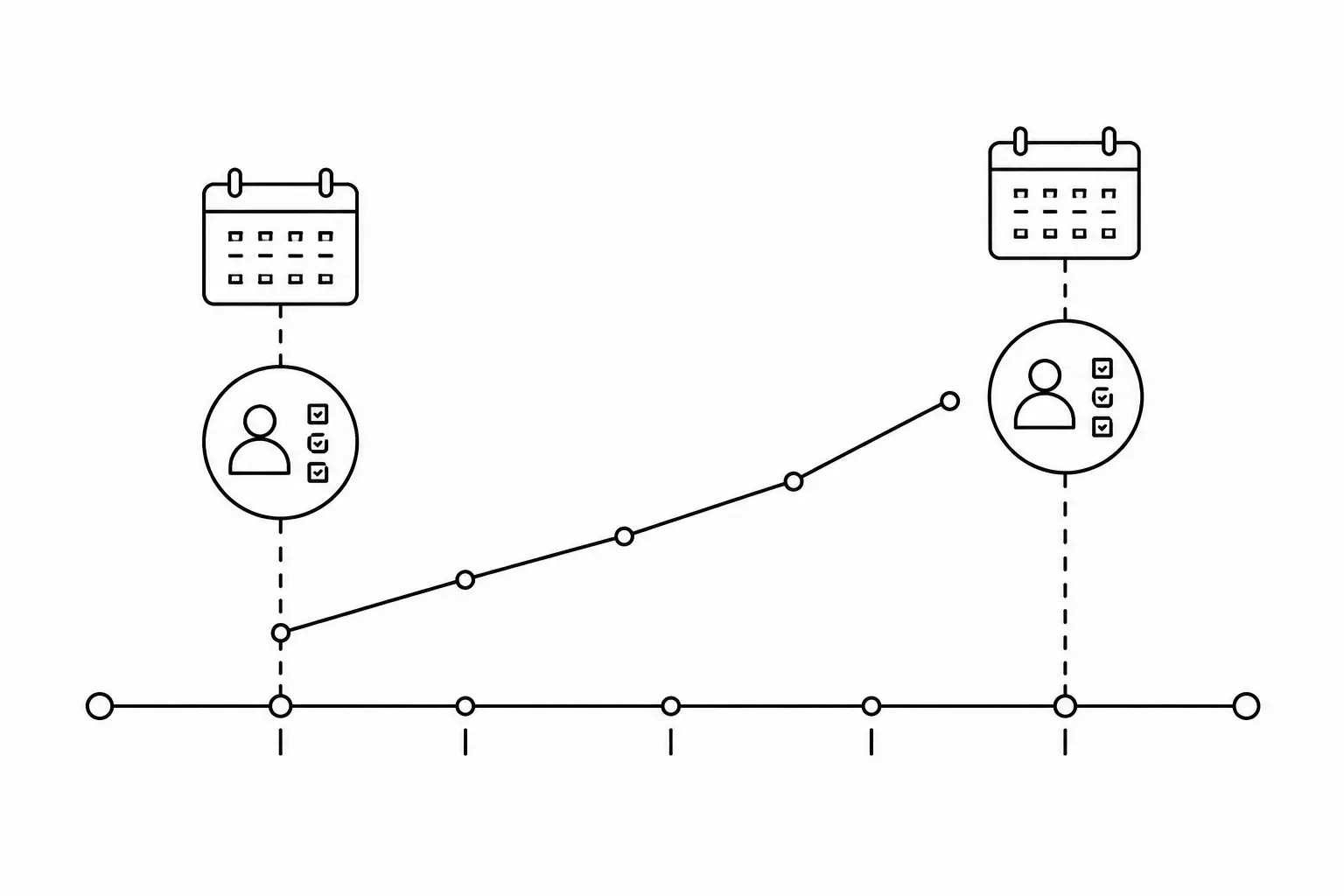
- Two-wave longitudinal design. Measure efficacy early in the term and performance at the end, with prior attainment as a covariate. This strengthens the case that efficacy precedes performance.
- Intervention study. Deliver an activity built around one of Bandura’s four sources, such as scaffolded mastery tasks or peer modeling, and compare efficacy before and after against a comparison group.
- Group comparison. Compare efficacy across first-generation and continuing-generation students, online and in-person cohorts, or programs, using an appropriate test for your scale.
- Mixed methods. Pair a scale with interviews asking students which experiences raised or lowered their confidence, so you can interpret surprising scores.
Whichever you choose, report the reliability you obtained in your own sample, not just the figure from the manual. The guide to Cronbach’s alpha shows how to compute and report it, and the piece on getting permission to use a validated questionnaire covers the written permission examiners may ask to see.
Illustrative hypotheses you can adapt
The following hypotheses are illustrative, written for a generic undergraduate course. Replace the population and the outcome with your own.
- H1: Course-level academic self-efficacy measured in week three is positively associated with the final assessment score after controlling for prior grade point average.
- H2: Students in the intervention section report a larger increase in academic self-efficacy between pre-test and post-test than students in the comparison section.
- H3: Self-efficacy for learning and performance is negatively associated with test anxiety.
- H4: Self-efficacy is positively associated with reported use of metacognitive self-regulation strategies.
- H5: Mean self-efficacy differs between first-generation and continuing-generation students.
- H6: Self-efficacy mediates the relationship between perceived peer support and course persistence.
Each hypothesis names a variable, a direction or contrast, and a population. The guide to hypotheses and variables for a psychology dissertation has more worked examples in the format committees expect.
Ten researchable titles
These are starting points. Narrow each one to a single course, program or institution, and a single period, before you submit a proposal.
- Course-level self-efficacy and final grades in first-year statistics: a two-wave study
- Academic self-efficacy and test anxiety among nursing students before a clinical examination
- Does a peer-modeling workshop raise academic writing self-efficacy in postgraduate students?
- Self-efficacy for learning and self-regulated strategy use in online and in-person sections of the same course
- Academic self-efficacy and persistence among first-generation university students
- General self-efficacy and academic self-efficacy in secondary school students: are they distinct?
- Self-efficacy, task value and test anxiety in first-year engineering students: a motivation profile
- Mastery experiences and academic self-efficacy in teacher education: an intervention study
- Sources of academic self-efficacy among doctoral students: a mixed-methods study
- Prior attainment, self-efficacy and course grade in a large lecture module: a hierarchical regression
Sampling, access and ethics
Student samples are convenient and sensitive at once. If you recruit from your own course or from a lecturer’s class, participants may feel pressure to take part, so use a recruitment route that makes refusal costless, collect responses anonymously where you can, and keep any link between scores and grades under the control of someone other than the instructor. Your institution’s review board will expect an information sheet, a consent statement and a data storage plan. If you plan to link survey responses to grades, include that link in your application, because it changes the data you hold.
Plan the sample around the analysis. A correlation, a hierarchical regression with covariates and a pre-post comparison need different numbers, so run the power calculation before you recruit and write it into the methods chapter. Report who was invited, who responded and how attrition between waves was handled.
Common mistakes that cost marks
- Using a general scale to predict performance in one subject, then concluding that self-efficacy does not matter.
- Adapting MSLQ wording or deleting items without saying so, then citing the manual’s reliability as if it applied to your version.
- Summing scores across unrelated MSLQ scales into one total.
- Concluding that efficacy causes achievement from a single cross-sectional survey.
- Equating self-efficacy with self-esteem or confidence in general.
- Copying an instrument’s items into an appendix without checking permission.
Where Tesify fits
When your definition, instrument and design are settled, Tesify’s thesis workspace helps you structure and organize your thesis, and 9,000+ students have written 15,000+ chapters with Tesify. Every word stays 100% written by you, and Tesify cannot choose your instrument, secure permission to use it or collect your data.
Frequently asked questions
What is academic self-efficacy?
It is a student’s belief in their own capability to complete particular academic tasks, following Bandura’s definition of self-efficacy as perceived ability to reach a goal, and it is specific to a task or domain.
How many items does the General Self-Efficacy Scale have?
According to the authors’ page, it has 10 items with four response options, scored by summing to a range of 10 to 40, and it is available in 33 languages.
Which MSLQ scale measures self-efficacy?
The self-efficacy for learning and performance scale, which has eight items in the 1991 manual and is one of the six motivation scales of the 81-item questionnaire.
Can I use only one scale from the MSLQ?
Yes. The manual describes the 15 scales as modular, to be used together or singly, but you should state which scales you administered and report each scale’s reliability in your own sample.
Should I use a general or a course-specific self-efficacy scale?
Match the scale to the outcome: a course-specific scale for performance in one course and a general scale for a broad disposition across contexts.
Is self-efficacy the same as self-esteem?
No. Self-efficacy is a perception of capability for a goal or task, whereas self-esteem is a sense of self-worth, and they can differ within the same person.
Can a cross-sectional survey show that self-efficacy improves grades?
No. It can show an association, but showing that efficacy precedes performance needs a design with measurement at more than one time point or an intervention.
Do I need permission to use the MSLQ or the GSE?
Check the current terms with the instrument’s holder or authors before you administer it, keep any written permission, and never reproduce full item lists in your thesis without it.
Write your thesis with AI
Structure, draft, cite, and format your thesis faster with Tesify’s AI writing tools, automatic bibliography, and plagiarism checker. Free to start, no credit card required.





Leave a Reply