
How to Manage Your Supervisor Relationship Through Your Thesis (2026)
Your supervisor is the single most influential person in your thesis journey — and yet most students receive almost no guidance on how to manage your supervisor relationship effectively. You are handed their email address, told when to submit your proposal, and left to figure out the rest. The result? Weeks lost to missed meetings, months spent waiting for feedback, and a creeping anxiety that you are somehow failing at something no one taught you to do.
The good news is that the supervisor-student relationship is a professional working relationship, and like any professional relationship it can be actively shaped, maintained, and — when necessary — repaired. This guide covers everything you need: setting expectations at the very first meeting, preparing productive agendas, giving and receiving feedback, handling slow responses, managing co-supervisors with competing views, knowing when and how to escalate, and understanding what your options are if the relationship breaks down entirely.
Setting Expectations at Your First Meeting
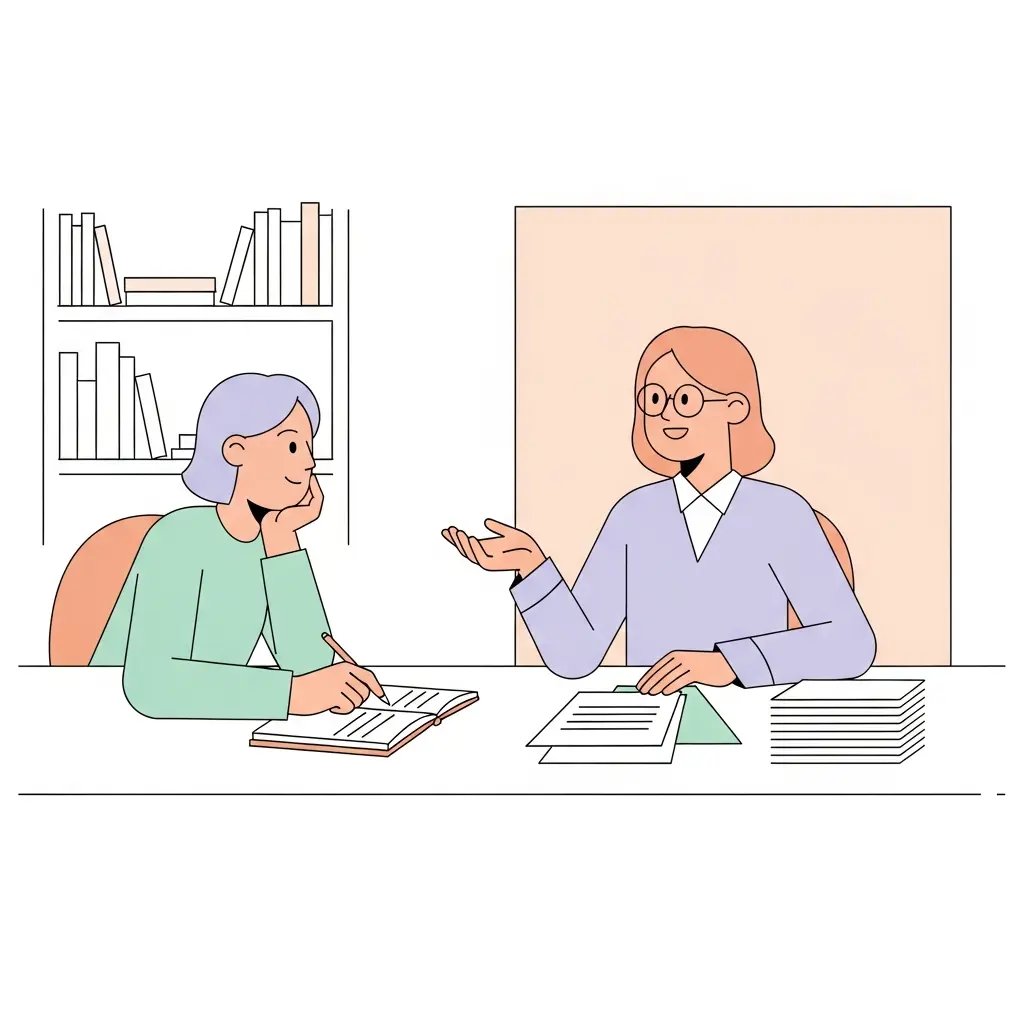
The first formal supervision meeting is the most important conversation you will have during your thesis. It is the moment when two people with very different assumptions about how this will work meet and — usually — say nothing about those assumptions. Changing that pattern is the single most effective thing you can do to protect the relationship long-term.
Come to your first meeting with a short list of practical questions. You are not being presumptuous; you are being professional. The UK Council for Graduate Education (UKCGE) notes that clear mutual expectations are foundational to productive doctoral supervision, and most doctoral colleges now provide a formal supervision agreement for exactly this purpose.
What to agree at your first meeting
| Topic | What to ask | Typical answer (UK/US) |
|---|---|---|
| Meeting frequency | How often do we meet formally? | Fortnightly (master’s); monthly (PhD) |
| Communication method | Email, Teams/Zoom, or in person? | Email for routine; in-person or video for meetings |
| Response time | How long for replies to routine emails? | 3–5 working days |
| Draft feedback turnaround | How long to return a chapter draft? | 2–3 weeks |
| Format of feedback | Tracked changes, margin comments, verbal? | Word tracked changes + verbal in meeting |
| Absence cover | Who covers if you are on leave? | Second supervisor or departmental contact |
Once these are agreed, summarise them in a short email to your supervisor afterwards. This creates a written record without being adversarial — it is simply good professional practice. Many universities now formalise this as a supervision agreement or learning contract, and signing one at the outset (or writing an informal version if your programme does not require one) dramatically reduces later friction.
How to Prepare for Every Supervision Meeting
Supervisors are busy academics with their own research, teaching loads, and administrative commitments. A student who arrives with a clear agenda and specific questions gets dramatically more useful feedback than one who arrives hoping for general encouragement. The preparation itself signals that you take the work seriously — which matters for the relationship.
The pre-meeting email (send 48 hours before)
A short email to your supervisor 48 hours before every meeting transforms the quality of supervision. Keep it to three elements:
- Progress update: One paragraph — what you have done since the last meeting.
- Agenda items: Two or three specific questions or decisions you need from this session. Not a list of ten — two or three.
- Attached material: Any draft sections, data summaries, or literature you want them to look at. If you are sending a draft chapter, include the specific question you want them to address (e.g., “Is the argument in section 3.2 logically coherent?” rather than “please review this”).
This structure lets your supervisor prepare, focuses the meeting, and keeps you in the driving seat of the project — which is where you should be.
During the meeting
Take notes. This seems obvious, but many students leave meetings with only a vague memory of what was agreed. Use a simple running document — a Google Doc or shared Notion page — where you record the date, agenda items, decisions made, and action points with owners and deadlines. If your supervisor agreed to read your methodology chapter by a given date, that is now written down. This removes ambiguity and makes chasing up easy and professional rather than awkward.
The post-meeting summary email
Within 24 hours of every meeting, send a brief summary email. Three bullet points is enough: what was discussed, what was agreed, and what each party will do by the next meeting. This is not bureaucratic box-ticking — it protects you both. If there is ever a dispute about what was said, the paper trail resolves it instantly.
For more on how meeting frequency varies across disciplines and career stages, see our detailed breakdown in Supervisor Meeting Frequency Statistics 2026.
Giving and Receiving Feedback Productively
Feedback is the central currency of supervision, and many students find it one of the hardest parts to manage. Supervisors vary enormously in their feedback style: some write extensive margin comments, others give brief verbal reactions; some are positive and constructive, others are blunt to the point of feeling discouraging. Learning to work with your supervisor’s style — and to ask clearly for what you need — is a learnable skill.
How to frame your request for feedback
The single most effective change most students can make is to be specific about what they want feedback on. Sending a chapter with the note “please let me know what you think” puts the entire interpretive burden on your supervisor and often results in comments that miss what you actually needed to hear.
Instead, frame every submission with a specific question:
- “Is the theoretical framework in Chapter 2 clearly justified, or does it need more grounding in the literature?”
- “Is my argument in section 4.3 logically coherent, or am I making an unjustified leap between the data and my conclusion?”
- “The methodology section feels thin to me — am I right, and if so, which gaps are most urgent?”
Research published in Assessment and Evaluation in Higher Education (2024) found that productive feedback relationships in doctoral supervision were characterised by collaborative, focused exchanges where students directed attention to specific concerns — and that supervisors responded more substantively when students framed submissions this way rather than submitting open-ended drafts.
Processing difficult feedback
Critical feedback is not a personal attack, even when it feels that way. Give yourself 24 hours before responding to feedback that stings — then read it again with fresh eyes. Most experienced supervisors’ apparently harsh comments translate, on reflection, into specific and fixable problems. If a comment is genuinely unclear, ask for clarification in your next meeting rather than guessing at what it means and revising in the wrong direction.
What to do when feedback is too vague
If your supervisor’s feedback is consistently too general to act on (“this chapter needs more depth” without specifying where), ask for a meeting specifically to unpack it. Bring the section in question, read the comment aloud, and ask: “Can you point me to the specific paragraph or argument that needs developing, so I focus my revision in the right place?” Most supervisors will respond well to a focused, calm question of this kind.
Handling Slow Responses and Long Feedback Waits
Slow supervisor response is one of the most common complaints among thesis students — and one of the most anxiety-inducing, because it can feel impossible to raise without seeming demanding or ungrateful. The key is to make response timing an agreed professional expectation from the start, so that following up on a missed deadline is simply holding someone to what they committed to, not a personal confrontation.
If your supervisor is slow to reply to emails
If you have not heard back within the agreed timeframe (typically three to five working days for routine correspondence), send a single polite chase. Keep it brief and assume good intent:
“Hi [Name], just following up on my email from [date] — I want to make sure it didn’t get buried. Happy to discuss in our next meeting if that’s easier. Best, [Your name]”
One chase is professional. Multiple chases within a short window are not. If you have sent one follow-up and still received no reply after another working week, note the date and raise it at your next meeting rather than escalating immediately.
If feedback on a draft is significantly overdue
If your supervisor is more than a week past the agreed feedback turnaround:
- Send a single, calm email referencing the timeline you agreed at the start: “I submitted the methodology draft on [date] — I just wanted to check in on where you are with it, as we had discussed aiming for [date].”
- If that produces no response in five working days, mention it at your next scheduled meeting: “The feedback turnaround is becoming an issue for my timeline — could we discuss how to manage this?”
- If the pattern continues and is affecting your ability to meet your submission deadline, this becomes a formal concern that your graduate school can help with (see the Escalation section below).
One thing worth remembering: your supervisor is not the only reader of your work. During long feedback waits, writing groups, peer review, and your own critical rereading can all move your thesis forward. You do not have to stop when the draft leaves your hands.
Managing Co-Supervisors and Supervisory Teams
Co-supervision — where you have two or more supervisors, often from different departments or disciplines — is increasingly common, particularly at PhD level. The UKCGE notes that team supervision has expanded significantly in recent years as a way of broadening doctoral candidates’ access to expertise and reducing dependency on any single person. The arrangement has real advantages: wider expertise, better coverage during absences, and richer feedback. But it also creates specific challenges that are worth preparing for. For a detailed breakdown of whether and when dual supervision makes sense, see our guide on whether you can have two thesis supervisors.
The three main challenges of co-supervision
1. Conflicting advice
This is the most common issue. Your primary supervisor says your methodology is appropriate; your second supervisor says it is flawed. Your first supervisor favours a quantitative approach; your second prefers qualitative. Without a mechanism for resolution, you are stuck in the middle.
The solution is to hold joint meetings regularly — at least once a term — where both supervisors are present at the same time. When a specific conflict surfaces, put it on the agenda of a joint meeting rather than trying to mediate it yourself. In the room together, supervisors usually either resolve the disagreement or articulate it clearly enough for you to make an informed choice about whose advice to follow and why.
2. Unclear primary responsibility
If it is not clear which supervisor takes the lead on day-to-day queries, feedback on specific chapters, or sign-off for progression milestones, you will default to emailing both and getting either duplicated or contradictory responses. Agree at the outset who is the primary contact for what: primary supervisor for chapter feedback and progression decisions; second supervisor for methodology questions and fieldwork support, for example.
3. One supervisor dominating
Occasionally one supervisor is significantly more engaged than the other — whether because of workload, interest, or personality. If your secondary supervisor has effectively gone absent, raise it with your primary supervisor rather than simply ignoring it. Co-supervision is a formal arrangement with institutional expectations; your doctoral school can intervene if a named supervisor is not fulfilling their role.
Handling Disagreement with Your Supervisor
Disagreement is a normal part of intellectual work, and you will almost certainly disagree with your supervisor at some point — about your research question, your methodology, your interpretation of data, or the direction of a chapter. Handled well, these disagreements can deepen your thesis. Handled poorly, they can damage the relationship for months.
When your supervisor is wrong (or you think they are)
The first thing to acknowledge is the possibility that you might be wrong. Your supervisor has years more experience in the field. Before pushing back, ask yourself: have I genuinely engaged with their criticism, or am I defending my original idea before giving it a fair hearing?
If, after honest reflection, you still think your approach is sound, you have every right to make the case. Academic supervision is not a hierarchy where supervisors are always right — it is a mentoring relationship in which you are the expert on your own research. Frame your response constructively:
- “I’ve thought hard about your point on [X]. I see the concern, but I think [Y] because of [evidence/reasoning]. Could you help me understand what you’d need to see to be satisfied with this approach?”
- “I’m going to try implementing your suggestion in section 3.2 and see how it reads — but could we keep the original version on file to compare?”
Write down the points of disagreement after the meeting. This helps you articulate your position more clearly, and it ensures you remember what was actually said rather than a conflated version of it.
When disagreement becomes persistent
If you and your supervisor have a recurring, unresolved disagreement about a substantive aspect of your research, consider requesting a panel meeting — involving your second supervisor, internal examiner, or thesis advisory panel if your programme has one. A third academic voice can often break a deadlock that the two-way dynamic cannot.
Escalation Paths: When and How to Involve Others
Most supervision problems can and should be resolved directly with your supervisor. But if direct conversation has not worked — or if the issue involves something that cannot appropriately be discussed with the supervisor (such as a welfare concern or allegation of misconduct) — universities have formal escalation structures.
The standard escalation ladder
- Direct conversation with your supervisor. Document your attempt in writing — a follow-up email saying “As we discussed, I’ve raised my concerns about [X]” is enough.
- Director of Graduate Studies (DGS) or Postgraduate Tutor. Every department has one. This is your first port of call for issues your supervisor cannot or will not resolve. Conversations at this stage are usually informal and confidential.
- Doctoral College / Graduate School. At most UK universities — and equivalent bodies at US, Australian, and Canadian institutions — the doctoral college is responsible for the quality of supervision. They have formal mechanisms to investigate inadequate supervision and, where necessary, to assign a new supervisor.
- University Ombudsperson or Student Advocate. The University of Washington Graduate School, for example, maintains a dedicated conflict resolution service for graduate students in conflict with advisors. Similar services exist at most research universities.
- Formal complaint. A last resort, with a written submission to the relevant dean or academic registrar.
Before escalating, make sure you have:
- A written record of specific incidents (dates, what was said or not done)
- Evidence of your good-faith attempt to resolve the issue directly
- A clear, specific account of the problem (not a general sense of dissatisfaction)
Northwestern University’s Graduate School advises that when filing a complaint you should “clearly state the reasons for your complaint, list all individuals involved, and describe your failed, good faith effort to resolve the conflict.” Most institutions commit to a response within ten working days.
When the Relationship Breaks Down Completely
Supervisor relationships do, occasionally, break down to the point where continuation is not viable. This is not common, but it is also not as rare as institutions sometimes imply — and it is survivable. Many students who change supervisors mid-thesis go on to complete and submit excellent work.
Signs a relationship has broken down
- You feel unable to share work or honest progress updates because you fear the response
- Meetings have stopped, and requests to reschedule are not answered
- You have received feedback that was abusive, discriminatory, or professionally inappropriate
- There is a fundamental, irresolvable disagreement about the direction of the thesis that cannot be resolved by a third party
- The supervisor’s behaviour constitutes a welfare concern or potential misconduct
How to change supervisor
The process varies by institution, but the general steps are:
- Identify a potential new supervisor who has the subject expertise and capacity to take you on. Have an informal conversation before making any formal request.
- Approach your Director of Graduate Studies or doctoral college to initiate the formal change. You do not need to have a new supervisor identified before raising the issue, but having one makes the process much smoother.
- Write a brief, factual account of why the change is needed. Focus on supervision issues (availability, feedback, direction) rather than personality — the institution needs to act on documented supervision problems, not interpersonal friction.
- Keep writing. The administrative process can take weeks. Continue working on your thesis throughout — stopping will make the transition harder, not easier.
See our guide on surviving your final year as a PhD student for advice on maintaining momentum through disruption, and our viva voce preparation guide for what comes after submission.
A note on wellbeing
A difficult supervisor relationship is one of the most significant stressors doctoral students report. If you are struggling, please use your institution’s mental health and counselling services — these exist for exactly this situation and are confidential. Reaching out is not a sign of weakness; it is recognising that the conditions around you have made a very hard task even harder.
When things do stabilise, the acknowledgements section of your thesis is one place where the people who supported you through the difficult periods get their due recognition — see our guide on how to write thesis acknowledgements with the right tone, order, and etiquette for guidance on getting this right.
Frequently Asked Questions
How often should I meet with my thesis supervisor?
For master’s students, fortnightly meetings are typical during the active writing phase. For PhD students, monthly meetings are the baseline at most UK and US institutions, though many supervisors meet more frequently in the early stages. The right frequency depends on your stage, discipline, and working style — agree it explicitly at your first meeting and revisit it as your project evolves. For data on how often PhD students actually meet their supervisors, see our supervisor meeting frequency statistics.
What should I do if my supervisor takes weeks to return feedback?
First, agree a feedback turnaround time at the start — typically two to three weeks for a chapter draft. If your supervisor regularly misses that window, send a polite chase email referencing the agreed timeline. If delays are persistent and affecting your submission deadline, escalate to your programme director, graduate tutor, or doctoral school as appropriate. Document everything in writing.
Can I change my thesis supervisor if the relationship breaks down?
Yes. All UK, US, Australian, and Canadian universities have a formal process for changing supervisor. You should first attempt resolution through your graduate school or doctoral college. If that fails, you can request a change of supervisor through your department, typically via the director of graduate studies or graduate programme coordinator. Document your concerns in writing before escalating.
How do I manage two supervisors who give conflicting advice?
Hold a joint meeting with both supervisors together to surface and resolve the disagreement directly. Before the meeting, note the specific points of conflict in writing so the discussion is focused. Most conflicts arise from supervisors commenting in isolation — a shared conversation usually aligns them. If the disagreement is about a genuine methodological debate, ask both supervisors to help you evaluate the options rather than expecting a single definitive answer.
What should I send my supervisor before each meeting?
Send a brief agenda email 48 hours before the meeting. Include: a one-paragraph update on progress since the last meeting, two or three specific questions or decisions you need from the session, and any draft sections or data you want them to look at. This lets your supervisor prepare, reduces wasted meeting time, and creates a written record of your progress.
What is a supervision agreement and do I need one?
A supervision agreement (sometimes called a learning agreement or supervisory contract) is a document that sets out the expectations of both student and supervisor — covering meeting frequency, feedback timelines, roles and responsibilities, and how disputes will be handled. Most UK doctoral colleges now require one. Even at master’s level it is worth drawing up an informal version at your first meeting to prevent misunderstandings later.
Conclusion
Managing your supervisor relationship is not about being deferential or difficult — it is about being professional. The students who get the most from supervision are the ones who take ownership of the relationship from the very first meeting: they agree expectations clearly, come to meetings prepared, follow up in writing, and raise problems early rather than letting resentment accumulate. That is a set of skills you can start practising today, regardless of where you are in your thesis.
If your relationship has already become strained, this guide gives you the language and the escalation map to address it. Universities have mechanisms precisely because difficult supervisor relationships are not rare — you are not the first person to need them, and you will not be the last.
The thesis you are writing is yours. The relationship with your supervisor is in service of that work — and managing it well is one of the most important, undervalued skills in academic life.
Write your thesis with AI
Structure, draft, cite, and format your thesis faster with Tesify’s AI writing tools, automatic bibliography, and plagiarism checker. Free to start, no credit card required.




Leave a Reply