

Does Oxford Allow AI Tools for Essays and Theses? (2026)
Yes, within limits. Oxford’s published guidance permits students to use generative AI tools in academic work when the use is responsible, ethical, and appropriately disclosed, but unauthorised or undeclared substantive AI use in essays and theses is treated as a breach of academic integrity, consistent with the university’s standards of rigour.

What Is Oxford’s Official Position on Generative AI?
Oxford has published its position across several official pages rather than a single blanket rule: a research-focused policy from the Research Practice Sub Committee, general student guidance at ox.ac.uk/gen-ai, and department-level guidance for specific courses. The consistent thread across these pages is that generative AI tools must be used responsibly and ethically, “in accordance with the academic standards of rigour and integrity that are expected of students at Oxford,” using AI with integrity, honesty, and transparency while maintaining a critical approach to AI-generated output. Researchers using GenAI remain personally responsible for any AI-generated content that appears in their work.
This is a permissive-with-conditions model, not a prohibition — closer to the approach the Russell Group’s principles on generative AI describe for UK research-intensive universities generally, of which Oxford is a member. Because departmental and faculty-level policies can add further detail (Oxford’s Mathematics department, for example, publishes its own guidance for MSc dissertations), always check your specific course handbook rather than relying on the university-wide position alone.

Does Oxford Provide Its Own AI Tool to Students?
Yes. Oxford became the first university in the UK to provide free ChatGPT Edu licences to all staff and students, as part of a broader offer of secure, enterprise-level generative AI tools. This matters for the “is it allowed” question because it signals that Oxford’s default stance is enablement with guardrails, rather than blocking AI access — the university would rather students use a governed, university-provided tool than an unmanaged public one. Providing a licensed, enterprise-grade tool also gives Oxford more control over data handling than it would have if students defaulted to free consumer AI accounts, which is likely one reason the university invested in a campus-wide rollout rather than leaving the choice of tool entirely to individual students.
When Do I Have to Declare AI Use at Oxford?
According to Oxford’s published student guidance, substantive use of generative AI should be declared whenever a stand-alone AI tool — such as ChatGPT Edu — is used in producing academic work. The guidance draws a distinction here: disclosure is generally expected for stand-alone tools, but not where GenAI functionality is simply embedded within existing software you would use regardless (for example, a grammar-check feature built into a word processor). If you’re unsure whether a specific use counts as “substantive,” the safer default is to disclose it and let your supervisor or department confirm.
What Counts as Unauthorised AI Use at Oxford?
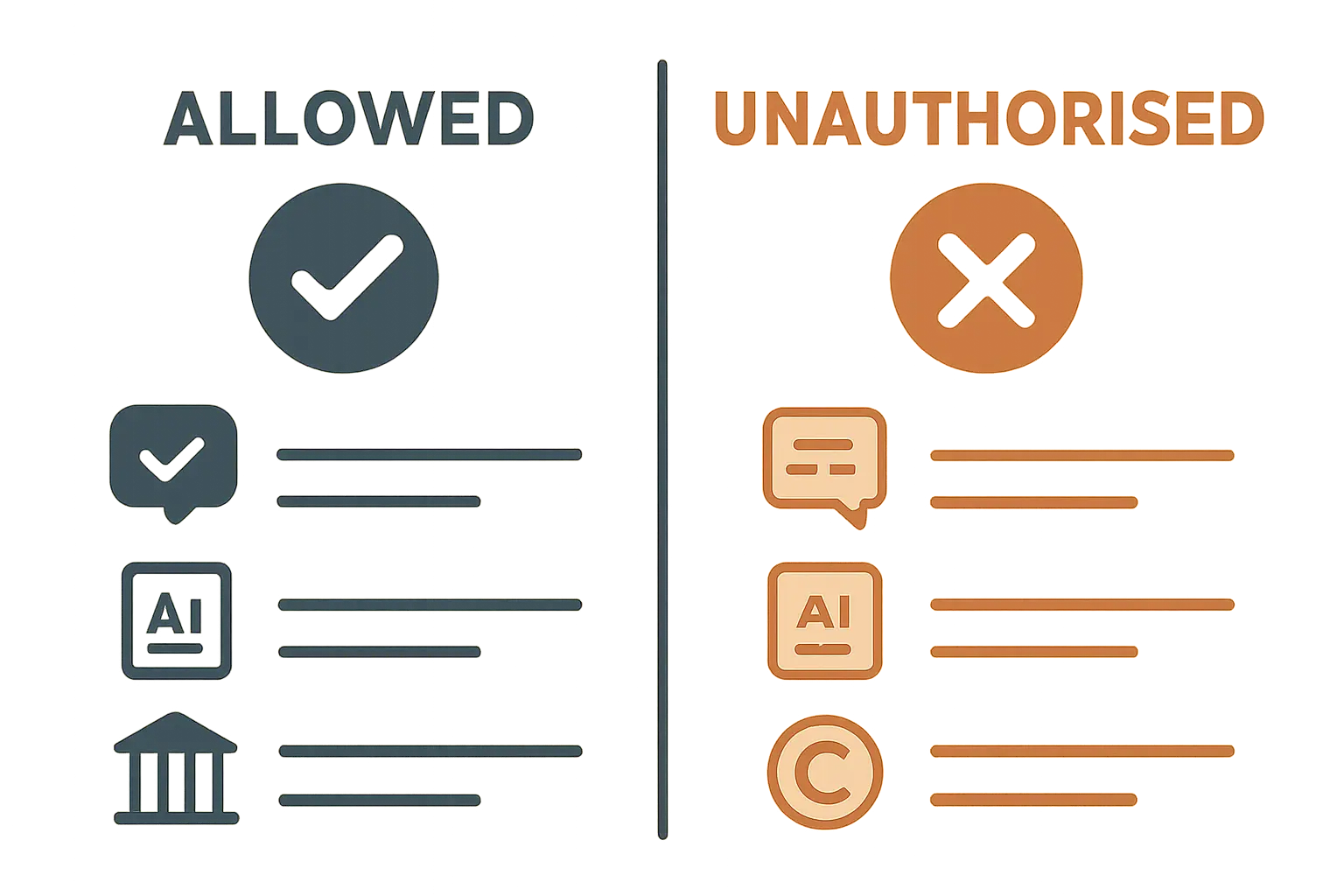
Oxford’s guidance frames unauthorised use around the same integrity, honesty, and transparency standard used to define acceptable use — meaning content generated substantively by AI and submitted as your own original work, without disclosure, sits outside what the university permits. This is consistent with how most Russell Group universities have implemented their shared AI principles: the ethical concern isn’t “AI touched this document” but “AI materially produced this content and the student represented it as entirely their own, undeclared.”
| Use case | Oxford’s general position |
|---|---|
| AI-embedded software feature (e.g. built-in grammar check) | Generally does not require separate disclosure |
| Stand-alone AI tool (e.g. ChatGPT Edu) for substantive drafting help | Disclosure expected |
| Submitting AI-generated analysis as your own undisclosed work | Treated as a breach of academic standards |
| Uploading unpublished thesis drafts to third-party AI tools | Flagged as a possible copyright risk |
Can I Upload My Thesis to an AI Tool Safely?
Be careful here. Oxford’s guidance specifically warns that uploading published or unpublished work to external AI tools may constitute a breach of copyright, unless the use is covered by an exception such as non-commercial research and private study, or criticism and review. In practice, that means pasting a full unpublished thesis draft into a public AI chatbot to “get feedback” is a genuinely different risk category than asking a governed, university-provided tool like ChatGPT Edu to check grammar on a short excerpt — and students should treat data protection and copyright as separate concerns from the academic-integrity question.
Does the Policy Differ Between Departments?
Yes, in practice. The university-wide position sets the floor, but individual departments — Oxford’s Mathematics department publishes explicit guidance for MSc dissertations, for instance — can add course-specific detail about what’s permitted for a given assessment type. If your thesis, DPhil, or coursework falls under a department with its own published AI policy, that document takes precedence over the general university guidance for the specifics of your assessment. Some departments may be more restrictive for specific assessment types, such as closed-book exams or vivas, where the whole point of the assessment is to test unaided understanding — always check the assessment-specific rules rather than assuming the general university guidance covers every situation you’ll encounter.
Is Oxford’s Policy Different From Other UK Universities?
Not dramatically. Oxford’s disclosure-based, “permitted with conditions” model tracks closely with the Russell Group’s five shared principles on generative AI in education — supporting AI literacy, equipping staff to guide appropriate use, adapting assessment for ethical AI use, upholding academic rigour and integrity, and sharing best practice as the technology evolves — which most of the 24 Russell Group universities, Oxford included, have committed to in some form. Where Oxford stands out is less in the policy language itself and more in the practical infrastructure: being the first UK university to roll out free ChatGPT Edu licences campus-wide is a concrete step beyond simply publishing a policy document, and it gives Oxford students a sanctioned default tool that many peer universities have not yet matched.
How Can Tesify Fit Within Oxford’s AI Guidance?
Tesify is designed around exactly the disclosure-friendly model Oxford describes: structuring chapters, organizing citations, and editing your own drafts, rather than generating substantive analysis in your voice without your involvement. If your department requires disclosure of AI-assisted tools, using Tesify for structural and citation support — and declaring it, as Oxford’s guidance asks for stand-alone tools — keeps you inside the university’s published framework rather than guessing at where the line is.
For the equivalent question in a specific discipline where the stakes of undisclosed AI use are especially high, see our companion piece on whether you can use AI to write a law dissertation. If you want the general admissions picture for Oxford beyond AI policy, our Oxford admission requirements guide covers the wider application process, and our AI detection accuracy statistics piece explains why detection tools are an unreliable way to police any university’s AI policy in practice.
Frequently Asked Questions
Does Oxford allow AI tools for essays and theses?
Yes, within limits. Oxford’s published guidance permits generative AI use in academic work when it is used responsibly, ethically, and with disclosure, but unauthorised or undeclared substantive use is treated as a breach of academic integrity.
Does Oxford provide students with an official AI tool?
Yes. Oxford became the first UK university to provide free ChatGPT Edu licences to staff and students as part of its expanding offer of secure, enterprise-level generative AI tools, rather than leaving students to rely solely on public consumer AI tools.
Do I have to declare AI use in my Oxford thesis or essay?
Oxford’s guidance states that substantive use of generative AI should be declared whenever a stand-alone AI tool such as ChatGPT is used, though disclosure is generally not required where AI functionality is embedded within existing software you would use anyway.
Can I upload my unpublished Oxford thesis to an AI tool?
Oxford’s guidance warns that uploading published or unpublished work to external AI tools may constitute a copyright breach unless it falls under an exception such as non-commercial research, private study, or criticism and review, so students should check before uploading full drafts to third-party AI platforms.
What counts as unauthorised AI use at Oxford?
Based on Oxford’s published guidance, unauthorised use generally means substantive, undisclosed AI generation of content submitted as your own original work, used without the critical review and transparency the university’s academic standards require — exact departmental rules can vary, so students should check their specific faculty’s policy.
Is Oxford’s AI policy stricter than other UK universities?
Not particularly. Oxford’s disclosure-based, permitted-with-conditions approach is broadly consistent with the Russell Group’s shared principles on generative AI in education, which most research-intensive UK universities including Oxford have adopted in some form, though Oxford’s provision of free ChatGPT Edu access to all students is a distinctive addition.
Write your thesis with AI
Structure, draft, cite, and format your thesis faster with Tesify’s AI writing tools, automatic bibliography, and plagiarism checker. Free to start, no credit card required.






Leave a Reply