
Thesis Embargo Statistics 2026: How Common Are Restricted Dissertations?
When a researcher submits their doctoral dissertation, the default expectation at most universities is immediate public access. Yet a meaningful share of theses sit behind embargo walls — hidden from global search engines, inaccessible to other researchers, and invisible in citation databases for months or years. Understanding thesis embargo statistics matters for anyone planning to deposit a thesis, publish research derived from it, or benchmark their institution’s open-access performance against sector norms.
This data roundup draws on the 2013 NDLTD Survey of ETD Practices, university repository policies across the US, UK, Australia, and Canada, ProQuest’s official guidance, and peer-reviewed studies on open-access citation effects. Key figures are presented upfront, followed by disciplinary and geographic breakdowns, common embargo triggers, and what the evidence says about the real cost of restricting early-career research.
Key Findings at a Glance
Video: Thesis/Dissertation Embargo: What graduate students need to know — Iowa State University Center for Communication Excellence (IowaStateCCE)
| Metric | Data point | Source |
|---|---|---|
| Institutions offering any embargo option | 84% of surveyed programmes | 2013 NDLTD Survey |
| Institutions restricting ETDs to campus-only audiences | 41% of surveyed programmes | 2013 NDLTD Survey |
| Institutions where >85% of embargoes exceed one year | 85% of embargoing institutions | 2013 NDLTD Survey |
| Post-embargo open-access citation advantage (median) | 18.5% more citations | Piwowar & Vision, PLOS ONE 2016 |
| Publishers who would reject revised book derived from open ETD | ~7% of journal editors; ~3% of university press directors | Swan, cited in Iowa Scholarly Resources guide |
| Maximum embargo at Cambridge (Apollo) | 6 years from date of deposit | Cambridge Apollo repository |
| Maximum embargo at UT Austin | 7 years | Texas ScholarWorks policy |
| EThOS open-access full texts (as of 2017 baseline) | ~160,000 of 500,000+ indexed UK theses | British Library / EThOS Wikipedia |
How Common Are Thesis Embargoes?
The most systematic survey of embargo prevalence across institutions remains the 2013 NDLTD Survey of ETD Practices, conducted by the Networked Digital Library of Theses and Dissertations. Although now over a decade old, it established a baseline that subsequent institutional data has broadly confirmed: embargo options are widely offered but relatively rarely used.
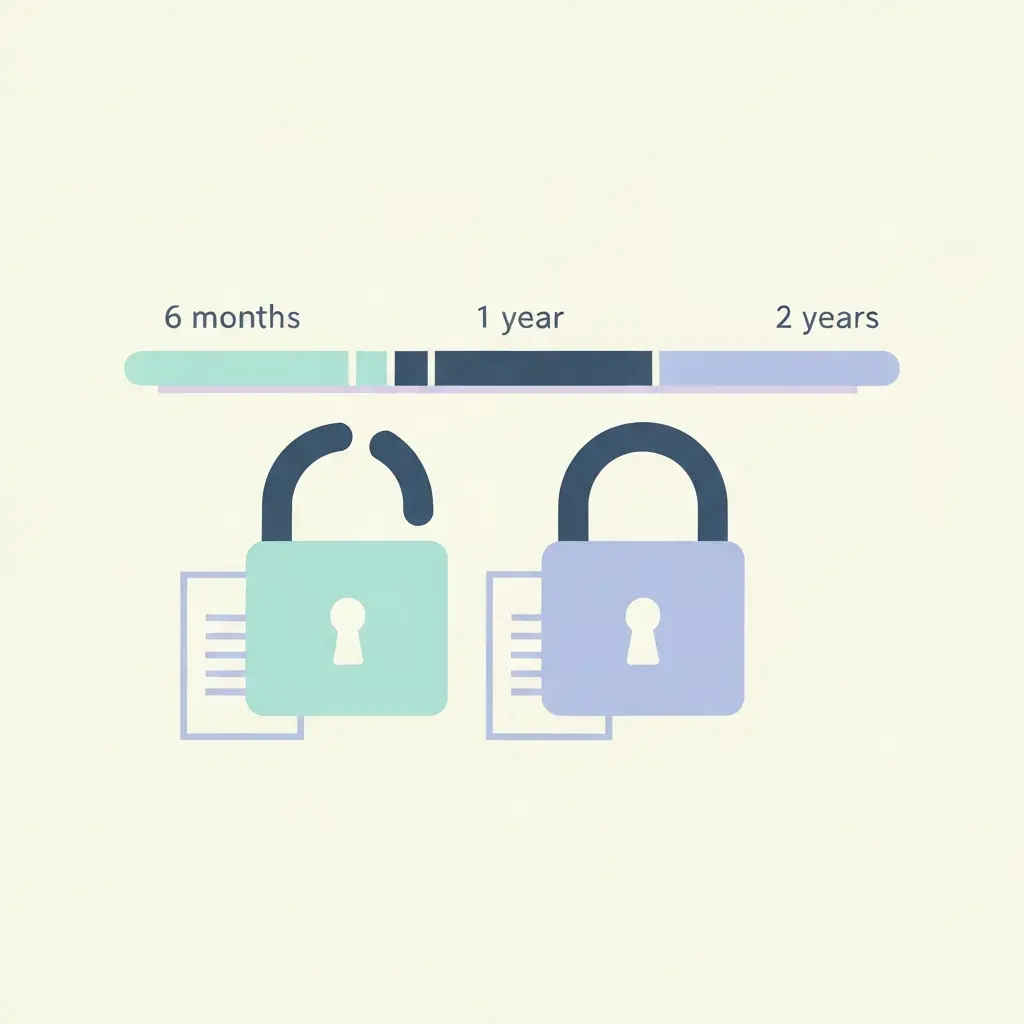
The survey found that 84% of participating graduate programmes offered the option to close a thesis to all audiences, and 41% reported operating a campus-only access tier rather than fully open access. However, making embargo infrastructure available does not mean most students use it. ProQuest, which archives the largest single repository of North American dissertations — now containing over seven million dissertations and theses — notes in its official guidance that “most students choose to make their work available immediately.” Standard ProQuest delayed-release options (6 months, 1 year, or 2 years) exist, but the default path remains immediate access.
Among the minority who do embargo, the picture varies substantially by discipline. STEM fields with patent-relevant research and humanities fields with prospective book publishers make up the bulk of long-embargo requests. Social science and professional programmes — law, education, public administration — tend toward shorter or no embargoes because their findings are less commercially sensitive and their publishing pathways less dependent on an exclusive first-release window.
It is also worth distinguishing between types of restriction. Not every “embargo” is the same:
- Full embargo: Both metadata (title, abstract) and full text are withheld from all audiences. Typically required only for active patent applications.
- Partial embargo: Metadata is publicly visible and indexed, but full text requires authentication or is restricted to institutional network users. This is the most common form at major research universities.
- Delayed release: Full text becomes publicly accessible automatically after the embargo period ends, with no further action required by the author.
- Indefinite restriction: Technically possible at some institutions but strongly discouraged. The University of Washington, for example, caps standard no-access embargoes at one year and requires documented justification for patent-based extensions.
For context on broader open-access trends that shape embargo decisions, see the data on open access publishing rates, APC costs, and institutional mandates in 2026. The broader question of whether you are even required to deposit your thesis — and what rights you retain when you do — is covered in our companion article on whether you have to publish your thesis in 2026.
Typical Embargo Durations by Institution
Standard embargo lengths across leading research universities cluster in the 6-month to 2-year range for most disciplines. The following table summarises official policies at a cross-section of major institutions, drawn directly from their graduate school and library documentation:
| Institution | Standard options | Maximum | Notes |
|---|---|---|---|
| Washington University in St Louis | 6 months, 1 year, 2 years | 2 years (standard); extensions via Dean | New policy effective Fall 2025 (Dec 2025 graduates) |
| Columbia University | 1 year, 2 years, 5 years | 5 years | 5-year option for exceptional circumstances |
| Carnegie Mellon University | 6 months – 5 years | 5 years | Range accommodates STEM and humanities needs |
| University of Texas at Austin | Custom, up to 7 years | 7 years | Among the most permissive US policies |
| University of Washington | 1 year, 2 years, 5 years (ResearchWorks) | 1 year “no access”; 5-year restriction with justification | Metadata always public regardless of embargo type |
| Georgetown University | Up to 2 years (standard) | Extensions via Graduate School Dean with mentor support | Restrictive embargo (metadata hidden) for active patents |
| Imperial College London | 6, 12, 18, or 24 months | 6 years (with successive 24-month extensions) | Strong STEM patent use-case; extensions well-documented |
| University of Cambridge (Apollo) | Institutional guidance varies by department | 6 years from deposit | Extension form required; advisor endorsement needed |
| University of Sheffield (UK) | Typically 12–24 months | Set by faculty and graduate school policy | UKRI funder requirements may override personal preference |
A clear trend across all these institutions: one to two years is the de facto standard. The 5- or 6-year outliers are reserved for documented exceptional cases — most commonly an active patent application with a non-disclosure clause, or a book contract with a university press that explicitly requires unpublished-status at submission.
Top Reasons Researchers Request Embargoes
Graduate school policies across multiple universities converge on four primary justifications for embargo requests. Each carries different evidentiary requirements and typical durations:
1. Pending Patent Applications
This is the most clearly legitimate trigger for a full embargo. Patent law in most jurisdictions defines prior public disclosure as a bar to patent registration; publishing a thesis that contains novel technical claims — processes, compounds, devices, software algorithms — before filing a patent can invalidate the application. Engineering, chemistry, biotechnology, and computer science are the most affected disciplines. Institutions like Georgetown and Imperial treat active patent applications as grounds for the most restrictive access tier, in which both metadata and full text are withheld. These embargoes typically match the patent prosecution timeline, often 12–18 months, though full patent-to-grant cycles can extend to 3 years or more in competitive fields.
2. Forthcoming Book Contracts
The humanities, particularly history, present a distinctive embargo dynamic. Many academic career paths in history require a book — a substantially revised dissertation — to achieve tenure. Following a controversial 2013 statement from the American Historical Association, which advocated for up to six-year embargo windows to protect early-career historians’ book prospects, significant debate arose. Critics, including Harvard’s Office of Scholarly Communication, challenged the empirical basis: publisher surveys cited in scholarship guides found that only approximately 7% of journal editors and 3% of university press directors would actually decline to consider a revised work derived from an openly available dissertation. The consensus in scholarly communication has since shifted away from long humanities embargoes, though some historians continue to request them.
3. Confidential or Sensitive Data
Research involving non-disclosure agreements with industry partners, clinical data with restricted consent, third-party proprietary datasets, or identifiable participant information in sensitive social science contexts can all justify embargo requests. This category includes:
- Industry-sponsored research with contractual confidentiality clauses
- Health data with specific consent restrictions on open publication timelines
- Research in conflict zones or on politically sensitive populations where open publication could endanger participants or the researcher
- Creative practice theses (novels, screenplays, musical works) where publication rights are pending commercial negotiation
In the UK, funders such as UKRI have specific policies about when embargo requests are permissible even for funded research, and EPSRC in particular has moved toward strong open-access default positions for data as well as publications.
4. Publication of Constituent Journal Articles
Many contemporary dissertations — particularly in the sciences — are written as compendiums of already-submitted or under-review journal articles. Journal publishers increasingly assign copyright on acceptance, and some subscription journals still include embargo clauses on pre-prints. A researcher may request a short thesis embargo (6–12 months) to allow time for constituent papers to clear peer review and be formally published before the underlying full dissertation is made openly accessible.
For data on how long peer review actually takes across disciplines — a variable that directly influences the practical embargo period needed for publication-pipeline reasons — see our full breakdown of journal peer review time statistics in 2026, which covers first-decision timelines of 8–18 weeks by field and the full cycle from submission to publication.
Country and Repository Variation
Embargo norms differ substantially across national systems, reflecting both funder mandates and the commercial logic of academic publishing in each region.
United States
The US has the most permissive and varied embargo landscape. ProQuest, which operates the dominant North American ETD repository, allows authors to request traditional publishing embargo periods independently of their institutional repository choice. Standard ProQuest options run 6 months, 1 year, or 2 years, with custom periods possible. Because most US graduate programmes submit to both ProQuest and an institutional repository (IR), students can have two different embargo statuses — leading to situations where the thesis is discoverable in the IR but not yet downloadable through ProQuest, or vice versa. The UT Austin policy of up to 7 years, noted above, represents the outer edge of US permissiveness.
United Kingdom
The UK system operates through a combination of institutional repositories and the British Library’s EThOS service, which as of 2017 provided open-access full text for approximately 160,000 of the more than 500,000 doctoral theses it indexed. That proportion — roughly 32% full-text open at that baseline — reflects a significant embargo and restricted-access load, though the figure has improved since EThOS began its active digitisation and repository-linking programme. UKRI’s open-access policy, which came into force for publications from April 2022, does not directly mandate open ETD access, but the Research Excellence Framework (REF) and institutional open-access policies increasingly push toward shorter embargoes. UK institutions typically cap standard embargoes at 2 years, with up to 6 years available only in documented exceptional cases (Imperial College London, Cambridge).
Australia and Canada
Australian universities operate under the Australian Open Access Support Group (AOASG) framework and National Library digitisation programmes. Embargo periods of 1–2 years are standard; embargo requests beyond that require graduate school approval. Canadian institutions, many of which are part of the Theses Canada / Library and Archives Canada programme, similarly default to immediate open access with short optional delay periods up to 2 years.
Continental Europe
European practice is the most open-access-oriented, driven partly by national mandates and partly by the DART-Europe e-theses infrastructure (now archived, having hosted over 100,000 open-access doctoral theses from European countries before its closure). Countries like the Netherlands, Germany, and the Nordic states operate under national ETD mandates that effectively treat embargoes as exceptions rather than defaults. French institutions deposit through the national TEL (thèses-en-ligne) system, where embargo periods beyond 6 months require documented justification submitted to the thesis commission.
The Citation Cost of Embargo
The strongest quantitative case against long embargoes comes from citation impact research. A landmark study by Piwowar and Vision, published in PLOS ONE in 2016, examined 3,850 articles from the University of Michigan institutional repository. Articles that transitioned from subscription-only to open access showed a median citation advantage of 18.5% (at 99% confidence interval ±6.5%). Critically, higher-quality articles — those already above median citation counts — captured a larger share of that advantage (19.3% at median, ±10.6%).
The Post-Embargo Open Access Citation Advantage (Piwowar & Vision, PLOS ONE 2016)
Peer-reviewed study: 18.5% median citation advantage when articles move from restricted to open access — evidence for the real cost of embargo
The implications for thesis embargoes are direct. A thesis embargoed for two years during what are typically a researcher’s most active network-building years (conference presentations, job applications, early career visibility) is effectively invisible. An embargoed thesis in UT Austin’s Vireo submission system was, in the institution’s own words, “basically invisible to anyone except the Vireo administrators.” That invisibility compounds: citations accumulated during the embargo period are zero, and those zero-citation years become the baseline against which future impact is measured.
The counterargument — that publishing a chapter before the thesis is publicly available makes the thesis itself less novel to journal reviewers — has proven largely overstated. The study cited in the University of Iowa scholarly resources guide found that the vast majority of publishers evaluate submissions on their merits after revision, not on the open-access status of the source dissertation. Only a small minority of editors would flag open ETD availability as a disqualifying factor.
This evidence base sits within the broader picture of open access publishing mandates and their growth trajectory, which shows that institutional and funder pressure is consistently moving toward faster, more open dissemination at every level of academic output — dissertations included.
The Policy Landscape in 2026
Several trends characterise thesis embargo policy as of 2026:
Funder Mandates Are Tightening
UKRI, the European Research Council, the National Institutes of Health (NIH), and the Bill and Melinda Gates Foundation have all moved toward zero-embargo or 6-month-maximum policies for publications arising from funded grants. While these mandates technically apply to journal articles and not raw dissertations, graduate students funded through these programmes face pressure to align their thesis access decisions with their broader grant obligations. A student who embargoes their thesis for 2 years but publishes constituent chapters open-access within 6 months faces no formal contradiction — but the inconsistency is increasingly visible to hiring committees and promotion panels assessing a candidate’s open-science commitment.
AI-Indexed Repositories Raise the Stakes of Invisibility
Large language models and academic AI tools now routinely index institutional repositories and ETD collections. An embargoed thesis is invisible not only to human researchers but also to the AI citation tools that increasingly inform literature review processes. This is a relatively new dynamic, but its practical effect is that embargoed dissertations are being systematically excluded from the emerging layer of AI-assisted knowledge synthesis — a form of citation disadvantage that has no precedent in the pre-LLM era. For an overview of how AI tools are being incorporated into academic writing workflows, see the round-up of AI detection accuracy statistics in 2026, which contextualises the growing role of AI in evaluating and processing academic texts.
Graduate Schools Are Tightening Renewal Criteria
Multiple US and UK graduate schools updated their embargo renewal policies between 2022 and 2025. Washington University introduced a revised policy effective for December 2025 graduates. The general direction is toward shorter maximum periods, stricter documentation requirements for renewals, and an explicit requirement for a supervisor’s written endorsement of any extension request. Permanent embargoes, while theoretically possible at some institutions (Rutgers ETD, for example, maintains a FAQ on how to set one), are increasingly stigmatised in faculty handbooks and doctoral programme guidelines as incompatible with research integrity norms.
The Embargo-Versus-Publication Tension Remains Discipline-Specific
There is no single correct answer that applies uniformly across fields. A chemistry PhD with a pending biotech patent has objectively different needs from a sociology PhD whose qualitative fieldwork involved sensitive interview data, who in turn has different needs from an English literature PhD hoping to convert three chapters into a monograph. The data presented here supports a rough framework:
- STEM with active IP: Full embargo up to patent filing; then lift or move to partial restriction
- STEM without IP: Immediate open access or 6-month delay at most
- Humanities with book contract in progress: 1–2 years; evidence for longer is thin
- Social science with sensitive data: Partial embargo (metadata public) for 1–2 years while data anonymisation or consent renegotiation is completed
- Clinical/health sciences with restricted consent: Case-by-case, guided by IRB/ethics committee conditions
Planning the embargo decision early — ideally at the same time as planning the research data management strategy and deciding whether constituent papers will be submitted open-access — is strongly recommended. Tools like Tesify — Write Your Thesis with AI help students structure the thesis submission workflow, including metadata, data management, and repository requirements, so that the embargo decision is made with full context rather than as a last-minute administrative box.
For the broader data context on how thesis completion, deposit, and post-submission career outcomes interact, the graduate employability statistics roundup tracks how dissertation completion and publication practices correlate with early-career research outcomes by field and country.
Frequently Asked Questions
What percentage of dissertations are embargoed?
No single global figure exists, but available evidence suggests that the majority of dissertations are made available immediately or with only a brief delay. The 2013 NDLTD Survey found that 84% of graduate programmes offer embargo options, and 41% operate campus-only access tiers — but actual take-up rates among individual students are substantially lower. ProQuest, the largest North American ETD repository, states that “most students choose to make their work available immediately.” Disciplines with high embargo rates (engineering, chemistry, history) pull aggregate numbers upward, while most social science, education, and professional programmes have very low embargo uptake.
How long does a typical thesis embargo last?
The most common embargo duration is 1 to 2 years. Most universities offer options of 6 months, 1 year, and 2 years as standard tiers. Extended periods — 5 years (Columbia, Carnegie Mellon), 6 years (Cambridge, Imperial College), or 7 years (UT Austin) — are available but require documented justification and are typically reserved for active patent applications or formally contracted book projects with a major university press.
Does embargoing a thesis hurt my citation count?
Evidence suggests that open access does provide a citation advantage. A 2016 PLOS ONE study found a median 18.5% citation advantage for articles after they transitioned from restricted to open access. The practical implication for dissertations is that years spent embargoed are years during which citation accumulation is effectively zero, with those zeros anchoring long-term impact statistics. The citation cost is real, though its magnitude depends on discipline, prestige of the depositing institution, and the researcher’s network activity during the embargo period.
Will publishers refuse to consider a book based on an open-access dissertation?
Research cited in scholarly communication literature found that only approximately 7% of journal editors and 3% of university press directors would decline to consider a revised manuscript because the source dissertation was openly available online. The large majority evaluate submissions on the quality and novelty of the revised work rather than the open-access status of the original. This evidence significantly undercuts the case for long embargo periods justified primarily by publication concerns — a position that Harvard’s Office of Scholarly Communication made publicly in 2013 when challenging the American Historical Association’s six-year embargo recommendation.
Can I extend a thesis embargo after it is set?
Yes, at most institutions, though with increasing documentary requirements. Extensions typically require a written request to the graduate school dean, a supporting statement from the primary supervisor, and documentation of the specific ongoing reason for continued restriction — usually evidence of active patent prosecution, a signed publishing contract, or updated ethics committee guidance. Georgetown University and Washington University both describe this process explicitly in their embargo guidelines. Many institutions have tightened renewal criteria since 2022, and permanent embargoes, while technically possible at some institutions, are increasingly treated as exceptional and requiring faculty-level approval.
Does a thesis embargo affect metadata and abstract availability?
In the large majority of cases, no. Most embargo types restrict only the full text, while title, author, abstract, and citation information remain publicly visible and indexed. Exceptions exist: Georgetown’s “restrictive embargo” option withholds all metadata, including title and abstract, and is used only in active patent situations. The University of Washington explicitly states that metadata “is openly available immediately” regardless of the access restriction selected for the full text. The British Library’s EThOS policy is to “display the metadata for all known theses as far as possible so that a full national record exists” even when full-text access cannot be provided.
References
- NDLTD. 2013 NDLTD Survey of ETD Practices. Virginia Tech, 2013.
- Piwowar H, Vision T. The Post-Embargo Open Access Citation Advantage: It Exists (Probably), It’s Modest (Usually), and the Rich Get Richer (of Course). PLOS ONE. 2016.
- American Historical Association. Statement on Policies Regarding the Option to Embargo Completed History PhD Dissertations. 2013.
- ProQuest. ProQuest Dissertations & Theses Global. Accessed 2026.
- University of Iowa. Embargo — Scholarly Resources for Dissertation Students. Accessed 2026.
- Georgetown University Library. Dissertations, Doctoral Projects, and Theses: Embargoes. Accessed 2026.
- University of Washington Libraries. Access Decisions — Electronic Theses and Dissertations. Accessed 2026.
- Imperial College London. Requesting an Embargo — Open Access Theses. Accessed 2026.
- British Library. EThOS: E-Theses Online Service Update. Accessed 2026.
- University of Texas at Austin. UT Electronic Theses and Dissertations — Texas ScholarWorks. Accessed 2026.
Write your thesis with AI
Structure, draft, cite, and format your thesis faster with Tesify’s AI writing tools, automatic bibliography, and plagiarism checker. Free to start, no credit card required.



Leave a Reply