

The 15 English Mistakes That Make a Thesis Read as Second-Language Writing
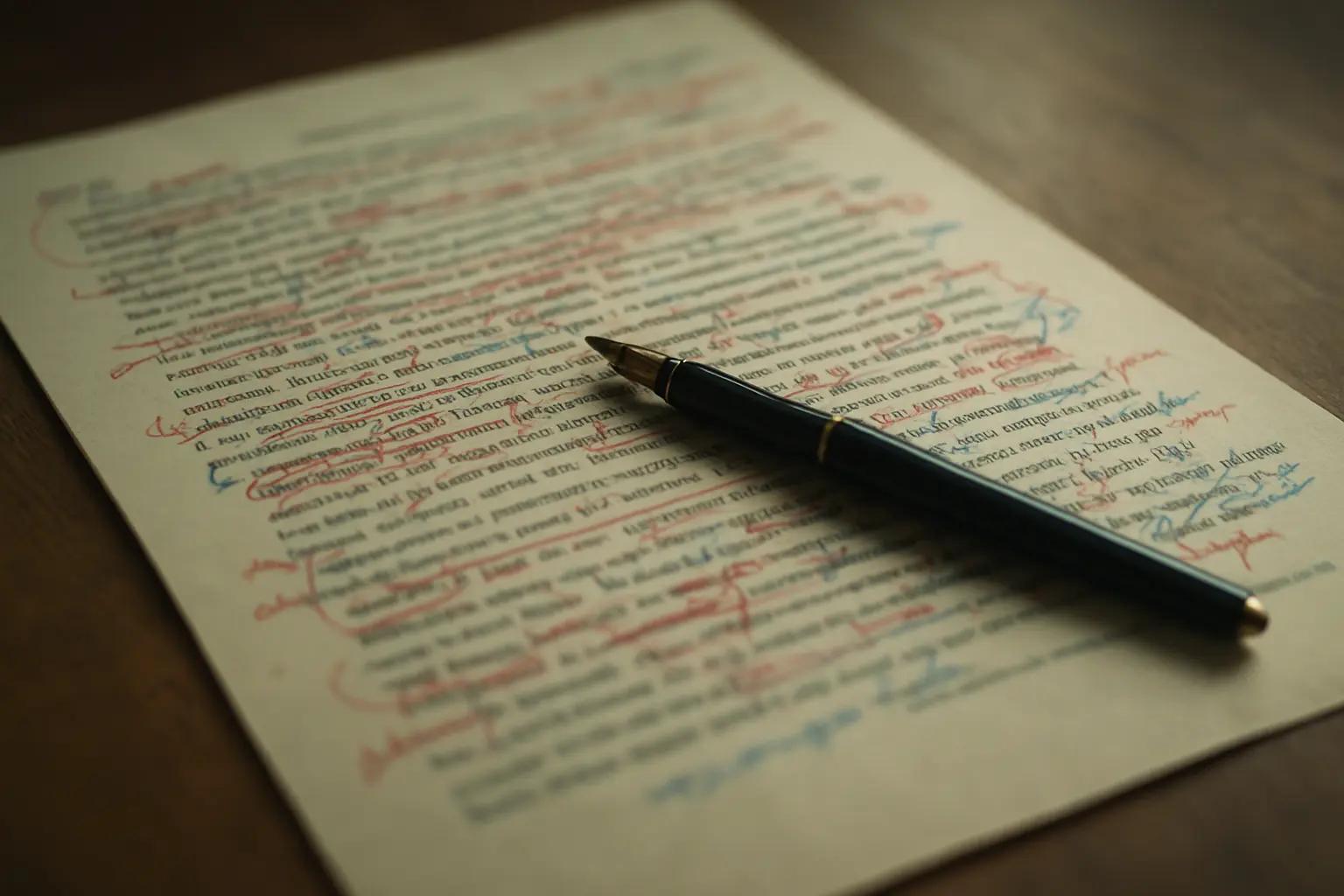
Here is the problem in one sentence: you are being assessed on your research, but you are being read through your English. An examiner who has to reconstruct what you meant three times a page starts to doubt the analysis, even when the analysis is sound. That is unfair, and it is also entirely fixable, because the errors are not random. They are systematic, they come from a short list, and once you can name them you can find them.
Below are the fifteen patterns that appear most often in postgraduate theses written by speakers of English as an additional language, each with the incorrect sentence, the corrected sentence, and — where possible — a search you can run on your own draft.

1. The missing or extra article
English requires an article where most languages do not, and forbids one where several languages insist. This is the single most frequent error and the hardest to self-correct.
✗ Results show that intervention was effective.
✓ The results show that the intervention was effective.
✗ The research on the second language acquisition has expanded.
✓ Research on second language acquisition has expanded.
Working rule: use the for something already identified or unique in context (the sample, the present study); use a/an for one of a class first mentioned (a pilot study was conducted); use no article for abstract or uncountable nouns used generally (research, evidence, knowledge).
2. Pluralising nouns that have no plural
✗ Previous researches have shown… ✓ Previous research has shown…
✗ Two evidences support this. ✓ Two pieces of evidence support this.
✗ The literatures suggest… ✓ The literature suggests…
Search tip: search for researches, evidences, literatures, informations, feedbacks, knowledges, advices and equipments. Every hit is an error. The wider countability question, including data, is set out in our comparison of the grammar questions academic style guides disagree on.
3. The spurious preposition after a transitive verb
Several very common academic verbs take a direct object with no preposition, and adding one is an immediate marker.
✗ This chapter discusses about the findings. ✓ This chapter discusses the findings.
✗ The author emphasises on the role of context. ✓ The author emphasises the role of context.
✗ She mentioned about the limitation. ✓ She mentioned the limitation.
Search tip: discuss about, emphasise on, mention about, investigate about, describe about, analyse about.
4. The wrong preposition in a fixed collocation
These simply have to be learned; no rule generates them.
| Incorrect | Correct |
|---|---|
| research about X | research on / into X |
| an effect to Y | an effect on Y |
| impact to Y | impact on Y |
| consist in three parts | consist of three parts |
| comprise of four items | comprise four items |
| different than | different from |
| in contrary to | contrary to / in contrast to |
| according to me | in my view / I argue that |
5. False friends
Words that look like a word in your language and mean something else in English. These are dangerous precisely because a spellchecker cannot see them.
- actual means real, not current. Write the current framework.
- eventual means final, not possible. Write a possible limitation.
- sensible means reasonable, not sensitive. An instrument is sensitive.
- pretend means feign, not intend or claim.
- assist to a lecture is wrong; you attend it.
- control does not mean check or verify in English.
- realise means become aware, not carry out. You conduct a study.
6. Translated connectors
✗ In the other hand… ✓ On the other hand…
✗ As we all know, … ✓ delete it, or cite something.
✗ According to me… ✓ I argue that…
✗ Nowadays, the world is changing rapidly. ✓ delete — this opening adds nothing and appears in thousands of theses.
7. The subjectless sentence
Languages that allow a dropped subject produce English sentences that need a dummy it.
✗ Is important to note that the sample was small.
✓ It is important to note that the sample was small.
✗ In Table 3 shows the descriptive statistics.
✓ Table 3 shows the descriptive statistics. (You cannot have both a preposition and a subject.)
8. Agreement lost across a long noun phrase
✗ The relationship between motivation and outcomes are significant.
✓ The relationship between motivation and outcomes is significant.
The verb agrees with relationship, not with the nearest noun. When a subject runs to more than six words, find its head noun before you choose the verb.
9. Sentences that never end
Romance and Slavic academic registers tolerate far longer sentences than English does. A ninety-word sentence with four subordinate clauses is normal in Spanish or Russian scholarship and unreadable in English.
Practical target: average 20 to 25 words. Any sentence over 40 words should be checked; any over 60 should be split. One idea, one sentence.
10. Adverb and adjective placement
✗ We analysed carefully the transcripts. ✓ We analysed the transcripts carefully. English resists separating a verb from its object.
✗ a green large sample container ✓ a large green sample container. English adjective order is fixed: opinion, size, age, shape, colour, origin, material, purpose.
11. Present perfect used as a past tense
✗ In 2019, Osei has conducted a longitudinal study.
✓ In 2019, Osei conducted a longitudinal study.
A finished event at a stated time takes the past simple. The present perfect is for a state of affairs continuing into the present: Research has consistently shown… Getting this wrong across a whole literature review is one of the most visible faults in a draft.
12. Overstating with intensifiers
✗ This is a very very important and really significant finding.
✓ This finding is important because…
Very, really, a lot of, totally, absolutely and huge belong to spoken register. Academic English creates emphasis through precision, not amplification. Replace a lot of studies with numerous studies or, better, with the number.
13. Capitalisation carried over from another language
German-speaking writers capitalise nouns; Romance-language writers lowercase nationalities and months. English capitalises proper nouns, nationalities (British, Kenyan), languages, months and days, and lowercases everything else in running text — including chapter, table and figure unless numbered (Table 3, Chapter 4).
14. Punctuation transferred from the source language
Spacing before a colon or question mark, guillemets for quotations, commas before every subordinate clause, and the decimal comma all travel across from other conventions. English uses no space before terminal punctuation and a decimal point rather than a comma. The full set is in our list of punctuation rules examiners actually notice.
15. Mixing two varieties of English
If you learned English in one country and are studying in another, your draft will contain both spellings. Decide which variety your institution requires and enforce it once — the decision procedure is set out in our guide to choosing British or American English for a thesis.
What is not a problem
Three things international students worry about that examiners do not mark:
- A smaller active vocabulary. Precision beats variety in academic prose. Repeating a technical term is correct, not lazy.
- Simple sentence structures. Clear short sentences read as confident. Complexity is not sophistication.
- Prose that does not sound native. Examiners assess argument, method and evidence. What they penalise is ambiguity, not accent on the page.

A workflow that actually clears these
- Draft in your own words. Never draft in another language and translate — translation is what produces patterns 3, 6, 7, 9 and 14 simultaneously.
- Run the six searches above for pluralised uncountables and spurious prepositions. This alone removes a visible share of the errors in twenty minutes.
- Read one chapter aloud. Article errors and run-on sentences are audible even when they are invisible on screen.
- Do a dedicated language pass separate from your content pass. Mixing the two means you fix neither.
- Keep an error log. Most writers repeat the same four or five patterns. Once you know yours, the search list gets shorter every chapter.
For a fuller sequencing of drafting, editing and disclosure, see our workflow for writing a thesis in a second language, and our comparison of academic editing tools built for non-native English writers.
Stop losing marks to the language rather than the research
Tesify’s AI Editor works at exactly this layer: it corrects articles, collocations, agreement and register while leaving your argument, your terminology and your voice untouched — and it explains each change, so the same error stops recurring in the next chapter. You write the research; it stops the English from getting in the reader’s way.
Start writing your thesis with Tesify
Frequently Asked Questions
Will examiners fail my thesis because of my English?
Almost never on language alone. Persistent errors are normally classified as presentational corrections rather than substantive failures. The real risk is indirect: writing that forces the examiner to reconstruct your meaning makes the argument look weaker than it is.
What is the most common English error in international students’ theses?
Article use — the missing or unnecessary a, an and the. It is the most frequent because most languages either lack articles entirely or distribute them differently, and because it is very hard to hear in your own writing.
Is “researches” ever correct?
Not as a plural noun in academic English. Research is uncountable: write previous research has shown or several studies have shown. The same holds for evidence, literature, information, feedback and advice.
Should I write in my first language and translate?
No. Translation produces several error classes at once — spurious prepositions, transferred connectors, subjectless sentences, over-long clauses and imported punctuation. Drafting directly in English, even simply, produces a cleaner document that is far quicker to edit.
How long should my sentences be in academic English?
Aim for an average of 20 to 25 words. Check anything over 40 and split anything over 60. English academic prose is markedly shorter-sentenced than Romance and Slavic academic registers, and long sentences are the fastest route to ambiguity.
Is a simple vocabulary a weakness in a thesis?
No. Academic writing rewards precision, not variety. Repeating the exact technical term is correct; substituting a synonym for elegance can change the meaning. Elaborate vocabulary used slightly wrongly does more damage than plain vocabulary used exactly.
Am I allowed to use a language-editing tool on my thesis?
Language correction is permitted at almost every institution; generative rewriting is where policies differ and where declaration is often required. Check your programme’s regulations, keep the edits at the level of grammar and register, and disclose the tool if your institution asks you to.
Write your thesis with AI
Structure, draft, cite, and format your thesis faster with Tesify’s AI writing tools, automatic bibliography, and plagiarism checker. Free to start, no credit card required.





Leave a Reply