
Law Dissertation Topics 2026: How to Find a Question Worth Writing About
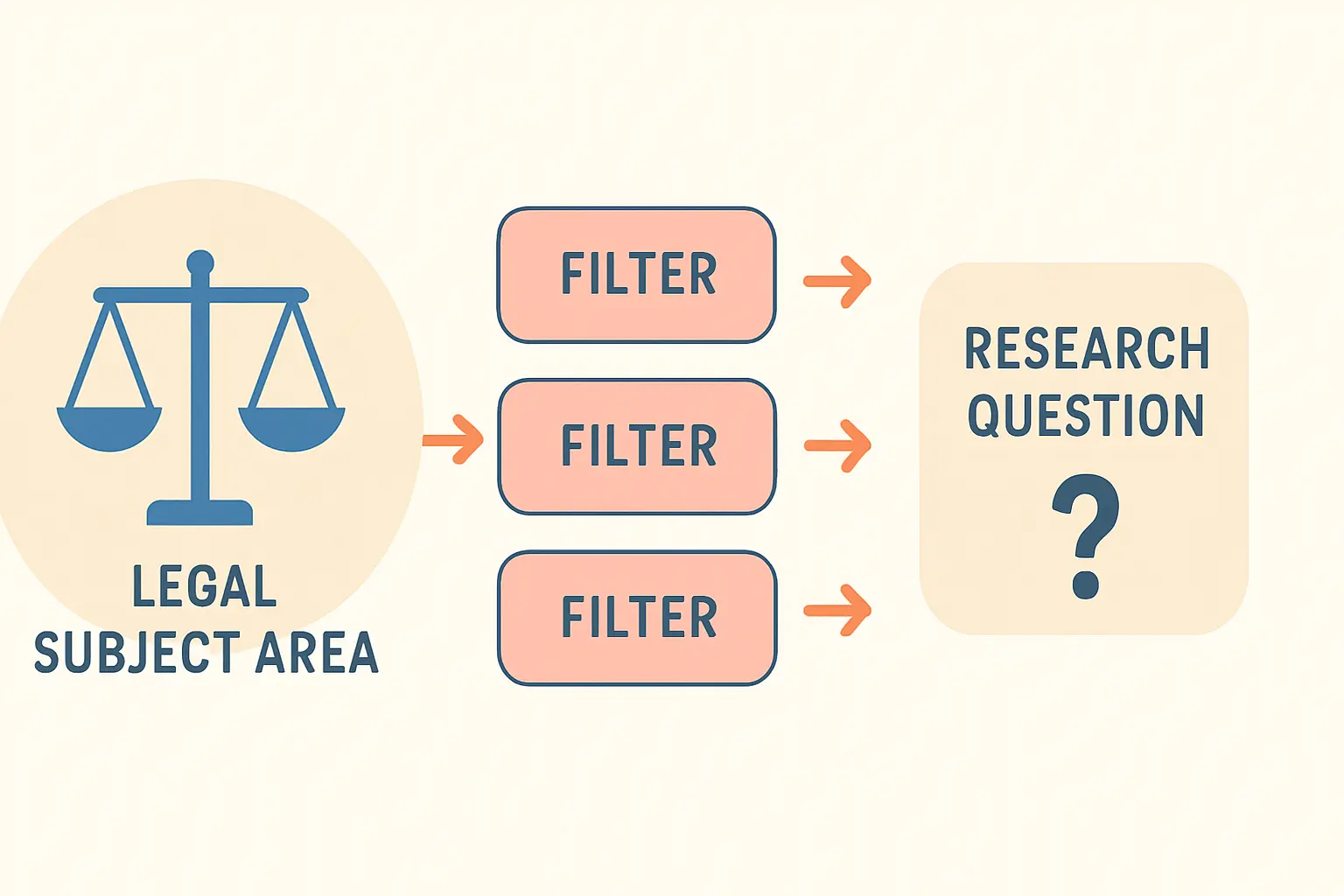
Most lists of law dissertation topics are useless, and predictably so. They offer broad subject areas — “the right to privacy”, “corporate criminal liability” — which are not topics but fields, and every student who searches for them finds the same twenty phrases. A topic that thousands of people can find in one search is, by definition, not distinctive.
The better approach is to learn where genuinely open legal questions come from, then generate your own. This guide sets out four methods, the test a topic has to pass, and how to narrow a subject area into a question you can actually answer in your word count.
What makes a law dissertation topic good?
A workable topic passes four tests. Apply them before you commit, because a topic that fails one of them will fail slowly and expensively.
| Test | The question | Failure looks like |
|---|---|---|
| Unsettled | Is there genuine disagreement or incoherence here? | A settled area where all you can do is describe the rule |
| Sourceable | Can you open the materials you need, today? | Depending on a jurisdiction or database you cannot access |
| Bounded | Can it be answered in your word count? | “Reform of company law” as a 12,000-word dissertation |
| Arguable | Could a competent lawyer disagree with your conclusion? | A question whose answer nobody contests |
The one students most often skip is sourceable, and it is the one that causes the most damage, because it fails in month four rather than month one. Before committing, open the key materials. Not search for them — open them.
Method 1: Start from a live reform question
This is the highest-yield method and almost nobody uses it. The Law Commission is the statutory body that reviews the law of England and Wales and recommends reform. Its project list is, in effect, an official register of legal questions considered unsettled enough to warrant review — which is exactly the first test above, already applied by experts.
Its current projects page lists 24 projects, grouped by area of law under headings including public law and law in Wales, property, family and trust law, commercial and common law, and criminal law. Projects named there include environmental legislation and farming, accessibility of transport for disabled people, management of housing estates, ownerless land, agricultural tenancies, commercial leasehold, product liability, criminal appeals and kinship care.
The Commission’s 14th Programme of Law Reform was launched on 4 September 2025. It states that “the ten new projects in the 14th Programme are”: agricultural tenancies; commercial leasehold; consent in the criminal law; deeds; the defence of insanity; desecration of a corpse; management of housing estates; ownerless land; product liability; and public sector automated decision-making. It adds that “the timetable for each new project will be announced in due course.”
Each of those is a field containing several dissertation-sized questions. Consultation papers are the richest material, because they set out the existing law, identify its defects and canvass reform options — which maps closely onto the structure of a reform-oriented dissertation.
Two cautions. First, a reform project is a subject area, not a question: you still have to narrow it. Second, if the Commission has already published a final report, check what it concluded before arguing for a position it considered and rejected.
Method 2: Start from a doctrinal tension
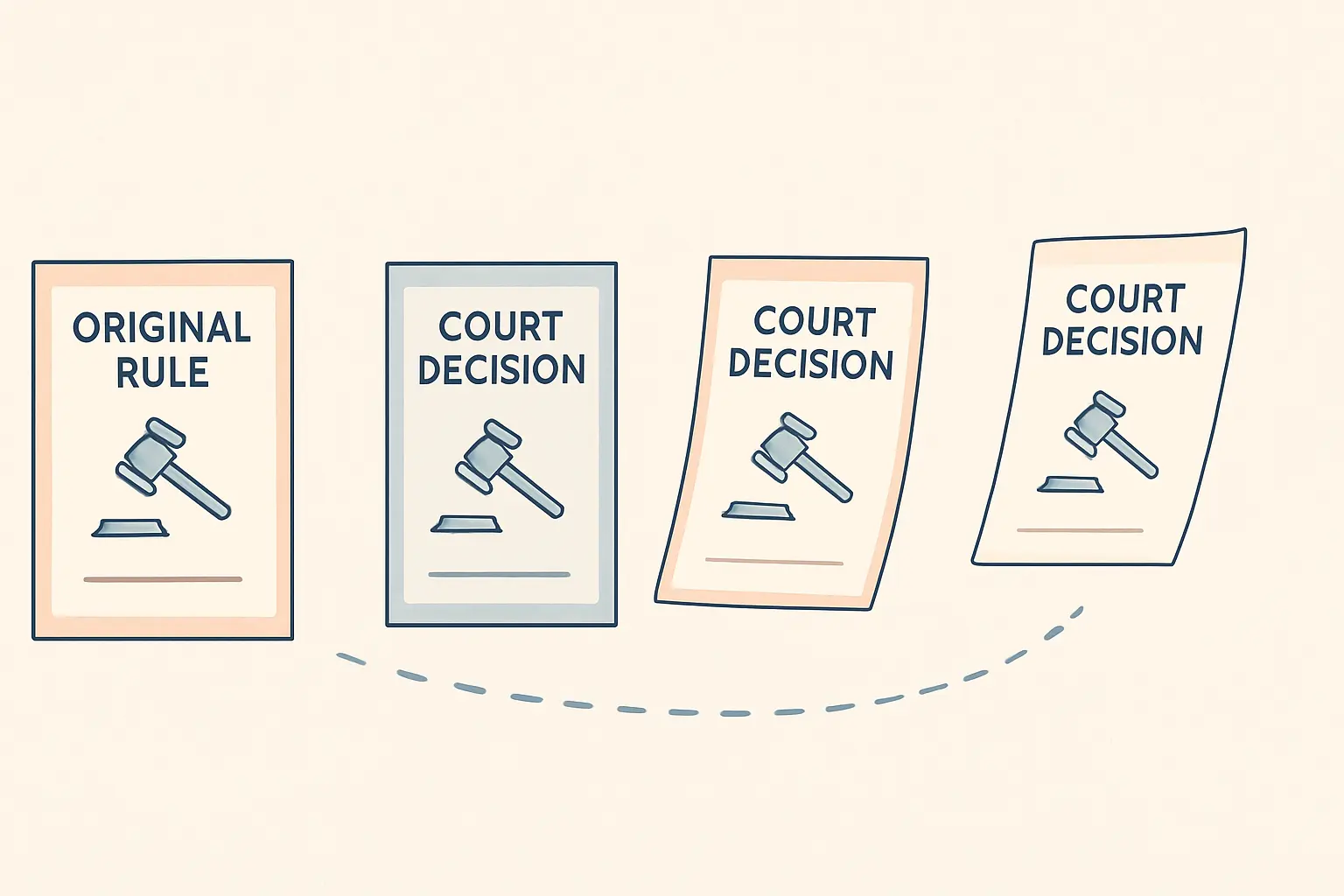
Look for places where the case law is straining. The clearest signal is a line of decisions distinguishing an authority on increasingly narrow grounds — courts reluctant to follow a rule but unable to overrule it. That pattern is direct evidence of an unstable doctrine, and the instability is your topic.
Other reliable signals include appellate courts reaching the same outcome by materially different reasoning, strong dissents, and passages where a judge expressly notes a difficulty and declines to resolve it. That last one is close to an invitation.
Identifying these depends on reading judgments properly rather than headnotes — see ratio decidendi and obiter dicta for how to tell an unresolved question from a settled holding.
Method 3: Start from a recent statute
New legislation creates a window. Provisions that have been enacted but not yet judicially interpreted raise real questions about scope and application, and nobody can claim the answer is settled because no court has settled it.
Two checks make this method safe. Confirm the commencement position, since an Act may come into force immediately, on a specific future date, or in stages, and an uncommenced provision is not yet operative law. Then check the extent, because geographical extent is assigned at provision level, so an Act can apply differently across the four UK nations.
Explanatory Notes are useful here for identifying intended operation, provided you remember they are evidence of context rather than of legal meaning. Our guide to primary legal sources for a law dissertation covers where to run both checks.
Method 4: Start from a comparison
If another legal system has confronted a problem your jurisdiction is still working through, the comparison itself can be the contribution. The discipline this requires is justifying the comparator — why that system, on what basis it is genuinely comparable for this problem, and whether the solution depends on features your system lacks.
Check source availability first. Free official judgment services are jurisdiction-bounded, so confirm you can actually reach the other system’s materials, in a language you read, before building a chapter on them. Our comparison of legal research methods covers what comparative work commits you to.
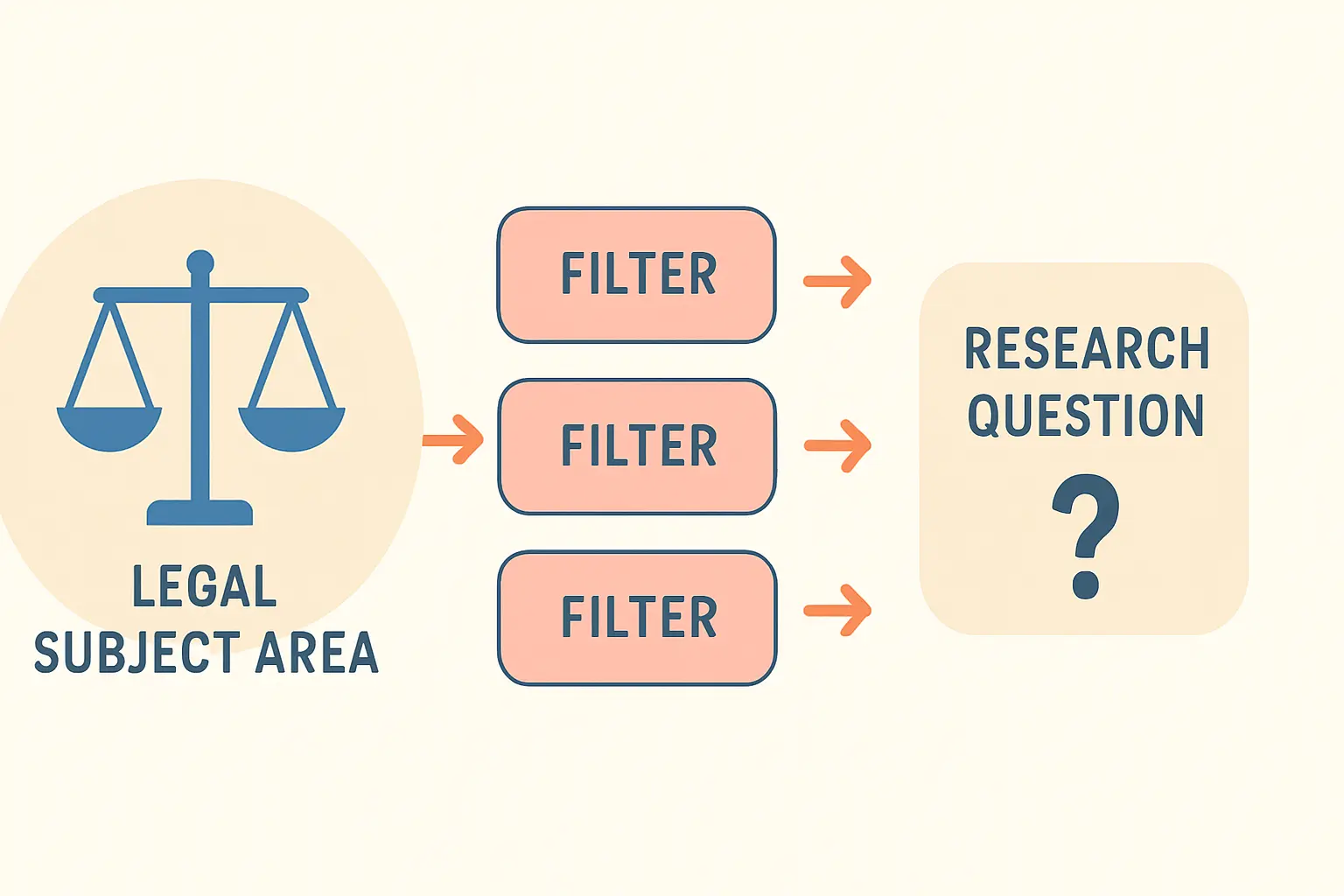
Narrowing a subject area into a question
Subject areas become topics by adding constraints. Take a broad area and apply three narrowing moves in turn:
- Narrow the doctrine. Not the whole field but one test, one duty, one exception.
- Narrow the context. One category of party, one type of transaction, one factual setting where the rule behaves oddly.
- Narrow the claim. State what you will argue, not what you will explore. “Whether X should be reformed” is a topic; “that the current test for X produces inconsistent outcomes in Y situations, and should be reformulated as Z” is a dissertation.
The third move is the one that converts reading into writing. Until you can state a claim someone could disagree with, you have a reading list rather than a thesis.
Red flags: topics that fail
- The essay question in disguise. If it could be set as a 2,000-word coursework question, it is too small — or you will pad.
- The whole field. “Reform of the law of evidence” is not answerable in any word count you have.
- The topic with no opposing view. If nobody could disagree, there is nothing to argue.
- The inaccessible jurisdiction. A comparative chapter on a system whose materials you cannot open is a chapter you will not write.
- The moving target. A live reform project mid-consultation may change position during your writing period. That is workable if you fix a date at which you state the law, and dangerous if you do not.
- The empirical topic without a plan. If your question is about how the law operates in practice, you need access and ethics approval, and both take longer than you expect.
How to test a topic in an afternoon
Before you commit, run this sequence. Open the leading statutory provision and confirm version, extent and commencement. Open three or four leading judgments and check whether they actually disagree. Search for recent academic commentary and see whether your intended argument has already been made. Then write your claim as a single sentence.
If the claim sentence comes out vague, the topic is not ready. If it comes out sharp and you can name the strongest objection to it, you have a dissertation.
Frequently asked questions
Can I use a topic someone has already written about?
Yes — most topics have been written about. What must be yours is the argument. Coming to a different conclusion, or reaching the same one by a better route on newer authority, is a contribution.
How specific should the title be?
Specific enough that a reader knows the doctrine, the context and the claim. A title naming only a field signals a dissertation that has not yet decided what it argues.
Should I pick a topic in the area I want to practise in?
It helps motivation and can help applications, but it is a weaker criterion than the four tests. A well-argued dissertation in a neighbouring area beats a weak one in your preferred field.
What if my supervisor rejects my topic?
Ask which of the four tests it failed. Rejections usually mean too broad, not genuinely contested, or not sourceable — and each has a different fix.
Do I need a topic before I choose a method?
They settle together. The question determines the method, so a shift from “what is the law” to “how does the law operate” changes your whole design — see choosing a legal research method.
How early should the topic be fixed?
Early enough that access and approval remain possible if your question is empirical, and late enough that you have read sufficiently to know the area is genuinely unsettled.
From question to first chapter
A good topic is a claim you can defend and a reader can dispute. Once you have one, the work is holding it steady across every chapter. Tesify helps you structure, draft and reference that argument while every word stays your own — 100% written by you.
Write your thesis with AI
Structure, draft, cite, and format your thesis faster with Tesify’s AI writing tools, automatic bibliography, and plagiarism checker. Free to start, no credit card required.






Leave a Reply