

How to Write Your Research Aims and Objectives (With Examples)
Getting research aims and objectives right is one of those small pieces of a dissertation that quietly determines whether the rest of the project holds together. Write them too vaguely and your methodology chapter has nothing concrete to respond to; write them too narrowly and you box yourself out of interesting findings that don’t fit the plan. Supervisors read this section first because it tells them, in two or three sentences, whether a student actually understands what their project is trying to do.
The good news is that the aim-objectives structure is genuinely learnable. It follows a small number of rules, a recognisable verb vocabulary, and a predictable relationship to your research questions and methodology. This guide walks through the distinction between an aim and an objective, how many objectives to write, how to phrase them so they hold up under scrutiny, and worked examples across several disciplines so you can see the pattern applied rather than just described.
Quick answer: A research aim is one broad statement of the overall purpose of your study, usually one sentence. Research objectives are three to five specific, measurable steps that, together, achieve that aim — each written with a precise action verb (examine, evaluate, compare, develop) rather than a vague one (understand, explore, look at). Objectives should map directly onto your research questions and the chapters or analyses of your methodology, so an examiner can trace a straight line from aim, to objectives, to questions, to methods, to findings.
Aim vs Objectives: What’s the Difference?
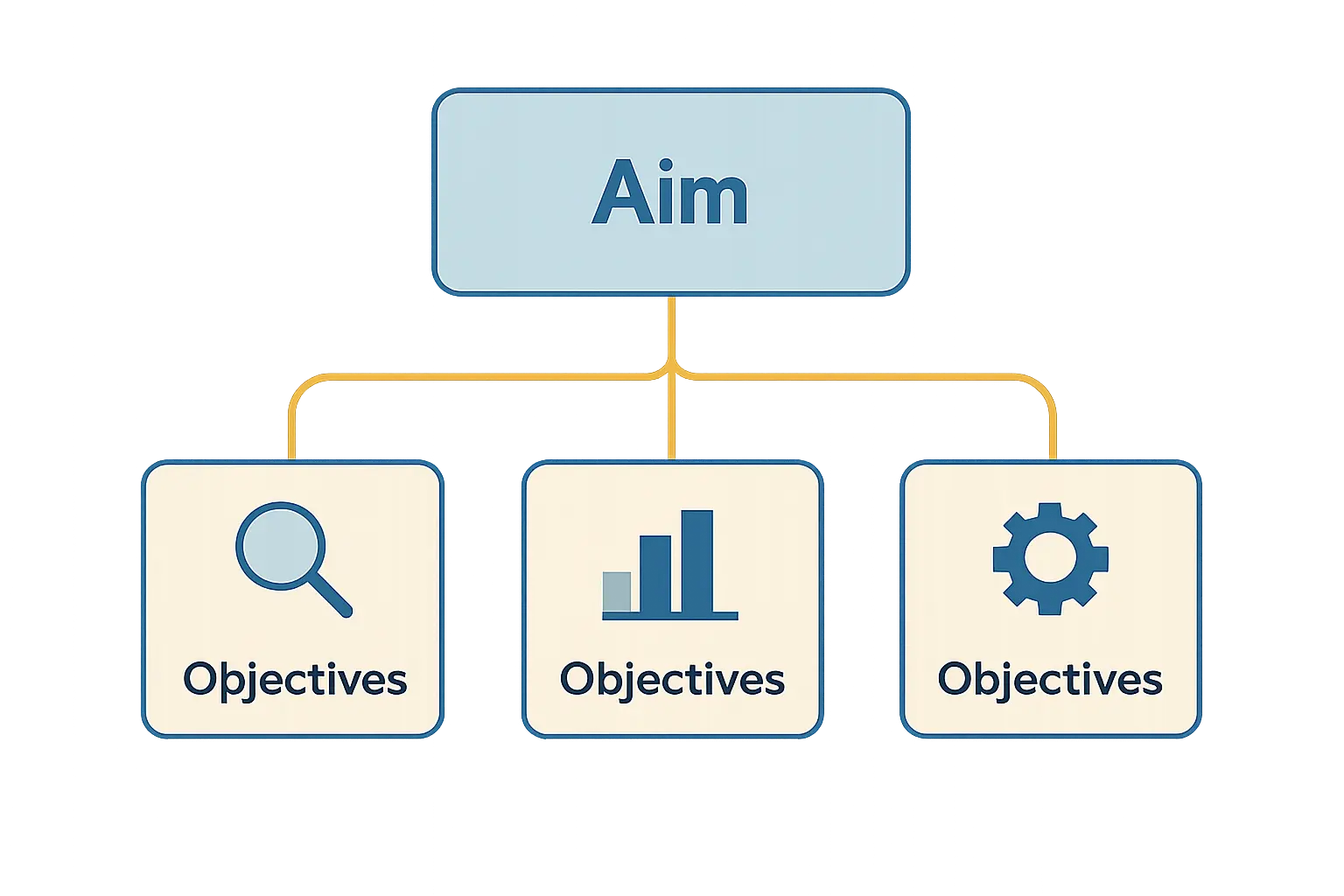
The aim is the single overarching purpose of your research, stated as one broad sentence that captures what the whole project is trying to achieve. It is deliberately general — a destination, not a route. The objectives are the specific, actionable steps that will get you there. Where the aim might read “to investigate the impact of remote work on employee wellbeing in the UK financial sector,” the objectives break that down into the discrete pieces of work needed to actually investigate it: reviewing the existing literature on remote work and wellbeing, measuring wellbeing indicators in a specific sample, identifying the factors that moderate the relationship, and so on.
A useful test: if a statement could realistically be the title of your thesis, it is probably your aim. If a statement describes one concrete task you will perform and could plausibly become one section of your methodology or one findings sub-heading, it is an objective. Students who conflate the two often end up with three or four “aims” and no objectives at all, which leaves the methodology chapter without a clear task list to organise itself around.
How Many Objectives Should You Write?
Most undergraduate and master’s dissertations work well with three to five objectives. Fewer than three usually means the objectives are too broad and are functioning more like sub-aims; more than five or six tends to fragment the project and makes it hard to deliver every objective in the space available, which examiners will notice if the findings chapter quietly drops one of them. PhD theses sometimes use a slightly larger set, particularly when the thesis is structured around discrete papers or studies, but the same logic holds: every single objective you list has to be visibly addressed somewhere in your methodology and findings, so only list what you can actually deliver.
SMART-Style Formulation
Borrowing loosely from the SMART framework used in project management, well-formed research objectives tend to be:
- Specific — naming the exact variable, population, or phenomenon, not a general topic area.
- Measurable — worded so that a reader can tell, from the findings chapter alone, whether the objective was achieved.
- Achievable — realistic given your timeframe, access to data, and available methods.
- Relevant — directly contributing to the overall aim, not a tangential side-interest.
- Time-bound — implicitly scoped to what is achievable within the dissertation timeline, even if you don’t literally write a date into the objective itself.
In practice, this framework is a useful editing checklist rather than a rigid template to be applied mechanically to every sentence. Run each draft objective through the five criteria and revise any that fail more than one.
A Verbs Taxonomy for Strong Objectives
The verb you choose signals exactly what kind of intellectual work the objective involves, which is why vague verbs (“understand,” “look at,” “explore,” “consider”) are penalised — they don’t commit you to a demonstrable outcome. Choose verbs from this taxonomy based on the actual cognitive task involved:
| Task type | Strong verbs |
|---|---|
| Reviewing existing knowledge | Review, synthesise, critically appraise, map |
| Gathering new data | Examine, measure, collect, document |
| Analysing relationships | Compare, evaluate, assess, test, analyse |
| Building something new | Develop, design, construct, propose |
| Drawing conclusions | Determine, establish, identify, recommend |
Worked Examples Across Disciplines
The following are illustrative model examples written to demonstrate structure, not extracts from any real published study.
Psychology
Aim: To investigate the relationship between social media use and self-reported anxiety among university undergraduates.
Objectives:
- Review the existing literature on social media use and anxiety in young adult populations.
- Measure daily social media use and anxiety symptom scores in a sample of undergraduate students using validated instruments.
- Test the statistical association between social media use and anxiety scores, controlling for relevant confounders.
- Identify which platform-use patterns show the strongest association with elevated anxiety scores.
Business and Management
Aim: To evaluate how flexible working arrangements affect employee retention in the UK retail sector.
Objectives:
- Review the literature on flexible working and employee retention across service industries.
- Survey employees at two retail organisations on flexible working availability and intention to remain with their employer.
- Compare retention-related outcomes between employees with and without access to flexible arrangements.
- Recommend practical policy adjustments based on the findings for retail HR practice.
Environmental Science
Aim: To assess the effect of urban green space proximity on local air quality in a mid-sized UK city.
Objectives:
- Map existing green space distribution across the study city using GIS data.
- Collect particulate matter (PM2.5) readings at matched sites with varying proximity to green space.
- Analyse the statistical relationship between green space proximity and measured air quality.
- Determine the implications of the findings for urban planning policy.
Education
Aim: To explore how first-year undergraduate students experience the transition from school-based to independent university learning.
Objectives:
- Review the literature on the school-to-university transition and independent learning.
- Conduct semi-structured interviews with first-year undergraduates about their transition experience.
- Analyse the interview data thematically to identify recurring challenges and coping strategies.
- Develop recommendations for induction programme design based on the findings.
Aligning Aims, Objectives, Questions and Methodology
Aims and objectives should not exist in isolation — they need to line up cleanly with your research questions and your methods chapter. A common and effective structure is to write one research question per objective, so each objective has a matching question that the methodology chapter then answers with a specific method. If you have not yet fixed your research question, our guide on how to write a strong research question for your thesis works through that step first, and pairs naturally with the objectives structure described here. If your objectives are struggling to hold together, it is often a sign that the underlying problem statement needs sharpening — see our guide to writing a statement of the problem for that earlier step in the process. Our sibling site’s problem statement step-by-step guide covers the same earlier step from a different angle, including a five-step template that pivots directly into study objectives, if you want a second worked reference.
In your methodology chapter, it helps to signpost this alignment explicitly — a short paragraph or table stating “Objective 1 is addressed through a systematic literature review (Chapter 2); Objective 2 is addressed through the survey described in Section 3.4” and so on. This single paragraph does a disproportionate amount of work in reassuring an examiner that the project is coherent from end to end.
Common Examiner Criticisms
- Objectives that aren’t actually addressed. If you list four objectives and the findings chapter only reports on three, the missing one needs to be acknowledged and explained, not silently dropped.
- Aim and objectives that don’t match the title. A mismatch between the thesis title, the stated aim, and the actual content analysed is one of the fastest ways to draw a “scope” comment at viva.
- Objectives phrased as questions. Objectives should be action statements (“to evaluate…”, “to identify…”), not restated questions — that confusion usually means the aims/objectives and research questions sections have been conflated.
- Too many objectives for the available data or timeframe. Ambitious objective lists that outstrip what a single dissertation can realistically deliver are a common and avoidable source of critique.
- Vague verbs that can’t be assessed. “To understand X” cannot be marked as achieved or not achieved in the way “to compare X and Y” can.
FAQ
What is the difference between a research aim and a research objective?
A research aim is one broad, overarching statement of what the study is trying to achieve. Research objectives are the specific, measurable steps — usually three to five of them — that together accomplish that aim.
How many research objectives should a dissertation have?
Most undergraduate and master’s dissertations use three to five objectives. Fewer than three usually means the objectives are too broad; more than five or six often makes the project difficult to deliver fully within the available time and word count.
Should objectives be written as questions or statements?
Objectives should be written as action statements using precise verbs, such as “to evaluate” or “to compare,” not as questions. Research questions are a separate, related section that typically maps one-to-one onto the objectives.
Can my research aim change after I start collecting data?
Minor refinement is normal and expected, particularly in qualitative or exploratory designs where the aim may sharpen as data collection progresses. A substantial change to the aim partway through usually needs to be discussed with your supervisor, since it can affect ethics approval and the coherence of the methodology already in place.
Do all objectives need their own dedicated chapter or section?
Not necessarily a full chapter, but each objective does need a clearly identifiable place in the methodology and findings where it is addressed, whether that is a subsection, an analysis, or a specific set of results.
Turning This Into Your Introduction Chapter
Once your aim and objectives are drafted, read them back to back with your title and your research questions and check that all three tell the same story. That alignment check, more than any single phrasing choice, is what separates an aims-and-objectives section that survives examiner scrutiny from one that invites follow-up questions. Structured drafting tools such as Tesify can help you keep this alignment visible while you write, but the judgement calls above — how many objectives, which verbs, how tightly scoped — are ones only you can make for your specific project.
Write your thesis with AI
Structure, draft, cite, and format your thesis faster with Tesify’s AI writing tools, automatic bibliography, and plagiarism checker. Free to start, no credit card required.






Leave a Reply